Recognition: 2 theorem links
· Lean TheoremEnabling Unsupervised Training of Deep EEG Denoisers With Intelligent Partitioning
Pith reviewed 2026-05-11 00:54 UTC · model grok-4.3
The pith
A partitioning technique trains deep EEG denoisers using only noisy segments by creating self-supervised pairs from the same underlying signal.
A machine-rendered reading of the paper's core claim, the machinery that carries it, and where it could break.
Core claim
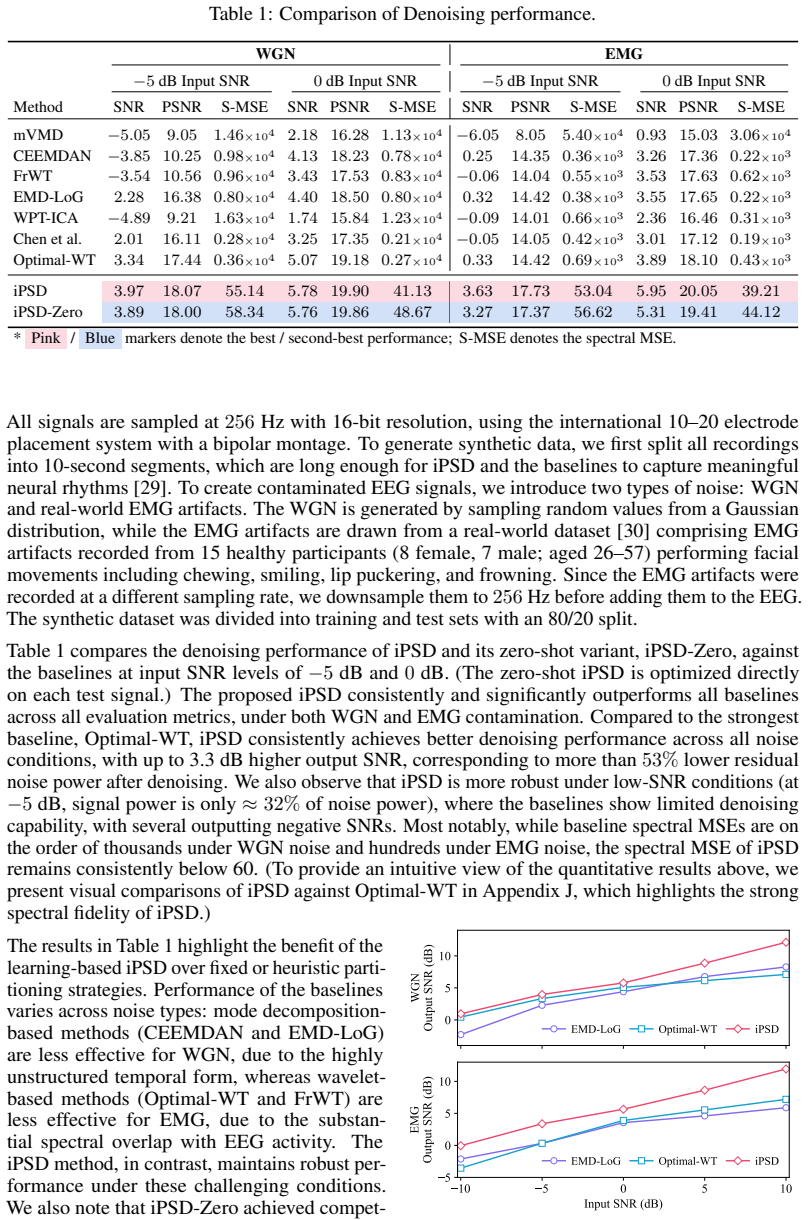
By training a network to intelligently partition an EEG segment into independent noisy realizations that contain exactly the same underlying neural activity, deep denoisers can be supervised without clean targets; the partitions serve as noisy inputs whose common signal provides the learning signal, enabling effective artifact removal even at signal-to-noise ratios as low as -10 dB and with challenging artifacts such as EMG.
What carries the argument
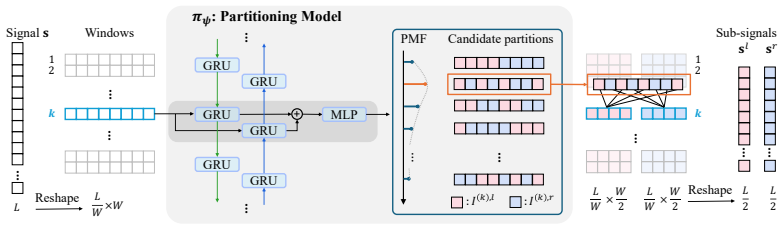
Intelligent Partitioning for Self-supervised Denoising (iPSD), which learns a partition of the input EEG segment so that the resulting sub-segments act as independent noisy observations of the identical clean neural signal.
If this is right
- Deep denoisers become trainable directly on real-world wearable EEG without simulated clean data.
- Denoising remains effective under extremely low SNR conditions down to -10 dB.
- Spectral fidelity of the output exceeds that of competitive methods by orders of magnitude for overlapping artifacts such as EMG.
- The same pipeline applies to in-ear wearable sensors without additional labeled data.
- Zero-shot denoising becomes possible on a single incoming EEG segment.
Where Pith is reading between the lines
- The same partitioning principle could be tested on other single-channel biosignals such as ECG where clean references are also scarce.
- On-device implementation might allow personal EEG headsets to adapt their denoiser continuously from incoming data alone.
- Long-term ambulatory recordings could improve if the method generalizes to non-stationary neural backgrounds within longer windows.
- Combining the partition loss with minimal amounts of simulated data might further stabilize training in practice.
Load-bearing premise
An EEG segment can be divided into parts that contain independent noise but share precisely the same underlying neural signal.
What would settle it
Denoising quality fails to improve or falls below strong baselines when the method is applied to EEG segments whose underlying neural activity changes within the segment or whose noise components remain correlated across the learned partitions.
Figures



read the original abstract
Denoising wearable electroencephalogram (EEG) is inherently challenging since neural activity is not only subtle but also inseparable from spectrally overlapping noise artifacts. Classical signal processing methods, relying on fixed or heuristic rules, cannot handle the time-varying pervasive artifacts in wearable EEGs. Deep learning methods, on the other hand, show promise in decomposition-free EEG denoising using highly expressive neural networks, but the training requires artifact-free EEG, which is inherently unobtainable. To address this, we propose Intelligent Partitioning for Self-supervised Denoising (iPSD). Our method eliminates the need for clean references by learning to partition an input EEG segment into independent noisy realizations with the same underlying signal. This enables self-supervision of deep learning denoisers, even in zero-shot settings where only a single EEG segment to be denoised is available. We validate iPSD through extensive experiments, including validations on wearable EEG from in-ear sensors. The results show that iPSD achieves state-of-the-art performance, most notably under extremely low signal-to-noise ratios (down to -10 dB) and challenging artifacts (e.g., EMG), with spectral fidelity orders of magnitude higher than competitive baselines.
Editorial analysis
A structured set of objections, weighed in public.
Referee Report
Summary. The manuscript proposes Intelligent Partitioning for Self-supervised Denoising (iPSD) to train deep EEG denoisers without clean references. The core idea is to learn a partitioning of a single input EEG segment into multiple realizations that contain identical underlying neural signals but independent noise, enabling self-supervision (including zero-shot use on one segment). Experiments on wearable in-ear EEG data are reported to yield state-of-the-art performance, especially at low SNRs down to -10 dB and with EMG artifacts, with spectral fidelity gains of orders of magnitude over baselines.
Significance. If the results and core assumption hold under scrutiny, the work would be significant for EEG signal processing and wearable sensing. Obtaining artifact-free EEG for supervised training is a long-standing barrier; a method that enables unsupervised or zero-shot deep denoising could broaden applicability to real-world monitoring, BCI, and clinical settings where clean data are unavailable.
major comments (2)
- Abstract: the claim of 'orders of magnitude higher' spectral fidelity at -10 dB SNR (and SOTA under EMG) is presented without any description of experimental setup, baselines, datasets, metrics, number of trials, or statistical testing. This absence makes the central empirical result impossible to assess from the provided information.
- Method (partitioning and self-supervision loss): the training objective rests on the untested assumption that partitions of a real EEG segment share exactly the same neural signal while having statistically independent noise. For non-stationary wearable EEG with temporally correlated artifacts, violation of this equality would cause the loss to optimize toward an incorrect target, undermining the reported low-SNR gains. Explicit validation (e.g., controlled simulations or partition-quality ablations) is required.
minor comments (1)
- Abstract and title: the precise mechanism by which the partition is learned (network architecture, loss terms, or optimization procedure) is not even sketched at a high level, hindering immediate understanding of the contribution.
Simulated Author's Rebuttal
We thank the referee for their thoughtful comments on our manuscript. We address the major concerns point by point below, indicating where revisions will be made to improve clarity and rigor.
read point-by-point responses
-
Referee: Abstract: the claim of 'orders of magnitude higher' spectral fidelity at -10 dB SNR (and SOTA under EMG) is presented without any description of experimental setup, baselines, datasets, metrics, number of trials, or statistical testing. This absence makes the central empirical result impossible to assess from the provided information.
Authors: We agree that the abstract, being a concise summary, omits specific details on the experimental setup. The full paper describes the wearable in-ear EEG dataset, the baselines compared (including traditional and deep learning methods), the spectral fidelity metric, the SNR levels tested down to -10 dB, and the number of trials. To make the abstract more informative, we will revise it to briefly mention the key elements: experiments on in-ear EEG data with EMG artifacts at SNRs as low as -10 dB, using spectral fidelity as the primary metric, and achieving SOTA performance. We will also ensure statistical significance is noted in the results section if not already explicit. revision: yes
-
Referee: Method (partitioning and self-supervision loss): the training objective rests on the untested assumption that partitions of a real EEG segment share exactly the same neural signal while having statistically independent noise. For non-stationary wearable EEG with temporally correlated artifacts, violation of this equality would cause the loss to optimize toward an incorrect target, undermining the reported low-SNR gains. Explicit validation (e.g., controlled simulations or partition-quality ablations) is required.
Authors: The assumption is central to iPSD, as the intelligent partitioning is designed to produce multiple noisy realizations of the identical neural activity with independent noise components. While direct verification is challenging without access to clean neural signals, the method's effectiveness is demonstrated through its superior performance in real-world low-SNR scenarios compared to baselines. The manuscript includes ablations on the partitioning module to support the validity of the approach. To further address the concern, we will add a new subsection with controlled simulations on synthetic data where the ground-truth neural signal is known, allowing us to quantify how well the partitions preserve the shared signal and independent noise properties. revision: yes
Circularity Check
No circularity: method rests on explicit partitioning assumption rather than self-referential derivation
full rationale
The paper introduces iPSD as a self-supervised denoising approach that learns to partition an input EEG segment into multiple realizations sharing identical underlying neural activity but with independent noise. This partitioning premise is stated directly as the enabling mechanism for training without clean references, including in zero-shot single-segment cases. No equations, fitted parameters, or derivations are presented that reduce the claimed performance gains to the inputs by construction. No self-citations are invoked as load-bearing uniqueness theorems, and the core claim does not rename a known result or smuggle an ansatz. The approach is self-contained as a methodological proposal whose validity hinges on the (externally testable) assumption holding for the data, not on internal logical reduction.
Axiom & Free-Parameter Ledger
axioms (1)
- domain assumption EEG signals consist of an underlying neural component plus additive noise that can be partitioned into independent realizations
Lean theorems connected to this paper
-
IndisputableMonolith/Cost/FunctionalEquation.leanwashburn_uniqueness_aczel unclear?
unclearRelation between the paper passage and the cited Recognition theorem.
The core idea is to learn to assign samples of a noisy input into two sub-signals with the same underlying clean signal... (sl,sr)∼πψ(·|s) are independent noisy realizations of the same underlying signal x. Then the θ⋆ that optimizes the self-supervised loss... also minimizes the expected L2 distance... (Theorem 1)
-
IndisputableMonolith/Foundation/Atomicity.leanatomic_tick unclear?
unclearRelation between the paper passage and the cited Recognition theorem.
intelligent partitioning... segments into non-overlapping local windows... learns to extract... subset I(k),l constrained to cardinality W/2
What do these tags mean?
- matches
- The paper's claim is directly supported by a theorem in the formal canon.
- supports
- The theorem supports part of the paper's argument, but the paper may add assumptions or extra steps.
- extends
- The paper goes beyond the formal theorem; the theorem is a base layer rather than the whole result.
- uses
- The paper appears to rely on the theorem as machinery.
- contradicts
- The paper's claim conflicts with a theorem or certificate in the canon.
- unclear
- Pith found a possible connection, but the passage is too broad, indirect, or ambiguous to say the theorem truly supports the claim.
Reference graph
Works this paper leans on
-
[1]
Haozhe Tian, Qiyu Rao, Nina Moutonnet, Pietro Ferraro, and Danilo Mandic. Machine intelligence on the edge: Interpretable cardiac pattern localisation using reinforcement learning.arXiv preprint arXiv:2508.21652, 2025
-
[2]
Liping Zhang, Anzi Li, Shukai Chen, Wei Ren, and Kim-Kwang Raymond Choo. A secure, flexible, and PPG-based biometric scheme for healthy IoT using homomorphic random forest.IEEE Internet of Things Journal, 11(1):612–622, 2023
work page 2023
-
[3]
Lei Chu, Ling Pei, and Robert Qiu. Ahed: A heterogeneous-domain deep learning model for IoT-enabled smart health with few-labeled EEG data.IEEE Internet of Things Journal, 8(23):16787–16800, 2021
work page 2021
-
[4]
Sophie Huhn et al. The impact of wearable technologies in health research: Scoping review.JMIR mHealth and uHealth, 10(1):e34384, 2022
work page 2022
-
[5]
Panorama: An enabling technology for Hearables
Qiyu Rao, Zdenka Babic, Scott C Douglas, and Danilo P Mandic. Panorama: An enabling technology for Hearables. InProceedings of the IEEE International Conference on Acoustics, Speech and Signal Processing, pages 1–5, 2025
work page 2025
-
[6]
V Krishnaveni, S Jayaraman, S Aravind, V Hariharasudhan, and K Ramadoss. Automatic identification and removal of ocular artifacts from EEG using wavelet transform.Measurement Science Review, 6(4): 45–57, 2006
work page 2006
-
[7]
Zaid Abdi Alkareem Alyasseri, Ahamad Tajudin Khader, Mohammed Azmi Al-Betar, Ammar Kamal Abasi, and Sharif Naser Makhadmeh. EEG signals denoising using optimal wavelet transform hybridized with efficient metaheuristic methods.IEEE access, 8:10584–10605, 2020
work page 2020
-
[8]
Norden E Huang et al. The empirical mode decomposition and the Hilbert spectrum for nonlinear and non-stationary time series analysis. InProceedings of the Royal Society of London. Series A: Mathematical, Physical and Engineering Sciences, pages 903–995, 1998
work page 1998
-
[9]
Variational mode decomposition.IEEE Transactions on Signal Processing, 62(3):531–544, 2013
Konstantin Dragomiretskiy and Dominique Zosso. Variational mode decomposition.IEEE Transactions on Signal Processing, 62(3):531–544, 2013
work page 2013
-
[10]
Banghua Yang, Kaiwen Duan, and Tao Zhang. Removal of EOG artifacts from EEG using a cascade of sparse autoencoder and recursive least squares adaptive filter.Neurocomputing, 214:1053–1060, 2016
work page 2016
-
[11]
Weitong Sun, Yuping Su, Xia Wu, and Xiaojun Wu. A novel end-to-end 1D-ResCNN model to remove artifact from EEG signals.Neurocomputing, 404:108–121, 2020
work page 2020
-
[12]
Marcin Jurczak, Marcin Kołodziej, and Andrzej Majkowski. Implementation of a convolutional neural network for eye blink artifacts removal from the electroencephalography signal.Frontiers in Neuroscience, 16:782367, 2022
work page 2022
-
[13]
Chun-Hsiang Chuang, Kong-Yi Chang, Chih-Sheng Huang, and Tzyy-Ping Jung. IC-U-Net: a U-Net-based denoising autoencoder using mixtures of independent components for automatic EEG artifact removal. NeuroImage, 263:119586, 2022
work page 2022
-
[14]
Noise2Noise: Learning image restoration without clean data
Jaakko Lehtinen, Jacob Munkberg, Jon Hasselgren, Samuli Laine, Tero Karras, Miika Aittala, and Timo Aila. Noise2Noise: Learning image restoration without clean data. InProceedings of the International Conference on Machine Learning, pages 2965–2974, 2018
work page 2018
-
[15]
Zero-shot Noise2Noise: Efficient image denoising without any data
Youssef Mansour and Reinhard Heckel. Zero-shot Noise2Noise: Efficient image denoising without any data. InProceedings of the IEEE/CVF Conference on Computer Vision and Pattern Recognition, pages 14018–14027, 2023
work page 2023
-
[16]
Hearables: Multimodal physiological in-ear sensing.Scientific Reports, 7(1): 6948, 2017
Valentin Goverdovsky et al. Hearables: Multimodal physiological in-ear sensing.Scientific Reports, 7(1): 6948, 2017. 10
work page 2017
-
[17]
Takashi Nakamura, Valentin Goverdovsky, and Danilo P Mandic. In-ear EEG biometrics for feasible and readily collectable real-world person authentication.IEEE Transactions on Information Forensics and Security, 13(3):648–661, 2017
work page 2017
-
[18]
Proximal Policy Optimization Algorithms
John Schulman, Filip Wolski, Prafulla Dhariwal, Alec Radford, and Oleg Klimov. Proximal policy optimization algorithms.arXiv preprint arXiv:1707.06347, 2017
work page internal anchor Pith review Pith/arXiv arXiv 2017
-
[19]
lil’ UCB: An optimal exploration algorithm for multi-armed bandits
Kevin Jamieson, Matthew Malloy, Robert Nowak, and Sébastien Bubeck. lil’ UCB: An optimal exploration algorithm for multi-armed bandits. InProceedings of the 27th Annual Conference on Learning Theory, volume 35, pages 423–439, 2014
work page 2014
-
[20]
Shengyi Huang, Rousslan Fernand Julien Dossa, Chang Ye, Jeff Braga, Dipam Chakraborty, Kinal Mehta, and João G.M. Araújo. CleanRL: High-quality single-file implementations of deep reinforcement learning algorithms.Journal of Machine Learning Research, 23(274):1–18, 2022. URL http://jmlr.org/ papers/v23/21-1342.html
work page 2022
-
[21]
Ibtissem Houamed, Lamir Saidi, and Fawzi Srairi. ECG signal denoising by fractional wavelet transform thresholding.Research on Biomedical Engineering, 36(3):349–360, 2020
work page 2020
-
[22]
Chinmayee Dora and Pradyut Kumar Biswal. Correlation-based ECG artifact correction from single channel EEG using modified variational mode decomposition.Computer Methods and Programs in Biomedicine, 183:105092, 2020
work page 2020
-
[23]
Marcelo A Colominas, Gastón Schlotthauer, and María E Torres. Improved complete ensemble EMD: A suitable tool for biomedical signal processing.Biomedical Signal Processing and Control, 14:19–29, 2014
work page 2014
-
[24]
Rakesh Ranjan, Bikash Chandra Sahana, and Ashish Kumar Bhandari. Motion artifacts suppression from EEG signals using an adaptive signal denoising method.IEEE Transactions on Instrumentation and Measurement, 71:1–10, 2022
work page 2022
-
[25]
EEG denoising using wavelet packet decomposition and indepen- dent component analysis
Yaroslav Kerechanin and Pavel Bobrov. EEG denoising using wavelet packet decomposition and indepen- dent component analysis. InProceedings of the IEEE Fourth International Conference Neurotechnologies and Neurointerfaces, pages 68–70, 2022
work page 2022
-
[26]
Wensheng Chen, Cong Yu, Zhenhua Zhao, Nan Zheng, Han Li, and Yurong Li. Self-supervised EEG denoising via dual-branch consistency learning with masked reconstruction.Knowledge-Based Systems, page 114703, 2025
work page 2025
-
[27]
CHB-MIT Scalp EEG Database.PhysioNet, June 2010
John Guttag. CHB-MIT Scalp EEG Database.PhysioNet, June 2010. doi: 10.13026/C2K01R. URL https://doi.org/10.13026/C2K01R. Version 1.0.0
-
[28]
PhD thesis, Massachusetts Institute of Technology, 2009
Ali Hossam Shoeb.Application of machine learning to epileptic seizure onset detection and treatment. PhD thesis, Massachusetts Institute of Technology, 2009
work page 2009
-
[29]
The impact of seg- ment length on EEG based biometric system
Ulla Delfana Rosiani, Pramana Yoga Saputra, and Muhammad Afif Hendrawan. The impact of seg- ment length on EEG based biometric system. InProceedings of the IEEE 7th Information Technology International Seminar, pages 1–5, 2021
work page 2021
-
[30]
A survey on the feasibility of surface EMG in facial pacing
Ville Rantanen et al. A survey on the feasibility of surface EMG in facial pacing. InProceedings of the 38th Annual International Conference of the IEEE Engineering in Medicine and Biology Society, pages 1688–1691, 2016
work page 2016
-
[31]
An open-source, high-performance tool for automated sleep staging
Raphael Vallat and Matthew P Walker. An open-source, high-performance tool for automated sleep staging. elife, 10:e70092, 2021
work page 2021
-
[32]
Yun Ji Lee, Jae Yong Lee, Jae Hoon Cho, and Ji Ho Choi. Interrater reliability of sleep stage scoring: a meta-analysis.Journal of Clinical Sleep Medicine, 18(1):193–202, 2022
work page 2022
-
[33]
EEG artifact removal—state-of-the-art and guidelines
Jose Antonio Urigüen and Begoña Garcia-Zapirain. EEG artifact removal—state-of-the-art and guidelines. Journal of neural engineering, 12(3):031001, 2015
work page 2015
-
[34]
Maximilian Grobbelaar et al. A survey on denoising techniques of electroencephalogram signals using wavelet transform.Signals, 3(3):577–586, 2022
work page 2022
-
[35]
Chamandeep Kaur, Amandeep Bisht, Preeti Singh, and Garima Joshi. EEG signal denoising using hybrid approach of variational mode decomposition and wavelets for depression.Biomedical Signal Processing and Control, 65:102337, 2021. 11
work page 2021
-
[36]
A novel convolutional neural network model to remove muscle artifacts from EEG
Haoming Zhang, Chen Wei, Mingqi Zhao, Quanying Liu, and Haiyan Wu. A novel convolutional neural network model to remove muscle artifacts from EEG. InProceedings of the IEEE International Conference on Acoustics, Speech and Signal Processing, pages 1265–1269, 2021
work page 2021
-
[37]
Madhav Mahesh Kashyap, Anuj Tambwekar, Krishnamoorthy Manohara, and S. Natarajan. Speech Denoising Without Clean Training Data: A Noise2Noise Approach. InInterspeech 2021, pages 2716– 2720, 2021. doi: 10.21437/Interspeech.2021-1130
-
[38]
Noise2V oid-learning denoising from single noisy images
Alexander Krull, Tim-Oliver Buchholz, and Florian Jug. Noise2V oid-learning denoising from single noisy images. InProceedings of the IEEE/CVF conference on computer vision and pattern recognition, pages 2129–2137, 2019
work page 2019
-
[39]
Neighbor2Neighbor: Self-supervised denoising from single noisy images
Tao Huang, Songjiang Li, Xu Jia, Huchuan Lu, and Jianzhuang Liu. Neighbor2Neighbor: Self-supervised denoising from single noisy images. InProceedings of the IEEE/CVF conference on computer vision and pattern recognition, pages 14781–14790, 2021
work page 2021
-
[40]
Ronald J Williams. Simple statistical gradient-following algorithms for connectionist reinforcement learning.Machine Learning, 8(3-4):229–256, 1992. Appendix A Proof of Theorem 1 Theorem 1.Suppose (sl,s r)∼π ψ(· |s) are independent noisy realizations of the same underlying signal x. Then the θ⋆ that optimizes the self-supervised loss in Eq.(1)also minimiz...
work page 1992
discussion (0)
Sign in with ORCID, Apple, or X to comment. Anyone can read and Pith papers without signing in.