Recognition: 2 theorem links
· Lean TheoremWhen to Use Wireless Challenge-Response Physical Layer Authentication: Design of a Measurable Guideline for OFDM
Pith reviewed 2026-05-11 00:53 UTC · model grok-4.3
The pith
A randomness test can determine when physical layer authentication remains secure against correlation attacks in practical OFDM channels.
A machine-rendered reading of the paper's core claim, the machinery that carries it, and where it could break.
Core claim
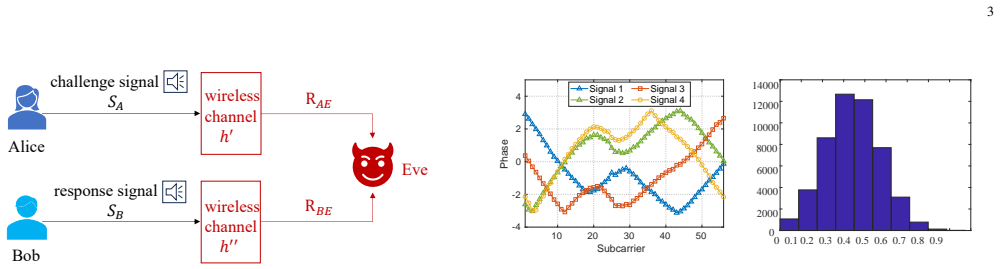
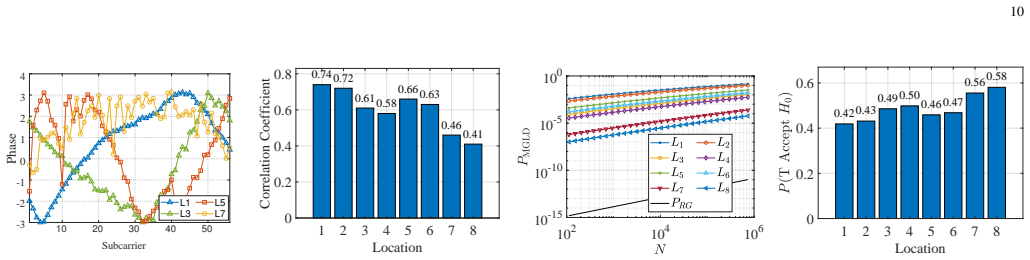
We introduce the Maximum Differential Likelihood Generator (MDLG) adversary model, which exploits the weak correlation property present in practical wireless fading channels to generate effective attacks against challenge-response physical layer authentication in OFDM systems. From this model we derive a measurable guideline that applies randomness testing to observed channel responses, thereby indicating the precise channel conditions under which the authentication scheme retains its security. Extensive over-the-air experiments confirm both that MDLG attacks succeed under correlated conditions and that the guideline reliably separates usable from non-usable scenarios.
What carries the argument
The Maximum Differential Likelihood Generator (MDLG) adversary model, which generates attacks by maximizing differential likelihood across weakly correlated OFDM subchannel responses.
If this is right
- PLA should be deployed only after the channel passes the randomness test; otherwise MDLG-style attacks become feasible.
- Randomness testing supplies a practical, low-overhead decision procedure that replaces the common assumption of ideal channel randomness.
- The security of challenge-response PLA is conditional on channel statistics rather than guaranteed by the protocol alone.
- System designers gain a concrete metric to evaluate whether a given wireless environment supports secure PLA.
Where Pith is reading between the lines
- The same randomness-testing approach could be adapted to decide safe use of other physical-layer security primitives that rely on channel unpredictability.
- In mobile or time-varying environments, periodic re-testing would be required to maintain the guideline's validity.
- Attack models like MDLG could guide the design of channel-robust PLA variants that deliberately reduce sensitivity to residual correlations.
Load-bearing premise
The MDLG model captures the actual capabilities of real-world adversaries and that standard randomness tests on channel samples accurately predict whether those adversaries can succeed.
What would settle it
A set of channel measurements that pass the proposed randomness test yet still permit the MDLG attack to achieve a high success rate would show the guideline does not protect PLA as claimed.
Figures




read the original abstract
The security of wireless challenge-response Physical Layer Authentication (PLA) based on Orthogonal Frequency Division Multiplexing (OFDM) relies on a sufficiently random fading channel condition, which is commonly assumed in existing studies. However, in practical scenarios, such a condition is not always guaranteed and the responses of OFDM subchannels may exhibit correlation.} Consequently, ensuring the security of such PLA systems remains an unsolved problem. In this paper, we propose a novel adversary model, called Maximum Differential Likelihood Generator (MDLG), which exploits the weak correlation property in practical wireless channel to launch effective attacks against PLA. Based on this model, we create a measurable guideline using randomness testing to decide when we can in fact use PLA in a practical wireless channel condition. Extensive real-world experiments validate the effectiveness of the MDLG attack and demonstrate how the proposed guideline can help protect the security of PLA.
Editorial analysis
A structured set of objections, weighed in public.
Referee Report
Summary. The paper claims that practical OFDM wireless channels often exhibit correlations between subchannel responses, violating the randomness assumption underlying challenge-response Physical Layer Authentication (PLA) security. It introduces the Maximum Differential Likelihood Generator (MDLG) adversary model that exploits these weak correlations to mount effective attacks, then derives a measurable guideline based on standard randomness tests to decide when PLA remains secure. The approach is supported by real-world experiments that demonstrate MDLG attack success in correlated channels and illustrate the guideline's use in protecting PLA.
Significance. If the guideline's predictive link holds, the work would offer a practical, testable criterion for deploying PLA outside idealized random-fading assumptions, addressing a recognized gap in wireless security. The real-world experimental validation is a positive element, but the overall significance is limited by the absence of a quantified mapping between test outcomes and attack performance.
major comments (2)
- [§6.2 and §7.1] §6.2 (Guideline Derivation) and §7.1 (Experimental Validation): The central claim requires that randomness-test outcomes reliably predict MDLG attack success rates so the guideline can serve as a decision rule. The reported experiments evaluate attack effectiveness in selected channels and randomness-test statistics in others, but provide no cross-scenario regression, ROC analysis, or correlation coefficient linking the two quantities. Without this, the guideline lacks the required empirical grounding.
- [§5.3] §5.3 (MDLG Model): The attack success probability is expressed in terms of channel correlation coefficients, yet the guideline thresholds are obtained by applying off-the-shelf randomness tests without showing that those thresholds correspond to the correlation values at which the MDLG success rate exceeds a security-relevant bound. This missing calibration step makes the guideline's security guarantee circular with respect to the model.
minor comments (2)
- [§4] Notation for the differential likelihood in the MDLG definition is introduced without an explicit comparison to standard likelihood-ratio tests used in prior PLA literature; a short clarifying sentence would improve readability.
- [Figure 9] Figure 9 caption does not state the number of independent channel realizations or the exact randomness-test implementation (e.g., NIST suite version), which is needed to reproduce the p-value distributions.
Simulated Author's Rebuttal
We thank the referee for the constructive feedback and for recognizing the practical value of the MDLG model and real-world experiments. We address each major comment below with targeted revisions that strengthen the empirical link between randomness tests and attack performance while preserving the manuscript's core contributions.
read point-by-point responses
-
Referee: [§6.2 and §7.1] §6.2 (Guideline Derivation) and §7.1 (Experimental Validation): The central claim requires that randomness-test outcomes reliably predict MDLG attack success rates so the guideline can serve as a decision rule. The reported experiments evaluate attack effectiveness in selected channels and randomness-test statistics in others, but provide no cross-scenario regression, ROC analysis, or correlation coefficient linking the two quantities. Without this, the guideline lacks the required empirical grounding.
Authors: We agree that an explicit quantitative mapping would make the guideline more robust as a decision rule. Section 6.2 derives the guideline by linking standard randomness tests to the detection of the weak subchannel correlations that the MDLG model exploits, and Section 7.1 demonstrates attack success in real channels where those correlations exist. To directly address the concern, the revised manuscript will add a new analysis subsection that computes Pearson correlation coefficients between test statistics (p-values from the applied randomness tests) and observed MDLG attack success rates across all experimental scenarios. We will also include ROC curves treating test outcomes as predictors of vulnerability, thereby providing the requested cross-scenario empirical grounding. revision: yes
-
Referee: [§5.3] §5.3 (MDLG Model): The attack success probability is expressed in terms of channel correlation coefficients, yet the guideline thresholds are obtained by applying off-the-shelf randomness tests without showing that those thresholds correspond to the correlation values at which the MDLG success rate exceeds a security-relevant bound. This missing calibration step makes the guideline's security guarantee circular with respect to the model.
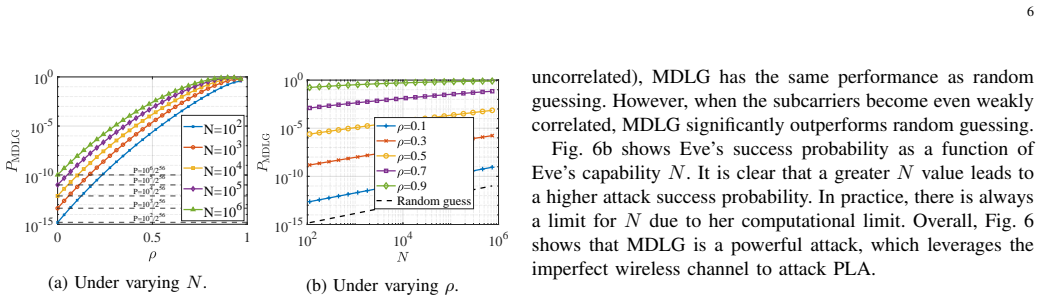
Authors: The referee correctly notes the need for explicit calibration. In Section 5.3 the MDLG success probability is given as a closed-form function of the correlation coefficient ρ, with a clear threshold (e.g., ρ > 0.3 yields success > 0.9 under the evaluated parameters). The randomness tests in Section 6.2 are selected precisely because they are sensitive to the autocorrelation levels that produce such ρ values in OFDM subchannel responses. In the revision we will augment Section 6.2 with a calibration table and supporting simulations that map each test's rejection threshold to the minimum detectable ρ and the corresponding MDLG success probability, removing any appearance of circularity and making the security bound explicit. revision: yes
Circularity Check
No circularity detected; derivation chain self-contained with independent model and guideline
full rationale
The abstract proposes a new MDLG adversary model that exploits channel correlations and then constructs a guideline from it via standard randomness testing. No equations, fitting procedures, or self-citations are present in the provided text to indicate that the guideline reduces to the model definition by construction, that predictions are statistically forced from fitted inputs, or that uniqueness is imported from prior author work. The derivation therefore remains independent of its inputs, consistent with the reader's observation that circularity cannot be assessed from the abstract alone. No load-bearing steps match the enumerated patterns.
Axiom & Free-Parameter Ledger
axioms (1)
- domain assumption Practical OFDM wireless channels exhibit weak but exploitable correlations between subchannels that violate the random fading assumption.
invented entities (1)
-
Maximum Differential Likelihood Generator (MDLG)
no independent evidence
Lean theorems connected to this paper
-
IndisputableMonolith/Cost/FunctionalEquation.leanwashburn_uniqueness_aczel unclear?
unclearRelation between the paper passage and the cited Recognition theorem.
Theorem 1: PMDLG = I_{(1-ρ)/2}(L-1-n_max, n_max+1) where n_max = max{n′ | 2 Σ_{n=0}^{n′} (L-1 choose n) ≤ N}
-
IndisputableMonolith/Foundation/ArithmeticFromLogic.leanLogicNat recovery and embed_strictMono_of_one_lt unclear?
unclearRelation between the paper passage and the cited Recognition theorem.
randomness testing (NIST suite) inserted into challenge-response PLA to decide when channel passes as 'sufficiently random'
What do these tags mean?
- matches
- The paper's claim is directly supported by a theorem in the formal canon.
- supports
- The theorem supports part of the paper's argument, but the paper may add assumptions or extra steps.
- extends
- The paper goes beyond the formal theorem; the theorem is a base layer rather than the whole result.
- uses
- The paper appears to rely on the theorem as machinery.
- contradicts
- The paper's claim conflicts with a theorem or certificate in the canon.
- unclear
- Pith found a possible connection, but the passage is too broad, indirect, or ambiguous to say the theorem truly supports the claim.
Reference graph
Works this paper leans on
-
[1]
Bloch and J
M. Bloch and J. Barros,Physical-layer security: from information theory to security engineering. Cambridge University Press, 2011
2011
-
[2]
Non-cryptographic authenti- cation and identification in wireless networks,
K. Zeng, K. Govindan, and P. Mohapatra, “Non-cryptographic authenti- cation and identification in wireless networks,”IEEE Wireless Commun., vol. 17, no. 5, 2010
2010
-
[3]
Physical layer authen- tication under intelligent spoofing in wireless sensor networks,
N. Gao, Q. Ni, D. Feng, X. Jing, and Y . Cao, “Physical layer authen- tication under intelligent spoofing in wireless sensor networks,”Signal Processing, vol. 166, p. 107272, 2020
2020
-
[4]
Two-factor user authentication in wireless sensor networks,
M. L. Das, “Two-factor user authentication in wireless sensor networks,” IEEE Trans. Wireless Commun., vol. 8, no. 3, pp. 1086–1090, 2009. 11
2009
-
[5]
Towards replay-resilient rfid authentication,
G. Wang, H. Cai, C. Qian, J. Han, X. Li, H. Ding, and J. Zhao, “Towards replay-resilient rfid authentication,” inProc. of ACM MOBICOM, 2018
2018
-
[6]
Phy-cram: Physical layer challenge-response authentication mechanism for wireless networks,
D. Shan, K. Zeng, W. Xiang, P. Richardson, and Y . Dong, “Phy-cram: Physical layer challenge-response authentication mechanism for wireless networks,”IEEE Journal on selected areas in communications, vol. 31, no. 9, pp. 1817–1827, 2013
2013
-
[7]
Physical layer challenge- response authentication in wireless networks with relay,
X. Du, D. Shan, K. Zeng, and L. Huie, “Physical layer challenge- response authentication in wireless networks with relay,” inIEEE INFOCOM, 2014, pp. 1276–1284
2014
-
[8]
A coding approach with key-channel randomization for physical-layer authentication,
J. Choi, “A coding approach with key-channel randomization for physical-layer authentication,”IEEE Trans. Inf. Forensics Security, vol. 14, no. 1, pp. 175–185, 2018
2018
-
[9]
Transmit antenna selection for security enhancement in MIMO wiretap channels,
N. Yang, P. L. Yeoh, M. Elkashlan, R. Schober, and I. B. Collings, “Transmit antenna selection for security enhancement in MIMO wiretap channels,”IEEE Trans. Commun., vol. 61, no. 1, pp. 144–154, 2013
2013
-
[10]
Securing{RFIDs}by randomizing the modulation and channel,
H. Hassanieh, J. Wang, D. Katabi, and T. Kohno, “Securing{RFIDs}by randomizing the modulation and channel,” inNSDI, 2015, pp. 235–249
2015
-
[11]
Learning-aided physical layer authentication as an intelligent process,
H. Fang, X. Wang, and L. Hanzo, “Learning-aided physical layer authentication as an intelligent process,”IEEE Transactions on Com- munications, vol. 67, no. 3, pp. 2260–2273, 2018
2018
-
[12]
Physical-layer authentication for multi-carrier transmission,
X. Wu and Z. Yang, “Physical-layer authentication for multi-carrier transmission,”IEEE Commun. Lett., vol. 19, no. 1, pp. 74–77, 2014
2014
-
[13]
Fingerprints in the ether: Using the physical layer for wireless authentication,
L. Xiao, L. Greenstein, N. Mandayam, and W. Trappe, “Fingerprints in the ether: Using the physical layer for wireless authentication,” inIEEE ICC, 2007
2007
-
[15]
EsaNet: Environ- ment semantics enabled physical layer authentication,
N. Gao, Q. Huang, C. Li, S. Jin, and M. Matthaiou, “EsaNet: Environ- ment semantics enabled physical layer authentication,”IEEE Wireless Communications Letters, vol. 13, no. 1, pp. 178–182, 2024
2024
-
[16]
A statistical test suite for random and pseudorandom number generators for cryp- tographic applications,
A. Rukhin, J. Soto, J. Nechvatal, M. Smid, and E. Barker, “A statistical test suite for random and pseudorandom number generators for cryp- tographic applications,” Booz-allen and hamilton inc mclean va, Tech. Rep., 2001
2001
-
[17]
Artificial-noise-aided physical layer phase challenge-response authentication for practical ofdm trans- mission,
X. Wu, Z. Yang, C. Ling, and X.-G. Xia, “Artificial-noise-aided physical layer phase challenge-response authentication for practical ofdm trans- mission,”IEEE Trans. on Wireless Commun., 2016
2016
-
[18]
Using the physical layer for wireless authentication in time-variant channels,
L. Xiao, L. J. Greenstein, N. B. Mandayam, and W. Trappe, “Using the physical layer for wireless authentication in time-variant channels,” IEEE Transactions on Wireless Communications, 2008
2008
-
[19]
Physical-layer authentication using multiple channel-based features,
N. Xie, J. Chen, and L. Huang, “Physical-layer authentication using multiple channel-based features,”IEEE transactions on Information Forensics and Security, vol. 16, pp. 2356–2366, 2021
2021
-
[20]
Phy-layer authentication with multiple landmarks with reduced overhead,
L. Xiao, X. Wan, and Z. Han, “Phy-layer authentication with multiple landmarks with reduced overhead,”IEEE Transactions on Wireless Communications, vol. 17, no. 3, pp. 1676–1687, 2017
2017
-
[21]
Physical layer authentication jointly utilizing channel and phase noise in mimo systems,
P. Zhang, Y . Shen, X. Jiang, and B. Wu, “Physical layer authentication jointly utilizing channel and phase noise in mimo systems,”IEEE Transactions on Communications, vol. 68, no. 4, pp. 2446–2458, 2020
2020
-
[22]
Csi-based physical layer authentication via deep learning,
S. Wang, K. Huang, X. Xu, Z. Zhong, and Y . Zhou, “Csi-based physical layer authentication via deep learning,”IEEE Wireless Communications Letters, vol. 11, no. 8, pp. 1748–1752, 2022
2022
-
[23]
Improved physical layer authentication scheme based on wireless channel phase,
X. Lu, J. Lei, Y . Shi, and W. Li, “Improved physical layer authentication scheme based on wireless channel phase,”IEEE Wireless Communica- tions Letters, vol. 11, no. 1, pp. 198–202, 2021
2021
-
[24]
A survey on ofdm physical layer security,
R. Melki, H. N. Noura, M. M. Mansour, D. o. E. Chehab American University of Beirut, and A. Computer, “A survey on ofdm physical layer security,”Physical Communication, vol. 32, pp. 1–30, 2019
2019
-
[25]
Physical layer authentication in ofdm systems based on hypothesis testing of cfo estimates,
W. Hou, X. Wang, and J.-Y . Chouinard, “Physical layer authentication in ofdm systems based on hypothesis testing of cfo estimates,” inIEEE ICC, 2012
2012
-
[26]
Authentication scheme for mobile ofdm based on security information technology of physical layer over time-variant and multipath fading channels,
W.-L. W. Chin, T. N. Le, and C.-L. Tseng, “Authentication scheme for mobile ofdm based on security information technology of physical layer over time-variant and multipath fading channels,”Information Sciences, vol. 321, pp. 238–249, 2015
2015
-
[27]
Artificial noise-aided mimo physical layer authentication with imperfect csi,
J. B. Perazzone, L. Y . Paul, B. M. Sadler, and R. S. Blum, “Artificial noise-aided mimo physical layer authentication with imperfect csi,” IEEE Transactions on Information Forensics and Security, 2021
2021
-
[28]
An efficient data rate maximization algorithm for ofdm based wireless networks,
Z. Ilic, A. Bazant, and B. Modlic, “An efficient data rate maximization algorithm for ofdm based wireless networks,”Wireless Netw, 2010
2010
-
[29]
An adaptive subcarrier allocation algorithm for multiuser ofdm system,
L. Xiaowen and Z. Jinkang, “An adaptive subcarrier allocation algorithm for multiuser ofdm system,” inIEEE VTC-Fall, 2003
2003
-
[30]
Scalable OFDMA physical layer in IEEE 802.16 Wire- lessMAN,
H. Yaghoobi, “Scalable OFDMA physical layer in IEEE 802.16 Wire- lessMAN,”Intel Technology Journal, vol. 8, no. 3, 2004
2004
-
[31]
Performance characterisation of MIMO-UWB systems for indoor environments,
G. H.-S. Tsao, “Performance characterisation of MIMO-UWB systems for indoor environments,” 2014
2014
-
[32]
Effect of mining ma- chinery on MIMO–UWB radiowave propagation within an underground gallery,
I. B. Mabrouk, L. Talbi, M. Nedil, and K. Hettak, “Effect of mining ma- chinery on MIMO–UWB radiowave propagation within an underground gallery,”IEEE Transactions on Antennas and Propagation, vol. 60, no. 11, pp. 5390–5399, 2012
2012
-
[33]
Goldsmith,Wireless Communications
A. Goldsmith,Wireless Communications. Cambridge Univ. Press, 2005
2005
-
[34]
OFDM and its wireless applications: A survey,
T. Hwang, C. Yang, G. Wu, S. Li, and G. Y . Li, “OFDM and its wireless applications: A survey,”IEEE transactions on Vehicular Technology, vol. 58, no. 4, pp. 1673–1694, 2008
2008
-
[35]
A novel ofdm receiver in the flat-fading channel,
Z. Ma and Y .-i. Kim, “A novel ofdm receiver in the flat-fading channel,” inThe 7th International Conference on Advanced Communication Technology, 2005, ICACT 2005.IEEE, 2005
2005
-
[36]
Dual optical encryption for binary data and secret key using phase-shifting digital holography,
S.-H. Jeon and S.-K. Gil, “Dual optical encryption for binary data and secret key using phase-shifting digital holography,”Journal of the Optical Society of Korea, vol. 16, no. 3, pp. 263–269, 2012
2012
-
[37]
How to test the randomness from the wireless channel for security?
Z. Qu, S. Zhao, J. Xu, Z. Lu, and Y . Liu, “How to test the randomness from the wireless channel for security?”IEEE Trans. Inf. Forensics Security, vol. 16, pp. 3753–3766, June 2021
2021
-
[38]
Automatic secret keys from reciprocal MIMO wireless channels: Measurement and analysis,
J. W. Wallace and R. K. Sharma, “Automatic secret keys from reciprocal MIMO wireless channels: Measurement and analysis,”IEEE Trans. Inf. Forensics Security, vol. 5, no. 3, pp. 381–392, 2010
2010
-
[39]
A note on bernoulli trials with dependence,
B. Lindqvist, “A note on bernoulli trials with dependence,”Scandinavian Journal of Statistics, pp. 205–208, 1978
1978
-
[40]
Statistical test suite for random and pseudorandom number generators for cryptographic applications,
A. Rukhin, J. Soto, J. Nechvatal, M. Smid, ElaineBarker, S. Leigh, M. Levenson, M. Vangel, D. Banks, A. Heckert, J. Dray, and S. V o, “Statistical test suite for random and pseudorandom number generators for cryptographic applications,”NIST Special Publication, 2010
2010
-
[41]
Precise power delay profiling with commodity wi-fi,
Y . Xie, Z. Li, and M. Li, “Precise power delay profiling with commodity wi-fi,”IEEE Trans. Mobile Comput., 2018
2018
-
[42]
On the effectiveness of secret key extraction from wireless signal strength in real environments,
S. Jana, S. N. Premnath, M. Clark, S. K. Kasera, N. Patwari, and S. V . Krishnamurthy, “On the effectiveness of secret key extraction from wireless signal strength in real environments,” inProc. of ACM MobiCom, 2009, pp. 321–332
2009
-
[43]
Radio- telepathy: extracting a secret key from an unauthenticated wireless channel,
S. Mathur, W. Trappe, N. Mandayam, C. Ye, and A. Reznik, “Radio- telepathy: extracting a secret key from an unauthenticated wireless channel,” inProc. of ACM MobiCom, 2008, pp. 128–139
2008
-
[44]
Wireless physical layer security,
H. V . Poor and F. S. Rafael, “Wireless physical layer security,”Proceed- ings of the National Academy of Sciences., 2017
2017
-
[45]
Randomness test for wireless physical layer key generation,
R. Upadhyay, S. Singh, V . Trivedi, and AnkitSoni, “Randomness test for wireless physical layer key generation,” inICACAT, 2018, pp. 1–6
2018
-
[46]
J. S. Soto, L. E. Bassham, W. Y . Yang, and C. G. Kang,Randomness testing of the advanced encryption standard finalist candidates. US De- partment of Commerce, Technology Administration, National Institute of Standards and Technology, 2000
2000
-
[47]
Analysis of key randomness in improved one-time pad cryptography,
E. Manucom, G. BD, and M. RP, “Analysis of key randomness in improved one-time pad cryptography,” inIEEE ASID, 2017, pp. 11–16
2017
-
[48]
On randomness testing in physical layer key agreement,
M. G ¨ohring and R. Schmitz, “On randomness testing in physical layer key agreement,” inIEEE WF-IoT, 2015, pp. 733–738
2015
-
[49]
Physical layer authentication for mobile systems with time-varying carrier frequency offsets,
W. Hou, X. Wang, J.-Y . Chouinard, and A. Refaey, “Physical layer authentication for mobile systems with time-varying carrier frequency offsets,”IEEE Trans. Commun., vol. 62, no. 5, pp. 1658–1667, 2014
2014
-
[50]
Accurate and efficient wireless device fingerprinting using channel state information,
J. Hua, H. Sun, Z. Shen, Z. Qian, and S. Zhong, “Accurate and efficient wireless device fingerprinting using channel state information,” inIEEE INFOCOM, 2018, pp. 1700–1708
2018
-
[51]
Towards scalable and channel-robust radio frequency fingerprint identification for lora,
G. Shen, J. Zhang, A. Marshall, and J. R. Cavallaro, “Towards scalable and channel-robust radio frequency fingerprint identification for lora,” IEEE Trans. Inf. Forensics Security, vol. 17, pp. 774–787, 2022. Haiyun Liu(Student Member, IEEE) received the B.S. degree in electrical engineering and automation from Shanghai University, Shanghai, China, in 201...
2022
-
[52]
student in the Bellini College of Artificial Intelligence, Cybersecurity and Computing, University of South Florida, Tampa, FL, USA
He is currently a Ph.D. student in the Bellini College of Artificial Intelligence, Cybersecurity and Computing, University of South Florida, Tampa, FL, USA. His research interests include security and privacy in wireless communications, and federated learning for networks. 12 Shangqing Zhao(Member, IEEE) received the Ph.D. degree in computer science from ...
2021
-
[53]
His research has been mainly focused on both theoretical and system perspectives on com- munication, network, and security
He is an associate professor with the Depart- ment of Electrical Engineering, University of South Florida. His research has been mainly focused on both theoretical and system perspectives on com- munication, network, and security. He received the NSF CISE CRII award in 2016, the Best Paper Award from IEEE GlobalSIP in 2019, and the NSF CAREER award in 2021
2016
discussion (0)
Sign in with ORCID, Apple, or X to comment. Anyone can read and Pith papers without signing in.