Recognition: 2 theorem links
· Lean TheoremA Linear-Transformer Hybrid for SNP-Based Genotype-to-Phenotype Prediction in Grapevine
Pith reviewed 2026-05-11 01:17 UTC · model grok-4.3
The pith
A hybrid linear-Transformer model improves SNP-based predictions of grapevine traits across years by combining additive effects with nonlinear interactions.
A machine-rendered reading of the paper's core claim, the machinery that carries it, and where it could break.
Core claim
LiT-G2P integrates stable additive genetic variance effects with learned Transformer-based nonlinear interaction patterns from genome-wide SNPs, yielding lower prediction error and higher tolerance accuracy than baselines for hair density and trichome density in both single-year and cross-year evaluations on grapevine data.
What carries the argument
The LiT-G2P hybrid that adds Transformer attention layers for nonlinear SNP interactions onto a linear backbone for additive effects, with attention weights used to extract prioritized SNPs for interpretability.
If this is right
- More reliable cross-year predictions support earlier selection decisions in grape breeding programs without waiting for multi-year field data.
- Prioritized SNPs extracted from attention weights supply concrete candidate markers for downstream biological validation.
- The same hybrid structure can be applied to other quantitative traits measured under field variability.
- Tolerance accuracy metrics above 74 percent in cross-year tests indicate the model maintains practical utility even when conditions shift between years.
Where Pith is reading between the lines
- Extending the same linear-plus-Transformer design to multi-year or multi-environment datasets in other crops could test whether the robustness pattern holds beyond grapevine.
- Attention-derived SNP rankings might highlight previously unknown gene-by-gene interactions that linear models alone miss.
- If the hybrid continues to outperform on larger SNP panels, it could reduce reliance on purely statistical genomic selection methods that ignore higher-order interactions.
Load-bearing premise
The performance gains arise from genuine cross-year generalization of the nonlinear patterns rather than overfitting to the particular two-year dataset or chosen baseline models.
What would settle it
Re-training and testing LiT-G2P on phenotype and SNP data collected from the same grape accessions in a third independent year, then checking whether the RMSE and accuracy advantages over linear baselines persist at similar levels.
Figures
read the original abstract
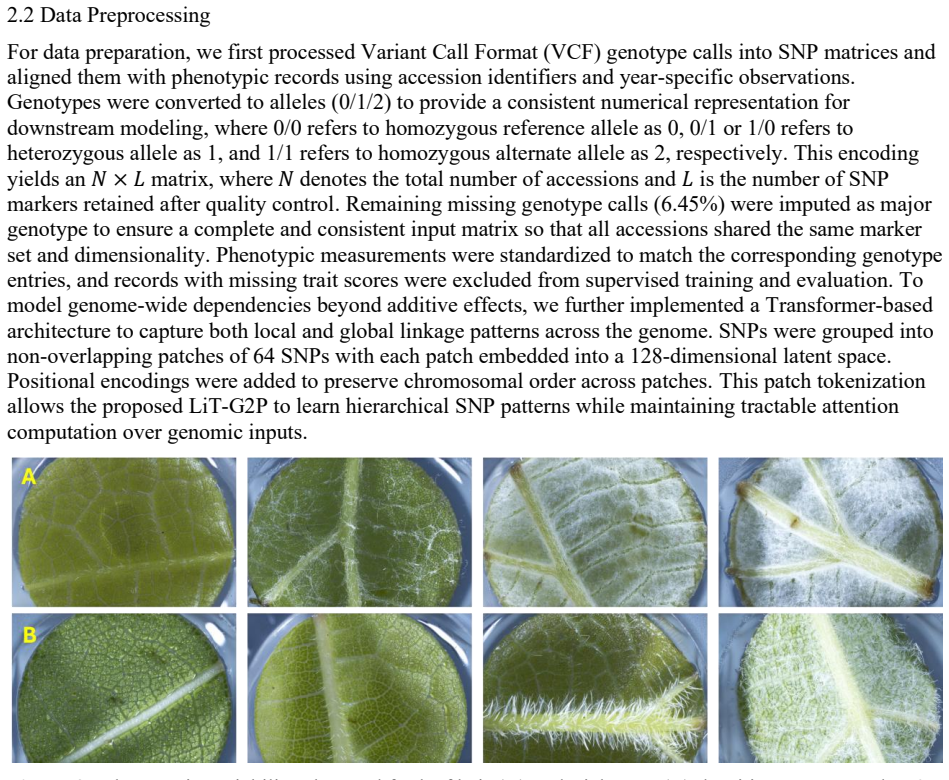
Robust genotype-to-phenotype (G2P) prediction is essential for accelerating breeding decisions and genetic gain. However, it remains challenging to measure complex traits under variable field conditions and across years. In this study, we propose a linear-Transformer approach, LiT-G2P (Linear-Transformer Genotype-to-Phenotype), an automated predictive framework that integrates additive genetic variance effects with Transformer-based nonlinear interactions using genome-wide single-nucleotide polymorphisms (SNPs) data. We evaluated LiT-G2P on a panel of diverse grape accessions, genotyped with SNP markers and measured for phenotypes across two consecutive years. Target phenotypic traits include leaf hair density and trichome density of grapevines. Across both single-year and cross-year testing scenarios, LiT-G2P consistently improves prediction performance compared with baseline models. For hair density, LiT-G2P achieves the lowest error in both single-year and cross-year evaluations, with RMSEs of 0.469 and 0.454, respectively, while maintaining strong tolerance accuracies of 79.2% and 74.6%, respectively. For trichome density, LiT-G2P also presents the best overall G2P performance. In addition, we extract model-prioritized SNPs from attention weights and apply genotype-stratified analysis to provide interpretable candidate marker for downstream validation. These results demonstrate that integrating stable additive effects with learned interaction patterns can enhance cross-year robustness and support practical SNP-based predictive modeling for genomic selection.
Editorial analysis
A structured set of objections, weighed in public.
Referee Report
Summary. The paper introduces LiT-G2P, a hybrid model combining linear additive genetic effects from SNPs with Transformer-based capture of nonlinear interactions for genotype-to-phenotype prediction in grapevine. It evaluates the model on a panel of accessions for leaf hair density and trichome density across two consecutive years, reporting improved RMSE and tolerance accuracy over unspecified baselines in both single-year and cross-year hold-outs, and extracts candidate SNPs via attention weights for interpretability.
Significance. If the performance gains prove robust, the hybrid approach could advance genomic selection by retaining interpretable additive components while modeling interactions, supporting more reliable cross-year predictions for complex traits in variable environments.
major comments (2)
- [Abstract and Results] Abstract and Results sections: The headline claim that LiT-G2P 'consistently improves prediction performance compared with baseline models' is unsupported by any description of the baseline models, their RMSE/accuracy values, hyperparameter selection, or statistical tests for the reported differences (e.g., hair-density RMSE of 0.469 single-year and 0.454 cross-year). This information is load-bearing for evaluating whether the hybrid architecture delivers genuine gains.
- [Methods and Evaluation] Methods and Evaluation: The cross-year tests use only two consecutive years with no reported sample size, heritability, permutation tests, or external validation cohort. Without these, it is impossible to determine whether the modest RMSE reductions reflect stable additive-plus-interaction modeling or exploitation of year-specific correlations in this limited panel.
minor comments (1)
- [Abstract] The term 'tolerance accuracies' (79.2% and 74.6%) is used without defining the tolerance threshold or how it relates to the continuous RMSE metric.
Simulated Author's Rebuttal
We thank the referee for the constructive comments, which highlight important areas for improving the clarity and rigor of our presentation. We address each major comment point-by-point below and will revise the manuscript accordingly.
read point-by-point responses
-
Referee: [Abstract and Results] Abstract and Results sections: The headline claim that LiT-G2P 'consistently improves prediction performance compared with baseline models' is unsupported by any description of the baseline models, their RMSE/accuracy values, hyperparameter selection, or statistical tests for the reported differences (e.g., hair-density RMSE of 0.469 single-year and 0.454 cross-year). This information is load-bearing for evaluating whether the hybrid architecture delivers genuine gains.
Authors: We agree that the abstract and results sections require additional detail to substantiate the performance claims. In the revised manuscript we will explicitly name the baseline models (ridge regression for additive effects, random forest, and a standalone Transformer), include a comparative table of their RMSE and accuracy values, describe the hyperparameter tuning procedure (grid search with inner cross-validation), and report statistical tests (paired t-tests across repeated random splits) to evaluate the significance of differences. These changes will be incorporated into both the abstract and the main results. revision: yes
-
Referee: [Methods and Evaluation] Methods and Evaluation: The cross-year tests use only two consecutive years with no reported sample size, heritability, permutation tests, or external validation cohort. Without these, it is impossible to determine whether the modest RMSE reductions reflect stable additive-plus-interaction modeling or exploitation of year-specific correlations in this limited panel.
Authors: We accept that these details are necessary for assessing robustness. The revised manuscript will report the panel sample size, narrow-sense heritability estimates for both traits (computed from the genomic relationship matrix), and results from permutation tests (random phenotype shuffles to confirm that observed errors are significantly lower than chance). The two-year cross-year design is a standard temporal hold-out for evaluating generalization across environments; we will expand the discussion to explicitly acknowledge the limitation of only two years and the lack of a fully independent external cohort, while clarifying that the hybrid architecture is intended to capture stable additive effects plus interactions. revision: yes
Circularity Check
No circularity: performance metrics derived from held-out test splits
full rationale
The paper trains the LiT-G2P hybrid on SNP-phenotype data from a two-year grapevine panel and reports RMSE/accuracy on explicitly held-out single-year and cross-year test partitions. These quantities are computed after model fitting and are not equivalent by construction to any fitted parameters or inputs. No equations, self-citations, or ansatzes are shown to reduce the central claims to tautologies; the attention-based SNP prioritization is post-hoc and does not alter the reported prediction results. The derivation chain is therefore self-contained against external benchmarks.
Axiom & Free-Parameter Ledger
free parameters (1)
- neural network hyperparameters
axioms (2)
- domain assumption Genome-wide SNPs capture sufficient additive genetic variance for the target traits
- domain assumption Non-additive (nonlinear) SNP interactions contribute measurably to phenotypic variation across years
Lean theorems connected to this paper
-
IndisputableMonolith/Cost/FunctionalEquation.leanwashburn_uniqueness_aczel unclearŷi = Wmain xi + fTF(xi) ... linear main effect branch ... Transformer interaction branch ... patch tokens ... self-attention
-
IndisputableMonolith/Foundation/RealityFromDistinction.leanreality_from_one_distinction uncleartwo consecutive years ... 320 accessions ... 15,388 SNPs ... cross-year RMSE 0.454 for hair density
Reference graph
Works this paper leans on
-
[1]
Moving from genotype to phenotype
Bailey-Serres, J., Parker, J. E., Ainsworth, E. A., Oldroyd, G. E. D., & Schroeder, J. I. (2019). Genetic strategies for improving crop yields. Nature, 575(7781), 109–118. https://doi.org/10.1038/s41586-019-1679-0 Boggess, M. V ., Lippolis, J. D., Hurkman, W. J., Fagerquist, C. K., Briggs, S. P., Gomes, A. V ., Righetti, P. G., & Bala, K. (2013). The need...
-
[2]
https://doi.org/10.1007/s00122-025-04986-w 13 of 15 Carvalho, L. C., Gonçalves, E. F., Marques Da Silva, J., & Costa, J. M. (2021). Potential Phenotyping Methodologies to Assess Inter- and Intravarietal Variability and to Select Grapevine Genotypes Tolerant to Abiotic Stress. Frontiers in Plant Science, 12, 718202. https://doi.org/10.3389/fpls.2021.718202...
-
[3]
E., Dufault, C., Wainberg, M., Forster, D., Karimzadeh, M., Goodarzi, H., Theis, F
https://doi.org/10.3390/biology12071033 Consens, M. E., Dufault, C., Wainberg, M., Forster, D., Karimzadeh, M., Goodarzi, H., Theis, F. J., Moses, A., & Wang, B. (2025). Transformers and genome language models. Nature Machine Intelligence, 7(3), 346–362. https://doi.org/10.1038/s42256-025-01007-9 Dalla-Torre, H., Gonzalez, L., Mendoza-Revilla, J., Lopez C...
-
[4]
https://doi.org/10.1038/s41576-022-00532-2 Quang, D., & Xie, X. (2016). DanQ: A hybrid convolutional and recurrent deep neural network for quantifying the function of DNA sequences. Nucleic Acids Research, 44(11), e107–e107. https://doi.org/10.1093/nar/gkw226 15 of 15 Sapkota, S., Martinez, D., Underhill, A., Chen, L.-L., Gadoury, D., Cadle-Davidson, L., ...
-
[5]
https://doi.org/10.3390/horticulturae10121309 Zhang, Y ., Huang, G., Zhao, Y ., Lu, X., Wang, Y ., Wang, C., Guo, X., & Zhao, C. (2025). Revolutionizing Crop Breeding: Next-Generation Artificial Intelligence and Big Data-Driven Intelligent Design. Engineering, 44, 245–255. https://doi.org/10.1016/j.eng.2024.11.034 Zou, C., Karn, A., Reisch, B., Nguyen, A....
discussion (0)
Sign in with ORCID, Apple, or X to comment. Anyone can read and Pith papers without signing in.