Recognition: 2 theorem links
· Lean TheoremAn HST Wide Field Survey of the Galactic Bulge: Overview, Strategy, and First Results
Pith reviewed 2026-05-11 00:45 UTC · model grok-4.3
The pith
HST wide-field survey of the Galactic Bulge supplies high-resolution pre-imaging to strengthen Roman exoplanet characterization.
A machine-rendered reading of the paper's core claim, the machinery that carries it, and where it could break.
Core claim
The survey establishes a 1.1-square-degree high-resolution imaging dataset of the Galactic Bulge that overlaps the Roman field, thereby enabling more precise characterization of detected exoplanet systems through improved astrometry and photometry while creating a lasting archive for broader investigations of the inner Galaxy.
What carries the argument
The 1.1 square degree survey area imaged via coordinated parallel mode with HST's ACS and WFC3 cameras in the F606W and F814W passbands, positioned to precede the Roman Galactic Exoplanet Survey.
If this is right
- Roman exoplanet detections will gain improved host-star astrometry and photometry from the HST priors.
- The dataset will enable detailed mapping of interstellar extinction and metallicities across the surveyed bulge region.
- Cluster associations and stellar dynamics in the Galactic center can be studied with greater accuracy using the combined high-resolution data.
- The archive will support community research on stellar populations and variability even after Roman observations begin.
Where Pith is reading between the lines
- Cross-matching HST and Roman catalogs over the overlap region could reveal proper motions or long-term variability inaccessible to either instrument alone.
- The coordinated parallel strategy used here offers a model for maximizing high-resolution coverage in other wide-area space telescope campaigns.
- The survey's legacy value may extend to calibration of future bulge observations beyond the Roman program.
Load-bearing premise
The HST image quality, astrometric precision, and areal overlap with the Roman field will prove sufficient to deliver meaningful improvements in exoplanet characterization once Roman data arrive.
What would settle it
A direct comparison in which exoplanet host-star positions, magnitudes, or variability measurements from Roman data show no gain in precision or completeness when the HST survey images are included versus when they are omitted.
Figures



read the original abstract
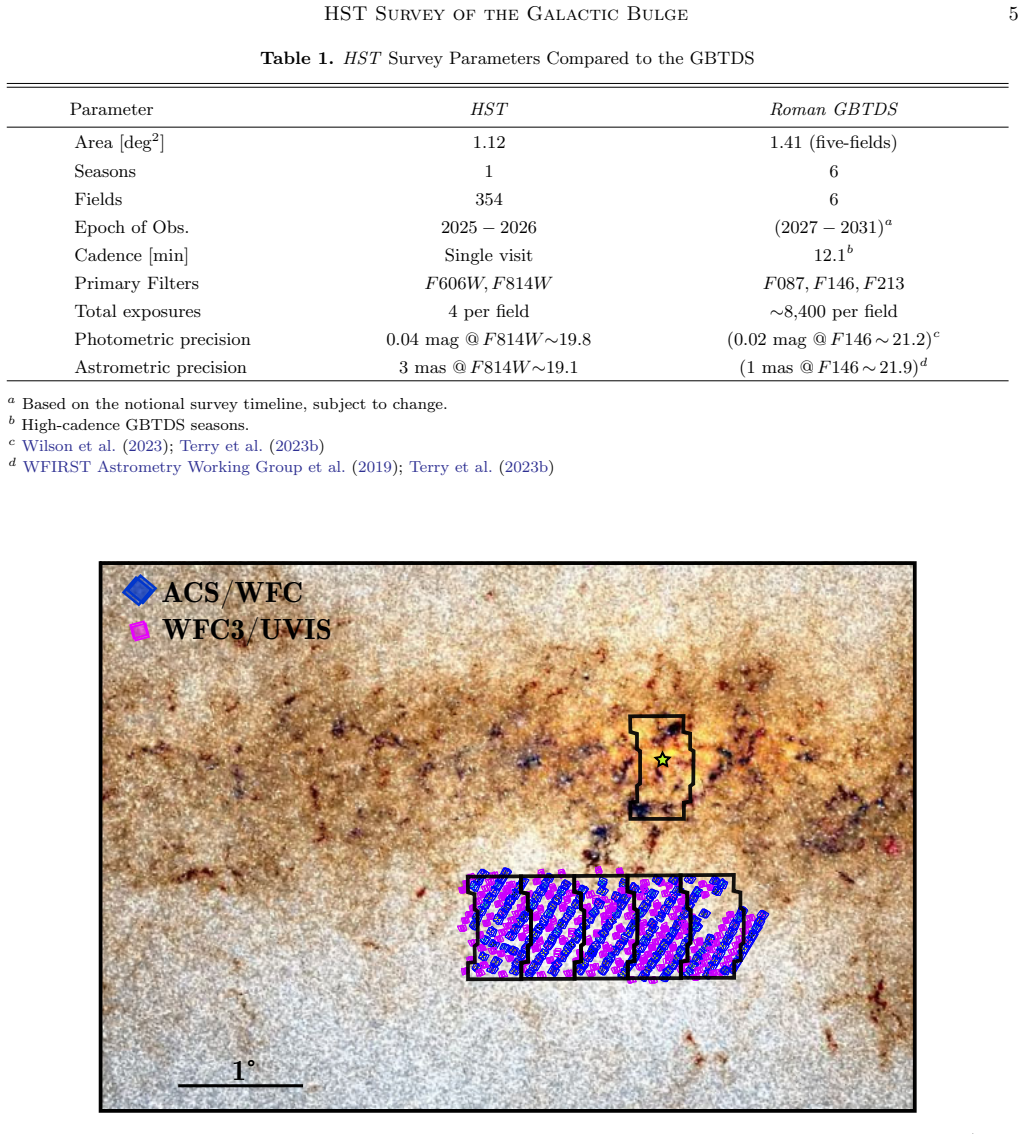
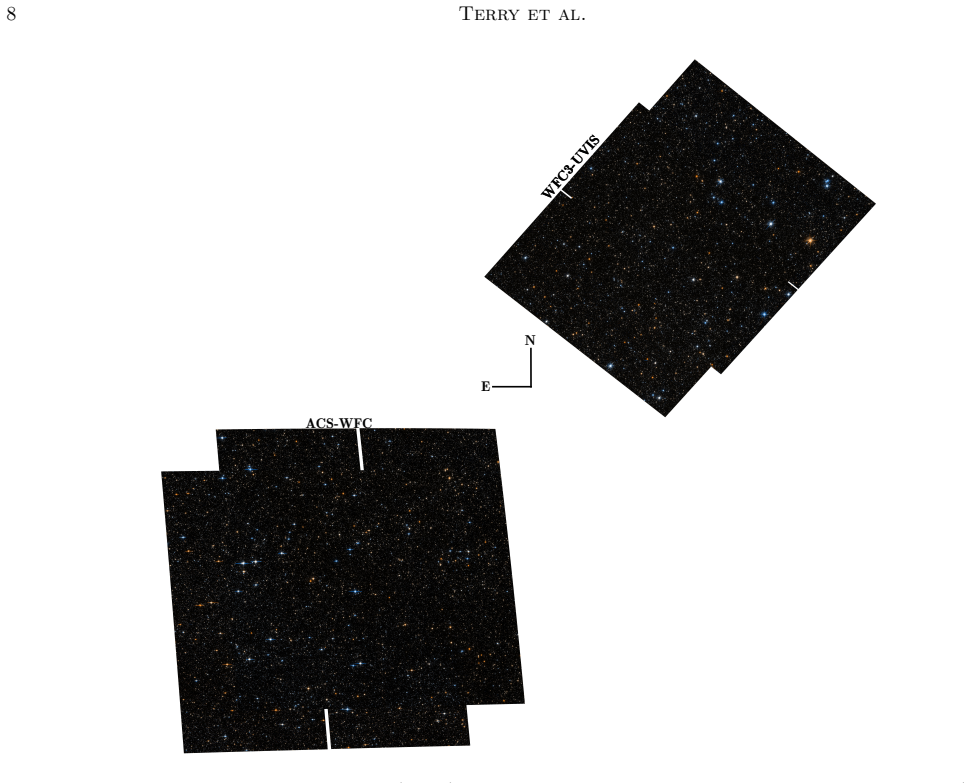
We present an HST imaging survey of a 1.1 sq. degree sky area toward the Milky Way Galactic Bulge. This field significantly overlaps with the upcoming Nancy Grace Roman Galactic Bulge Time Domain Survey (GBTDS). High angular resolution imaging of this area with HST before the start of the Roman Galactic Exoplanet Survey (RGES) will greatly strengthen Roman's ability to characterize detected exoplanet systems, as well as provide a rich and wide-field archive for use as a legacy dataset toward the Galactic Bulge for the broader community. We conduct coordinated-parallel imaging with both wide-field cameras on HST, Wide-field Camera 3 (WFC3) and Advanced Camera for Surveys (ACS), utilizing the F606W and F814W passbands. Approximately 70% of the survey was conducted during HST Cycle 32, with the remaining 30% conducted during Cycle 33. In this paper, the first in a series, we give a general overview of the program and the observing strategy, and present early results. This campaign secures HST's lasting impact on the high-precision study of stellar populations, dynamics, exoplanet systems, interstellar extinction, metallicities, cluster associations, and more toward the center of our Galaxy.
Editorial analysis
A structured set of objections, weighed in public.
Referee Report
Summary. The paper presents an overview of a 1.1 sq. deg HST imaging survey of the Galactic Bulge using coordinated-parallel WFC3 and ACS observations in F606W and F814W, with 70% executed in Cycle 32 and 30% in Cycle 33. It describes the observing strategy chosen to overlap the Roman Galactic Exoplanet Survey (RGES/GBTDS) footprint and reports early results on image quality and coverage, positioning the dataset as a legacy archive that will greatly strengthen Roman exoplanet characterization through improved source identification, astrometry, and deblending.
Significance. If the described coverage, depth, and astrometric quality are achieved, the survey supplies a valuable high-resolution, multi-band pre-Roman reference dataset for the bulge. This directly supports stellar-population, extinction, and dynamics studies while providing a practical archive for the community; the coordinated-parallel strategy is an efficient use of HST time.
major comments (2)
- [Abstract, §1] Abstract and §1: The central assertion that the HST data 'will greatly strengthen' Roman's ability to characterize detected exoplanet systems is presented without any quantitative support (e.g., expected gain in astrometric precision, fraction of blended sources resolved, or simulated reduction in planet-parameter uncertainties). No error budget or end-to-end microlensing simulation is supplied to link the achieved HST image quality to the claimed improvement.
- [§4] §4 (First Results): The reported image quality and coverage metrics are described but not connected to Roman-specific figures of merit such as source density, blending fraction, or proper-motion precision that would be required to substantiate the prospective utility claim.
minor comments (2)
- [Figure 2] Figure 2 (coverage map): Adding an explicit overlay of the Roman GBTDS footprint would make the overlap fraction immediately clear to readers.
- [Table 1] Table 1 (exposure summary): The table would benefit from an additional column giving the achieved 5σ depth in each filter for the early fields.
Simulated Author's Rebuttal
We thank the referee for their constructive review and positive assessment of the survey's potential as a legacy dataset supporting Roman observations. We address the two major comments below, noting that this is the first paper in a planned series focused on overview and early results.
read point-by-point responses
-
Referee: [Abstract, §1] Abstract and §1: The central assertion that the HST data 'will greatly strengthen' Roman's ability to characterize detected exoplanet systems is presented without any quantitative support (e.g., expected gain in astrometric precision, fraction of blended sources resolved, or simulated reduction in planet-parameter uncertainties). No error budget or end-to-end microlensing simulation is supplied to link the achieved HST image quality to the claimed improvement.
Authors: We agree that quantitative estimates (e.g., astrometric gains, blending fractions, or simulated planet-parameter improvements) would strengthen the claim. This manuscript is the first in a series and is limited to describing the survey strategy, execution, and preliminary image-quality metrics. Detailed error budgets, end-to-end microlensing simulations, and Roman-specific figures of merit are reserved for subsequent papers that will analyze the full dataset. We will revise the abstract and §1 to include a brief forward reference stating that quantitative assessments of the improvement to Roman exoplanet characterization will appear in follow-up work. revision: partial
-
Referee: [§4] §4 (First Results): The reported image quality and coverage metrics are described but not connected to Roman-specific figures of merit such as source density, blending fraction, or proper-motion precision that would be required to substantiate the prospective utility claim.
Authors: Section 4 presents early results on achieved image quality and areal coverage to demonstrate that the survey meets its design goals. Linking these metrics quantitatively to Roman figures of merit (source density, blending, proper-motion precision) requires completed data reduction, catalog construction, and simulations that are outside the scope of this overview paper. We will add a short paragraph at the end of §4 that qualitatively connects the reported FWHM, depth, and overlap with the RGES footprint to expected benefits for source deblending and astrometry, while explicitly deferring quantitative Roman-specific calculations to later papers in the series. revision: partial
Circularity Check
No circularity: paper is observational overview with no derivations or self-referential predictions
full rationale
The paper describes an HST survey strategy, coverage, and early results for a field overlapping the Roman GBTDS. It contains no equations, no fitted parameters, no predictions derived from data, and no self-citations invoked to justify uniqueness or ansatzes. The central claim that the HST imaging 'will greatly strengthen' Roman exoplanet characterization is a prospective statement about future utility based on planned overlap and image quality, not a result that reduces by construction to the paper's own inputs or prior self-citations. The derivation chain is absent; the document is self-contained as a survey description.
Axiom & Free-Parameter Ledger
Lean theorems connected to this paper
-
IndisputableMonolith/Foundation/RealityFromDistinction.lean (and Cost modules)reality_from_one_distinction unclear?
unclearRelation between the paper passage and the cited Recognition theorem.
High angular resolution imaging of this area with HST before the start of the Roman Galactic Exoplanet Survey (RGES) will greatly strengthen Roman's ability to characterize detected exoplanet systems... We conduct coordinated-parallel imaging with both wide-field cameras on HST, Wide-field Camera 3 (WFC3) and Advanced Camera for Surveys (ACS), utilizing the F606W and F814W passbands.
-
IndisputableMonolith/Cost/FunctionalEquation.leanwashburn_uniqueness_aczel unclear?
unclearRelation between the paper passage and the cited Recognition theorem.
We have developed a custom data reduction pipeline that is largely based on the hst1pass algorithm... Artificial star tests... completeness-corrected LFs... compared to the SynthPop simulation
What do these tags mean?
- matches
- The paper's claim is directly supported by a theorem in the formal canon.
- supports
- The theorem supports part of the paper's argument, but the paper may add assumptions or extra steps.
- extends
- The paper goes beyond the formal theorem; the theorem is a base layer rather than the whole result.
- uses
- The paper appears to rely on the theorem as machinery.
- contradicts
- The paper's claim conflicts with a theorem or certificate in the canon.
- unclear
- Pith found a possible connection, but the passage is too broad, indirect, or ambiguous to say the theorem truly supports the claim.
Reference graph
Works this paper leans on
-
[1]
The Astrophysical Journal , volume=
The first direct detection of a gravitational -lens toward the Galactic bulge , author=. The Astrophysical Journal , volume=
-
[2]
Nature , volume=
Direct detection of a microlens in the Milky Way , author=. Nature , volume=. 2001 , publisher=
2001
-
[3]
Astronomy & Astrophysics , volume=
Hiding its age: the case for a younger bulge , author=. Astronomy & Astrophysics , volume=. 2016 , publisher=
2016
-
[4]
Monthly Notices of the Royal Astronomical Society , volume=
Mapping the tilt of the Milky Way bulge velocity ellipsoids with ARGOS and Gaia DR2 , author=. Monthly Notices of the Royal Astronomical Society , volume=. 2021 , publisher=
2021
-
[5]
The Astrophysical Journal , volume=
Deciphering the 3D structure of the old galactic bulge from the OGLE RR Lyrae stars , author=. The Astrophysical Journal , volume=. 2015 , publisher=
2015
-
[6]
The bulge radial velocity assay (BRAVA). II. Complete sample and data release , author=. The Astronomical Journal , volume=. 2012 , publisher=
2012
-
[7]
Monthly Notices of the Royal Astronomical Society , pages=
Dynamical modelling of the galactic bulge and bar: the Milky Way’s pattern speed, stellar and dark matter mass distribution , author=. Monthly Notices of the Royal Astronomical Society , pages=. 2016 , publisher=
2016
-
[8]
Monthly Notices of the Royal Astronomical Society , volume=
Made-to-measure models of the Galactic box/peanut bulge: stellar and total mass in the bulge region , author=. Monthly Notices of the Royal Astronomical Society , volume=. 2015 , publisher=
2015
-
[9]
III-A dynamical model for the Milky Way bulge , author=
Galactic structure from the spacelab infrared telescope. III-A dynamical model for the Milky Way bulge , author=. Astrophysical Journal, Part 1 (ISSN 0004-637X), vol. 387, March 1, 1992, p. 181-188. , volume=
1992
-
[10]
Monthly Notices of the Royal Astronomical Society , volume=
A maximum disc model for the galaxy , author=. Monthly Notices of the Royal Astronomical Society , volume=. 1988 , publisher=
1988
-
[11]
Age and abundance structure of the stellar populations in the central sub-kpc of the Milky Way , author=
Chemical evolution of the Galactic bulge as traced by microlensed dwarf and subgiant stars-VI. Age and abundance structure of the stellar populations in the central sub-kpc of the Milky Way , author=. Astronomy & Astrophysics , volume=. 2017 , publisher=
2017
-
[12]
Publications of the Astronomical Society of the Pacific , volume=
Rubin observatory LSST transients and variable stars roadmap , author=. Publications of the Astronomical Society of the Pacific , volume=. 2023 , publisher=
2023
-
[13]
arXiv preprint arXiv:1403.4241 , year=
WFIRST ultra-precise astrometry I: Kuiper belt objects , author=. arXiv preprint arXiv:1403.4241 , year=
-
[14]
The Astrophysical Journal , volume=
Modeling Asteroseismic Yields for the Roman Galactic Bulge Time-domain Survey , author=. The Astrophysical Journal , volume=. 2025 , publisher=
2025
-
[15]
arXiv preprint arXiv:1410.7395 , year=
WFIRST Ultra-precise astrometry II: asteroseismology , author=. arXiv preprint arXiv:1410.7395 , year=
- [16]
-
[17]
Astrophysical Journal, Part 2-Letters (ISSN 0004-637X), vol
Gravitational microlensing of the Galactic bulge stars , author=. Astrophysical Journal, Part 2-Letters (ISSN 0004-637X), vol. 371, April 20, 1991, p. L63-L67. , volume=
1991
-
[18]
General Relativity and Gravitation , keywords =
Microlensing as a probe of the Galactic structure: 20 years of microlensing optical depth studies. General Relativity and Gravitation , keywords =. doi:10.1007/s10714-009-0925-4 , archivePrefix =. 1001.2707 , primaryClass =
-
[19]
Gravitational microlensing of the Galactic bulge stars. , keywords =. doi:10.1086/187448 , adsurl =
-
[21]
Full orbital solution for the binary system in the northern Galactic disc microlensing event Gaia16aye. , keywords =. doi:10.1051/0004-6361/201935097 , archivePrefix =. 1901.07281 , primaryClass =
-
[22]
Astronomy & Astrophysics , volume=
HST pre-imaging of a free-floating planet candidate microlensing event , author=. Astronomy & Astrophysics , volume=. 2026 , publisher=
2026
-
[23]
Predictions of the Nancy Grace Roman Space Telescope Galactic Exoplanet Survey. III. Detectability of Giant Exomoons of Wide-separation Giant Planets , author=. The Astronomical Journal , volume=. 2025 , publisher=
2025
- [24]
-
[25]
JATIS , volume=
Astrometry with the wide-field infrared space telescope , author=. JATIS , volume=. 2019 , publisher=
2019
-
[26]
R v-dependent Optical and Near-Ultraviolet Extinction. , keywords =. doi:10.1086/173713 , adsurl =
-
[27]
The Relationship between Infrared, Optical, and Ultraviolet Extinction.ApJ1989, 345, 245
The Relationship between Infrared, Optical, and Ultraviolet Extinction. , keywords =. doi:10.1086/167900 , adsurl =
-
[28]
The Astrophysical Journal Letters , volume=
Parallax systematics and photocenter motions of benchmark eclipsing binaries in Gaia EDR3 , author=. The Astrophysical Journal Letters , volume=. 2021 , publisher=
2021
-
[29]
, volume=
SynthPop: A New Framework for Synthetic Milky Way Population Generation , author=. , volume=. 2025 , publisher=
2025
-
[30]
doi:10.5281/zenodo.573372 , version =
isoclassify: v1.2. doi:10.5281/zenodo.573372 , version =
-
[31]
2025 , eprint=
Deriving Stellar Properties, Distances, and Reddenings using Photometry and Astrometry with BRUTUS , author=. 2025 , eprint=
2025
-
[32]
isochrones: Stellar model grid package
-
[34]
The Astronomical Journal , author =
The Astropy Project: Building an Open-science Project and Status of the v2.0 Core Package. , keywords =. doi:10.3847/1538-3881/aabc4f , archivePrefix =. 1801.02634 , primaryClass =
-
[35]
The Astropy Project: Sustaining and Growing a Community-oriented Open-source Project and the Latest Major Release (v5.0) of the Core Package. , keywords =. doi:10.3847/1538-4357/ac7c74 , archivePrefix =. 2206.14220 , primaryClass =
work page internal anchor Pith review Pith/arXiv arXiv doi:10.3847/1538-4357/ac7c74
-
[36]
Charles R. Harris and K. Jarrod Millman and St. Array programming with. 2020 , month = sep, journal =. doi:10.1038/s41586-020-2649-2 , publisher =
-
[37]
The Astronomical Journal , volume=
The two micron all sky survey (2MASS) , author=. The Astronomical Journal , volume=. 2006 , publisher=
2006
-
[38]
Surface brightness relations calibrated by interferometry
The angular sizes of dwarf stars and subgiants. Surface brightness relations calibrated by interferometry. , keywords =. doi:10.1051/0004-6361:20035930 , archivePrefix =. astro-ph/0404180 , primaryClass =
-
[39]
, archivePrefix = "arXiv", eprint =
Predicting stellar angular diameters from V, I _ C , H and K photometry. , keywords =. doi:10.1093/mnras/stx2367 , archivePrefix =. 1709.03902 , primaryClass =
-
[40]
HST Proposal , pages=
Correcting for the Effects of Interstellar Extinction Toward the Roman Galactic Exoplanet Survey Fields , author=. HST Proposal , pages=
-
[41]
HST Proposal , pages=
-
[42]
, archivePrefix = "arXiv", eprint =
Interstellar extinction curve variations towards the inner Milky Way: a challenge to observational cosmology. , keywords =. doi:10.1093/mnras/stv2843 , archivePrefix =. 1510.01321 , primaryClass =
-
[43]
Interstellar extinction and the distribution of stellar populations in the direction of the ultra-deep Chandra Galactic field. , keywords =. doi:10.1051/0004-6361/200913527 , archivePrefix =. 1003.2965 , primaryClass =
-
[44]
Calibration of the MACHO Photometry Database. , keywords =. doi:10.1086/316469 , archivePrefix =. astro-ph/9909227 , primaryClass =
-
[45]
The Wide-field Infrared Survey Explorer (WISE): Mission Description and Initial On-orbit Performance. , keywords =. doi:10.1088/0004-6256/140/6/1868 , archivePrefix =. 1008.0031 , primaryClass =
work page internal anchor Pith review Pith/arXiv arXiv doi:10.1088/0004-6256/140/6/1868
-
[46]
The Two Micron All Sky Survey (2MASS). , keywords =. doi:10.1086/498708 , adsurl =
-
[47]
The Dark Energy Camera Plane Survey 2 (DECaPS2): More Sky, Less Bias, and Better Uncertainties. , keywords =. doi:10.3847/1538-4365/aca594 , archivePrefix =. 2206.11909 , primaryClass =
-
[48]
, archivePrefix = "arXiv", eprint =
VVV DR1: The first data release of the Milky Way bulge and southern plane from the near-infrared ESO public survey VISTA variables in the V \' a L \'a ctea. , keywords =. doi:10.1051/0004-6361/201118407 , archivePrefix =. 1111.5511 , primaryClass =
-
[49]
Kepler Input Catalog: Photometric Calibration and Stellar Classification. , keywords =. doi:10.1088/0004-6256/142/4/112 , archivePrefix =. 1102.0342 , primaryClass =
-
[50]
The Revised TESS Input Catalog and Candidate Target List. , keywords =. doi:10.3847/1538-3881/ab3467 , archivePrefix =. 1905.10694 , primaryClass =
-
[51]
Transiting Exoplanet Yields for the Roman Galactic Bulge Time Domain Survey Predicted from Pixel-level Simulations. , keywords =. doi:10.3847/1538-4365/acf3df , archivePrefix =. 2305.16204 , primaryClass =
-
[52]
Microlensing events indicate that super-Earth exoplanets are common in Jupiter-like orbits. Science , keywords =. doi:10.1126/science.adn6088 , archivePrefix =. 2504.20158 , primaryClass =
-
[53]
Comparing Observed Stellar Kinematics and Surface Densities in a Low-latitude Bulge Field to Galactic Population Synthesis Models. , keywords =. doi:10.3847/1538-4357/ab629b , archivePrefix =. 1910.02297 , primaryClass =
-
[54]
Astronomy & Astrophysics , volume=
A synthetic view on structure and evolution of the Milky Way , author=. Astronomy & Astrophysics , volume=. 2003 , publisher=
2003
-
[55]
The Astrophysical Journal , volume=
OGLE-2011-BLG-0265Lb: A jovian microlensing planet orbiting an m dwarf , author=. The Astrophysical Journal , volume=. 2015 , publisher=
2011
-
[56]
Astronomy & Astrophysics , volume=
Astropy: A community Python package for astronomy , author=. Astronomy & Astrophysics , volume=. 2013 , publisher=
2013
-
[57]
Astronomy & Astrophysics , volume=
Detecting stars, galaxies, and asteroids with Gaia , author=. Astronomy & Astrophysics , volume=. 2015 , publisher=
2015
-
[58]
The Astrophysical Journal , volume=
Predicted space motions for hypervelocity and runaway stars: proper motions and radial velocities for the gaia era , author=. The Astrophysical Journal , volume=. 2014 , publisher=
2014
-
[59]
Monthly Notices of the Royal Astronomical Society , volume=
Discovery of a nearby 1700 km s- 1 star ejected from the Milky Way by Sgr A , author=. Monthly Notices of the Royal Astronomical Society , volume=. 2020 , publisher=
2020
-
[60]
Hypervelocity Stars. III. The Space Density and Ejection History of Main-Sequence Stars from the Galactic Center. , keywords =. doi:10.1086/523642 , archivePrefix =. 0709.1471 , primaryClass =
-
[61]
Nature , volume=
Hyper-velocity and tidal stars from binaries disrupted by a massive Galactic black hole , author=. Nature , volume=. 1988 , publisher=
1988
-
[62]
Boletin de los Observatorios Tonantzintla y Tacubaya , volume=
Run-away Stars as the Result of the Gravitational Collapse of Proto-stellar Clusters , author=. Boletin de los Observatorios Tonantzintla y Tacubaya , volume=
-
[63]
run-away
On the origin of the O-and B-type stars with high velocities (the" run-away" stars), and some related problems , author=. Bulletin of the Astronomical Institutes of the Netherlands, Vol. 15, p. 265 , volume=
-
[64]
, author=
Spectral Classification of the High-Velocity Stars. , author=. Astrophysical Journal, vol. 117, p. 241 , volume=
-
[65]
, author=
Evidence from the motions of old stars that the Galaxy collapsed. , author=. Astrophysical Journal, vol. 136, p. 748 , volume=
-
[66]
Temperate Earth-sized planets transiting a nearby ultracool dwarf star. , keywords =. doi:10.1038/nature17448 , archivePrefix =. 1605.07211 , primaryClass =
-
[67]
False Positive Probabilities for all Kepler Objects of Interest: 1284 Newly Validated Planets and 428 Likely False Positives. , keywords =. doi:10.3847/0004-637X/822/2/86 , archivePrefix =. 1605.02825 , primaryClass =
-
[68]
Substellar-mass Companions to the K-dwarf BD+14 4559 and the K-giants HD 240210 and BD+20 2457. , keywords =. doi:10.1088/0004-637X/707/1/768 , archivePrefix =. 0906.1804 , primaryClass =
-
[69]
Monthly Notices of the Royal Astronomical Society , volume=
Transit probabilities around hypervelocity and runaway stars , author=. Monthly Notices of the Royal Astronomical Society , volume=. 2017 , publisher=
2017
-
[70]
Monthly Notices of the Royal Astronomical Society , volume=
Hypervelocity planets and transits around hypervelocity stars , author=. Monthly Notices of the Royal Astronomical Society , volume=. 2012 , publisher=
2012
-
[71]
The Astrophysical Journal , volume=
New method to measure proper motions of microlensed sources: application to candidate free-floating-planet event MOA-2011-BLG-262 , author=. The Astrophysical Journal , volume=. 2014 , publisher=
2011
-
[72]
Monthly Notices of the Royal Astronomical Society , volume=
The effect of late giant collisions on the atmospheres of protoplanets and the formation of cold sub-Saturns , author=. Monthly Notices of the Royal Astronomical Society , volume=. 2022 , publisher=
2022
-
[73]
The Astrophysical Journal , volume=
A theoretical framework for the mass distribution of gas giant planets forming through the core accretion paradigm , author=. The Astrophysical Journal , volume=. 2021 , publisher=
2021
-
[74]
The Astrophysical Journal , volume=
Gaia and the galactic center origin of hypervelocity stars , author=. The Astrophysical Journal , volume=. 2018 , publisher=
2018
-
[75]
The Astrophysical Journal , volume=
MMT hypervelocity star survey , author=. The Astrophysical Journal , volume=. 2008 , publisher=
2008
-
[76]
Astronomical Journal (ISSN 0004-6256), vol
A pattern-matching algorithm for two-dimensional coordinate lists , author=. Astronomical Journal (ISSN 0004-6256), vol. 91, May 1986, p. 1244-1248. , volume=
1986
-
[77]
, volume=
A search for stellar-mass black holes via astrometric microlensing , author=. , volume=. 2016 , publisher=
2016
-
[78]
Astronomy & Astrophysics , volume=
The astrometric core solution for the gaia mission-overview of models, algorithms, and software implementation , author=. Astronomy & Astrophysics , volume=. 2012 , publisher=
2012
-
[79]
Astronomy & Astrophysics , volume=
Gaia data release 3-summary of the content and survey properties , author=. Astronomy & Astrophysics , volume=. 2023 , publisher=
2023
-
[80]
arXiv preprint arXiv:2302.01168 , year=
OGLE-2016-BLG-1195Lb: A Sub-Neptune Beyond the Snow Line of an M-dwarf Confirmed by Keck AO , author=. arXiv preprint arXiv:2302.01168 , year=
-
[81]
Journal of Astronomical Telescopes, Instruments, and Systems , volume=
Transiting exoplanet survey satellite , author=. Journal of Astronomical Telescopes, Instruments, and Systems , volume=. 2015 , publisher=
2015
-
[82]
The Astronomical Journal , volume=
Confirmation of Color-dependent Centroid Shift Measured After 1.8 Years with HST , author=. The Astronomical Journal , volume=. 2023 , publisher=
2023
discussion (0)
Sign in with ORCID, Apple, or X to comment. Anyone can read and Pith papers without signing in.