Recognition: 2 theorem links
· Lean TheoremDoes a Fractional Quantum Hall Edge Have a Protected Intrinsic Dipole Moment?
Pith reviewed 2026-05-11 00:55 UTC · model grok-4.3
The pith
FQH edges have a protected intrinsic dipole moment only at filling factor 1/3.
A machine-rendered reading of the paper's core claim, the machinery that carries it, and where it could break.
Core claim
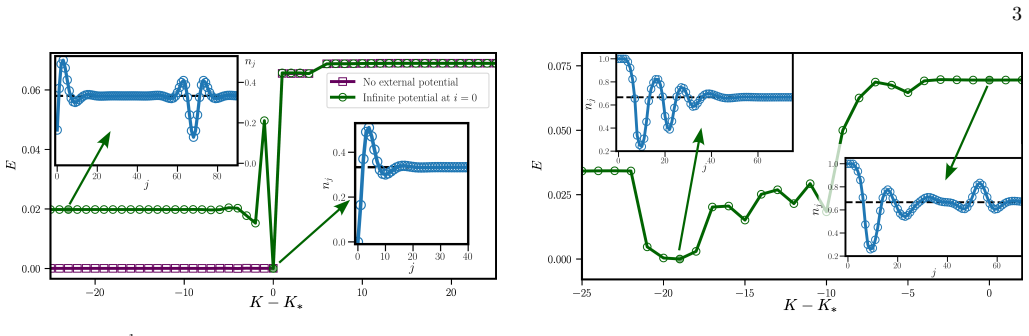
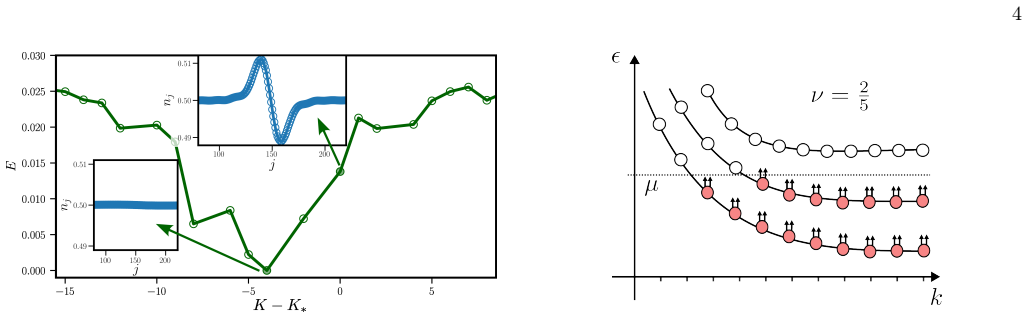
Contrary to the expectation of a universal protected dipole, the edge dipole takes the intrinsic value only at nu=1/3. For the nu=2/3-vacuum edge and the Pfaffian-anti-Pfaffian interface, DMRG computations reveal that the dipole does not match the claimed intrinsic value. Arguments based on composite fermions indicate that hierarchy states in general should not exhibit protected intrinsic dipoles, with consequences for the energetics and edge structure of FQH systems.
What carries the argument
Ground-state electric dipole moment at the physical edge, extracted from DMRG simulations on cylinder geometries for the three representative FQH systems.
If this is right
- The intrinsic dipole is not a general feature of FQH edges but appears only in special cases such as nu=1/3.
- Hierarchy states are expected to lack protected dipoles on the basis of composite-fermion reasoning.
- Accurate dipole values require controlled convergence of DMRG calculations.
- Models of edge energetics and reconstruction must be revised for non-Laughlin states.
Where Pith is reading between the lines
- Absence of protection at most fillings suggests edge reconstruction or extra neutral modes are needed to stabilize the observed states.
- Different filling factors may produce qualitatively different tunneling or transport signatures due to varying dipole contributions.
- Composite-fermion wave functions could be used to compute dipole moments for additional fractions beyond those studied.
- Results highlight the need for systematic finite-size scaling in future edge studies of topological phases.
Load-bearing premise
The DMRG ground-state dipole converges to the thermodynamic limit without significant finite-size or truncation artifacts for the studied system sizes and bond dimensions.
What would settle it
A converged DMRG or experimental measurement of the edge dipole at nu=2/3 that equals the Park-Haldane intrinsic value would falsify the central finding.
Figures
read the original abstract
We investigate the claims by Park and Haldane [Phys. Rev. B 90, 045123 (2014)] of an intrinsic protected value of the electric dipole moment at the physical edge of fractional quantum Hall (FQH) systems. Contrary to prevailing expectations, we find that the edge dipole takes the expected intrinsic value only in certain very special cases. We identify key limitations in earlier numerical studies and employ density matrix renormalization group (DMRG) methods to accurately compute the ground-state dipole. We focus on three representative systems: the $\nu=1/3$-vacuum edge, the $\nu=2/3$-vacuum edge, and the interface between Pfaffian and anti-Pfaffian phases. We find that the expected intrinsic dipole value occurs only at $\nu=1/3$, whereas the other systems do not exhibit the claimed intrinsic value. We give arguments based on composite fermions as to why hierarchy states should generally not have protected intrinsic dipoles. These results have important implications for the energetics and edge structure of FQH states.
Editorial analysis
A structured set of objections, weighed in public.
Referee Report
Summary. The paper claims that the protected intrinsic electric dipole moment at FQH edges proposed by Park and Haldane occurs only in special cases such as the ν=1/3-vacuum edge. DMRG calculations on the ν=1/3-vacuum, ν=2/3-vacuum, and Pfaffian-anti-Pfaffian interface show the expected dipole value only for ν=1/3, with deviations in the other two systems. Composite-fermion arguments are given for why hierarchy states generally lack such protection, with implications for edge energetics.
Significance. If the findings hold, the work would refine understanding of FQH edge structure by showing protected dipoles are not generic. Strengths include application of DMRG to representative geometries and explicit identification of limitations in prior numerics; the composite-fermion perspective provides a useful generalization framework.
major comments (2)
- [DMRG results for ν=2/3-vacuum edge] In the DMRG results for the ν=2/3-vacuum edge, the computed dipole deviates from the intrinsic value, but no finite-size scaling, bond-dimension extrapolation, or truncation-error estimates are provided. Since the dipole is a global integral sensitive to edge density fluctuations, this is needed to confirm the deviation persists in the thermodynamic limit.
- [Pfaffian-anti-Pfaffian interface results] For the Pfaffian-anti-Pfaffian interface, the reported dipole likewise lacks convergence diagnostics with system size or bond dimension χ. This is load-bearing for the central claim that protection is absent outside the ν=1/3 case.
minor comments (2)
- [Figures] Figure captions should specify the bond dimensions, system lengths, and any extrapolation procedures used in the DMRG runs.
- [Abstract] The abstract would be clearer if it quoted the numerical dipole values obtained for each of the three systems.
Simulated Author's Rebuttal
We thank the referee for their careful reading, positive assessment of the significance of our results, and constructive suggestions regarding the DMRG convergence analysis. We address each major comment below and will revise the manuscript to incorporate the requested diagnostics.
read point-by-point responses
-
Referee: In the DMRG results for the ν=2/3-vacuum edge, the computed dipole deviates from the intrinsic value, but no finite-size scaling, bond-dimension extrapolation, or truncation-error estimates are provided. Since the dipole is a global integral sensitive to edge density fluctuations, this is needed to confirm the deviation persists in the thermodynamic limit.
Authors: We agree that explicit convergence checks are important given the global nature of the dipole and its sensitivity to edge fluctuations. Although our calculations used multiple system sizes and bond dimensions sufficient to observe a clear deviation, we did not present the scaling analysis in the original manuscript. In the revised version, we will add finite-size scaling plots for the ν=2/3-vacuum edge dipole, bond-dimension extrapolations, and truncation-error estimates. These will confirm that the deviation from the intrinsic value remains robust in the thermodynamic limit. revision: yes
-
Referee: For the Pfaffian-anti-Pfaffian interface, the reported dipole likewise lacks convergence diagnostics with system size or bond dimension χ. This is load-bearing for the central claim that protection is absent outside the ν=1/3 case.
Authors: We concur that convergence diagnostics are essential for this geometry, which supports our central claim. In the revised manuscript, we will include explicit data on the dipole moment versus system size and bond dimension χ for the Pfaffian-anti-Pfaffian interface, together with extrapolations to the thermodynamic limit and infinite bond dimension. This will demonstrate that the dipole remains distinct from the intrinsic value, reinforcing that protection is absent in this case. revision: yes
Circularity Check
No circularity: central claims rest on independent DMRG numerics and composite-fermion arguments, not reductions to inputs by construction.
full rationale
The paper computes edge dipoles via DMRG for three explicit systems and contrasts them with the Park-Haldane claim, then supplies separate composite-fermion reasoning for why hierarchy states lack protection. These steps are not self-definitional, do not rename fitted quantities as predictions, and do not rely on load-bearing self-citations whose content reduces to the present result. The derivation chain remains self-contained against external benchmarks and does not exhibit any of the enumerated circular patterns.
Axiom & Free-Parameter Ledger
Lean theorems connected to this paper
-
IndisputableMonolith/Foundation/AbsoluteFloorClosure.leanreality_from_one_distinction unclearWe employ 'segment' DMRG in the cylinder geometry... cut-and-glue method... E vs. K(Ly) profiles
Reference graph
Works this paper leans on
-
[1]
Park and F
Y. Park and F. D. M. Haldane, Phys. Rev. B90, 045123 (2014)
2014
-
[2]
J. E. Avron, R. Seiler, and P. G. Zograf, Phys. Rev. Lett. 75, 697 (1995)
1995
-
[3]
N. Read and E. H. Rezayi, Physical Review B84, 10.1103/physrevb.84.085316 (2011)
-
[4]
E. H. Rezayi, K. Pakrouski, and F. D. M. Haldane, Phys. Rev. B104, L081407 (2021)
2021
-
[5]
Read, Phys
N. Read, Phys. Rev. B79, 045308 (2009)
2009
-
[6]
B. Bradlyn, M. Goldstein, and N. Read, Physical Review B86, 10.1103/physrevb.86.245309 (2012)
-
[7]
F. D. M. Haldane, "hall viscosity" and intrinsic met- ric of incompressible fractional hall fluids (2009), arXiv:0906.1854 [cond-mat.str-el]
-
[8]
M. P. Zaletel, R. S. K. Mong, and F. Pollmann, Phys. Rev. Lett.110, 236801 (2013)
2013
-
[9]
M. P. Zaletel, R. S. K. Mong, F. Pollmann, and E. H. Rezayi, Physical Review B91, 10.1103/phys- revb.91.045115 (2015)
-
[10]
Hu and W
L. Hu and W. Zhu, Phys. Rev. B105, 165145 (2022)
2022
-
[11]
W. Zhu, D. N. Sheng, and K. Yang, Phys. Rev. Lett. 125, 146802 (2020)
2020
-
[12]
R. B. Laughlin, Phys. Rev. Lett.50, 1395 (1983)
1983
-
[13]
Does a Fractional Quantum Hall Edge Have a Protected Intrinsic Dipole Moment? Supplementary Material
-
[14]
S. R. White, Phys. Rev. Lett.69, 2863 (1992)
1992
-
[15]
The density-matrix renormalization group in the age of matrix product states
U. Schollwöck, Annals of Physics326, 96 (2011), arXiv:1008.3477 [cond-mat.str-el]
work page Pith review arXiv 2011
-
[16]
Anyon molecules in fractional quantum Hall states
T. Wang and M. P. Zaletel, Anyon molecules in fractional quantum hall states (2026), arXiv:2604.09798 [cond- mat.mes-hall]
work page internal anchor Pith review Pith/arXiv arXiv 2026
-
[17]
T. Lotrič, T. Wang, M. P. Zaletel, S. H. Simon, and S. A. Parameswaran, Majorana edge reconstruction and theν= 5/2non-abelian thermal hall puzzle (2025), arXiv:2507.07161 [cond-mat.mes-hall]
-
[18]
Hauschild and F
J. Hauschild and F. Pollmann, Tenpy: Tensor network python library (2018), https://github.com/tenpy/tenpy
2018
-
[19]
F. D. M. Haldane, Phys. Rev. Lett.51, 605 (1983)
1983
-
[20]
V. L. Pokrovsky and A. L. Talapov, Journal of Physics C: Solid State Physics18, L691 (1985)
1985
-
[21]
S. A. Trugman and S. Kivelson, Phys. Rev. B31, 5280 (1985)
1985
-
[22]
B. I. Halperin, Phys. Rev. Lett.52, 1583 (1984)
1984
-
[23]
J. K. Jain,Composite Fermions(Cambridge University Press, 2007)
2007
-
[24]
J. K. Jain, Phys. Rev. Lett.63, 199 (1989)
1989
-
[25]
Lopez and E
A. Lopez and E. Fradkin, Phys. Rev. B44, 5246 (1991)
1991
-
[26]
J. K. Jain and R. K. Kamilla, Phys. Rev. B55, R4895 (1997)
1997
-
[27]
Pu,Study of Fractional Quantum Hall Effect in Pe- riodic Geometries(The Pennsylvania State University, 2021)
S. Pu,Study of Fractional Quantum Hall Effect in Pe- riodic Geometries(The Pennsylvania State University, 2021)
2021
-
[28]
Yang and Z.-X
Y. Yang and Z.-X. Hu, Phys. Rev. B107, 115162 (2023)
2023
-
[29]
D. B. Chklovskii, Physical Review B51, 9895 (1995)
1995
-
[30]
Brey, Phys
L. Brey, Phys. Rev. B50, 11861 (1994)
1994
-
[31]
Does a Fractional Quantum Hall Edge Have a Protected Intrinsic Dipole Moment?
G. J. Sreejith, S. Jolad, D. Sen, and J. K. Jain, Phys. Rev. B84, 245104 (2011). Supplementary Information for “Does a Fractional Quantum Hall Edge Have a Protected Intrinsic Dipole Moment?” CONTENTS I. DMRG Methods 7
2011
-
[32]
Schmidt decomposition and canonical form 7 b
MPS basics and notation 7 a. Schmidt decomposition and canonical form 7 b. Conservation laws and charges 7
-
[33]
Variation of the momentum sectorK9 b
Construction of the interface 8 a. Variation of the momentum sectorK9 b. Practical implementation for FQH/FQH interfaces 10 c. FQH/vacuum interface 10
-
[34]
Jain composite fermion trial states and Variational Monte Carlo 11
MPO construction 11 II. Jain composite fermion trial states and Variational Monte Carlo 11
-
[35]
Introduction to CF picture and Jain-Kamila projection 11
-
[36]
Boundary conditions 14
-
[37]
DifferentKsectors within Jain-Kamila projection 14 III.ν= 1 3/vacuum interface 15
-
[38]
Composite-fermion interpretation of theν= 1 3/vacuum interface within theV1 interaction 15 2.V 1, V3 interaction 15
-
[39]
Coulomb interaction 17 IV.ν= 2 3/vacuum interface 18
-
[40]
HaldaneV 1 interaction — finite size scaling 18
-
[41]
Pfaffian/AntiPfaffian interface, additional data 19 VI
Coulomb interaction 19 V. Pfaffian/AntiPfaffian interface, additional data 19 VI. Other filling fractions 20 1.ν= 2 5/vacuum interface 20 a. Coulomb interaction 20 b.V 1 = 1, V3 = 0.05interaction 22 2.ν= 1 5/vacuum interface 22 3.ν= 3 7/vacuum interface 23 7 Appendix I: DMRG Methods
-
[42]
Schmidt decomposition and canonical form We briefly introduce the standard matrix product state (MPS) notation utilized in DMRG
MPS basics and notation a. Schmidt decomposition and canonical form We briefly introduce the standard matrix product state (MPS) notation utilized in DMRG. Consider a one- dimensional system of lengthL, with local basis states{|σ j⟩}at each sitej. A generic many-body wavefunction can be written as |Ψ⟩= X σ1,...,σL Ψσ1...σL |σ1 . . . σL⟩.(S1.1) In the MPS ...
-
[43]
Construction of the interface Here, we describe the construction of an interface between two distinct fractional quantum Hall phases, as well as between an FQH phase and the vacuum. The procedures for constructing FQH/FQH and FQH/vacuum interfaces are closely related, so we focus primarily on the FQH/FQH case and discuss the necessary modifications for th...
-
[44]
We first obtain the ground states of the two distinct bulk phases independently using infinite DMRG (iDMRG), which directly targets the infinite cylinder limit (Lx → ∞, L y finite), converging to a ground state with a unit cell of ˜Msites
-
[45]
Since this is a gauge transformation, the bulk wavefunctions themselves remain unchanged; however, the way in which charges are assigned is modified
We apply a gauge transformation that uniformly shifts the momentum quantum numberKon the auxiliary legs of the right bulk wavefunction by an amount∆K, while no shift is applied to the left bulk wavefunction. Since this is a gauge transformation, the bulk wavefunctions themselves remain unchanged; however, the way in which charges are assigned is modified....
-
[46]
Truncating it at the right boundary yields a semi-infinite MPS
We start from an infinite MPS. Truncating it at the right boundary yields a semi-infinite MPS. From this, we retain only a finite numberM 2 of sites near the truncation point, while all sites further to the left are absorbed into an environment tensor representing the bulk. This allows us to represent a semi-infinite cylinder using only M 2 B-tensors toge...
-
[47]
Importantly, at the connected legs, the Schmidt values are replaced by random numbers
The two truncated bulk states are then connected by contracting their auxiliary indices, with the bond structure enforcing matching conserved quantum numbers. Importantly, at the connected legs, the Schmidt values are replaced by random numbers. This state is in the correct symmetry sector, despite it potentially being a bad guess for the ground state. We...
-
[48]
Finally, we perform segment DMRG to optimize the finite region between the left and right environments, allowing the interface to relax to an optimized state. 9 FIG. S6. Figure illustrating steps 2–4 of the modified cut-and-glue procedure. In step 2, a uniform shiftK(αj)→K(α j) + ∆K is applied to the auxiliary quantum numbers on all legs of one infinite M...
-
[49]
In constructing the MPO, we introduce a cutoffϵand discard all terms with|Vm1,m2,m3,m4 |< ϵ, typically takingϵ= 10 −5
MPO construction In MPO representation, any 2-body interaction is written as V= X m1,m2,m3,m4 Vm1,m2,m3,m4 c† m1 c† m2 cm3 cm4 ,(S1.9) whereV m1,m2,m3,m4 are the interaction matrix elements for orbitals given by momenta numbers{mi}in the Landau level basis. In constructing the MPO, we introduce a cutoffϵand discard all terms with|Vm1,m2,m3,m4 |< ϵ, typica...
-
[50]
reference
Introduction to CF picture and Jain-Kamila projection The composite fermion (CF) approach provides a systematic framework for constructing accurate trial wave func- tions for fractional quantum Hall (FQH) states. In essence, electrons in a strong magnetic field are envisioned as 12 binding an even number2pof zeros of the wavefunction, which we roughly thi...
-
[51]
reference
Intrinsic dipole Here, we construct composite fermion states that possess an intrinsic dipole predicted byP&H. Generally, to describe a state with bulk filling fractionν, one must fill exactlyν ∗ Λlevels in the bulk for each CF momentum numberk. Near the edge, however, the occupation profile in the ground state may deviate from this uniform structure. We ...
-
[52]
reference
Boundary conditions In order to proceed with the construction of trial composite fermion functions, we need to translate the DMRG confining potential from in electronic Landau level orbitals, to composite fermionΛlevel orbitals. In particular, the hard-wall constraint imposed in the DMRG setup translates, within the composite-fermion picture, into a restr...
-
[53]
reference
DifferentKsectors within Jain-Kamila projection Finally, we are ready to construct trial composite fermion wavefunctions for different confining potentials. To construct trial states withK̸=K ∗, we modify the occupancies near the edge. The basic idea is to promote a single composite fermion near the edge from a filledΛlevel to an empty orbital with a diff...
-
[54]
reference
Composite-fermion interpretation of theν= 1 3/vacuum interface within theV1 interaction In this section, we analyse the results from the main text for theν=1 3/vacuum interface with theV1 interaction, in the context of composite-fermion trial wavefunctions. In the case of a hard-wall confining potential atj <0, forK < K ∗ a composite fermion can occupy th...
-
[55]
By fixingV1 = 1as the energy scale of the system, we investigate how the ground-state dipole evolves by changingV3. To study the effectV3 has on the interface energetics, we should of course ensure that the V3 term does not destabilize the Laughlin bulk ground state, which in turn fixes the intrinsic dipole. Starting from the exactly solvable pointV3 = 0,...
-
[56]
We consider a hard wall atj≤0, in accordance with the definition given in the main text
Coulomb interaction In this section, we present results for theν=1 3/vacuum interface with screened Coulomb interaction. We consider a hard wall atj≤0, in accordance with the definition given in the main text. FIG. S13. Figures showing theE(K)profile for theν= 1 3/vacuum interface. Subfigure (a) presents DMRG results for a system with a hard wall atj≤0. S...
-
[57]
HaldaneV 1 interaction — finite size scaling In the main text, we concluded that theν= 2 3/vacuum interface under theV 1 interaction with a hard-wall boundary does not exhibit an intrinsic dipole at the system size considered (Ly = 22ℓB). As Eq. (1) holds only in the thermodynamic limit, to extend this conclusion, we have to examine the finite-size scalin...
-
[58]
Coulomb interaction The data forν= 2 3/vacuum interface with a screened Coulomb interaction in presence of a hard wall atj <0is remarkably similar to theν= 2 3/vacuum data under the Haldane interaction presented in the main text (Fig. 2). Here, we use a screening length ofζ= 4ℓ B, andL y = 19ℓ B. The DMRG data is presented in the Fig. S16. We see that the...
-
[59]
The VMC energy profileE(K)is shown in Fig
Consistent with this, the DMRG density profile shows an enhanced occupancy near the edge, whereas this feature is absent in the VMC results for our trial wavefunctions. The VMC energy profileE(K)is shown in Fig. S19, from which we can draw further conclusions about the energetics. We provide an intuition using the effective dispersion of composite fermion...
discussion (0)
Sign in with ORCID, Apple, or X to comment. Anyone can read and Pith papers without signing in.