Recognition: unknown
Anyon molecules in fractional quantum Hall states
Pith reviewed 2026-05-10 16:36 UTC · model grok-4.3
The pith
Screening from nearby gates can bind like-charged anyons into stable molecules in fractional quantum Hall states.
A machine-rendered reading of the paper's core claim, the machinery that carries it, and where it could break.
Core claim
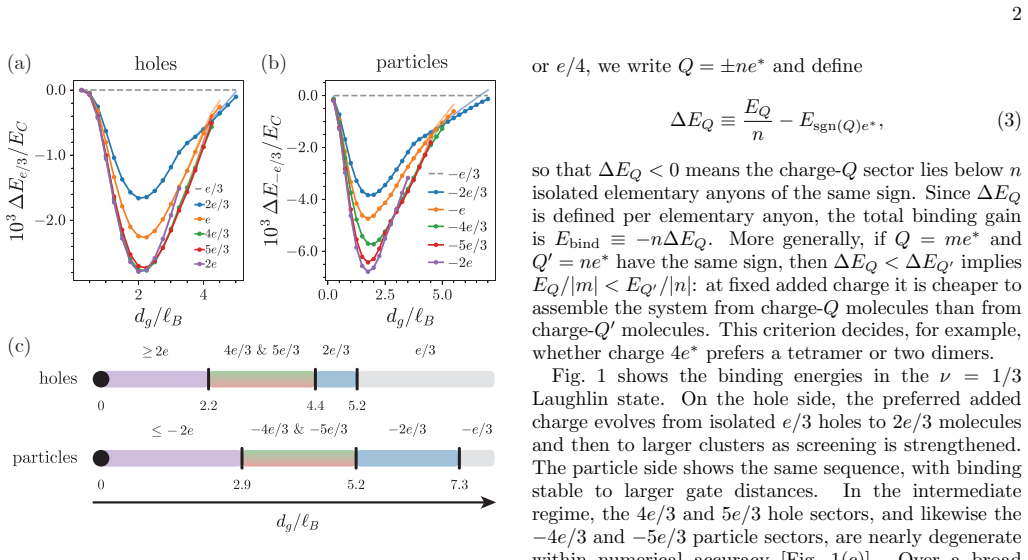
In the ν=1/3 Laughlin state stable ±2e/3 molecules and larger clusters appear over a broad gate-distance window. The ν=2/5 Jain state is molecular throughout the range considered. In the ν=5/2 anti-Pfaffian state binding is strongest on the hole side, where the charge-e/2 molecule is fused into the ψ channel over a broad window of gate distances. In all three cases screening suppresses long-range repulsion and exposes an intermediate-range attraction encoded in the oscillatory density tail of the fundamental anyon.
What carries the argument
The gate-screened Coulomb interaction acting on the effective anyon model, which exposes binding through the oscillatory density tail of the fundamental anyon.
If this is right
- Addition spectra will register steps at the charge of the bound molecules rather than at the charge of single anyons.
- Interferometry will show modified phase shifts reflecting the statistics of the composite objects.
- Wigner crystallization will occur with molecular units instead of isolated anyons.
- Possible anyon superconductivity or pairing phenomena will be influenced by the intermediate-range attraction.
- Entropy measurements will count the internal degeneracy of the molecular states rather than isolated anyons.
Where Pith is reading between the lines
- Varying the gate distance in experiment could map a phase diagram of molecule stability and dissociation.
- Similar screening-induced binding may occur in other topological phases that host anyonic excitations.
- Molecule formation could be used to engineer effective interactions for braiding or fusion measurements.
- The attraction might stabilize new liquid or crystal phases of anyons at intermediate densities.
Load-bearing premise
The effective anyon model plus the gate-screened Coulomb interaction accurately captures the low-energy charged excitations of the real microscopic fractional quantum Hall system.
What would settle it
Measuring whether the energy cost to add two like-charged anyons is lower than twice the cost of adding one, or imaging density clustering under controlled gate distances, would directly test whether molecules form.
Figures


read the original abstract
We use segment DMRG on the infinite cylinder to compute energies of charged excitations in gate-screened fractional quantum Hall states. For the $\nu=1/3$ Laughlin, $\nu=2/5$ Jain, and $\nu=5/2$ anti-Pfaffian states, we find screening can bind like-charged anyons into molecules, with a strong dependence on filling-factor, gate distance, and fusion channel. In the Laughlin state, stable $\pm 2e/3$ molecules and larger clusters appear over a broad gate-distance window. The Jain state is molecular throughout the range we consider. In the anti-Pfaffian, binding is strongest on the hole side, where the charge-$e/2$ molecule is fused into the $\psi$ channel over a broad window of gate distances. In all three cases, screening suppresses long-range repulsion and exposes an intermediate-range attraction encoded in the oscillatory density tail of the fundamental anyon. We discuss consequences for addition spectra, interferometry, Wigner crystallization, anyon superconductivity, and entropy measurements.
Editorial analysis
A structured set of objections, weighed in public.
Referee Report
Summary. The manuscript uses segment DMRG on the infinite cylinder to compute energies of charged excitations in gate-screened fractional quantum Hall states. For the ν=1/3 Laughlin, ν=2/5 Jain, and ν=5/2 anti-Pfaffian states, it reports that screening binds like-charged anyons into molecules, with strong dependence on filling factor, gate distance, and fusion channel. Stable ±2e/3 molecules and larger clusters appear over a broad gate-distance window in the Laughlin state; the Jain state is molecular throughout the considered range; binding is strongest on the hole side in the anti-Pfaffian, where the charge-e/2 molecule fuses into the ψ channel over a broad window. Screening suppresses long-range repulsion and exposes intermediate-range attraction from the oscillatory density tail of the fundamental anyon.
Significance. If the numerical results hold, the work shows that gate screening can stabilize anyon molecules in standard FQHE states, with concrete implications for addition spectra, interferometry, Wigner crystallization, anyon superconductivity, and entropy measurements. The approach directly extracts binding from the microscopic anyon density profile rather than from phenomenological models, and the filling-factor and fusion-channel dependence provides testable predictions.
major comments (2)
- [Methods] Methods section (effective Hamiltonian construction): the paper employs an effective anyon model plus gate-screened Coulomb interaction without an internal cross-check against full microscopic Hilbert-space calculations (e.g., small-system exact diagonalization or full DMRG at the same parameters), so it is unclear whether higher-Landau-level mixing or finite-thickness corrections could change the sign or magnitude of the reported binding energies.
- [Results] Results section (binding-energy curves vs. gate distance): no convergence data, bond-dimension truncation errors, cylinder-circumference scaling, or statistical error estimates are provided for the extracted binding energies, despite the central claim resting on the precise values, their signs, and their dependence on fusion channel.
minor comments (2)
- [Abstract] The abstract introduces 'segment DMRG' without specifying the segment length or other numerical parameters used in the calculations.
- [Introduction] Notation for fusion channels (e.g., ψ channel) is used without a brief reminder of the underlying anyon theory in the main text for readers outside the immediate subfield.
Simulated Author's Rebuttal
We thank the referee for their thoughtful review and for highlighting the potential implications of our results. We address each major comment below and will revise the manuscript to improve clarity and completeness.
read point-by-point responses
-
Referee: [Methods] Methods section (effective Hamiltonian construction): the paper employs an effective anyon model plus gate-screened Coulomb interaction without an internal cross-check against full microscopic Hilbert-space calculations (e.g., small-system exact diagonalization or full DMRG at the same parameters), so it is unclear whether higher-Landau-level mixing or finite-thickness corrections could change the sign or magnitude of the reported binding energies.
Authors: Our calculations employ segment DMRG directly on the microscopic lowest-Landau-level Hamiltonian with the gate-screened Coulomb interaction; the anyonic excitations are introduced via the segment construction rather than through a separate phenomenological anyon Hamiltonian. We agree that an explicit benchmark against small-system exact diagonalization including higher-Landau-level mixing would be desirable. Such benchmarks are computationally prohibitive at the cylinder circumferences and bond dimensions required to resolve binding energies of multiple anyons. We have added a new paragraph in the Methods section citing literature estimates of Landau-level mixing strengths at the relevant fillings and gate distances, arguing that the reported binding trends are unlikely to be qualitatively altered. Finite-thickness corrections are already incorporated via the standard form factor in the interaction. revision: partial
-
Referee: [Results] Results section (binding-energy curves vs. gate distance): no convergence data, bond-dimension truncation errors, cylinder-circumference scaling, or statistical error estimates are provided for the extracted binding energies, despite the central claim resting on the precise values, their signs, and their dependence on fusion channel.
Authors: We apologize for the omission of explicit convergence diagnostics. In the revised manuscript we add a dedicated subsection (and associated supplementary figures) that reports binding energies versus bond dimension (up to D=8000), versus cylinder circumference (L=12 to 20), and with explicit truncation-error estimates obtained from the DMRG variance. These data confirm that the signs of the binding energies, their dependence on gate distance, and the fusion-channel ordering remain stable within the reported precision. revision: yes
Circularity Check
No significant circularity; results are direct numerical outputs
full rationale
The paper computes binding energies and molecular stability via segment DMRG on an infinite-cylinder effective anyon Hamiltonian with gate-screened Coulomb interactions. No parameter is fitted to the target binding energies, no self-definitional loop equates inputs to outputs, and no load-bearing self-citation reduces the central claims (filling-factor and fusion-channel dependence of binding) to prior results by construction. The derivation chain is self-contained numerical evaluation against external benchmarks (microscopic FQH physics), consistent with the reader's assessment of only minor circularity risk.
Axiom & Free-Parameter Ledger
axioms (2)
- domain assumption The low-energy charged excitations of the FQHE states are accurately described by the anyon model with screened interactions.
- domain assumption Segment DMRG on the infinite cylinder converges to the thermodynamic limit for the energies of interest.
Forward citations
Cited by 3 Pith papers
-
Does a Fractional Quantum Hall Edge Have a Protected Intrinsic Dipole Moment?
The claimed intrinsic dipole moment at FQH edges is protected only at filling factor 1/3 and absent in other representative edge systems.
-
Dispersion of Anyon Bloch Bands
Anyon Bloch bands in ideal FCIs have m-fold degeneracy in the magnetic BZ and bandwidth controlled by quantum geometry non-uniformity, with higher harmonics strongly suppressing dispersion through emergent symmetries.
-
Generalized Model Fractional Quantum Hall States on Lattices
Lattice model states for Laughlin, Moore-Read, and Z_k Read-Rezayi fractional quantum Hall series are constructed with idealized energy, entanglement, and modified clustering properties distinct from continuum versions.
Reference graph
Works this paper leans on
-
[1]
R. B. Laughlin, Anomalous quantum hall effect: An incompressible quantum fluid with fractionally charged excitations, Phys. Rev. Lett.50, 1395 (1983)
1983
-
[2]
Arovas, J
D. Arovas, J. R. Schrieffer, and F. Wilczek, Fractional statistics and the quantum hall effect, Phys. Rev. Lett. 53, 722 (1984)
1984
-
[3]
An interesting precedent already exists atν= 1, where sufficiently small Zeeman energy can favor a charge-two skyrmion over two charge-one skyrmions. [47]
-
[4]
J. K. Jain, Composite-fermion approach for the fractional quantum hall effect, Phys. Rev. Lett.63, 199 (1989)
1989
-
[5]
J. K. Jain,Composite Fermions(Cambridge University Press, Cambridge, 2007)
2007
-
[6]
M. P. Zaletel, R. S. K. Mong, and F. Pollmann, Topological characterization of fractional quantum hall ground states from microscopic hamiltonians, Phys. Rev. Lett.110, 236801 (2013)
2013
-
[7]
S. A. Trugman and S. Kivelson, Exact results for the fractional quantum hall effect with general interactions, Phys. Rev. B31, 5280 (1985)
1985
- [8]
-
[9]
Laturia, M
A. Laturia, M. L. Van de Put, and W. G. Vandenberghe, Dielectric properties of hexagonal boron nitride and transition metal dichalcogenides: from monolayer to bulk, npj 2D Materials and Applications2, 6 (2018)
2018
-
[10]
Nakamura, S
J. Nakamura, S. Fallahi, H. Sahasrabudhe, R. Rahman, S. Liang, G. C. Gardner, and M. J. Manfra, Aharonov– bohm interference of fractional quantum hall edge modes, Nature Physics15, 563 (2019)
2019
-
[11]
L. A. Cohen, N. L. Samuelson, T. Wang, K. Klocke, C. C. Reeves, T. Taniguchi, K. Watanabe, S. Vijay, M. P. Zaletel, and A. F. Young, Nanoscale electrostatic control in ultraclean van der waals heterostructures by local anodic oxidation of graphite gates, Nature Physics 19, 1502 (2023)
2023
-
[12]
Werkmeister, J
T. Werkmeister, J. R. Ehrets, Y. Ronen, M. E. Wesson, D. Najafabadi, Z. Wei, K. Watanabe, T. Taniguchi, D. E. Feldman, B. I. Halperin, A. Yacoby, and P. Kim, Strongly coupled edge states in a graphene quantum hall interferometer, Nature Communications15, 6533 (2024)
2024
-
[13]
Y. Zeng, Z. Xia, K. Kang, J. Zhu, P. Kn¨ uppel, C. Vaswani, K. Watanabe, T. Taniguchi, K. F. Mak, and J. Shan, Thermodynamic evidence of fractional chern insulator in moir´ e MoTe2, Nature622, 69 (2023)
2023
-
[14]
S. H. Aronson, T. Han, Z. Lu, Y. Yao, J. P. Butler, K. Watanabe, T. Taniguchi, L. Ju, and R. C. Ashoori, Displacement field-controlled fractional chern insulators and charge density waves in a graphene/hbn moir´ e superlattice, Phys. Rev. X15, 031026 (2025)
2025
-
[15]
Waters, A
D. Waters, A. Okounkova, R. Su, B. Zhou, J. Yao, K. Watanabe, T. Taniguchi, X. Xu, Y.-H. Zhang, J. Folk, and M. Yankowitz, Chern insulators at integer and fractional filling in moir´ e pentalayer graphene, Phys. Rev. X15, 011045 (2025)
2025
-
[16]
Z. Lu, T. Han, Y. Yao, A. P. Reddy, J. Yang, J. Seo, K. Watanabe, T. Taniguchi, L. Fu, and L. Ju, Fractional quantum anomalous hall effect in multilayer graphene, Nature626, 759 (2024)
2024
-
[17]
Fractional exclusion statistics and residual interactions 7 between anyons are not relevant in the dilute limit we consider
-
[18]
D. G. Polyakov and B. I. Shklovskii, Activated conduc- tivity in the quantum hall effect, Phys. Rev. Lett.73, 1150 (1994)
1994
-
[19]
M. N. Saha, Liii. ionization in the solar chromosphere, The London, Edinburgh, and Dublin Philosophical Magazine and Journal of Science 6,40, 472 (1920)
1920
-
[20]
J. P. Eisenstein, L. N. Pfeiffer, and K. W. West, Negative compressibility of interacting two-dimensional electron and quasiparticle gases, Physical Review Letters68, 674 (1992)
1992
-
[21]
A. Assouline, T. Wang, H. M. Yoo, R. Fan, F. Yang, R. Zhang, T. Taniguchi, K. Watanabe, M. P. Zaletel, and A. F. Young, Entropy of strongly correlated electrons in a partially filled landau level, Physical Review X 10.1103/jpf1-4zdk (2026), in press
-
[22]
Hu, Y.-C
Y. Hu, Y.-C. Tsui, M. He, U. Kamber, T. Wang, A. S. Mohammadi, K. Watanabe, T. Taniguchi, Z. Papi´ c, M. P. Zaletel, and A. Yazdani, High-resolution tunnelling spectroscopy of fractional quantum hall states, Nature Physics21, 716 (2025)
2025
-
[23]
C.-L. Chiu, T. Wang, R. Fan, K. Watanabe, T. Taniguchi, X. Liu, M. P. Zaletel, and A. Yazdani, High spatial resolution charge sensing of quantum hall states, Proceedings of the National Academy of Sciences of the United States of America122, e2424781122 (2025)
2025
-
[24]
Assouline, T
A. Assouline, T. Wang, H. Zhou, L. A. Cohen, F. Yang, R. Zhang, T. Taniguchi, K. Watanabe, R. S. K. Mong, M. P. Zaletel, and A. F. Young, Energy gap of the even- denominator fractional quantum hall state in bilayer graphene, Phys. Rev. Lett.132, 046603 (2024)
2024
-
[25]
Cooper and A
N. Cooper and A. Stern, Observable bulk signatures of non-abelian quantum hall states, Physical Review Letters 102, 176807 (2009)
2009
-
[26]
K. Yang and B. I. Halperin, Thermopower as a possible probe of non-abelian quasiparticle statistics in fractional quantum hall liquids, Physical Review B79, 115317 (2009), arXiv:0901.1429 [cond-mat.mes-hall]
-
[27]
Estimated fromC≃2ϵ zA/dg usingd g = 40 nm,ϵ z = 3, ϵxy = 6.6,B= 14 T, andE bind = 0.004EC
- [28]
-
[29]
B. I. Halperin, A. Stern, I. Neder, and B. Rosenow, Theory of the fabry-p´ erot quantum hall interferometer, Phys. Rev. B83, 155440 (2011)
2011
-
[30]
Rosenow and B
B. Rosenow and B. I. Halperin, Influence of interactions on flux and back-gate period of quantum hall interferom- eters, Phys. Rev. Lett.98, 106801 (2007)
2007
-
[31]
Nakamura, S
J. Nakamura, S. Liang, G. C. Gardner, and M. J. Manfra, Impact of bulk-edge coupling on observation of anyonic braiding statistics in quantum hall interferometers, Nature Communications13, 344 (2022)
2022
-
[32]
N. L. Samuelson, L. A. Cohen, W. Wang, S. Blanch, T. Taniguchi, K. Watanabe, M. P. Zaletel, and A. F. Young, Slow quasiparticle dynamics and anyonic statis- tics in a fractional quantum hall fabry-p´ erot interferom- eter, Phys. Rev. X16, 011062 (2026)
2026
-
[33]
C. E. Henzinger, J. R. Ehrets, R. Fushio, J. Dong, T. Werkmeister, M. E. Wesson, K. Watanabe, T. Taniguchi, A. Vishwanath, B. I. Halperin, A. Ya- coby, and P. Kim, Controlled localization of anyons in a graphene quantum hall interferometer (2026), arXiv:2603.11182 [cond-mat.str-el]
-
[34]
A. Bid, N. Ofek, M. Heiblum, V. Umansky, and D. Mahalu, Shot noise and charge at the 2/3 composite fractional quantum hall state, Phys. Rev. Lett.103, 236802 (2009)
2009
-
[35]
Ghosh, M
B. Ghosh, M. Labendik, V. Umansky, M. Heiblum, and D. F. Mross, Coherent bunching of anyons and dissociation in an interference experiment, Nature642, 922 (2025)
2025
-
[36]
A. De, C. Boudet, J. Nath, M. Kapfer, I. Farrer, D. A. Ritchie, P. Roulleau, and D. C. Glattli, Electronic hong– ou–mandel interferences to unveil the 2/3 fractional quantum hall edge channel dynamics, Nature Commu- nications16, 8466 (2025)
2025
-
[37]
R. B. Laughlin, Superconducting ground state of nonin- teracting particles obeying fractional statistics, Physical Review Letters60, 2677 (1988)
1988
-
[38]
R. B. Laughlin, The relationship between high- temperature superconductivity and the fractional quan- tum hall effect, Science242, 525 (1988)
1988
-
[39]
B. I. Halperin, Anyons in the quantized hall effect and in models of high temperature superconductors, Helvetica Physica Acta65, 215 (1992)
1992
-
[40]
Lee and M
D.-H. Lee and M. P. A. Fisher, Anyon superconductivity and charge-vortex duality, Int. J. Mod. Phys. B5, 2675 (1991)
1991
-
[41]
Z. D. Shi and T. Senthil, Doping a fractional quantum anomalous hall insulator, Phys. Rev. X15, 031069 (2025)
2025
-
[42]
Pichler, C
F. Pichler, C. Kuhlenkamp, M. Knap, and A. Vish- wanath, Microscopic mechanism of anyon superconduc- tivity emerging from fractional chern insulators, Newton 2, 100340 (2026)
2026
-
[43]
T. Wang and M. P. Zaletel, Chiral superconductivity near a fractional chern insulator (2025), arXiv:2507.07921 [cond-mat.str-el]
-
[44]
Q. Xu, G. Ji, Y. Wang, H. Q. Trung, and B. Yang, Dynamics of anyon clusters in fractional quantum hall fluids, Phys. Rev. B112, 235112 (2025), editors’ Suggestion
2025
-
[45]
Gattu and J
M. Gattu and J. K. Jain, Molecular anyons in the fractional quantum hall effect, Phys. Rev. Lett.135, 236601 (2025)
2025
- [46]
-
[47]
Lillieh¨ o¨ ok, K
D. Lillieh¨ o¨ ok, K. Lejnell, A. Karlhede, and S. L. Sondhi, Quantum hall skyrmions with higher topological charge, Phys. Rev. B56, 6805 (1997)
1997
discussion (0)
Sign in with ORCID, Apple, or X to comment. Anyone can read and Pith papers without signing in.