Recognition: 2 theorem links
· Lean TheoremQuantum Annealing: Optimisation, Sampling, and Many-Body Dynamics
Pith reviewed 2026-05-11 01:51 UTC · model grok-4.3
The pith
Quantum annealing maps optimization problems to quantum spin systems and explores them via continuous Hamiltonian evolution driven by fluctuations and dissipation.
A machine-rendered reading of the paper's core claim, the machinery that carries it, and where it could break.
Core claim
Quantum annealing is a computational paradigm in which optimisation problems are mapped onto the energy landscape of an interacting quantum system and explored through its dynamical evolution. By continuously transforming a simple initial Hamiltonian into one whose ground state encodes the solution, the system traverses a complex landscape via a combination of quantum fluctuations, tunnelling processes, and dissipative dynamics. Unlike gate-based quantum computing, quantum annealing is a specialised and near-term approach aimed primarily at discrete optimisation and sampling tasks. While it is not expected to provide polynomial-time solutions to NP-hard problems in the worst case, it offersa
What carries the argument
Continuous transformation of an initial Hamiltonian into a problem-encoding Hamiltonian, using quantum fluctuations, tunnelling, and open-system dissipation to traverse the energy landscape.
If this is right
- Modern quantum annealers with thousands of qubits function as experimental platforms for studying non-equilibrium many-body quantum dynamics in regimes difficult to access classically.
- Performance is shaped by tunnelling rates, spectral gaps, and open-system effects, which must be analysed to improve computational outcomes.
- Applications extend to optimisation, machine learning, quantum simulation, and many-body physics, positioning the method as complementary to classical and gate-based approaches.
- Central challenges remain in benchmarking, scaling, and control of the devices.
Where Pith is reading between the lines
- If the heuristic proves reliable at larger scales, hybrid classical-quantum workflows could emerge that use annealing specifically for sampling or landscape exploration steps.
- The same hardware could reveal new dynamical phases or correlation patterns in programmable spin systems that classical simulators cannot reach.
- Integration with error mitigation or post-processing techniques might extend the practical range of problem sizes without requiring full quantum error correction.
Load-bearing premise
The combination of quantum fluctuations, tunnelling processes, and dissipative dynamics reliably enables effective exploration of complex energy landscapes for the surveyed applications and hardware platforms.
What would settle it
A series of large-scale benchmark instances where classical heuristic solvers consistently match or exceed the solution quality and speed of current quantum annealers, with no observable scaling advantage from the quantum hardware.
Figures


read the original abstract
Quantum annealing is a computational paradigm in which optimisation problems are mapped onto the energy landscape of an interacting quantum system and explored through its dynamical evolution. By continuously transforming a simple initial Hamiltonian into one whose ground state encodes the solution, the system traverses a complex landscape via a combination of quantum fluctuations, tunnelling processes, and dissipative dynamics. Unlike gate-based quantum computing, quantum annealing is a specialised and near-term approach aimed primarily at discrete optimisation and sampling tasks. While it is not expected to provide polynomial-time solutions to NP-hard problems in the worst case, it offers a physically motivated heuristic for navigating rugged energy landscapes that arise across science and engineering. Modern quantum annealers realise programmable spin systems with thousands of qubits, placing them among the largest controllable quantum devices currently available. As a result, their significance extends beyond optimisation: they also function as experimental platforms for studying non-equilibrium many-body quantum dynamics in regimes that are difficult to access using classical simulation. In this review we present an accessible introduction to the principles of quantum annealing, describe the main hardware platforms and algorithmic techniques, and analyse how tunnelling, spectral gaps, and open-system effects shape computational performance. We survey applications ranging from optimisation and machine learning to quantum simulation and many-body physics, and discuss the central challenges in benchmarking, scaling, and control. These perspectives position quantum annealing as a distinctive framework at the interface of optimisation, stochastic sampling, and programmable quantum dynamics, with a role that is complementary to both classical algorithms and gate-based quantum computing.
Editorial analysis
A structured set of objections, weighed in public.
Referee Report
Summary. The manuscript is a review article on quantum annealing (QA). It describes the core paradigm of mapping discrete optimization problems onto the ground state of a programmable Ising Hamiltonian and evolving an initial transverse-field Hamiltonian into the problem Hamiltonian via a combination of quantum tunneling, fluctuations, and open-system dissipation. The review covers hardware realizations (programmable spin systems with thousands of qubits), algorithmic extensions beyond basic annealing, performance factors such as spectral gaps and decoherence, and applications spanning combinatorial optimization, sampling for machine learning, and experimental studies of non-equilibrium many-body quantum dynamics. It positions QA as a near-term, specialized heuristic complementary to both classical algorithms and gate-based quantum computing, while highlighting benchmarking and scaling challenges.
Significance. If the synthesis is accurate and balanced, the review offers a timely, accessible entry point into a rapidly developing area that sits at the intersection of optimization heuristics and programmable quantum matter. By explicitly linking QA hardware to both practical sampling tasks and controlled many-body experiments that are hard to simulate classically, the manuscript helps delineate the distinctive scientific niche of quantum annealers relative to other quantum platforms. Such integrative reviews can accelerate cross-community understanding and identify open questions in control and benchmarking.
major comments (2)
- [§4] §4 (Hardware platforms): The claim that modern annealers constitute 'among the largest controllable quantum devices' is presented without a quantitative comparison of effective coherence times or control fidelity against other platforms (e.g., superconducting circuits or trapped ions). This weakens the subsequent assertion that they uniquely enable many-body dynamics studies; a short table or explicit metrics would be needed to support the positioning.
- [§6] §6 (Applications to many-body physics): The statement that QA devices access 'regimes difficult to access using classical simulation' is central to the dual-use argument but lacks concrete examples of observables or system sizes where classical methods (tensor networks, quantum Monte Carlo) demonstrably fail while QA data are available. Without such anchors the claim risks remaining qualitative.
minor comments (2)
- [Abstract / §1] The abstract and introduction use 'dissipative dynamics' and 'open-system effects' interchangeably; a brief clarification of the distinction (e.g., coherent vs. incoherent tunneling) would improve precision for readers new to the field.
- [§5–§7] Several application subsections cite review papers from 2015–2018; more recent experimental benchmarks (post-2020) on scaling of tunneling rates or sampling quality should be added to keep the survey current.
Simulated Author's Rebuttal
We thank the referee for the careful reading of the manuscript and the constructive comments. We address each major point below and have prepared revisions accordingly.
read point-by-point responses
-
Referee: [§4] §4 (Hardware platforms): The claim that modern annealers constitute 'among the largest controllable quantum devices' is presented without a quantitative comparison of effective coherence times or control fidelity against other platforms (e.g., superconducting circuits or trapped ions). This weakens the subsequent assertion that they uniquely enable many-body dynamics studies; a short table or explicit metrics would be needed to support the positioning.
Authors: We agree that a quantitative comparison would provide useful context for readers. While the manuscript already notes the qubit count and programmability of current annealers, we acknowledge that metrics on coherence times and control fidelity relative to other platforms would strengthen the positioning. In the revised manuscript we will add a concise table in §4 comparing representative values (qubit number, T2 times, gate/anneal fidelity) across quantum annealing, superconducting circuits, and trapped ions. revision: yes
-
Referee: [§6] §6 (Applications to many-body physics): The statement that QA devices access 'regimes difficult to access using classical simulation' is central to the dual-use argument but lacks concrete examples of observables or system sizes where classical methods (tensor networks, quantum Monte Carlo) demonstrably fail while QA data are available. Without such anchors the claim risks remaining qualitative.
Authors: We appreciate the suggestion to anchor this claim more firmly. The manuscript already cites several experimental studies of non-equilibrium dynamics, but we agree that explicit examples of system sizes and observables would make the argument more precise. In the revision we will expand §6 with concrete cases, including the measurement of Kibble-Zurek scaling in systems of several hundred qubits and the extraction of spin-glass correlation functions where tensor-network or QMC methods encounter exponential cost due to entanglement or sign problems. revision: yes
Circularity Check
Review synthesis with no derivations or predictions
full rationale
The manuscript is a review that synthesizes existing literature on quantum annealing principles, hardware, algorithms, and applications. It presents no new derivations, first-principles results, equations, or predictions. The strongest claim is positioned as a summary of established perspectives on QA as a heuristic and experimental platform. No load-bearing steps reduce to self-definitions, fitted inputs renamed as predictions, or self-citation chains. The paper is self-contained against external benchmarks as a survey.
Axiom & Free-Parameter Ledger
Lean theorems connected to this paper
-
IndisputableMonolith/Cost/FunctionalEquation.leanwashburn_uniqueness_aczel unclear?
unclearRelation between the paper passage and the cited Recognition theorem.
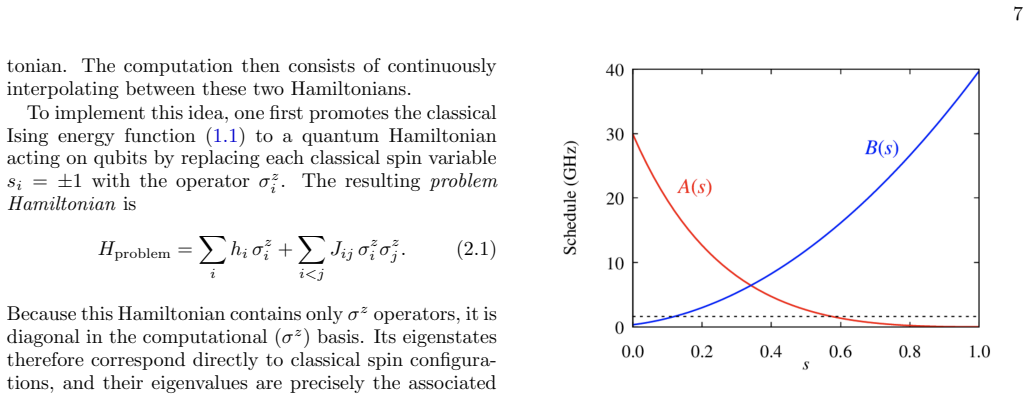
The optimisation problem is encoded in a final Hamiltonian whose ground state represents the desired solution... H(t) = A(t) H_driver + B(t) H_problem
-
IndisputableMonolith/Foundation/DimensionForcing.leanalexander_duality_circle_linking unclear?
unclearRelation between the paper passage and the cited Recognition theorem.
Ising encodings... H_Ising({s_i}) = ∑ h_i s_i + ∑ J_ij s_i s_j
What do these tags mean?
- matches
- The paper's claim is directly supported by a theorem in the formal canon.
- supports
- The theorem supports part of the paper's argument, but the paper may add assumptions or extra steps.
- extends
- The paper goes beyond the formal theorem; the theorem is a base layer rather than the whole result.
- uses
- The paper appears to rely on the theorem as machinery.
- contradicts
- The paper's claim conflicts with a theorem or certificate in the canon.
- unclear
- Pith found a possible connection, but the passage is too broad, indirect, or ambiguous to say the theorem truly supports the claim.
Reference graph
Works this paper leans on
-
[1]
Ising formulations of many NP prob- lems,
Andrew Lucas, “Ising formulations of many NP prob- lems,” Front. in Phys.2, 5 (2014), arXiv:1302.5843 [cond- mat.stat-mech]
-
[2]
Quantum annealing in the transverse ising model,
Tadashi Kadowaki and Hidetoshi Nishimori, “Quantum annealing in the transverse ising model,” Physical Review E58, 5355 (1998)
work page 1998
-
[3]
Adiabatic quan- tum computation,
Tameem Albash and Daniel A. Lidar, “Adiabatic quan- tum computation,” Rev. Mod. Phys.90, 015002 (2018)
work page 2018
-
[4]
Perspec- tives of quantum annealing: Methods and implementa- tions,
Philipp Hauke, Helmut G Katzgraber, Wolfgang Lechner, Hidetoshi Nishimori, and William D Oliver, “Perspec- tives of quantum annealing: Methods and implementa- tions,” Reports on Progress in Physics83, 054401 (2020)
work page 2020
-
[5]
Quantum annealing: An overview,
Atanu Rajak, Sei Suzuki, Amit Dutta, and Bikas K Chakrabarti, “Quantum annealing: An overview,” Philo- sophical Transactions of the Royal Society A: Mathemat- ical, Physical and Engineering Sciences381(2023)
work page 2023
-
[6]
Aitor Gomez-Tejedor, Eneko Osaba, and Esther Villar- Rodriguez, “Addressing the Minor-Embedding Problem in Quantum Annealing and Evaluating State-of-the- Art Algorithm Performance,” (2025), arXiv:2504.13376 [quant-ph]
-
[7]
Minor embedding for quantum an- nealing with reinforcement learning,
Riccardo Nembrini, Maurizio Ferrari Dacrema, and Paolo Cremonesi, “Minor embedding for quantum an- nealing with reinforcement learning,” Quantum Machine Intelligence8, 15 (2026), arXiv:2507.16004 [quant-ph]
-
[8]
arXiv preprint, 1901.04405 , year=
Nike Dattani, “Quadratization in discrete optimization and quantum mechanics,” arXiv:1901.04405 [quant-ph]
-
[9]
Bounds for the adiabatic approximation with appli- cations to quantum computation,
Sabine Jansen, Mary-Beth Ruskai, and Ruedi Seiler, “Bounds for the adiabatic approximation with appli- cations to quantum computation,” J. Math. Phys.48, 102111 (2007)
work page 2007
-
[10]
Adiabatic quan- tum computation is equivalent to standard quantum computation,
Dorit Aharonov, Wim Van Dam, Julia Kempe, Zeph Lan- dau, Seth Lloyd, and Oded Regev, “Adiabatic quan- tum computation is equivalent to standard quantum computation,” SIAM review50, 755–787 (2008), quant- ph/0405098
-
[11]
A quan- tum adiabatic evolution algorithm applied to random in- stances of an np-complete problem,
Edward Farhi, Jeffrey Goldstone, Sam Gutmann, Joshua Lapan, Andrew Lundgren, and Daniel Preda, “A quan- tum adiabatic evolution algorithm applied to random in- stances of an np-complete problem,” Science292, 472– 475 (2001)
work page 2001
-
[12]
Searching for quantum speedup in quasistatic quantum annealers,
Mohammad H Amin, “Searching for quantum speedup in quasistatic quantum annealers,” Physical Review A92, 052323 (2015)
work page 2015
-
[13]
Tunneling and speedup in quantum op- timization for permutation-symmetric problems,
Siddharth Muthukrishnan, Tameem Albash, and Daniel A Lidar, “Tunneling and speedup in quantum op- timization for permutation-symmetric problems,” Physi- cal Review X6, 031010 (2016)
work page 2016
-
[14]
A study of heuristic guesses for adiabatic quantum computation,
Alejandro Perdomo-Ortiz, Salvador E Venegas-Andraca, and Al´ an Aspuru-Guzik, “A study of heuristic guesses for adiabatic quantum computation,” Quantum Information Processing10, 33–52 (2011)
work page 2011
-
[15]
Quantum annealing with manufactured spins,
Mark W Johnson, Mohammad HS Amin, Suzanne Gildert, Trevor Lanting, Firas Hamze, Neil Dickson, Richard Harris, Andrew J Berkley, Jan Johansson, Paul Bunyk,et al., “Quantum annealing with manufactured spins,” Nature473, 194–198 (2011)
work page 2011
-
[16]
Quantum optimization of fully connected spin glasses,
Davide Venturelli, Salvatore Mandr` a, Sergey Knysh, Bryan O’Gorman, Rupak Biswas, and Vadim Smelyan- skiy, “Quantum optimization of fully connected spin glasses,” Physical Review X5, 031040 (2015)
work page 2015
-
[17]
Kelly Boothby, Paul Bunyk, Jack Raymond, and Aidan Roy, “Next-generation topology of d-wave quantum pro- cessors,” (2020), arXiv:2003.00133
-
[18]
King, Kelly Boothby, and Jack Raymond, Zephyr Topology of D-Wave Quantum Processors, Tech
Andrew D. King, Kelly Boothby, and Jack Raymond, Zephyr Topology of D-Wave Quantum Processors, Tech. Rep. (D-Wave Systems, 2021)
work page 2021
-
[19]
Tunable two-dimensional ar- rays of single Rydberg atoms for realizing quantum Ising models,
Henning Labuhn, Daniel Barredo, Sylvain Ravets, Syl- vain de L´ es´ eleuc, Tommaso Macr` ı, Thierry Lahaye, and Antoine Browaeys, “Tunable two-dimensional ar- rays of single Rydberg atoms for realizing quantum Ising models,” Nature534, 667–670 (2016), arXiv:1509.04543 [cond-mat.quant-gas]
-
[20]
Hannes Bernienet al., “Probing many-body dynamics on a 51-atom quantum simulator,” Nature551, 579–584 (2017), arXiv:1707.04344 [quant-ph]
-
[21]
Quantum simulation of frustrated ising spins with trapped ions,
Kihwan Kim, M-S Chang, Simcha Korenblit, Rajibul Is- lam, Emily E Edwards, James K Freericks, G-D Lin, L-M Duan, and Christopher Monroe, “Quantum simulation of frustrated ising spins with trapped ions,” Nature465, 590–593 (2010)
work page 2010
-
[22]
Onset of a quantum phase transition with a trapped ion quantum simulator,
R. Islamet al., “Onset of a quantum phase transition with a trapped ion quantum simulator,” Nature Com- mun.2, 377 (2011), arXiv:1103.2400 [quant-ph]
-
[23]
Defining and de- tecting quantum speedup,
Troels F Rønnow, Zhihui Wang, Joshua Job, Sergio Boixo, Sergei V Isakov, David Wecker, John M Martinis, Daniel A Lidar, and Matthias Troyer, “Defining and de- tecting quantum speedup,” science345, 420–424 (2014)
work page 2014
-
[24]
Evidence for quantum annealing with more than one hundred qubits,
Sergio Boixo, Troels F Rønnow, Sergei V Isakov, Zhihui Wang, David Wecker, Daniel A Lidar, John M Martinis, and Matthias Troyer, “Evidence for quantum annealing with more than one hundred qubits,” Nature physics10, 218–224 (2014)
work page 2014
-
[25]
Helmut G Katzgraber, Firas Hamze, and Ruben S Andrist, “Glassy chimeras could be blind to quantum speedup: Designing better benchmarks for quantum an- nealing machines,” Physical Review X4, 021008 (2014)
work page 2014
-
[26]
What is the computational value of finite-range tunneling?
Vasil S Denchev, Sergio Boixo, Sergei V Isakov, Nan Ding, Ryan Babbush, Vadim Smelyanskiy, John Marti- nis, and Hartmut Neven, “What is the computational value of finite-range tunneling?” Physical Review X6, 031015 (2016)
work page 2016
-
[27]
Seung Woo Shin, Graeme Smith, John A. Smolin, and Umesh Vazirani, “How ”Quantum” is the D-Wave Ma- 27 chine?” (2014), arXiv:1401.7087 [quant-ph]
-
[28]
Classical signature of quantum annealing,
John A Smolin and Graeme Smith, “Classical signature of quantum annealing,” Frontiers in physics2, 52 (2014)
work page 2014
-
[29]
Quantum critical dynamics in a 5,000-qubit programmable spin glass,
Andrew D. Kinget al., “Quantum critical dynamics in a 5,000-qubit programmable spin glass,” Nature617, 61– 66 (2023), arXiv:2207.13800 [quant-ph]
-
[30]
Beyond-classical compu- tation in quantum simulation,
Andrew D. King, Alberto Nocera, Marek M. Rams, Jacek Dziarmaga, Roeland Wiersema, William Bernoudy, Jack Raymond, Nitin Kaushal, Niclas Heinsdorf, Richard Harris, Kelly Boothby, Fabio Altomare, Mohsen Asad, Andrew J. Berkley, Martin Boschnak, Kevin Chern, Holly Christiani, Samantha Cibere, Jake Connor, Martin H. Dehn, Rahul Deshpande, Sara Ejtemaee, Pau F...
-
[31]
Scaling Advantage in Approximate Optimization with Quan- tum Annealing,
Humberto Munoz Bauza and Daniel Lidar, “Scaling Advantage in Approximate Optimization with Quan- tum Annealing,” Phys. Rev. Lett.134, 160601 (2025), arXiv:2401.07184 [quant-ph]
-
[32]
Observation of a many-body dynami- cal phase transition with a 53-qubit quantum simulator,
J. Zhang, G. Pagano, P. W. Hess, A. Kyprianidis, P. Becker, H. Kaplan, A. V. Gorshkov, Z. X. Gong, and C. Monroe, “Observation of a many-body dynami- cal phase transition with a 53-qubit quantum simulator,” Nature551, 601–604 (2017), arXiv:1708.01044 [quant- ph]
-
[33]
Quantum spin dynamics and en- tanglement generation with hundreds of trapped ions,
Justin G. Bohnet, Brian C. Sawyer, Joseph W. Brit- ton, Michael L. Wall, Ana Maria Rey, Michael Foss-Feig, and John J. Bollinger, “Quantum spin dynamics and en- tanglement generation with hundreds of trapped ions,” Science352, 1297–1301 (2016), arXiv:1512.03756 [quant- ph]
-
[34]
Vincent Lienhard, Sylvain de L´ es´ eleuc, Daniel Barredo, Thierry Lahaye, Antoine Browaeys, Michael Schuler, Louis-Paul Henry, and Andreas M. L¨ auchli, “Observ- ing the Space- and Time-Dependent Growth of Correla- tions in Dynamically Tuned Synthetic Ising Models with Antiferromagnetic Interactions,” Phys. Rev. X8, 021070 (2018), arXiv:1711.01185 [quant-ph]
-
[35]
Probing the Quench Dynam- ics of Antiferromagnetic Correlations in a 2D Quantum Ising Spin System,
Elmer Guardado-Sanchez, Peter T. Brown, Debayan Mi- tra, Trithep Devakul, David A. Huse, Peter Schauss, and Waseem S. Bakr, “Probing the Quench Dynam- ics of Antiferromagnetic Correlations in a 2D Quantum Ising Spin System,” Phys. Rev. X8, 021069 (2018), arXiv:1711.00887 [quant-ph]
-
[36]
Domain wall encoding of discrete variables for quantum annealing and QAOA,
Nicholas Chancellor, “Domain wall encoding of discrete variables for quantum annealing and QAOA,” Quantum Sci. Technol.4, 045004 (2019)
work page 2019
-
[37]
Quantum computing for quantum tunneling,
Steven Abel, Nicholas Chancellor, and Michael Span- nowsky, “Quantum computing for quantum tunneling,” Phys. Rev. D103, 016008 (2021), arXiv:2003.07374 [hep- ph]
-
[38]
Quantum-Field- Theoretic Simulation Platform for Observing the Fate of the False Vacuum,
Steven Abel and Michael Spannowsky, “Quantum-Field- Theoretic Simulation Platform for Observing the Fate of the False Vacuum,” PRX Quantum2, 010349 (2021), arXiv:2006.06003 [hep-th]
- [39]
-
[40]
Semiclassical Theory,” Phys. Rev. D15, 2929–2936 (1977), [Erratum: Phys.Rev.D 16, 1248 (1977)]
work page 1977
-
[41]
The Fate of the False Vacuum. 2. First Quantum Corrections,
Curtis G. Callan, Jr. and Sidney R. Coleman, “The Fate of the False Vacuum. 2. First Quantum Corrections,” Phys. Rev. D16, 1762–1768 (1977)
work page 1977
-
[42]
Stirring the false vacuum via interacting quantized bubbles on a 5564-qubit quantum annealer,
Jaka Vodeb, Jean-Yves Desaules, Andrew Hallam, An- drea Rava, Gregor Humar, Dennis Willsch, Fengping Jin, Madita Willsch, Kristel Michielsen, and Zlatko Papi´ c, “Stirring the false vacuum via interacting quantized bubbles on a 5564-qubit quantum annealer,” (2024), 10.1038/s41567-024-02765-w, arXiv:2406.14718 [quant- ph]
-
[43]
Observation of topological phe- nomena in a programmable lattice of 1,800 qubits,
Andrew D. Kinget al., “Observation of topological phe- nomena in a programmable lattice of 1,800 qubits,” Na- ture560, 456–460 (2018)
work page 2018
-
[44]
Steven H. Adachi and Maxwell P. Henderson, “Applica- tion of Quantum Annealing to Training of Deep Neural Networks,” (2015), arXiv:1510.06356 [quant-ph]
-
[45]
Mohammad H. Amin, Evgeny Andriyash, Jason Rolfe, Bohdan Kulchytskyy, and Roger Melko, “Quantum Boltzmann Machine,” Phys. Rev. X8, 021050 (2018), arXiv:1601.02036 [quant-ph]
-
[46]
Quantum- Assisted Learning of Hardware-Embedded Probabilistic Graphical Models,
Marcello Benedetti, John Realpe-G´ omez, Rupak Biswas, and Alejandro Perdomo-Ortiz, “Quantum- Assisted Learning of Hardware-Embedded Probabilistic Graphical Models,” Phys. Rev. X7, 041052 (2017), arXiv:1609.02542 [quant-ph]
-
[47]
Quantum-assisted associative adversarial net- work: applying quantum annealing in deep learn- ing,
Max Wilson, Thomas Vandal, Tad Hogg, and Eleanor G. Rieffel, “Quantum-assisted associative adversarial net- work: applying quantum annealing in deep learn- ing,” Quantum Machine Intelligence3, 19 (2021), arXiv:1904.10573 [cs.LG]
-
[48]
Guantao Xu and William S. Oates, “Adaptive hyperpa- rameter updating for training restricted boltzmann ma- chines on quantum annealers,” Scientific Reports11, 2727 (2021)
work page 2021
-
[49]
Solving a Higgs optimization problem with quantum annealing for machine learning,
Alex Mott, Joshua Job, Jean Roch Vlimant, Daniel Li- dar, and Maria Spiropulu, “Solving a Higgs optimization problem with quantum annealing for machine learning,” Nature550, 375–379 (2017)
work page 2017
-
[50]
Ising Machines for Diophantine Problems in Physics,
Steven A. Abel and Luca A. Nutricati, “Ising Machines for Diophantine Problems in Physics,” Fortsch. Phys.70, 2200114 (2022), arXiv:2206.09956 [hep-th]
-
[51]
Quantum Anneal- ing for Prime Factorization,
Shuxian Jiang, Keith A. Britt, Alexander J. McCaskey, Travis S. Humble, and Sabre Kais, “Quantum Anneal- ing for Prime Factorization,” Sci. Rep.8, 17667 (2018), arXiv:1804.02733 [quant-ph]
-
[52]
Effective prime factorization via quantum anneal- ing by modular locally-structured embedding,
Jingwen Ding, Giuseppe Spallitta, and Roberto Sebas- tiani, “Effective prime factorization via quantum anneal- ing by modular locally-structured embedding,” Sci. Rep. 14, 3518 (2024), arXiv:2310.17574 [quant-ph]
-
[53]
Experimental realization of shor’s quantum factoring algorithm using nuclear magnetic res- onance,
Lieven M. K. Vandersypen, Matthias Steffen, Gregory Breyta, Costantino S. Yannoni, Mark H. Sherwood, and Isaac L. Chuang, “Experimental realization of shor’s quantum factoring algorithm using nuclear magnetic res- onance,” Nature414, 883–887 (2001)
work page 2001
-
[54]
Realization of a scalable Shor algorithm,
Thomas Monz, Daniel Nigg, Esteban A. Martinez, Matthias F. Brandl, Philipp Schindler, Richard Rines, 28 Shannon X. Wang, Isaac L. Chuang, and Rainer Blatt, “Realization of a scalable Shor algorithm,” Science351, 1068–1070 (2016), arXiv:1507.08852 [quant-ph]
-
[55]
Qade: solving differential equations on quantum anneal- ers,
Juan Carlos Criado and Michael Spannowsky, “Qade: solving differential equations on quantum anneal- ers,” Quantum Sci. Technol.8, 015021 (2023), arXiv:2204.03657 [quant-ph]
-
[56]
Traffic flow optimization using a quantum annealer,
Florian Neukart, Gabriele Compostella, Christian Sei- del, David Von Dollen, Sheir Yarkoni, and Bob Parney, “Traffic flow optimization using a quantum annealer,” Frontiers in ICT4, 29 (2017)
work page 2017
-
[57]
Quantum annealing for industry applica- tions: Introduction and review,
Sheir Yarkoni, Elena Raponi, Thomas B¨ ack, and Sebas- tian Schmitt, “Quantum annealing for industry applica- tions: Introduction and review,” Reports on Progress in Physics85, 104001 (2022)
work page 2022
-
[58]
Quantum computing for finance: Overview and prospects,
Rom´ an Or´ us, Samuel Mugel, and Enrique Lizaso, “Quantum computing for finance: Overview and prospects,” Reviews in Physics4, 100028 (2019)
work page 2019
-
[59]
Finley Alexander Quinton, Per Arne Sevle Myhr, Mostafa Barani, Pedro Crespo del Granado, and Hongyu Zhang, “Quantum annealing applications, challenges and limitations for optimisation problems compared to classi- cal solvers,” Sci. Rep.15, 12733 (2025), arXiv:2409.05542 [quant-ph]
-
[60]
Folding lattice proteins with quantum annealing,
Anders Irb¨ ack, Lucas Knuthson, Sandipan Mohanty, and Carsten Peterson, “Folding lattice proteins with quantum annealing,” Phys. Rev. Res.4, 043013 (2022)
work page 2022
-
[61]
An approach to quantum- computational hydrologic inverse analysis,
Daniel O’Malley, “An approach to quantum- computational hydrologic inverse analysis,” Scientific reports8, 6919 (2018)
work page 2018
-
[62]
Error-correcting codes for adiabatic quantum compu- tation,
Stephen P. Jordan, Edward Farhi, and Peter W. Shor, “Error-correcting codes for adiabatic quantum compu- tation,” Phys. Rev. A74, 052322 (2006), arXiv:quant- ph/0512170
-
[63]
Error-corrected quantum annealing with hun- dreds of qubits,
Kristen L. Pudenz, Tameem Albash, and Daniel A. Lidar, “Error-corrected quantum annealing with hun- dreds of qubits,” Nature Commun.5, 3243 (2014), arXiv:1307.8190 [quant-ph]
-
[64]
Nested quantum annealing correction,
Walter Vinci, Tameem Albash, and Daniel A. Lidar, “Nested quantum annealing correction,” npj Quantum Inf.2, 16017 (2016), arXiv:1511.07084 [quant-ph]
-
[65]
Error mitigation for short-depth quantum cir- cuits,
Kristan Temme, Sergey Bravyi, and Jay M. Gam- betta, “Error mitigation for short-depth quantum cir- cuits,” Phys. Rev. Lett.119, 180509 (2017)
work page 2017
-
[66]
Quantum annealing with antiferromagnetic fluctuations,
Yuya Seki and Hidetoshi Nishimori, “Quantum annealing with antiferromagnetic fluctuations,” Phys. Rev. E85, 051112 (2012)
work page 2012
-
[67]
Many-body transverse interactions in the quantum annealing of the p-spin ferromagnet,
Beatriz Seoane and Hidetoshi Nishimori, “Many-body transverse interactions in the quantum annealing of the p-spin ferromagnet,” Journal of Physics A: Mathematical and Theoretical45, 435301 (2012)
work page 2012
-
[68]
Role of nonstoquastic catalysts in quantum adiabatic optimization,
Tameem Albash, “Role of nonstoquastic catalysts in quantum adiabatic optimization,” Phys. Rev. A99, 042334 (2019)
work page 2019
-
[69]
Phase transitions in the frustrated ising ladder with stoquastic and nonstoquastic catalysts,
Kabuki Takada, Shigetoshi Sota, Seiji Yunoki, Bibek Pokharel, Hidetoshi Nishimori, and Daniel A. Lidar, “Phase transitions in the frustrated ising ladder with stoquastic and nonstoquastic catalysts,” Physical Review Research3(2021), 10.1103/physrevresearch.3.043013
-
[70]
Gadgets for sim- ulating a non-nativeXXinteraction in quantum anneal- ing,
Robert J. Banks, Natasha Feinstein, Roopayan Ghosh, Sougato Bose, and P. A. Warburton, “Gadgets for sim- ulating a non-nativeXXinteraction in quantum anneal- ing,” (2025), arXiv:2503.16663 [quant-ph]
-
[71]
Power of pausing: Advancing un- derstanding of thermalization in experimental quantum annealers,
Jeffrey Marshall, Davide Venturelli, Itay Hen, and Eleanor G Rieffel, “Power of pausing: Advancing un- derstanding of thermalization in experimental quantum annealers,” Physical Review Applied11, 044083 (2019)
work page 2019
-
[72]
Reverse annealing for the fully connected p-spin model,
Masaki Ohkuwa, Hidetoshi Nishimori, and Daniel A Li- dar, “Reverse annealing for the fully connected p-spin model,” Physical Review A98, 022314 (2018)
work page 2018
-
[73]
Rom´ an Or´ us, “A practical introduction to tensor net- works: Matrix product states and projected entangled pair states,” Annals of physics349, 117–158 (2014)
work page 2014
-
[74]
The density-matrix renormalization group in the age of matrix product states,
Ulrich Schollw¨ ock, “The density-matrix renormalization group in the age of matrix product states,” Annals of physics326, 96–192 (2011)
work page 2011
-
[75]
Classical simula- tion of quantum many-body systems with a tree tensor network,
Y.-Y. Shi, L.-M. Duan, and G. Vidal, “Classical simula- tion of quantum many-body systems with a tree tensor network,” Phys. Rev. A74, 022320 (2006)
work page 2006
-
[76]
G. Vidal, “Entanglement renormalization,” Phys. Rev. Lett.99, 220405 (2007), cond-mat/0512165
-
[77]
Class of quantum many-body states that can be efficiently simulated,
G. Vidal, “Class of quantum many-body states that can be efficiently simulated,” Phys. Rev. Lett.101, 110501 (2008)
work page 2008
-
[78]
Tensor renormal- ization group approach to two-dimensional classical lat- tice models,
Michael Levin and Cody P. Nave, “Tensor renormal- ization group approach to two-dimensional classical lat- tice models,” Phys. Rev. Lett.99, 120601 (2007), cond- mat/0611687
-
[79]
Tensor network renor- malization,
Glen Evenbly and Guifre Vidal, “Tensor network renor- malization,” Phys. Rev. Lett.115, 180405 (2015), 1412.0732
-
[80]
Solving the quantum many-body problem with artificial neural net- works,
Giuseppe Carleo and Matthias Troyer, “Solving the quantum many-body problem with artificial neural net- works,” Science355, 602–606 (2017)
work page 2017
discussion (0)
Sign in with ORCID, Apple, or X to comment. Anyone can read and Pith papers without signing in.