Recognition: no theorem link
Climate and dengue synchronization in southern Brazil: a municipal analysis with cross-state validation
Pith reviewed 2026-05-11 00:48 UTC · model grok-4.3
The pith
Conducive climate conditions drive a two-stage process that increases synchronization of dengue outbreaks across municipalities.
A machine-rendered reading of the paper's core claim, the machinery that carries it, and where it could break.
Core claim
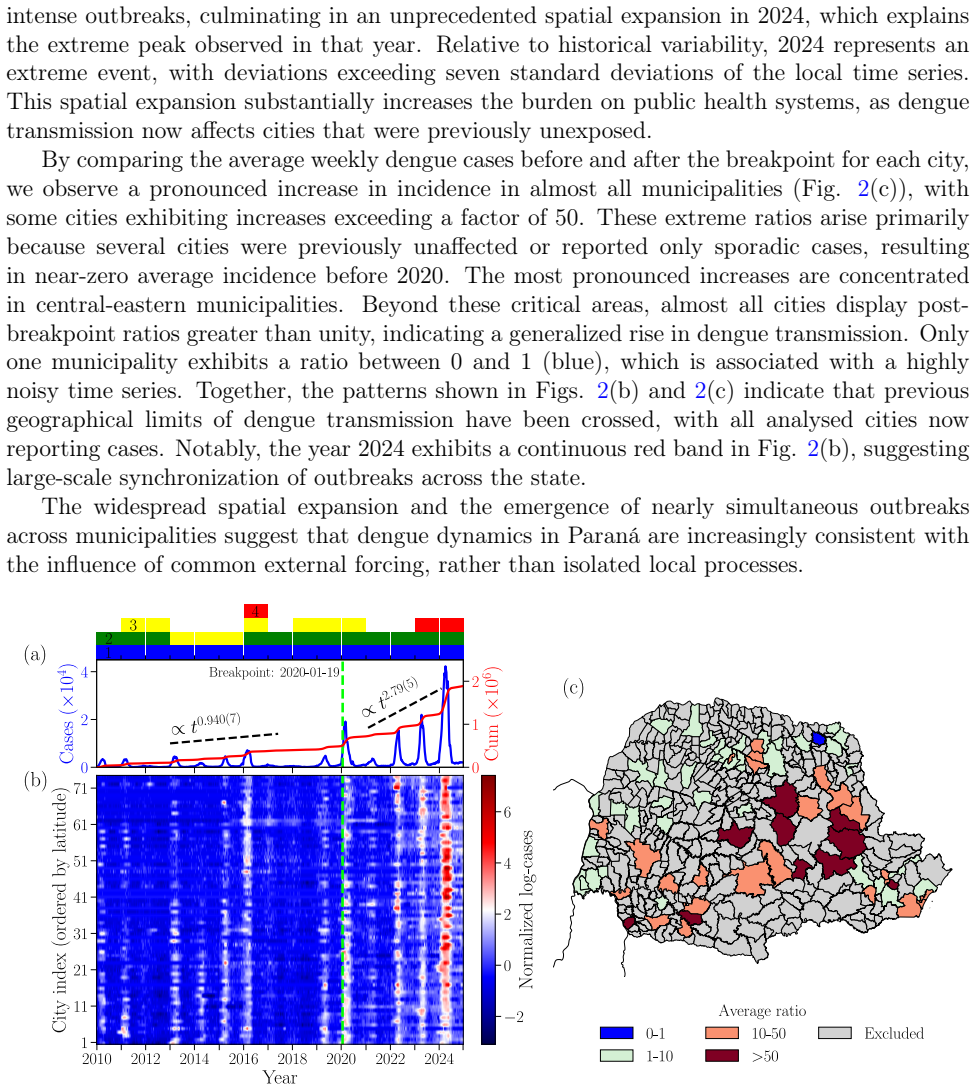
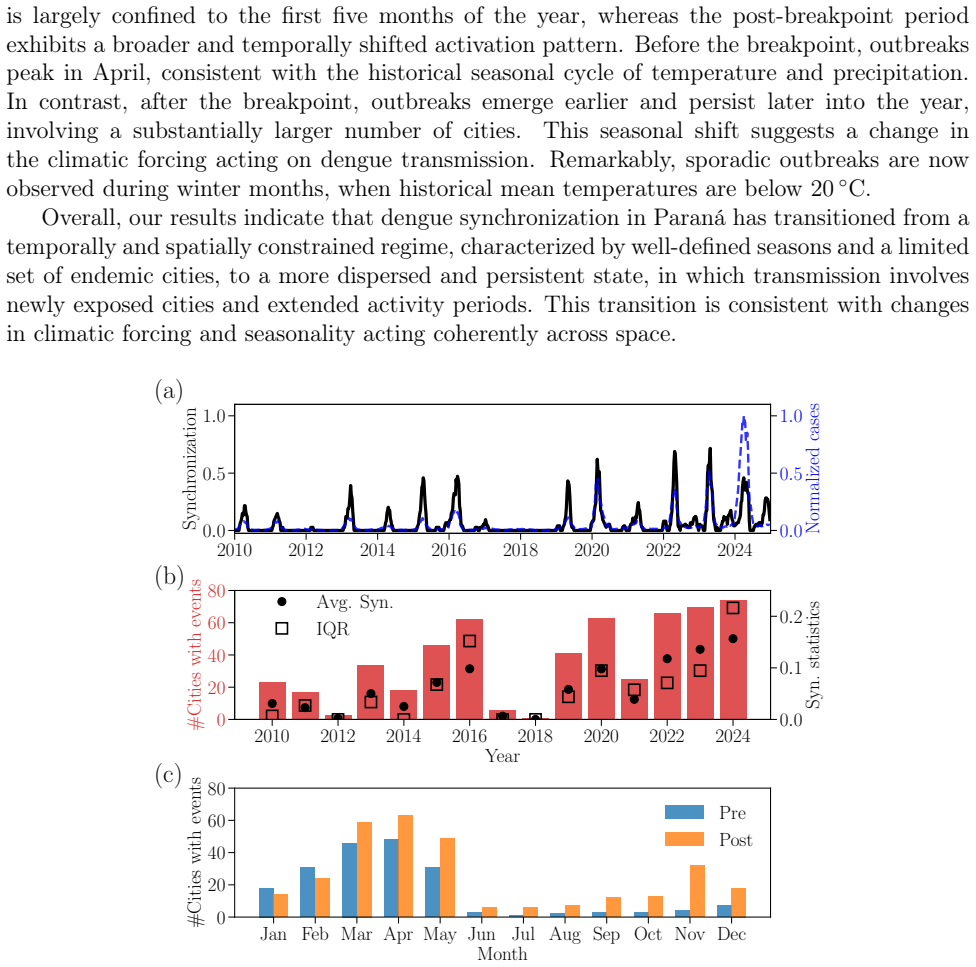
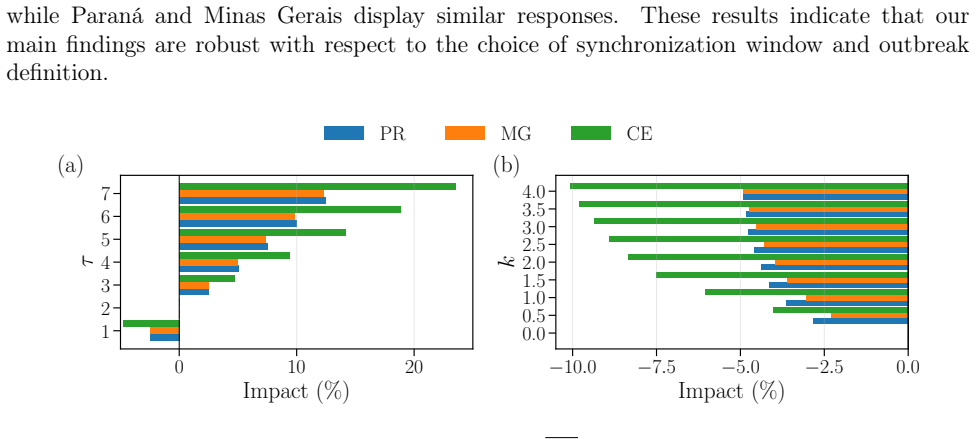
In the Paraná municipal dataset, a shift from low- to high-transmission regimes occurs together with a clear rise in outbreak synchronization. Climate anomalies increase permissive transmission days, which the analysis associates with a two-stage process: these days first reduce the probability of asynchronous states and coincide with the appearance of synchronized outbreaks, then maintain higher synchronization levels thereafter. Cross-validation in Ceará and Minas Gerais confirms that climate consistently amplifies synchronization, while the role in onset depends on local climatic regimes.
What carries the argument
The two-stage climate mechanism, in which conducive anomalies first reduce asynchronous outbreak states and then sustain higher synchronization levels, identified through Event Synchronization applied to municipal incidence time series.
If this is right
- High-transmission regimes coincide with increased outbreak coherence across cities.
- Permissive climate days are statistically linked to the emergence and maintenance of synchronized outbreaks.
- The two-stage mechanism operates across multiple Brazilian states despite differing baseline climates.
- Regional climate regimes modulate how climate influences the initial appearance of synchronization.
Where Pith is reading between the lines
- Regional surveillance systems could monitor climate anomalies to anticipate periods when outbreaks are likely to align across municipalities.
- Interventions timed to reduce transmission during permissive windows might disrupt synchronization more efficiently than uniform local efforts.
- Similar climate-driven coherence patterns could appear in other mosquito-borne diseases under comparable conditions.
Load-bearing premise
That the Event Synchronization measure on reported municipal case counts reflects genuine biological outbreak timing without being driven by differences in surveillance, population movement, or other unmeasured factors.
What would settle it
Repeating the analysis on individual-level infection records or mobility-adjusted data that removes the observed link between permissive climate days and synchronization levels would falsify the claimed association.
Figures



read the original abstract
Dengue transmission is rapidly expanding beyond its historical tropical range, raising concerns about how climate change may alter the collective dynamics of epidemics. While most studies focus on transmission risk, much less is known about how climate affects the synchronization of outbreaks. In this work, we investigate dengue synchronization using epidemiological and climate data from 74 municipalities in the state of Paran\'a (southern Brazil) between 2010 and 2024. We quantify outbreak coherence using the Event Synchronization (ES) method. Our results reveal a transition from a low-transmission regime to a high-transmission regime accompanied by a marked increase in synchronization across cities. We also show that climate anomalies increase the number of permissive days for dengue transmission. Our results suggest that such days are significantly associated with outbreak synchronization. We identify a two-stage climate mechanism: conducive climatic conditions first reduce the probability of asynchronous states and coincide with the emergence of synchronized outbreaks, and subsequently sustain higher synchronization levels. Extending the analysis through comparative analyses in Cear\'a and Minas Gerais, we uncover that climate consistently amplifies synchronization, although its role in the onset of synchronization depends on regional climatic regimes. These findings highlight climate-driven synchronization as an emerging feature shaping dengue dynamics.
Editorial analysis
A structured set of objections, weighed in public.
Referee Report
Summary. The manuscript examines dengue outbreak synchronization across 74 municipalities in Paraná, Brazil (2010–2024) using the Event Synchronization (ES) method on case time series. It reports a shift from low- to high-transmission regimes with increased inter-municipal coherence, links climate anomalies to more permissive transmission days, and proposes a two-stage mechanism in which conducive conditions first reduce asynchrony and then maintain higher synchronization levels. Cross-state comparisons in Ceará and Minas Gerais are used to assess consistency across climatic regimes.
Significance. If the associations survive controls for surveillance heterogeneity and mobility, the work would strengthen evidence that climate can shape not only local transmission risk but also the spatial coherence of dengue epidemics. The cross-state validation is a positive feature that could help distinguish regime-dependent effects, with potential relevance for early-warning systems in southern Brazil and similar expanding transmission zones.
major comments (3)
- [§3.2] §3.2 (Event Synchronization application): The central claim that ES applied to municipal case counts measures genuine biological outbreak coherence rests on the assumption that synchronization is not driven by shared reporting calendars, heterogeneous surveillance intensity, or inter-municipal population movement. No reporting-rate adjustments, mobility matrices, or sensitivity tests to threshold choices are described; this is load-bearing because spurious ES peaks can arise from these artifacts and would undermine both the synchronization metric and its climate association.
- [Results] Results section on the two-stage mechanism: The inference that climate anomalies first reduce the probability of asynchronous states and subsequently sustain synchronization is presented as a mechanistic finding, yet it is derived from temporal associations between permissive-day counts and ES values without lagged models, synthetic controls, or formal mediation analysis. The language shift from “significantly associated” to “two-stage climate mechanism” therefore requires additional identification steps to support the causal interpretation.
- [Cross-state validation] Cross-state validation section: While the extension to Ceará and Minas Gerais is useful, the manuscript does not report quantitative comparisons (e.g., effect-size differences or interaction terms) showing how the relative importance of onset versus sustenance phases varies with regional climatic regimes; the claim that “climate consistently amplifies synchronization, although its role in the onset depends on regional regimes” therefore remains qualitative.
minor comments (3)
- [Abstract] Abstract: The transition between low- and high-transmission regimes is stated without reference to the specific incidence thresholds or statistical criteria used to define the regimes.
- [Methods] Methods: Clarify whether ES was computed on raw weekly case counts or on binarized outbreak indicators, and report the exact synchronization threshold and window parameters employed.
- [Figures] Figure captions: Ensure all panels indicate the exact time window, number of municipalities, and any data exclusions applied.
Simulated Author's Rebuttal
We thank the referee for the constructive and detailed comments, which have helped us identify areas where the manuscript can be strengthened. We address each major comment below and indicate the revisions we will make.
read point-by-point responses
-
Referee: [§3.2] §3.2 (Event Synchronization application): The central claim that ES applied to municipal case counts measures genuine biological outbreak coherence rests on the assumption that synchronization is not driven by shared reporting calendars, heterogeneous surveillance intensity, or inter-municipal population movement. No reporting-rate adjustments, mobility matrices, or sensitivity tests to threshold choices are described; this is load-bearing because spurious ES peaks can arise from these artifacts and would undermine both the synchronization metric and its climate association.
Authors: We agree that potential artifacts from surveillance and mobility represent an important consideration for interpreting the ES results. The ES method follows standard implementations used in prior epidemiological synchronization studies, but we acknowledge the absence of explicit robustness checks in the current version. In the revised manuscript we will add sensitivity analyses varying the ES threshold parameters and report stability of the synchronization-climate associations. We will also expand the discussion to address surveillance heterogeneity and note that the cross-state comparisons (different reporting systems) provide partial mitigation. Comprehensive municipal-level mobility matrices for the full study period are not available, so we cannot fully adjust for movement; however, we will include a limitations paragraph on this point. revision: partial
-
Referee: [Results] Results section on the two-stage mechanism: The inference that climate anomalies first reduce the probability of asynchronous states and subsequently sustain synchronization is presented as a mechanistic finding, yet it is derived from temporal associations between permissive-day counts and ES values without lagged models, synthetic controls, or formal mediation analysis. The language shift from “significantly associated” to “two-stage climate mechanism” therefore requires additional identification steps to support the causal interpretation.
Authors: We accept that the original wording overstates the inferential strength. The two-stage description was intended to capture the observed temporal ordering (permissive-day increases preceding synchronization rises, followed by sustained levels), but we agree this does not constitute formal causal identification. In revision we will replace “two-stage climate mechanism” with “two-stage associative pattern” or equivalent phrasing throughout the results and discussion. We will also add lagged cross-correlation analyses between permissive-day counts and subsequent ES values to better document the temporal sequence. Full mediation analysis or synthetic controls lie beyond the scope of the available observational data and would require additional assumptions we cannot justify here; we will explicitly state these limits. revision: yes
-
Referee: [Cross-state validation] Cross-state validation section: While the extension to Ceará and Minas Gerais is useful, the manuscript does not report quantitative comparisons (e.g., effect-size differences or interaction terms) showing how the relative importance of onset versus sustenance phases varies with regional climatic regimes; the claim that “climate consistently amplifies synchronization, although its role in the onset depends on regional regimes” therefore remains qualitative.
Authors: We thank the referee for this observation. The cross-state extension was designed to illustrate regime dependence, but we agree that quantitative support is needed. In the revised manuscript we will report effect-size differences (e.g., Pearson correlations between permissive days and ES for onset versus sustenance phases) across the three states and include a pooled regression with state-by-phase interaction terms to test whether the onset-phase association varies significantly by climatic regime. These additions will make the comparative claim statistically grounded rather than purely qualitative. revision: yes
Circularity Check
No circularity in derivation chain; empirical associations are independent of inputs
full rationale
The paper applies the standard Event Synchronization method to raw municipal dengue case time series from Paraná (2010-2024), counts permissive climate days, and reports statistical associations plus a two-stage interpretive mechanism. No equations define synchronization in terms of climate (or vice versa), no parameters are fitted to a subset and then relabeled as predictions, and no uniqueness theorems or ansatzes are imported via self-citation to force the result. The cross-state comparisons in Ceará and Minas Gerais supply external grounding. The central claims rest on observed correlations rather than any reduction of outputs to inputs by construction, making the analysis self-contained.
Axiom & Free-Parameter Ledger
Reference graph
Works this paper leans on
-
[1]
W. H. Organization, Dengue: https://www.who.int/news-room/fact- sheets/detail/dengue-and-severe-dengue, WHO (2025). 21
2025
-
[2]
Bhatt, P
S. Bhatt, P. W. Gething, O. J. Brady, J. P. Messina, A. W. Farlow, C. L. Moyes, J. M. Drake, J. S. Brownstein, A. G. Hoen, O. Sankoh, M. F. Myers, D. B. George, T. Jaenisch, G. R. W. Wint, C. P. Simmons, T. W. Scott, J. J. Farrar, S. I. Hay, The global distribution and burden of dengue, Nature 496 (2013) 504–507
2013
-
[3]
C. P. Simmons, J. J. Farrar, N. van Vinh Chau, B. Wills, Dengue, New England Journal of Medicine 366 (15) (2012) 1423–1432
2012
-
[4]
S. A. Kularatne, C. Dalugama, Dengue infection: Global importance, immunopathology and management, Clinical Medicine 22 (1) (2022) 9–13
2022
-
[5]
M. K. Dash, S. Samal, S. Rout, C. K. Behera, M. C. Sahu, B. Das, Immunomodulation in dengue: towards deciphering dengue severity markers, Cell Communication and Signaling 33 (2024)
2024
-
[6]
M. G. Guzman, E. Harris, Dengue, Lancet 385 (2015) 453–65
2015
-
[7]
A. A. Sebayang, H. Fahlena, V. Anam, D. Knopoff, N. Stollenwerk, M. Aguiar, E. Soewono, Modeling dengue immune responses mediated by antibodies: A qualitative study, Biology 10 (9) (2021) 941
2021
-
[8]
V. Anam, B. V. Guerrero, A. K. Srivastav, N. Stollenwerk, M. Aguiar, Within-host models unravelling the dynamics of dengue reinfections, Infectious Disease Modelling 9 (2) (2024) 458–473
2024
-
[9]
Aguiar, S
M. Aguiar, S. Ballesteros, N. Stollenwerk, Two strain dengue model with temporary cross immunity and seasonality, AIP Conference Proceedings 1281 (1) (2010) 732–735
2010
-
[10]
Aguiar, B
M. Aguiar, B. Kooi, J. Martins, N. Stollenwerk, Scaling of stochasticity in dengue hemor- rhagic fever epidemics, Mathematical Modelling of Natural Phenomena 7 (3) (2012) 1–11
2012
-
[11]
Aguiar, B
M. Aguiar, B. W. Kooi, F. Rocha, P. Ghaffari, N. Stollenwerk, How much complexity is needed to describe the fluctuations observed in dengue hemorrhagic fever incidence data?, Ecological Complexity 16 (2013) 31–40
2013
-
[12]
Aguiar, N
M. Aguiar, N. Stollenwerk, Are we modelling the correct dataset? minimizing false pre- dictions for dengue fever in thailand, Epidemiology and Infection (2014).doi:10.1017/ S0950268813003348
2014
-
[13]
V. Steindorf, A. K. Srivastav, N. Stollenwerk, B. W. Kooi, M. Aguiar, Modeling secondary infections with temporary immunity and disease enhancement factor: Mechanisms for complex dynamics in simple epidemiological models, Chaos, Solitons & Fractals 164 (2022) 112709.doi:10.1016/j.chaos.2022.112709
-
[14]
Aguiar, V
M. Aguiar, V. Anam, K. B. Blyuss, C. D. S. Estadilla, B. V. Guerrero, D. Knopoff, B. W. Kooi, A. K. Srivastav, V. Steindorf, N. Stollenwerk, Mathematical models for dengue fever epidemiology: A 10-year systematic review, Physics of Life Reviews 40 (2022) 65–92
2022
-
[15]
M. Aguiar, N. Stollenwerk, S. B. Halstead, The impact of the newly licensed dengue vaccine in endemic countries, PLOS Neglected Tropical Diseases 10 (12) (2016) e0005179. doi:10.1371/journal.pntd.0005179. 22
-
[16]
M. Aguiar, Denguevaccination: amoreethical approach isneeded, The Lancet391(10135) (2018) 1769–1770.doi:10.1016/S0140-6736(18)30865-1
-
[17]
M. Aguiar, N. Stollenwerk, The impact of serotype cross-protection on vaccine trials: Denvax as a case study, Vaccines 8 (4) (2020) 674.doi:10.3390/vaccines8040674
-
[18]
A. K. Srivastav, et al., Explicit vector dynamics in a two-infection dengue model, Journal of Mathematical Biology (2026).doi:10.1007/s00285-026-02341-1
-
[19]
P. Doutor, R. Castelhano, M. C. Soares, B. V. Guerrero, N. Stollenwerk, M. Aguiar, Complex dynamics in an epidemic model with imitation-driven vaccination strategy, SIAM Journal on Applied Dynamical Systems 24 (2025).doi:10.1137/24M1703707
-
[20]
Aguiar, S
M. Aguiar, S. Ballesteros, B. W. Kooi, N. Stollenwerk, The role of seasonality and import in a minimalistic multi-strain dengue model capturing differences between primary and secondary infections: complex dynamics and its implications for data analysis, Journal of Theoretical Biology 289 (2011) 181–196
2011
-
[21]
Rocha, L
F. Rocha, L. Mateus, U. Skwara, M. Aguiar, N. Stollenwerk, Understanding dengue fever dynamics: a study of seasonality in vector-borne disease models, International Journal of Computer Mathematics 93 (8) (2014) 1405–1422
2014
-
[22]
S. T. da Silva, E. C. Gabrick, P. R. Protachevicz, K. C. Iarosz, I. L. Caldas, A. M. Batista, J. Kurths, When climate variables improve the dengue forecasting: a machine learning approach, The European Physical Journal Special Topics 234 (2025) 555–569
2025
-
[23]
Merkenschlager, F
C. Merkenschlager, F. Bangelesa, H. Paeth, E. Hertig, Evolution of the recent habitat suitability area of aedes albopictus in the extended mediterranean area due to land-use and climate change, Science of the Total Environment 974 (2025) 179202
2025
-
[24]
R. Gibb, F. J. Colón-González, P. T. Lan, P. T. Huong, V. S. Nam, V. T. Duoc, H. D. Thai, N. T. Dong, V. C. Chien, L. T. T. Trang, D. K. Quoc, T. M. Hoa, N. H. Tai, T. T. Hang, G. Tsarouchi, E. Ainscoe, Q. Harpham, B. Hofmann, D. Lumbroso, O. J. Brady, R. Lowe, Interactions between climate change, urban infrastructure and mobility are driving dengue emerg...
2023
-
[25]
N. A. M. H. Abdullah, N. C. Dom, S. A. Salleh, H. Salim, N. Precha, The association between dengue case and climate: A systematic review and meta-analysis, One Health 15 (2022) 100452
2022
-
[26]
E. A. Mordecai, J. M. Cohen, M. V. Evans, P. Gudapati, L. R. Johnson, C. A. Lippi, K. Miazgowicz, C. C. Murdock, J. R. Rohr, S. J. Ryan, V. Savage, M. S. Shocket, A. Stew- art Ibarra, M. B. Thomas, D. P. Weikel, Detecting the impact of temperature on transmis- sion of zika, dengue, and chikungunya using mechanistic models, PLOS Neglected Tropical Diseases...
2017
-
[27]
R. Lowe, A. Gasparrini, C. J. Van Meerbeeck, C. A. Lippi, R. Mahon, A. R. Trotman, L. Rollock, A. Q. J. Hinds, S. J. Ryan, A. M. Stewart-Ibarra, Nonlinear and delayed impacts of climate on dengue risk in barbados: A modelling study, PLOS Medicine 15 (2018) 1–24. 23
2018
-
[28]
Y. Liu, X. Wang, B. Tang, A novel approach to quantify the optimal range and causal effect of rainfall on vector-borne diseases: a case study of dengue epidemics available to purchase, Journal of The Royal Society Interface 22 (227) (2025) 20250029
2025
-
[29]
C. M. Benedum, O. M. E. Seidahmed, E. A. B. Eltahir, N. Markuzon, Statistical modeling of the effect of rainfall flushing on dengue transmission in singapore, PLOS Neglected Tropical Diseases 12 (2018) e0006935
2018
-
[30]
Islam, C
S. Islam, C. E. Haque, S. Hossain, K. Rochon, Role of container type, behavioural, and ecological factors in aedes pupal production in dhaka, bangladesh: An application of zero- inflated negative binomial model, Acta Tropica 193 (2019) 50–59
2019
-
[31]
European Centre for Disease Prevention and Control, World mosquito day 2025: Europe sets new records for mosquito-borne diseases, ECDC (2025)
2025
-
[32]
URLhttps://www.ecdc.europa.eu/en/dengue/surveillance-and-updates/ seasonal-surveillance-dengue-eueea-weekly
European Centre for Disease Prevention and Control, Seasonal surveillance of dengue in the eu/eea, weekly report, ECDC (2025). URLhttps://www.ecdc.europa.eu/en/dengue/surveillance-and-updates/ seasonal-surveillance-dengue-eueea-weekly
2025
-
[33]
W. M. de Souza, S. C. Weaver, Effects of climate change and human activities on vector- borne diseases, Nature Reviews Microbiology 22 (2024) 476–491
2024
-
[34]
Nakase, M
T. Nakase, M. Giovanetti, U. Obolski, J. Lourenço, Population at risk of dengue virus transmission has increased due to coupled climate factors and population growth, Com- munications Earth and Environment 5 (2024) 475
2024
-
[35]
E. L. Estallo, R. Sippy, M. A. Robert, S. Ayala, C. J. B. Pizard, P. E. Pérez-Estigarribia, A. M. Stewart-Ibarra, Increasing arbovirus risk in chile and neighboring countries in the southern cone of south america, The Lancet 23 (2023) 100542
2023
-
[36]
F. J. Colón-González, M. O. Sewe, A. M. Tompkins, H. Sjödin, A. Casallas, J. Rocklöv, C. Caminade, R. Lowe, Projecting the risk of mosquito-borne diseases in a warmer and more populated world: a multi-model, multi-scenario intercomparison modelling study, Lancet Planet Health 5 (2021) e404–14
2021
-
[37]
Stollenwerk, L
N. Stollenwerk, L. Mateus, V. Steindorf, B. V. Guerrero, R. Blasco-Aguado, A. Cevi- danes, J. B. Van-Dierdonck, M. Aguiar, Evaluating the risk of mosquito-borne diseases in non-endemic regions: A dynamic modeling approach, Mathematics and Computers in Simulation 238 (2025) 1–24
2025
-
[38]
B. V. Guerrero, V. Steindorf, R. Blasco-Aguado, L. Mateus, A. Cevidanes, J. F. Barandika, A. R. de La Peciña Pérez, J. B. Van-Dierdonck, J. A. O. Armentia, N. Stollenwerk, M. Aguiar, Assessing the spatio-temporal risk of aedes-borne arboviral diseases in non- endemic regions: The case of northern spain, PLoS Negl Trop Dis 19 (7) (2025) e0013325
2025
-
[39]
Pisaneschi, P
G. Pisaneschi, P. Manfredi, A. Landi, N. Stollenwerk, M. Aguiar, When few mosquitoes are enough: Dengue outbreaks in non-endemic areas, One Health 22 (2026) 101308
2026
-
[40]
Steindorf, H
V. Steindorf, H. M. K. B., N. Stollenwerk, A. Cevidanes, J. F. Barandika, P. Vazquez, A. L. García-Pérez, M. Aguiar, Forecasting invasive mosquito abundance in the basque country, spain using machine learning techniques, Parasites & Vectors 18 (2025) 109. 24
2025
-
[41]
R. E. Baker, A. S. Mahmud, I. F. Miller, M. Rajeev, F. Rasambainarivo, B. L. Rice, S. Takahashi, A. J. Tatem, C. E. Wagner, L.-F. Wang, A. Wesolowski, J. E. Metcalf, Infectious disease in an era of global change, Nature Reviews Microbiology 20 (2022) 193– 205
2022
-
[42]
C. J. E. Metcalf, K. S. Walter, A. Wesolowski, C. O. Buckee, E. Shevliakova, A. J. Tatem, W.R.Boos, D.M.Weinberger, V.E.Pitzer, Identifyingclimatedriversofinfectiousdisease dynamics: recent advances and challenges ahead, Proc. R. Soc. B 284 (2017) 20170901
2017
-
[43]
G. E. C. Charnley, T. Alcayna, A. Almuedo-Riera, C. Antoniou, A. Badolo, F. Bartumeus, L.-L. Boodram, R. Bueno-Marí, C. Codeço, F. C. Coelho, F. Costa, H. Cox, N. Haddad, N. A. Hamid, P. Kittayapong, G. Korukluoğlu, A. Michaelakis, R. M. de Freitas, T. Mon- talvo, J. Muñoz, S. S. Oliveras, J. R. B. Palmer, C. J. B. Pizard, G. S. Ribeiro, R. Lowe, Strength...
2025
-
[44]
Tegar, D
S. Tegar, D. P. Brass, B. V. Purse, C. A. Cobbold, S. M. White, Temperature-sensitive incubation, transmissibilityandriskofaedesalbopictus-bornechikungunyavirusineurope, Journal of The Royal Society Interface 23 (235) (2026) 20250707
2026
-
[45]
S. B. Pereira, B. C. Bohm, A. dos Reis Gomes, G. A. Gonçalves, N. C. P. Bruhn, V. S. Belo, F. Aguilera-Benavente, F. R. P. Bruhn, Emergence and spatiotemporal incidence of dengue in rio grande do sul, brazil, Scientific Reports 15 (2025) 18933
2025
-
[46]
S. J. Ryan, C. J. Carlson, E. A. Mordecai, L. R. Johnson, Global expansion and redistri- bution of aedes-borne virus transmission risk with climate change, Plos Neglected Tropical Diseases 13 (2019) e0007213
2019
-
[47]
M. U. G. Kraemer, R. C. R. Jr, O. J. Brady, J. P. Messina, M. Gilbert, D. M. Pigott, D. Yi, K. Johnson, L. Earl, L. B. Marczak, S. Shirude, N. D. Weaver, D. Bisanzio, T. A. Perkins, S. Lai, X. Lu, P. Jones, G. E. Coelho, R. G. Carvalho, W. V. Bortel, C. Marsboom, G. Hendrickx, F. Schaffner, C. G. Moore, H. H. Nax, L. Bengtsson, E. Wetter, A. J. Tatem, J. ...
2019
-
[48]
Barcellos, V
C. Barcellos, V. Matos, R. M. Lana, R. Lowe, Climate change, thermal anomalies, and the recent progression of dengue in brazil, Scientific Reports 14 (2024) 5948
2024
-
[49]
Finch, C
E. Finch, C. chen Chang, A. Kucharski, S. Sim, L.-C. Ng, R. Lowe, Climate variation and serotype competition drive dengue outbreak dynamics in singapore, Nature Communica- tions (2025)
2025
-
[50]
M. L. Childs, K. Lyberger, M. J. Harris, M. Burke, E. A. Mordecai, Climate warming is expanding dengue burden in the americas and asia, Proceedings of the National Academy of Sciences 122 (37) (2025) e2512350122
2025
-
[51]
V. M. Cox, F. C. de Melo Iani, W. Hinsley, P. S. Peixoto, F. C. Coelho, C. A. P. Ju- nior, M. O’Driscoll, N. Ferguson, S. Bhatt, N. R. Faria, I. Dorigatti, Spatiotemporal rela- tionships between extreme weather events and arbovirus transmission across brazil, eLife Sciences Publications 14 (2025) RP108289. 25
2025
-
[52]
A.Pikovsky, M.Rosenblum, J.Kurths, Synchronization: AUniversalConceptinNonlinear Sciences, Cambridge University Press, Cambridge, 2001
2001
-
[53]
Viboud, O
C. Viboud, O. N. Bjørnstad, D. L. Smith, L. Simonsen, M. A. Miller, B. T. Grenfell, Synchrony, waves, and spatial hierarchies in the spread of influenza, Science 312 (2006) 447
2006
-
[54]
M. A. J. Talia M. Quandelacy, et al., Synchronized dynamics of dengue across the americas, Science Translational Medicine 17 (2025) eadq4326
2025
-
[55]
W. G. van Panhuis, M. Choisy, X. Xiong, N. S. Chok, P. Akarasewi, S. Iamsirithaworn, S. K. Lam, C. K. Chong, F. C. Lam, B. Phommasak, P. Vongphrachanh, K. Bouaphanh, H. Rekol, N. T. Hien, P. Q. Thai, T. N. Duong, J.-H. Chuang, Y.-L. Liu, L.-C. Ng, Y. Shi, E. A. Tayag, V. G. Roque, L. L. L. Suy, R. G. Jarman, R. V. Gibbons, J. M. S. Velasco, I.-K. Yoon, D....
2015
-
[56]
Garcia-Carreras, B
B. Garcia-Carreras, B. Yang, M. K. Grabowski, L. W. Sheppard, A. T. Huang, H. Salje, H. E. Clapham, S. Iamsirithaworn, P. Doung-Ngern, J. Lessler, D. A. T. Cummings, Periodic synchronisation of dengue epidemics in thailand over the last 5 decades driven by temperature and immunity, Plos Biology 20 (2022) e3001160
2022
-
[57]
I. B. Schwartz, L. B. Shaw, D. A. T. Cummings, L. Billings, M. McCrary, D. S. Burke, Chaotic desynchronization of multistrain diseases, Physical Review E 72 (2005) 066201
2005
-
[58]
Churakov, C
M. Churakov, C. J. Villabona-Arenas, M. U. G. Kraemer, H. Salje, S. Cauchemez, Spatio- temporal dynamics of dengue in brazil: Seasonal travelling waves and determinants of regional synchrony, PLoS Negl Trop Dis 13 (2019) e0007012
2019
-
[59]
Rohani, D
P. Rohani, D. J. D. Earn, B. T. Grenfell, Opposite patterns of synchrony in sympatric disease metapopulations, Science 286 (1999) 968–971
1999
-
[60]
D. J. D. Earn, P. Rohani, B. T. Grenfell, Persistence, chaos and synchrony in ecology and epidemiology, Proceedings of the Royal Society B: Biological Sciences 265 (1390) (1998) 7–10
1998
-
[61]
J. P. Rodríguez, V. M. Eguíluz, Coupling between infectious diseases leads to synchroniza- tion of their dynamics, Chaos: An Interdisciplinary Journal of Nonlinear Science 33 (2) (2023) 021103
2023
-
[62]
D. A. Cummings, R. A. Irizarry, N. E. Huang, T. P. Endy, A. Nisalak, K. Ungchusak, D. S. Burke, Travelling waves in the occurrence of dengue haemorrhagic fever in thailand, Nature 427 (2004) 344–347
2004
-
[63]
R. Q. Quiroga, T. Kreuz, P. Grassberger, Event synchronization: A simple and fast method to measure synchronicity and time delay patterns, Physical Review E 66 (2002) 041904
2002
-
[64]
R. Q. Quiroga, A. Kraskov, Kreuz, P. Grassberger, Performance of different synchroniza- tion measures in real data: A case study on electroencephalographic signals, Physical Review E 65 (2002) 041903. 26
2002
-
[65]
Kreuz, J
T. Kreuz, J. S. Haas, A. Morelli, H. D. Abarbanel, A. Politi, Measuring spike train syn- chrony, Journal of Neuroscience Methods 165 (1) (2007) 151–161
2007
-
[66]
Pereda, R
E. Pereda, R. Q. Quiroga, J. Bhattacharya, Nonlinear multivariate analysis of neurophys- iological signals, Progress in Neurobiology 77 (1) (2005) 1–37
2005
-
[67]
Y. Tang, M. Luo, S. Wu, X. Li, Increasing synchrony of extreme heat and precipitation events under climate warming, Geophysical Research Letters 52 (2025) e2024GL113021
2025
-
[68]
Boers, B
N. Boers, B. Goswami, A. Rheinwalt, B. Bookhagen, B. Hoskins, J. Kurths, Complex net- works reveal global pattern of extreme-rainfall teleconnections, Nature 566 (2019) 373–377
2019
-
[69]
Z. Su, H. Meyerhenke, J. Kurths, The climatic interdependence of extreme-rainfall events around the globe, Chaos: An Interdisciplinary Journal of Nonlinear Science 32 (4) (2022) 043126
2022
-
[70]
C.Codeco, F.Coelho, O.Cruz, S.Oliveira, T.Castro, L.Bastos, Infodengue: Anowcasting system for the surveillance of arboviruses in brazil, Revue d’Épidémiologie et de Santé Publique 66 (2018) S386
2018
-
[71]
GOV, Boletins da dengue
P. GOV, Boletins da dengue. availabe on https://www.dengue.pr.gov.br/pagina/boletins- da-dengue, PR GOV (2025)
2025
-
[72]
IBGE, https://www.ibge.gov.br/estatisticas/sociais/saude/22827-censo-demografico- 2022.html, IBGE (2022)
2022
-
[73]
J. M. Sabater, Era5-land hourly data from 1950 to present, Copernicus Climate Change Service (C3S) Climate Data Store (CDS) (2019)
1950
-
[74]
availabe on https://www.ibge.gov.br/geociencias/organizacao- do-territorio/malhas-territoriais/, IBGE 66 (2024)
IBGE, Malha municipal. availabe on https://www.ibge.gov.br/geociencias/organizacao- do-territorio/malhas-territoriais/, IBGE 66 (2024)
2024
-
[75]
Agarwal, N
A. Agarwal, N. Marwan, M. Rathinasamy, B. Merz, J. Kurths, Multi-scale event syn- chronization analysis for unravelling climate processes: a wavelet-based approach, Nonlin. Processes Geophys. 24 (2017) 599–611
2017
-
[76]
M. T. de Almeida, D. G. S. Merighi, A. B. Visnardi, C. A. B. Gonçalves, V. M. de Fre- itas Amorim, A. S. de Almeida Ferrari, A. S. de Souza, C. R. Guzzo, Latin america’s dengue outbreak poses a global health threat, Viruses 17 (2025) 57
2025
-
[77]
C. Xu, J. Xu, L. Wang, Long-term effects of climate factors on dengue fever over a 40-year period, BMC Public Health 24 (2024) 1451
2024
-
[78]
I. V. G. Borges, A. Musah, L. M. M. Dutra, M. Tunali, C. L. Lima, M. M. Tunali, A. C. G. da Silva, A. Aldosery, G. M. M. Moreno, W. P. dos Santos, T. Massoni, O. Yenigün, P. Kostkova, R. P. da Rocha, L. C. Campos, T. Ambrizzi, Analysis of the interrelationship between precipitation and confirmed dengue cases in the city of recife (brazil) covering climate...
2025
-
[79]
E. C. Gabrick, Dengue synchronization under climate change,https://zenodo.org/ ecgabrick/dengue_synchronization_climate_change, zenodorepository.Accesson: 14 abr. 2026 (2026). 27
2026
-
[80]
E. C. Gabrick, Dengue synchronization under climate change,https://github.com/ ecgabrick/dengue_synchronization_climate_change, gitHubrepository.Accesson: 14 abr. 2026 (2026). 28
2026
discussion (0)
Sign in with ORCID, Apple, or X to comment. Anyone can read and Pith papers without signing in.