Recognition: 2 theorem links
· Lean TheoremIn-Context Credit Assignment via the Core
Pith reviewed 2026-05-11 00:48 UTC · model grok-4.3
The pith
The least core from cooperative game theory enables stable in-context credit assignment for AI-generated content using far fewer LLM calls.
A machine-rendered reading of the paper's core claim, the machinery that carries it, and where it could break.
Core claim
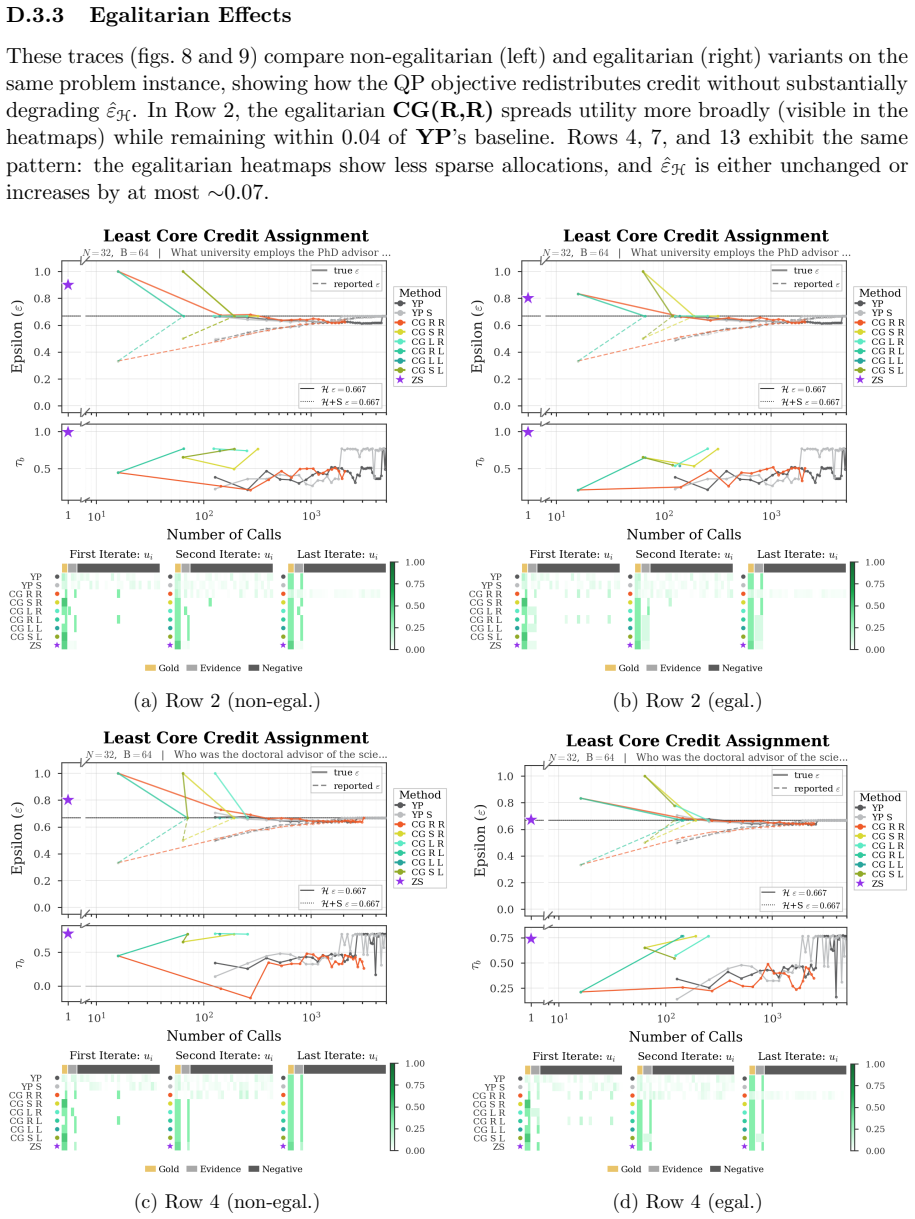
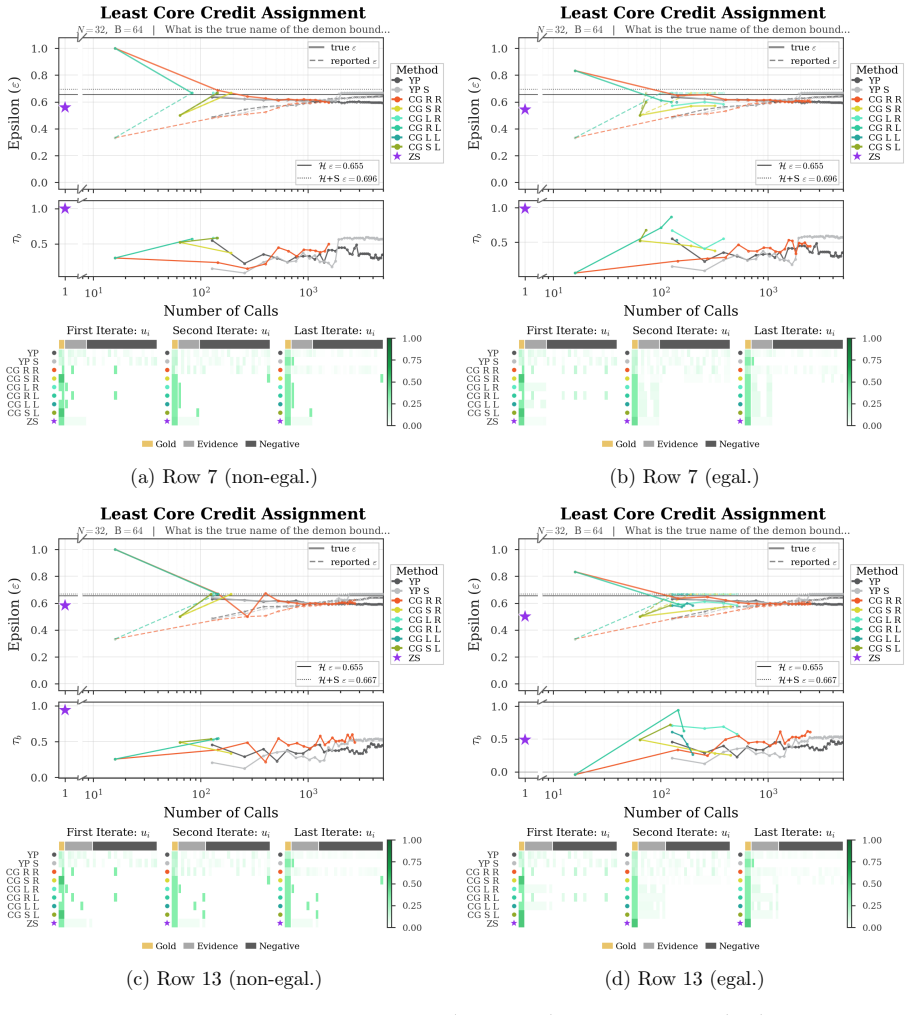
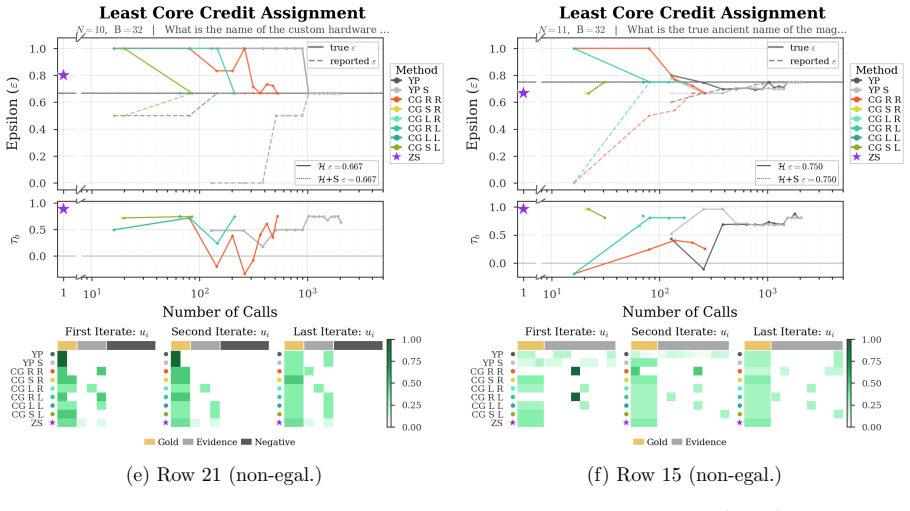
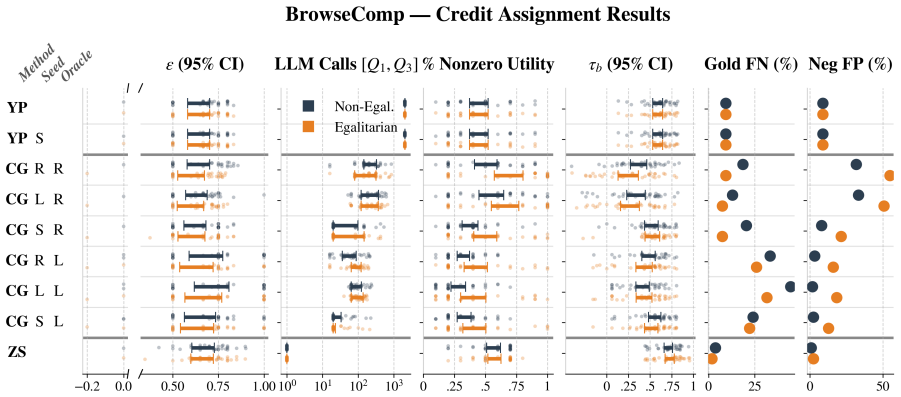
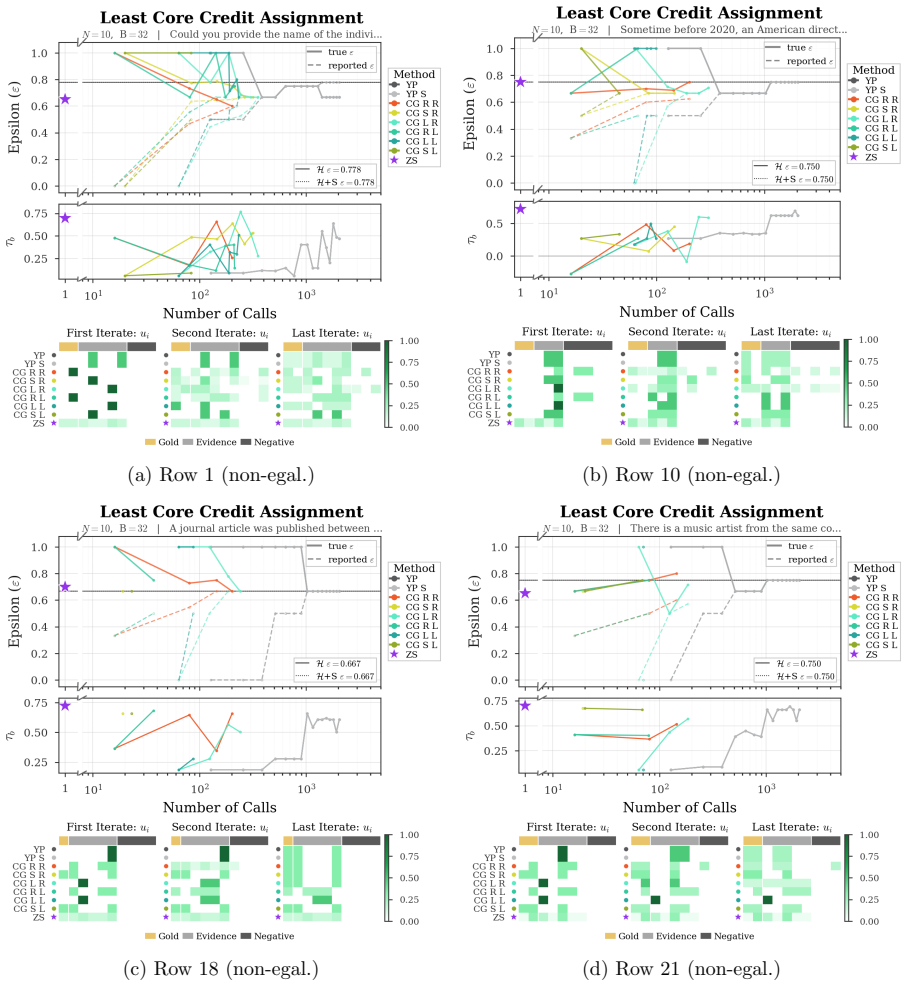
We develop algorithms for approximating the least core that leverage novel routines for constraint seeding and constraint separation. On a web retrieval credit assignment task, these approaches approximate the least core using orders of magnitude fewer LLM calls compared to alternative methods.
What carries the argument
The least core solution concept, which minimizes the maximum dissatisfaction of any coalition by distributing value such that no subset is significantly under-compensated relative to their independent generation value.
Load-bearing premise
That queries to large language models can accurately estimate the value any coalition of creators could produce on their own.
What would settle it
A direct comparison on the web retrieval task showing that the proposed algorithms do not use significantly fewer LLM calls than the alternative methods.
Figures







read the original abstract
We propose incentive-aligned mechanisms for in-context credit assignment: the task of assigning credit for AI-generated content (e.g. code, news articles, short-form videos) among creators whose intellectual property appears in the context window. Our approach is based on the least core solution concept from cooperative game theory, which distributes value in a way that is as stable as possible by ensuring that no subset of creators is significantly under-compensated relative to the value they could generate on their own. We develop algorithms for approximating the least core, which leverage novel routines for constraint seeding and constraint separation. On a web retrieval credit assignment task, we find that our approaches are capable of approximating the least core using orders of magnitude fewer LLM calls compared to alternative methods.
Editorial analysis
A structured set of objections, weighed in public.
Referee Report
Summary. The paper proposes incentive-aligned mechanisms for in-context credit assignment among creators whose intellectual property appears in an LLM context window. It applies the least core solution concept from cooperative game theory and develops algorithms based on novel constraint seeding and separation routines to approximate the least core. On a web retrieval credit assignment task, the methods are reported to approximate the least core using orders of magnitude fewer LLM calls than alternative approaches.
Significance. If the empirical results hold with proper validation, the work offers a theoretically grounded approach to a timely problem in generative AI by importing an established cooperative game theory concept without introducing free parameters. The reported efficiency gains in LLM calls could make stable credit assignment practical at scale, and the internal consistency of the LP formulation once the value oracle is granted is a positive feature.
major comments (1)
- Abstract and experimental section: the central claim that the proposed methods approximate the least core using orders of magnitude fewer LLM calls is load-bearing, yet the manuscript provides no details on the experimental setup, the precise definition of the value function, how coalition values are estimated via LLM queries, the specific baselines, number of trials, or statistical significance testing. This prevents verification of the performance claim.
Simulated Author's Rebuttal
We thank the referee for their review and for highlighting the need for greater experimental transparency. We address the single major comment below and will revise the manuscript accordingly.
read point-by-point responses
-
Referee: Abstract and experimental section: the central claim that the proposed methods approximate the least core using orders of magnitude fewer LLM calls is load-bearing, yet the manuscript provides no details on the experimental setup, the precise definition of the value function, how coalition values are estimated via LLM queries, the specific baselines, number of trials, or statistical significance testing. This prevents verification of the performance claim.
Authors: We agree that the current manuscript does not provide sufficient detail on the experimental protocol to allow independent verification of the reported efficiency gains. In the revised version we will expand the experimental section (and update the abstract if needed) to include: (i) the exact definition of the value function for the web-retrieval credit-assignment task, (ii) the procedure for estimating coalition values via LLM queries, (iii) the full list of baseline algorithms, (iv) the number of independent trials, and (v) the statistical tests used to support the “orders of magnitude” claim. These additions will make the central empirical result verifiable without altering the underlying algorithms or theoretical results. revision: yes
Circularity Check
No significant circularity detected
full rationale
The paper applies the established least core solution concept from cooperative game theory to the new domain of in-context credit assignment. The central contribution consists of algorithmic routines (constraint seeding and separation) for approximating the least core in an LP formulation, with empirical evaluation on LLM-based value oracles. No derivation step reduces by construction to the paper's own inputs, fitted parameters, or self-citations; the mathematical definition of the least core is imported as an external fact, and the performance claims concern computational efficiency rather than re-deriving the core itself.
Axiom & Free-Parameter Ledger
axioms (1)
- domain assumption The credit assignment problem can be modeled as a cooperative game with a well-defined value function for coalitions.
Lean theorems connected to this paper
-
IndisputableMonolith/Cost/FunctionalEquation.leanwashburn_uniqueness_aczel unclearthe least core solution concept from cooperative game theory... LP (2) ... constraint generation (CG) algorithm ... sampling-based separation oracle
-
IndisputableMonolith/Foundation/RealityFromDistinction.leanreality_from_one_distinction unclearTheorem 3.1 ... balanced distributions ... quantitative analog of the Bondareva-Shapley theorem
Reference graph
Works this paper leans on
-
[1]
Making AI-enhanced videos: Analyzing generative AI use cases in YouTube content creation
Torin Anderson and Shuo Niu. Making AI-enhanced videos: Analyzing generative AI use cases in YouTube content creation. InProceedings of the Extended Abstracts of the CHI Conference on Human Factors in Computing Systems, pages 1–7, 2025
2025
-
[2]
Learning cooperative games
Maria-Florina Balcan, Ariel D Procaccia, and Yair Zick. Learning cooperative games. InProceedings of the 24th International Joint Conference on Artificial Intelligence, pages 475–481, 2015. 11
2015
-
[3]
Statistical cost sharing.Advances in Neural Information Processing Systems, 30, 2017
Eric Balkanski, Umar Syed, and Sergei Vassilvitskii. Statistical cost sharing.Advances in Neural Information Processing Systems, 30, 2017
2017
-
[4]
Jopa: Explaining large language model’s generation via joint prompt attribution
Yurui Chang, Bochuan Cao, Yujia Wang, Jinghui Chen, and Lu Lin. Jopa: Explaining large language model’s generation via joint prompt attribution. InProceedings of the 63rd Annual Meeting of the Association for Computational Linguistics (Volume 1: Long Papers), pages 22106–22122, 2025
2025
-
[5]
Mingxuan Du, Benfeng Xu, Chiwei Zhu, Xiaorui Wang, and Zhendong Mao
Zijian Chen, Xueguang Ma, Shengyao Zhuang, Ping Nie, Kai Zou, Andrew Liu, Joshua Green, Kshama Patel, Ruoxi Meng, Mingyi Su, et al. BrowseComp-Plus: A more fair and transparent evaluation benchmark of deep-research agent.arXiv preprint arXiv:2508.06600, 2025
-
[6]
Con- textcite: Attributing model generation to context.Advances in Neural Information Pro- cessing Systems, 37:95764–95807, 2024
Benjamin Cohen-Wang, Harshay Shah, Kristian Georgiev, and Aleksander Madry. Con- textcite: Attributing model generation to context.Advances in Neural Information Pro- cessing Systems, 37:95764–95807, 2024
2024
-
[7]
Quadratic core-selecting payment rules for combina- torial auctions.Operations Research, 60(3):588–603, 2012
Robert W Day and Peter Cramton. Quadratic core-selecting payment rules for combina- torial auctions.Operations Research, 60(3):588–603, 2012
2012
-
[8]
Fair payments for efficient allocations in public sector combinatorial auctions.Management science, 53(9):1389–1406, 2007
Robert W Day and Subramanian Raghavan. Fair payments for efficient allocations in public sector combinatorial auctions.Management science, 53(9):1389–1406, 2007
2007
-
[9]
Improving context-attribution with semi-supervised cross-encoders.Euro- pean Conference on Artificial Intelligence (ECAI), 2025
Luca De Grandisa, Francesco Maria Granataa, Davide Costaa, Antonio Lanzaa, and Er- melinda Oroa. Improving context-attribution with semi-supervised cross-encoders.Euro- pean Conference on Artificial Intelligence (ECAI), 2025
2025
-
[10]
Springer Science & Business Media, 2006
Guy Desaulniers, Jacques Desrosiers, and Marius M Solomon.Column Generation, vol- ume 5. Springer Science & Business Media, 2006
2006
-
[11]
Approximating the core via iterative coalition sampling
Ian Gemp, Marc Lanctot, Luke Marris, Yiran Mao, Edgar Du´ e˜ nez-Guzm´ an, Sarah Perrin, Andras Gyorgy, Romuald Elie, Georgios Piliouras, Michael Kaisers, et al. Approximating the core via iterative coalition sampling. InProceedings of the 23rd International Confer- ence on Autonomous Agents and Multiagent Systems, pages 669–678, 2024
2024
-
[12]
Data Shapley: Equitable valuation of data for machine learning
Amirata Ghorbani and James Zou. Data Shapley: Equitable valuation of data for machine learning. InInternational Conference on Machine Learning, pages 2242–2251. PMLR, 2019
2019
-
[13]
Solutions to general non-zero-sum games.Contributions to the Theory of Games, 4(40):47–85, 1959
Donald B Gillies. Solutions to general non-zero-sum games.Contributions to the Theory of Games, 4(40):47–85, 1959
1959
-
[14]
Gemini 3 flash model card
Google DeepMind. Gemini 3 flash model card. Technical report, Google DeepMind, De- cember 2025. URLhttps://storage.googleapis.com/deepmind-media/Model-Cards/ Gemini-3-Flash-Model-Card.pdf. Model card
2025
-
[15]
Gemini 3 pro model card
Google DeepMind. Gemini 3 pro model card. Technical report, Google DeepMind, Novem- ber 2025. URLhttps://storage.googleapis.com/deepmind-media/Model-Cards/ Gemini-3-Pro-Model-Card.pdf. Model card
2025
-
[16]
The ellipsoid method and its consequences in combinatorial optimization.Combinatorica, 1(2):169–197, 1981
Martin Gr¨ otschel, L´ aszl´ o Lov´ asz, and Alexander Schrijver. The ellipsoid method and its consequences in combinatorial optimization.Combinatorica, 1(2):169–197, 1981
1981
-
[17]
Springer, 1988
Martin Gr¨ otschel, L´ aszl´ o Lov´ asz, and Alexander Schrijver.Geometric algorithms and com- binatorial optimization. Springer, 1988. 12
1988
-
[18]
Laquer: Localized attribution queries in content-grounded generation
Eran Hirsch, Aviv Slobodkin, David Wan, Elias Stengel-Eskin, Mohit Bansal, and Ido Da- gan. Laquer: Localized attribution queries in content-grounded generation. InProceedings of the 63rd Annual Meeting of the Association for Computational Linguistics (Volume 1: Long Papers), pages 15355–15370, 2025
2025
-
[19]
Towards efficient data valuation based on the Shapley value
Ruoxi Jia, David Dao, Boxin Wang, Frances Ann Hubis, Nick Hynes, Nezihe Merve G¨ urel, Bo Li, Ce Zhang, Dawn Song, and Costas J Spanos. Towards efficient data valuation based on the Shapley value. InThe 22nd International Conference on Artificial Intelligence and Statistics, pages 1167–1176. PMLR, 2019
2019
-
[20]
How much research is being written by large language models.Human-Centered Artificial Intelligence
P Kanna. How much research is being written by large language models.Human-Centered Artificial Intelligence. Stanford University. Retrieved August, 16, 2024
2024
-
[21]
The cutting-plane method for solving convex programs.Journal of the society for Industrial and Applied Mathematics, 8(4):703–712, 1960
James E Kelley, Jr. The cutting-plane method for solving convex programs.Journal of the society for Industrial and Applied Mathematics, 8(4):703–712, 1960
1960
-
[22]
An exact bound on epsilon for nonempti- ness of epsilon cores of games.Mathematics of Operations Research, 26(4):654–678, 2001
Alexander Kovalenkov and Myrna Holtz Wooders. An exact bound on epsilon for nonempti- ness of epsilon cores of games.Mathematics of Operations Research, 26(4):654–678, 2001
2001
-
[23]
Ruizhe Li, Chen Chen, Yuchen Hu, Yanjun Gao, Xi Wang, and Emine Yilmaz. Attributing response to context: A jensen-shannon divergence driven mechanistic study of context attribution in retrieval-augmented generation.arXiv preprint arXiv:2505.16415, 2025
-
[24]
Fengyuan Liu, Nikhil Kandpal, and Colin Raffel. Attribot: A bag of tricks for efficiently approximating leave-one-out context attribution.arXiv preprint arXiv:2411.15102, 2024
-
[25]
A unified approach to interpreting model predictions
Scott M Lundberg and Su-In Lee. A unified approach to interpreting model predictions. Advances in neural information processing systems, 30, 2017
2017
-
[26]
arXiv preprint arXiv:2507.04480 , year=
Ikhtiyor Nematov, Tarik Kalai, Elizaveta Kuzmenko, Gabriele Fugagnoli, Dimitris Sacharidis, Katja Hose, and Tomer Sagi. Source attribution in retrieval-augmented gener- ation.arXiv preprint arXiv:2507.04480, 2025
-
[27]
The fairest core in cooperative games with transferable utilities.Oper- ations Research Letters, 43(1):34–39, 2015
Tri-Dung Nguyen. The fairest core in cooperative games with transferable utilities.Oper- ations Research Letters, 43(1):34–39, 2015
2015
-
[28]
Finding the nucleoli of large cooperative games
Tri-Dung Nguyen and Lyn Thomas. Finding the nucleoli of large cooperative games. European Journal of Operational Research, 248(3):1078–1092, 2016
2016
-
[29]
Context Attribution with Multi-Armed Bandit Optimization
Deng Pan, Keerthiram Murugesan, Nuno Moniz, and Nitesh Chawla. Context attribution with multi-armed bandit optimization.arXiv preprint arXiv:2506.19977, 2025
work page internal anchor Pith review Pith/arXiv arXiv 2025
-
[30]
Sara Patel, Mingxun Zhou, and Giulia Fanti. Maxshapley: Towards incentive-compatible generative search with fair context attribution.arXiv preprint arXiv:2512.05958, 2025
-
[31]
Weakest bidder types and new core-selecting combinatorial auctions
Siddharth Prasad, Maria-Florina Balcan, and Tuomas Sandholm. Weakest bidder types and new core-selecting combinatorial auctions. InProceedings of the AAAI Conference on Artificial Intelligence, volume 40, pages 17206–17214, 2026
2026
-
[32]
Model internals-based answer attribution for trustworthy retrieval-augmented generation
Jirui Qi, Gabriele Sarti, Raquel Fern´ andez, and Arianna Bisazza. Model internals-based answer attribution for trustworthy retrieval-augmented generation. InProceedings of the 2024 Conference on Empirical Methods in Natural Language Processing, pages 6037–6053, 2024
2024
-
[33]
A value for n-person games.Contributions to the Theory of Games II, 1953
Lloyd S Shapley. A value for n-person games.Contributions to the Theory of Games II, 1953. 13
1953
-
[34]
On balanced sets and cores.Naval Research Logistics Quarterly, 14(4): 453–460, 1967
Lloyd S Shapley. On balanced sets and cores.Naval Research Logistics Quarterly, 14(4): 453–460, 1967
1967
-
[35]
Cores of convex games.International Journal of Game Theory, 1(1): 11–26, 1971
Lloyd S Shapley. Cores of convex games.International Journal of Game Theory, 1(1): 11–26, 1971
1971
-
[36]
Transparentize the internal and external knowledge utilization in llms with trustworthy citation
Jiajun Shen, Tong Zhou, Yubo Chen, Delai Qiu, Shengping Liu, Kang Liu, and Jun Zhao. Transparentize the internal and external knowledge utilization in llms with trustworthy citation. InFindings of the Association for Computational Linguistics: ACL 2025, pages 17858–17877, 2025
2025
-
[37]
pyDVL: The python library for data valuation, Mar 2025
TransferLab Team. pyDVL: The python library for data valuation, Mar 2025. URLhttps: //pydvl.org/stable/
2025
-
[38]
Data Shapley in one training run.arXiv preprint arXiv:2406.11011, 2024
Jiachen T Wang, Prateek Mittal, Dawn Song, and Ruoxi Jia. Data Shapley in one training run.arXiv preprint arXiv:2406.11011, 2024
-
[39]
In34th USENIX Security Symposium (USENIX Security 25), pages 3845–3864, 2025
Yanting Wang, Wei Zou, Runpeng Geng, and Jinyuan Jia.{TracLLM}: A generic frame- work for attributing long context{LLMs}. In34th USENIX Security Symposium (USENIX Security 25), pages 3845–3864, 2025
2025
-
[40]
The nucleolus and kernel for simple games or special valid inequalities for 0–1 linear integer programs.International Journal of Game Theory, 5(4):227–238, 1976
LA Wolsey. The nucleolus and kernel for simple games or special valid inequalities for 0–1 linear integer programs.International Journal of Game Theory, 5(4):227–238, 1976
1976
-
[41]
Tokenshapley: Token level context attribution with shapley value
Yingtai Xiao, Yuqing Zhu, Sirat Samyoun, Wanrong Zhang, Jiachen T Wang, and Jian Du. Tokenshapley: Token level context attribution with shapley value. InFindings of the Association for Computational Linguistics: ACL 2025, pages 3882–3894, 2025
2025
-
[42]
If you like Shapley then you’ll love the core
Tom Yan and Ariel D Procaccia. If you like Shapley then you’ll love the core. InProceedings of the AAAI Conference on Artificial Intelligence, volume 35, pages 5751–5759, 2021
2021
-
[43]
arXiv preprint arXiv:2509.13772 (2025)
Baolei Zhang, Haoran Xin, Yuxi Chen, Zhuqing Liu, Biao Yi, Tong Li, Lihai Nie, Zheli Liu, and Minghong Fang. Who taught the lie? responsibility attribution for poisoned knowledge in retrieval-augmented generation.arXiv preprint arXiv:2509.13772, 2025
-
[44]
X i∈S u(alg) i +ε (alg) <bv(S) # < δ, because otherwise the final oracle call would have returned a violated coalition instead of al- lowing termination. Sinceε≤bε, PS∼D
Lianmin Zheng, Wei-Lin Chiang, Ying Sheng, Siyuan Zhuang, Zhanghao Wu, Yonghao Zhuang, Zi Lin, Zhuohan Li, Dacheng Li, Eric Xing, et al. Judging llm-as-a-judge with mt-bench and chatbot arena.Advances in neural information processing systems, 36:46595– 46623, 2023. 14 A Discussion: Cooperative solution concepts The Shapley value and the core are two of th...
2023
-
[45]
Her mother was 21
Since (u 0, t0) violates t0 ≥ 1 2 ∥u0∥2 2, we have u⊤ 0 u0 −t 0 > 1 2 ∥u0∥2 2, so (u 0, t0) lies strictly outside the halfspace, which therefore separates it from the epigraph. Hence the quadratic epigraph admits an exact deterministic separation oracle. The remaining constraints are the coalition constraints X i∈S ui ≥bv(S)−ε (alg) ∀S⊆N. 18 For these, us...
discussion (0)
Sign in with ORCID, Apple, or X to comment. Anyone can read and Pith papers without signing in.