Recognition: no theorem link
Nuclear Constraints on ¹²C(α,γ)¹⁶O and Their Impact on Black-Hole Mass Predictions
Pith reviewed 2026-05-11 01:06 UTC · model grok-4.3
The pith
Updated nuclear constraints on the carbon-alpha fusion reaction place the lower edge of the first-generation black-hole mass gap at 61 to 75 solar masses.
A machine-rendered reading of the paper's core claim, the machinery that carries it, and where it could break.
Core claim
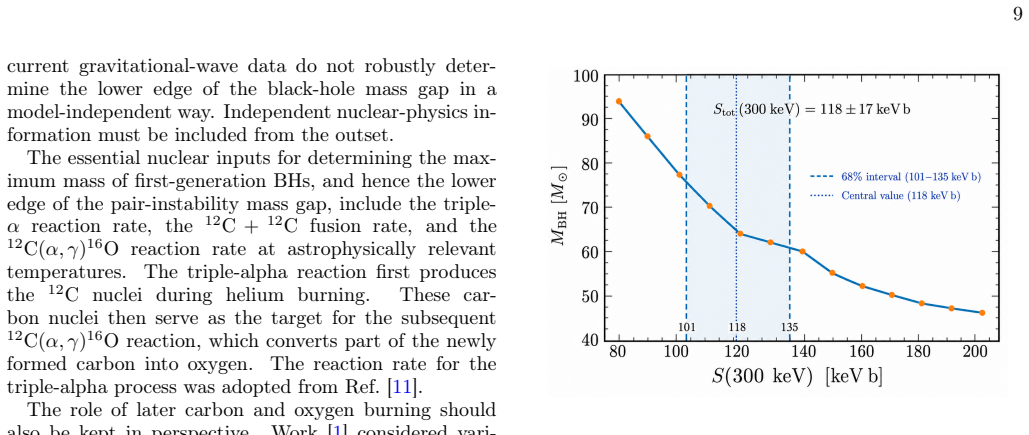
Reanalysis of the ^{12}C(α,γ)^{16}O S factor with new subthreshold and ground-state asymptotic normalization coefficients produces a constrained S(300 keV) range that, through the stellar-evolution relation between this quantity and the pair-instability mass gap, implies M_BH/M_⊙ ≃ 61–75 and therefore a relatively high lower edge for the first-generation black-hole mass gap.
What carries the argument
The asymptotic normalization coefficients (ANCs) for the subthreshold 1^{-} and 2^{+} resonances and the ground state of ^{16}O, which together determine the low-energy extrapolation of the ^{12}C(α,γ)^{16}O S factor and its mapping to the carbon-to-oxygen ratio after core helium burning.
If this is right
- The carbon-to-oxygen ratio left after core helium burning is lower, shifting the onset of pulsational pair instability to higher initial stellar masses.
- First-generation black holes formed by single-star evolution are expected to have minimum masses in the upper half of the 30–75 solar-mass window commonly considered.
- Population-synthesis models that infer S(300 keV) from gravitational-wave catalogs must be reconciled with the narrower nuclear range rather than allowing arbitrarily high values.
- The tension between nuclear constraints and some black-hole population inferences is reduced when the lower edge of the mass gap is taken near 61–75 solar masses.
Where Pith is reading between the lines
- Tighter ANC measurements at facilities that can reach lower energies would further narrow the allowed mass-gap window.
- If the stellar-evolution mapping itself depends on metallicity or rotation, the nuclear constraint would translate into a joint limit on those parameters as well.
- The result suggests that a larger fraction of observed merging black holes may originate from hierarchical mergers or from environments with different mass-loss histories than previously assumed.
- Future direct-capture experiments below 300 keV could be prioritized because they would directly test the load-bearing nuclear input.
Load-bearing premise
The mapping from a given value of S(300 keV) to a specific lower edge of the pair-instability mass gap is adopted without modification from earlier stellar-evolution calculations.
What would settle it
A new experimental determination of S(300 keV) lying outside the ANC-derived interval, or a stellar-evolution simulation that alters the functional dependence between S(300 keV) and the mass-gap edge, would falsify the reported 61–75 solar-mass range.
Figures



read the original abstract
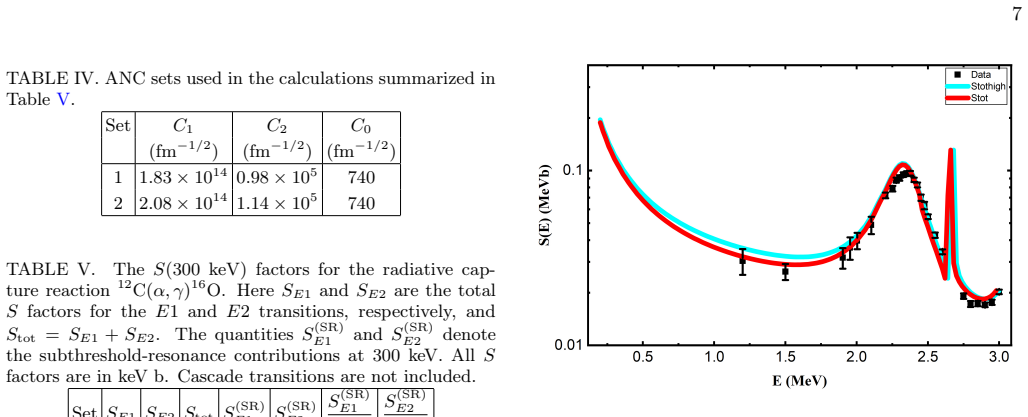
Gravitational-wave observations have renewed interest in the black-hole mass gap and in the maximum mass of first-generation black holes below its lower edge. The \(^{12}{\rm C}(\alpha,\gamma)^{16}{\rm O}\) reaction plays a central role in this problem because it determines the carbon-to-oxygen ratio after core-helium burning and thereby affects the later evolution of massive stars toward pulsational pair instability and pair-instability supernovae. Recent attempts to constrain \(S(300~{\rm keV})\) from gravitational-wave population inferences face important limitations, because the lower edge of the black-hole mass gap is not directly measured. It is inferred model dependently from assumptions about stellar evolution, metallicity, mass loss, rotation, binary evolution, hierarchical mergers, selection effects, priors, and the adopted population model. Therefore, values of \(S(300~{\rm keV})\) inferred from black-hole populations must remain consistent with independent nuclear-physics constraints. In this work we reanalyze the low-energy \(^{12}{\rm C}(\alpha,\gamma)^{16}{\rm O}\) \(S\) factor using updated information on the subthreshold \(1^{-}\) and \(2^{+}\) ANCs and on the ground-state ANC of \(^{16}{\rm O}\), together with direct capture data. These constraints favor a lower \(S(300~{\rm keV})\) than the older central evaluation and disfavor very large values required by some black-hole-population interpretations. Using the resulting ANC-constrained \(S(300~{\rm keV})\) range and the transformed relation between this quantity and the lower edge of the pair-instability mass gap, we estimate \[ \frac{M_{\rm BH}}{M_\odot}\simeq 61\text{--}75 . \] Thus, the present nuclear-physics constraints favor a relatively high lower edge of the first-generation black-hole mass gap.
Editorial analysis
A structured set of objections, weighed in public.
Referee Report
Summary. The paper reanalyzes the low-energy S-factor for the 12C(α,γ)16O reaction at 300 keV by incorporating updated subthreshold 1− and 2+ ANCs together with the ground-state ANC of 16O and direct-capture data. The resulting constraint on S(300 keV) is lower than older central values and disfavors the very large S-factors required by some gravitational-wave population interpretations. The authors then apply a pre-existing transformed relation between this S-factor and the lower edge of the pair-instability mass gap to obtain the estimate M_BH/M_⊙ ≃ 61–75, concluding that nuclear-physics constraints favor a relatively high lower edge for the first-generation black-hole mass gap.
Significance. If the nuclear reanalysis is robust, the work supplies an independent, data-driven anchor that can be compared with gravitational-wave inferences of the black-hole mass gap. It illustrates how updated ANCs can tighten the nuclear input to stellar-evolution models and thereby affect predictions for the pair-instability gap. The significance is reduced, however, by the fact that the final numerical range rests entirely on an external mapping whose systematic uncertainties are not re-examined.
major comments (1)
- [Abstract] Abstract (final paragraph) and the section presenting the transformed relation: the quoted interval M_BH/M_⊙ ≃ 61–75 is obtained by feeding the new ANC-constrained S(300 keV) range into a fixed transformation taken from prior stellar-evolution calculations. The manuscript performs no new stellar modeling and does not propagate or vary uncertainties arising from mass-loss rates, rotation, metallicity, or binary evolution; any systematic offset in that external mapping directly shifts the reported range and the claim that nuclear data favor a high lower edge.
minor comments (1)
- A table summarizing the adopted ANC values, their uncertainties, and the resulting S(300 keV) range would improve traceability of the nuclear constraint.
Simulated Author's Rebuttal
We thank the referee for the careful reading of our manuscript and the constructive feedback. We address the major comment point by point below, with proposed revisions where appropriate.
read point-by-point responses
-
Referee: [Abstract] Abstract (final paragraph) and the section presenting the transformed relation: the quoted interval M_BH/M_⊙ ≃ 61–75 is obtained by feeding the new ANC-constrained S(300 keV) range into a fixed transformation taken from prior stellar-evolution calculations. The manuscript performs no new stellar modeling and does not propagate or vary uncertainties arising from mass-loss rates, rotation, metallicity, or binary evolution; any systematic offset in that external mapping directly shifts the reported range and the claim that nuclear data favor a high lower edge.
Authors: We agree that the numerical range M_BH/M_⊙ ≃ 61–75 is obtained by applying our new ANC-constrained S(300 keV) interval to a fixed transformation taken from prior stellar-evolution work, without new modeling or explicit propagation of uncertainties in mass-loss rates, rotation, metallicity, or binary evolution. The manuscript's scope is the nuclear reanalysis of the S-factor; the transformed relation is adopted from the literature as the best available mapping at the time of submission. We will revise the abstract and the section on the transformed relation to state explicitly that the reported interval is conditional on the adopted mapping and its associated systematic uncertainties, and that variations in the listed stellar-physics parameters could shift the numerical bounds. This clarification will temper the language while preserving the independent value of the nuclear constraint, which disfavors the very large S-factors required by some population interpretations. revision: partial
Circularity Check
No significant circularity: nuclear S-factor reanalysis uses external ANC inputs; M_BH mapping is adopted from independent stellar-evolution literature.
full rationale
The paper's core derivation reanalyzes the low-energy S-factor from updated subthreshold ANCs, ground-state ANC, and direct capture data (external experimental inputs). The estimate M_BH/M_⊙ ≃ 61–75 is obtained by feeding the resulting S(300 keV) interval into a pre-existing transformed relation taken from prior stellar-evolution calculations; this mapping is not re-derived, fitted, or reduced to any quantity internal to the present manuscript. No self-definitional loops, fitted inputs renamed as predictions, load-bearing self-citations, or ansatz smuggling appear in the provided derivation chain. The nuclear-physics segment is self-contained against external benchmarks, and the astrophysical translation step remains an external application rather than a circular reduction.
Axiom & Free-Parameter Ledger
axioms (2)
- domain assumption Asymptotic normalization coefficients from subthreshold states accurately determine the low-energy tail of the 12C(alpha,gamma)16O S-factor.
- domain assumption A direct, invertible relation exists between the value of S(300 keV) and the lower edge of the pair-instability black-hole mass gap.
Reference graph
Works this paper leans on
-
[1]
2020, ApJL, 902, L36, doi: 10.3847/2041-8213/abbadd
R. Farmer, M. Renzo, S. E. de Mink, M. Fishbach, and S. Justham, Astrophys. J. Lett.902, L36 (2020). doi.org/10.3847/2041-8213/abbadd
-
[2]
S. E. Woosley and A. Heger, Astrophys. J. Lett.912, L31 (2021). doi.org/10.3847/2041-8213/abf2c4
-
[3]
A. K. Mehta, A. Buonanno, J. Gair, M. C. Miller, E. Farag, R. J. deBoer, M. Wiescher, and F. X. Timmes, Astrophys. J.924, 39 (2022). doi.org/10.3847/1538- 4357/ac3130
-
[4]
Y.-Z. Wang, Y.-J. Li, S.-J. Gao, S.-P. Tang, and Y.-Z. Fan, arXiv:2510.22698 [astro-ph.HE]. doi.org/10.48550/arXiv.2510.22698
-
[5]
H. Tonget al., arXiv:2511.05316 [astro-ph.HE]. doi.org/10.48550/arXiv.2511.05316
-
[6]
F. Antonini, I. M. Romero-Shaw, and T. Cal- lister, Phys. Rev. Lett.134, 011401 (2025). doi.org/10.1103/PhysRevLett.134.011401
-
[7]
2026, ApJL, 998, L20, doi: 10.3847/2041-8213/ae374d
A. Ray and V. Kalogera, Astrophys. J. Lett.998, L20 (2025). doi.org/10.3847/2041-8213/ae374d
-
[8]
R. J. deBoer, J. Görres, M. Wiescher, R. E. Azuma, A. Best, C. R. Brune, C. E. Fields, S. Jones, M. Pignatari, K. Smith,et al., Rev. Mod. Phys.89, 035007 (2017). doi.org/10.1103/RevModPhys.89.035007
-
[9]
Abbottet al.[LIGO Scientific and Virgo], Phys
R. Abbott, T. D. Abbott, S. Abraham, F. Acernese, K. Ackley, C. Adams, R. X. Adhikari, V. B. Adya, C. Af- feldt, M. Agathos,et al., Phys. Rev. Lett.125, 101102 (2020). doi.org/10.1103/PhysRevLett.125.101102
-
[10]
B. P. Abbott, R. Abbott, T. D. Abbott, S. Abraham, F. Acernese, K. Ackley, C. Adams, R. X. Adhikari, V. B. Adya, C. Affeldt,et al., Astrophys. J. Lett.900, L13 (2020). doi.org/10.3847/2041-8213/aba493
-
[11]
G. R. Caughlan and W. A. Fowler, At. Data Nucl. Data Tables40, 283 (1988). doi.org/10.1016/0092- 640X(88)90009-5
-
[12]
Xinet al., Res
W. Xinet al., Res. Astron. Astrophys.26, in press (2026)
2026
-
[13]
A. M. Mukhamedzhanov, R. J. deBoer, B. F. Irgaziev, L. D. Blokhintsev, A. S. Kadyrov, and D. A. Savin, Phys. Rev. C110, 055803 (2024). doi.org/10.1103/PhysRevC.110.055803
-
[14]
A. M. Mukhamedzhanov, Phys. Rev. C113, 025803 (2026). doi.org/10.1103/PhysRevC.113.025803
-
[15]
C. R. Brune, W. H. Geist, R. W. Kavanagh, and K. D. Veal, Phys. Rev. Lett.83, 4025 (1999). doi.org/10.1103/PhysRevLett.83.4025
-
[16]
M. L. Avila, G. V. Rogachev, E. Koshchiy, L. T. Baby, J. Belarge, K. W. Kemper, A. N. Kuchera, E. Uberseder, and D. Santiago-Gonzalez, Phys. Rev. Lett.114, 071101 (2015). doi.org/10.1103/PhysRevLett.114.071101
-
[17]
L. D. Blokhintsev, V. I. Kukulin, A. A. Sakharuk, D. A. Savin, and E. V. Kuznetsova, Phys. Rev. C48, 2390 (1993). doi.org/10.1103/PhysRevC.48.2390
-
[18]
C. Hebborn, M. L. Avila, K. Kravvaris, G. Potel, and S. Quaglioni, Phys. Rev. C109, L061601 (2024). doi.org/10.1103/PhysRevC.109.L061601
-
[19]
L. D. Blokhintsev, A. S. Kadyrov, A. M. Mukhamedzhanov, and D. A. Savin, Eur. Phys. J. A59, 162 (2023). doi.org/10.1140/epja/s10050-023- 01091-5
-
[20]
M. Assunção, M. Fey, A. Lefebvre-Schuhl, J. Kiener, V. Tatischeff, J. W. Hammer, C. Beck, C. Boukari-Pelissie, A. Coc, J. J. Correia,et al., Phys. Rev. C73, 055801 (2006). doi.org/10.1103/PhysRevC.73.055801
-
[21]
M. C. Morais and R. Lichtenthäler, Nucl. Phys. A857, 1 (2011). doi.org/10.1016/j.nuclphysa.2011.03.005
-
[22]
K. Kundaliaet al., Phys. Lett. B869, 139836 (2025). doi.org/10.1016/j.physletb.2025.139836
-
[23]
D. B. Sayre, C. R. Brune, D. E. Carter, D. K. Jacobs, T. N. Massey, and J. E. O’Donnell, Phys. Rev. Lett.109, 142501 (2012). doi.org/10.1103/PhysRevLett.109.142501
-
[24]
L. H. Chien and P. Descouvemont, Phys. Rev. C110, 024611 (2024). doi.org/10.1103/PhysRevC.110.024611
-
[25]
S. Adhikariet al., J. Phys. G44, 015102 (2017). doi.org/10.1088/0954-3899/44/1/015102 12
-
[26]
L. D. Blokhintsev and D. A. Savin, Phys. Atom. Nucl. 89, in press (2026)
2026
-
[27]
Y. Shen, B. Guo, R. J. deBoer, E. Li,et al., Astrophys. J.945, 41 (2023). doi.org/10.3847/1538-4357/acb7de
-
[28]
D. Schürmann, L. Gialanella, R. Kunz, and F. Strieder, Phys. Lett. B711, 35 (2012). doi.org/10.1016/j.physletb.2012.03.064
-
[29]
H. Yamaguchi, K. Sagara, K. Fujita, D. Kodama, Y. Narikiyo, K. Hamamoto, T. Ban, N. Tao, and T. Teranishi, AIP Conf. Proc.1594, 229 (2014). doi.org/10.1063/1.4874074
-
[30]
Anderset al.(LUNA Collaboration), Phys
M. Anderset al.(LUNA Collaboration), Phys. Rev. Lett.113, 042501 (2014). doi.org/10.1103/PhysRevLett.113.042501
discussion (0)
Sign in with ORCID, Apple, or X to comment. Anyone can read and Pith papers without signing in.