Recognition: 2 theorem links
· Lean TheoremSocial Theory Should Be a Structural Prior for Agentic AI: A Formal Framework for Multi-Agent Social Systems
Pith reviewed 2026-05-13 07:54 UTC · model grok-4.3
The pith
Agentic AI systems must incorporate social theory as a structural prior to model emergent behaviors in multi-agent environments.
A machine-rendered reading of the paper's core claim, the machinery that carries it, and where it could break.
Core claim
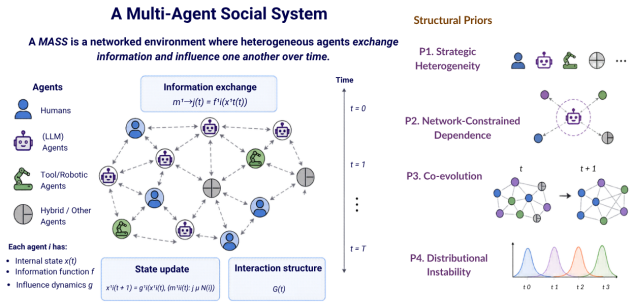
Agentic AI systems must be modeled with social theory as a structural prior, formalized as the Multi-Agent Social Systems (MASS) framework representing a dynamical system of information generation, local influence, and interaction structure, defined by four structural priors: strategic heterogeneity, networked-constrained dependence, co-evolution, and distributional instability.
What carries the argument
The MASS framework, a dynamical system class defined by information generation, local influence, and interaction structure, anchored in the four social theory priors of strategic heterogeneity, networked-constrained dependence, co-evolution, and distributional instability.
If this is right
- AI agents with these priors allow formal propositions about how individual actions generate system-level social outcomes.
- Evaluation of multi-agent AI should incorporate tests for adherence to these social structural priors.
- Governance strategies for AI systems must address co-evolution and instability to manage emergent risks.
- Modeling and simulation of AI societies should start from these priors rather than from scratch.
Where Pith is reading between the lines
- If the framework holds, AI training methods would need to enforce these priors as constraints rather than relying on post-hoc alignment techniques.
- This connects to challenges in multi-agent reinforcement learning where emergent norms often deviate from intended behaviors.
- Testable extension: Deploy MASS-constrained agents in a simulated social network and compare their interaction patterns to unconstrained agents against real human data.
Load-bearing premise
The structural priors identified from human social theory transfer directly and sufficiently to artificial agents without modification or additional AI-specific validation.
What would settle it
A controlled simulation of multi-agent AI where agents without the four social priors produce identical emergent system behaviors to those with the priors, or where the priors fail to predict observed dynamics in actual AI deployments.
Figures


read the original abstract
Agentic AI systems are increasingly deployed not in isolation, but inside social environments populated by other agents and humans, such as in social media platforms, multi-agent LLM pipelines or autonomous robotics fleets. In these settings, system behavior emerges not from individual agents alone, but from the multi-agent interactions over time. Emergent dynamics of individuals in a social group have been long studied by social scientists in human contexts. \textbf{This position paper argues that agentic AI systems must be modeled with social theory as a structural prior, and formalizes a Multi-Agent Social Systems (MASS) framework for how agents interact and influence to generate system-level outcomes.} We represent MASS as a class of dynamical system of information generation, local influence and interaction structure, formulated by four structural priors anchored in social theory: strategic heterogeneity, networked-constrained dependence, co-evolution and distributional instability. We demonstrate the importance of each structural prior through formal propositions, and articulate a research agenda for how MASS should be modeled, evaluated and governed.
Editorial analysis
A structured set of objections, weighed in public.
Referee Report
Summary. This position paper argues that agentic AI systems deployed in social environments must be modeled using social theory as a structural prior. It formalizes a Multi-Agent Social Systems (MASS) framework as a class of dynamical systems of information generation, local influence, and interaction structure, defined via four structural priors drawn from social theory (strategic heterogeneity, networked-constrained dependence, co-evolution, and distributional instability). The paper demonstrates the importance of each prior through formal propositions and outlines a research agenda for modeling, evaluation, and governance of such systems.
Significance. If the central claim holds, the MASS framework could offer a principled interdisciplinary approach to predicting emergent dynamics in multi-agent AI deployments such as social media platforms or robotic fleets, potentially improving system robustness and informing governance by importing established insights from social theory into AI design.
major comments (3)
- [Abstract] Abstract and central claim: The assertion that agentic AI systems 'must be modeled with social theory as a structural prior' is not accompanied by any argument or counterexample showing why the four priors cannot be replaced by AI-native alternatives (e.g., homogeneous rationality plus explicit communication protocols); this necessity claim is load-bearing for the thesis but remains unestablished.
- [MASS Framework] MASS framework definition: The manuscript describes MASS as a dynamical system formulated by the four priors but supplies no explicit equations, state-transition rules, or formal specification of how information generation, local influence, and interaction structure are mathematically encoded, preventing assessment of whether the priors function as structural constraints.
- [Formal Propositions] Formal propositions: The propositions are presented as demonstrating the importance of each prior, yet the text contains no derivations, proofs, or concrete examples illustrating how violation of any prior alters system-level outcomes within the claimed dynamical system.
minor comments (1)
- [Introduction] The term 'agentic AI' is used without an explicit definition distinguishing it from standard multi-agent systems; a brief clarification in the introduction would improve accessibility.
Simulated Author's Rebuttal
We thank the referee for the constructive feedback on this position paper. We clarify that the manuscript is intended as a conceptual bridge between social theory and agentic AI rather than a complete mathematical treatise, and we address each major comment by committing to targeted revisions that strengthen the arguments without altering the core thesis.
read point-by-point responses
-
Referee: [Abstract] Abstract and central claim: The assertion that agentic AI systems 'must be modeled with social theory as a structural prior' is not accompanied by any argument or counterexample showing why the four priors cannot be replaced by AI-native alternatives (e.g., homogeneous rationality plus explicit communication protocols); this necessity claim is load-bearing for the thesis but remains unestablished.
Authors: We acknowledge that the necessity claim is central and currently rests on the accumulated evidence from social science rather than explicit contrasts with AI-native alternatives. In revision we will expand the abstract and add a short subsection contrasting the four priors with homogeneous rationality plus explicit protocols, using examples such as how the latter fails to generate distributional instability or co-evolution in multi-agent LLM deployments, thereby providing the requested argument. revision: yes
-
Referee: [MASS Framework] MASS framework definition: The manuscript describes MASS as a dynamical system formulated by the four priors but supplies no explicit equations, state-transition rules, or formal specification of how information generation, local influence, and interaction structure are mathematically encoded, preventing assessment of whether the priors function as structural constraints.
Authors: As a position paper the MASS framework is introduced at a high level to emphasize the structural priors. We agree that an explicit encoding would improve evaluability. In the revised manuscript we will insert a dedicated formalization subsection that defines the state space (agent strategies, network topology, information distribution) and sketches transition rules showing how each prior constrains the dynamics. revision: yes
-
Referee: [Formal Propositions] Formal propositions: The propositions are presented as demonstrating the importance of each prior, yet the text contains no derivations, proofs, or concrete examples illustrating how violation of any prior alters system-level outcomes within the claimed dynamical system.
Authors: The propositions are currently stated as direct implications from social theory. We accept that derivations and concrete examples are missing. We will revise the propositions section to include brief logical steps for each claim together with one illustrative example per prior (e.g., violation of co-evolution in robotic fleet coordination), thereby demonstrating their effect on system-level outcomes. revision: yes
Circularity Check
No circularity in MASS framework formalization
full rationale
The paper defines the Multi-Agent Social Systems (MASS) framework explicitly as a class of dynamical system formulated by four structural priors drawn from external social theory literature (strategic heterogeneity, networked-constrained dependence, co-evolution, distributional instability). It then articulates formal propositions to demonstrate the importance of each prior. This is a standard position-paper framework construction that adopts and illustrates external concepts rather than deriving outputs that reduce to the inputs by construction. No equations, fitted parameters, self-citations, or uniqueness theorems are shown to create a closed loop; the central claim is an advocacy position for adopting these priors, supported by external literature, without self-referential reduction or renaming of known results.
Axiom & Free-Parameter Ledger
axioms (2)
- domain assumption Social theory from human contexts supplies valid structural priors for AI agent behavior
- domain assumption Strategic heterogeneity, networked-constrained dependence, co-evolution, and distributional instability are the key structural priors
invented entities (1)
-
MASS framework
no independent evidence
Lean theorems connected to this paper
-
IndisputableMonolith/Foundation/RealityFromDistinction.leanreality_from_one_distinction unclearWe represent MASS as a class of dynamical system of information generation, local influence and interaction structure, formulated by four structural priors anchored in social theory: strategic heterogeneity, networked-constrained dependence, co-evolution and distributional instability.
-
IndisputableMonolith/Cost/FunctionalEquation.leanwashburn_uniqueness_aczel unclearProposition 1 (Heterogeneity Non-Reducibility)... Proposition 4 (Non-existence of a Stationary Distribution)
Reference graph
Works this paper leans on
-
[1]
Icek Ajzen. The theory of planned behavior.Organizational behavior and human decision processes, 50(2):179–211, 1991
work page 1991
- [2]
-
[3]
Position: Llm social simulations are a promising research method
Jacy Reese Anthis, Ryan Liu, Sean M Richardson, Austin C Kozlowski, Bernard Koch, Erik Brynjolfsson, James Evans, and Michael S Bernstein. Position: Llm social simulations are a promising research method. InForty-second International Conference on Machine Learning Position Paper Track, 2025
work page 2025
-
[4]
Sinan Aral, Lev Muchnik, and Arun Sundararajan. Distinguishing influence-based contagion from homophily-driven diffusion in dynamic networks.Proceedings of the National Academy of Sciences, 106(51):21544–21549, 2009
work page 2009
-
[5]
Valentina A Assenova. Modeling the diffusion of complex innovations as a process of opinion formation through social networks.PloS one, 13(5):e0196699, 2018
work page 2018
-
[6]
Princeton university press, 1997
Robert Axelrod.The Complexity of Cooperation: Agent-Based Models of Competition and Collaboration: Agent-Based Models of Competition and Collaboration. Princeton university press, 1997
work page 1997
-
[7]
The role of social networks in information diffusion
Eytan Bakshy, Itamar Rosenn, Cameron Marlow, and Lada Adamic. The role of social networks in information diffusion. InProceedings of the 21st international conference on World Wide Web, pages 519–528, 2012
work page 2012
-
[8]
Exposure to ideologically diverse news and opinion on facebook.Science, 348(6239):1130–1132, 2015
Eytan Bakshy, Solomon Messing, and Lada A Adamic. Exposure to ideologically diverse news and opinion on facebook.Science, 348(6239):1130–1132, 2015
work page 2015
-
[9]
Albert-László Barabási. Network science.Philosophical Transactions of the Royal Society A: Mathematical, Physical and Engineering Sciences, 371(1987), 2013
work page 1987
-
[10]
Understanding incentives: Mechanism design becomes algorithm design
Yang Cai, Constantinos Daskalakis, and S Matthew Weinberg. Understanding incentives: Mechanism design becomes algorithm design. In2013 IEEE 54th Annual Symposium on Foundations of Computer Science, pages 618–627. IEEE, 2013
work page 2013
-
[11]
Donald T Campbell. Assessing the impact of planned social change.Journal of MultiDisci- plinary Evaluation, 7(15):3–43, 2011
work page 2011
-
[12]
Xuanyu Cao, Yan Chen, Chunxiao Jiang, and KJ Ray Liu. Evolutionary information diffusion over heterogeneous social networks.IEEE Transactions on Signal and Information Processing over Networks, 2(4):595–610, 2016
work page 2016
-
[13]
Kathleen Carley. An approach for relating social structure to cognitive structure.Journal of Mathematical sociology, 12(2):137–189, 1986
work page 1986
-
[14]
Kathleen M Carley. Computational modeling for reasoning about the social behavior of humans.Computational and Mathematical Organization Theory, 15(1):47–59, 2009
work page 2009
-
[15]
Kathleen M Carley. Social cybersecurity: an emerging science.Computational and mathemat- ical organization theory, 26(4):365–381, 2020. 10
work page 2020
-
[16]
Simulation of stance perturbations
Peter Carragher, Lynnette Hui Xian Ng, and Kathleen M Carley. Simulation of stance perturbations. InInternational conference on social computing, behavioral-cultural modeling and prediction and behavior representation in modeling and simulation, pages 159–168. Springer, 2023
work page 2023
-
[17]
Statistical physics of social dynamics
Claudio Castellano, Santo Fortunato, and Vittorio Loreto. Statistical physics of social dynamics. Reviews of Modern Physics, 81(2):591–646, 2009
work page 2009
-
[18]
Why Do Multi-Agent LLM Systems Fail?
Mert Cemri, Melissa Z Pan, Shuyi Yang, Lakshya A Agrawal, Bhavya Chopra, Rishabh Tiwari, Kurt Keutzer, Aditya Parameswaran, Dan Klein, Kannan Ramchandran, et al. Why do multi-agent llm systems fail?arXiv preprint arXiv:2503.13657, 2025
work page internal anchor Pith review Pith/arXiv arXiv 2025
-
[19]
The spread of behavior in an online social network experiment.science, 329 (5996):1194–1197, 2010
Damon Centola. The spread of behavior in an online social network experiment.science, 329 (5996):1194–1197, 2010
work page 2010
-
[20]
Shelly Chaiken and Alison Ledgerwood. A theory of heuristic and systematic information processing.Handbook of theories of social psychology, 1:246–266, 2012
work page 2012
-
[21]
ChatEval: Towards Better LLM-based Evaluators through Multi-Agent Debate
Chi-Min Chan, Weize Chen, Yusheng Su, Jianxuan Yu, Wei Xue, Shanghang Zhang, Jie Fu, and Zhiyuan Liu. Chateval: Towards better llm-based evaluators through multi-agent debate. arXiv preprint arXiv:2308.07201, 2023
work page internal anchor Pith review arXiv 2023
-
[22]
Nuo Chen, Yicheng Tong, Yuzhe Yang, Yufei He, Xueyi Zhang, Zou Qingyun, Qian Wang, and Bingsheng He. Diversity collapse in multi-agent llm systems: Structural coupling and collective failure in open-ended idea generation.arXiv preprint arXiv:2604.18005, 2026
work page internal anchor Pith review Pith/arXiv arXiv 2026
-
[23]
Examining identity drift in conversations of llm agents.arXiv preprint arXiv:2412.00804, 2024
Junhyuk Choi, Yeseon Hong, Minju Kim, and Bugeun Kim. Examining identity drift in conversations of llm agents.arXiv preprint arXiv:2412.00804, 2024
-
[24]
Sujin Choi. The two-step flow of communication in twitter-based public forums.Social science computer review, 33(6):696–711, 2015
work page 2015
-
[25]
Paul F Christiano, Jan Leike, Tom Brown, Miljan Martic, Shane Legg, and Dario Amodei. Deep reinforcement learning from human preferences.Advances in neural information processing systems, 30, 2017
work page 2017
-
[26]
Simulating opinion dynamics with networks of llm-based agents
Yun-Shiuan Chuang, Agam Goyal, Nikunj Harlalka, Siddharth Suresh, Robert Hawkins, Sijia Yang, Dhavan Shah, Junjie Hu, and Timothy Rogers. Simulating opinion dynamics with networks of llm-based agents. InFindings of the association for computational linguistics: NAACL 2024, pages 3326–3346, 2024
work page 2024
-
[27]
Renita Coleman, Maxwell McCombs, Donald Shaw, and David Weaver. Agenda setting. In The handbook of journalism studies, pages 167–180. Routledge, 2009
work page 2009
-
[28]
Reaching a consensus.Journal of the American Statistical association, 69 (345):118–121, 1974
Morris H DeGroot. Reaching a consensus.Journal of the American Statistical association, 69 (345):118–121, 1974
work page 1974
-
[29]
Improv- ing factuality and reasoning in language models through multiagent debate
Yilun Du, Shuang Li, Antonio Torralba, Joshua B Tenenbaum, and Igor Mordatch. Improv- ing factuality and reasoning in language models through multiagent debate. InForty-first international conference on machine learning, 2024
work page 2024
-
[30]
Jinglong Duan, Weihua Li, Quan Bai, Minh Nguyen, Xiaodan Wang, and Jianhua Jiang. Llm-botguard: A novel framework for detecting llm-driven bots with mixture of experts and graph neural networks.IEEE Transactions on Computational Social Systems, 2025
work page 2025
-
[31]
Yuri Dunaiev and Menusch Khadjavi. Collective honesty? experimental evidence on the effectiveness of honesty nudging for teams.Frontiers in Psychology, 12:684755, 2021
work page 2021
-
[32]
Social role theory.Handbook of theories of social psychology, 2(9):458–476, 2012
Alice H Eagly and Wendy Wood. Social role theory.Handbook of theories of social psychology, 2(9):458–476, 2012
work page 2012
-
[33]
Emilio Ferrara and Zeyao Yang. Quantifying the effect of sentiment on information diffusion in social media.PeerJ Computer Science, 1:e26, 2015. 11
work page 2015
-
[34]
Camille Francois, Vladimir Barash, and John Kelly. Measuring coordinated versus spontaneous activity in online social movements.New Media & Society, 25(11):3065–3092, 2023
work page 2023
-
[35]
Social positions in influence networks.Social networks, 19(3):209–222, 1997
Noah E Friedkin and Eugene C Johnsen. Social positions in influence networks.Social networks, 19(3):209–222, 1997
work page 1997
-
[36]
Paolo Gerbaudo. Tiktok and the algorithmic transformation of social media publics: From social networks to social interest clusters.New Media & Society, 28(3):1019–1036, 2026
work page 2026
-
[37]
Structuration theory: past, present and future
Anthony Giddens. Structuration theory: past, present and future. InGiddens’ theory of structuration, pages 201–221. Routledge, 2014
work page 2014
-
[38]
Threshold models of collective behavior.American journal of sociology, 83(6):1420–1443, 1978
Mark Granovetter. Threshold models of collective behavior.American journal of sociology, 83(6):1420–1443, 1978
work page 1978
-
[39]
Economic action and social structure: The problem of embeddedness
Mark Granovetter. Economic action and social structure: The problem of embeddedness. American journal of sociology, 91(3):481–510, 1985
work page 1985
-
[40]
The strength of weak ties.American journal of sociology, 78(6): 1360–1380, 1973
Mark S Granovetter. The strength of weak ties.American journal of sociology, 78(6): 1360–1380, 1973
work page 1973
-
[41]
Douglas Guilbeault and Damon Centola. Topological measures for identifying and predicting the spread of complex contagions.Nature communications, 12(1):4430, 2021
work page 2021
-
[42]
Rainer Hegselmann and Ulrich Krause. Opinion dynamics and bounded confidence models, analysis, and simulation.Journal of Artificial Societies and Social Simulation, 5(3), 2002
work page 2002
-
[43]
Measuring Massive Multitask Language Understanding
Dan Hendrycks, Collin Burns, Steven Basart, Andy Zou, Mantas Mazeika, Dawn Song, and Jacob Steinhardt. Measuring massive multitask language understanding.arXiv preprint arXiv:2009.03300, 2020
work page internal anchor Pith review Pith/arXiv arXiv 2009
-
[44]
Modeling information access in construct
Brian Hirshman, Michael K Martin, and Kathleen M Carley. Modeling information access in construct. Technical report, Technical report, Carnegie Mellon University School of Computer Science, 2008
work page 2008
-
[45]
Metagpt: Meta programming for a multi-agent collaborative framework
Sirui Hong, Mingchen Zhuge, Jonathan Chen, Xiawu Zheng, Yuheng Cheng, Jinlin Wang, Ceyao Zhang, Zili Wang, Steven Ka Shing Yau, Zijuan Lin, et al. Metagpt: Meta programming for a multi-agent collaborative framework. InThe twelfth international conference on learning representations, 2023
work page 2023
-
[46]
Evolution of social norms in llm agents using natural language.arXiv preprint arXiv:2409.00993, 2024
Ilya Horiguchi, Takahide Yoshida, and Takashi Ikegami. Evolution of social norms in llm agents using natural language.arXiv preprint arXiv:2409.00993, 2024
-
[47]
Nomiclaw: Emergent trust and strategic argumentation in llms during collaborative law-making
Asutosh Hota and Jussi PP Jokinen. Nomiclaw: Emergent trust and strategic argumentation in llms during collaborative law-making. InProceedings of the AAAI/ACM Conference on AI, Ethics, and Society, volume 8, pages 1278–1289, 2025
work page 2025
-
[48]
Simulating rumor spreading in social networks using llm agents.arXiv preprint arXiv:2502.01450, 2025
Tianrui Hu, Dimitrios Liakopoulos, Xiwen Wei, Radu Marculescu, and Neeraja J Yad- wadkar. Simulating rumor spreading in social networks using llm agents.arXiv preprint arXiv:2502.01450, 2025
-
[49]
Tracking china’s cross-strait bot networks against taiwan
Charity S Jacobs, Lynnette Hui Xian Ng, and Kathleen M Carley. Tracking china’s cross-strait bot networks against taiwan. InInternational conference on social computing, behavioral- cultural modeling and prediction and behavior representation in modeling and simulation, pages 115–125. Springer, 2023
work page 2023
-
[50]
SWE-bench: Can Language Models Resolve Real-World GitHub Issues?
Carlos E Jimenez, John Yang, Alexander Wettig, Shunyu Yao, Kexin Pei, Ofir Press, and Karthik Narasimhan. Swe-bench: Can language models resolve real-world github issues? arXiv preprint arXiv:2310.06770, 2023
work page internal anchor Pith review Pith/arXiv arXiv 2023
-
[51]
Habermas on strategic and communicative action.Political theory, 19(2): 181–201, 1991
James Johnson. Habermas on strategic and communicative action.Political theory, 19(2): 181–201, 1991. 12
work page 1991
-
[52]
Tuja Khaund, Baris Kirdemir, Nitin Agarwal, Huan Liu, and Fred Morstatter. Social bots and their coordination during online campaigns: a survey.IEEE Transactions on Computational Social Systems, 9(2):530–545, 2021
work page 2021
-
[53]
Semi-Supervised Classification with Graph Convolutional Networks
Thomas N Kipf and Max Welling. Semi-supervised classification with graph convolutional networks.arXiv preprint arXiv:1609.02907, 2016
work page internal anchor Pith review Pith/arXiv arXiv 2016
-
[54]
Dezhang Kong, Shi Lin, Zhenhua Xu, Zhebo Wang, Minghao Li, Yufeng Li, Yilun Zhang, Hujin Peng, Xiang Chen, Zeyang Sha, et al. A survey of llm-driven ai agent communication: Protocols, security risks, and defense countermeasures.arXiv preprint arXiv:2506.19676, 2025
-
[55]
Deuksin Kwon, Kaleen Shrestha, Bin Han, Elena Hayoung Lee, and Gale Lucas. Evaluating behavioral alignment in conflict dialogue: A multi-dimensional comparison of llm agents and humans. InProceedings of the 2025 Conference on Empirical Methods in Natural Language Processing, pages 16377–16391, 2025
work page 2025
-
[56]
Large language models miss the multi-agent mark
Emanuele La Malfa, Gabriele La Malfa, Samuele Marro, Jie M Zhang, Elizabeth Black, Michael Luck, Philip Torr, and Michael Wooldridge. Large language models miss the multi- agent mark.arXiv preprint arXiv:2505.21298, 2025
-
[57]
The “panel” as a new tool for measuring opinion.Public Opinion Quarterly, 2(4):596–612, 1938
Paul Lazarsfeld and Marjorie Fiske. The “panel” as a new tool for measuring opinion.Public Opinion Quarterly, 2(4):596–612, 1938
work page 1938
-
[58]
Paul F Lazarsfeld. The logical and mathematical foundation of latent structure analysis.Studies in social psychology in world war II Vol. IV: Measurement and prediction, pages 362–412, 1950
work page 1950
-
[59]
Llm generated persona is a promise with a catch
Ang Li, Haozhe Chen, Hongseok Namkoong, and Tianyi Peng. Llm generated persona is a promise with a catch. InThe Thirty-Ninth Annual Conference on Neural Information Processing Systems Position Paper Track
-
[60]
Guohao Li, Hasan Hammoud, Hani Itani, Dmitrii Khizbullin, and Bernard Ghanem. Camel: Communicative agents for" mind" exploration of large language model society.Advances in neural information processing systems, 36:51991–52008, 2023
work page 2023
-
[61]
Does socialization emerge in AI agent society? A case study of Moltbook
Ming Li, Xirui Li, and Tianyi Zhou. Does socialization emerge in ai agent society? a case study of moltbook.arXiv preprint arXiv:2602.14299, 2026
-
[62]
Wenkai Li, Lynnette Hui Xian Ng, Andy Liu, and Daniel Fried. Measuring fine-grained negotiation tactics of humans and llms in diplomacy.arXiv preprint arXiv:2512.18292, 2025
-
[63]
Individual and shared meanings.Research on Language & Social Interaction, 10(3-4):341–373, 1977
Bonnie Litowitz. Individual and shared meanings.Research on Language & Social Interaction, 10(3-4):341–373, 1977
work page 1977
-
[64]
AgentBench: Evaluating LLMs as Agents
Xiao Liu, Hao Yu, Hanchen Zhang, Yifan Xu, Xuanyu Lei, Hanyu Lai, Yu Gu, Hangliang Ding, Kaiwen Men, Kejuan Yang, et al. Agentbench: Evaluating llms as agents.arXiv preprint arXiv:2308.03688, 2023
work page internal anchor Pith review Pith/arXiv arXiv 2023
-
[65]
Network studies of social influence.Sociological Methods & Research, 22(1):127–151, 1993
Peter V Marsden and Noah E Friedkin. Network studies of social influence.Sociological Methods & Research, 22(1):127–151, 1993
work page 1993
-
[66]
Tula Masterman, Sandi Besen, Mason Sawtell, and Alex Chao. The landscape of emerging ai agent architectures for reasoning, planning, and tool calling: A survey.arXiv preprint arXiv:2404.11584, 2024
-
[67]
The agenda-setting function of mass media.Public opinion quarterly, 36(2):176–187, 1972
Maxwell E McCombs and Donald L Shaw. The agenda-setting function of mass media.Public opinion quarterly, 36(2):176–187, 1972
work page 1972
-
[68]
The role-set: Problems in sociological theory.The British journal of sociology, 8(2):106–120, 1957
Robert K Merton. The role-set: Problems in sociological theory.The British journal of sociology, 8(2):106–120, 1957
work page 1957
-
[69]
Shaila M Miranda and Carol S Saunders. The social construction of meaning: An alternative perspective on information sharing.Information systems research, 14(1):87–106, 2003. 13
work page 2003
- [70]
-
[71]
Isabel Murdock, Kathleen M Carley, and Osman Ya ˘gan. Identifying cross-platform user relationships in 2020 us election fraud and protest discussions.Online Social Networks and Media, 33:100245, 2023
work page 2020
-
[72]
Lynnette Hui Xian Ng and Kathleen M Carley. Pro or anti? a social influence model of online stance flipping.IEEE Transactions on Network Science and Engineering, 10(1):3–19, 2022
work page 2022
-
[73]
Lynnette Hui Xian Ng and Kathleen M Carley. A combined synchronization index for evaluating collective action social media.Applied network science, 8(1):1, 2023
work page 2023
-
[74]
Lynnette Hui Xian Ng and Kathleen M Carley. A global comparison of social media bot and human characteristics.Scientific Reports, 15(1):10973, 2025
work page 2025
-
[75]
Lynnette Hui Xian Ng and Iain J Cruickshank. Recruitment promotion via twitter: a network- centric approach of analyzing community engagement using social identity.Digital Govern- ment: Research and Practice, 4(4):1–17, 2023
work page 2023
-
[76]
Building bridges between users and content across multiple platforms during natural disasters
Lynnette Hui Xian Ng, Iain J Cruickshank, and David Farr. Building bridges between users and content across multiple platforms during natural disasters. InProceedings of the 17th ACM Web Science Conference 2025, pages 499–503, 2025
work page 2025
-
[77]
Aurasight: generating realistic social media data.arXiv preprint arXiv:2509.08927, 2025
Lynnette Hui Xian Ng, Bianca NY Kang, and Kathleen M Carley. Aurasight: generating realistic social media data.arXiv preprint arXiv:2509.08927, 2025
-
[78]
Hiroko Oe and Junkichi Mochizuki. An examination of nudge policy through the lens of" the enormous turnip": Fostering collective action and persistence.International Journal of Academic Research in Progressive Education and Development, 14(2):1746–1772, 2025
work page 2025
-
[79]
Cambridge university press, 1990
Elinor Ostrom.Governing the commons: The evolution of institutions for collective action. Cambridge university press, 1990
work page 1990
-
[80]
Jarkko Paavola, Tuomo Helo, Harri Jalonen, Miika Sartonen, and Aki-Mauri Huhtinen. Under- standing the trolling phenomenon: The automated detection of bots and cyborgs in the social media.Journal of Information Warfare, 15(4):100–111, 2016
work page 2016
discussion (0)
Sign in with ORCID, Apple, or X to comment. Anyone can read and Pith papers without signing in.