Recognition: 2 theorem links
· Lean TheoremRegion4Web: Rethinking Observation Space Granularity for Web Agents
Pith reviewed 2026-05-11 02:07 UTC · model grok-4.3
The pith
Web agents achieve higher task success with shorter observations by using functional regions instead of element-level details.
A machine-rendered reading of the paper's core claim, the machinery that carries it, and where it could break.
Core claim
Reorganizing the AXTree into functional regions through hierarchical decomposition and semantic abstraction exposes the page's functional organization as a more compact and informative basis for the actor agent than element-level signals, and PageDigest supplies this region-level view as a persistent per-page digest that improves task success rates on WebArena while reducing observation length across diverse LLMs and established agent methods.
What carries the argument
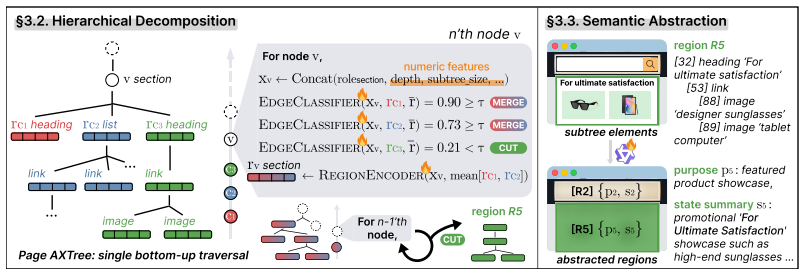
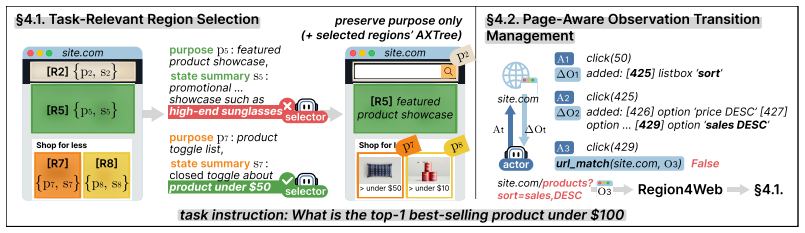
Region4Web framework that hierarchically decomposes and semantically abstracts the AXTree into functional regions, delivered via PageDigest as a compact per-page inference pipeline that persists across agent steps.
Load-bearing premise
The hierarchical decomposition and semantic abstraction of the AXTree into functional regions accurately captures each page's functional organization and supplies a strictly more useful signal to the agent than element-level observations.
What would settle it
An experiment on WebArena tasks that keeps the same agents and LLMs but swaps PageDigest for standard element-level AXTree observations and measures whether success rates stay the same or fall.
Figures




read the original abstract
Web agents perceive web pages through an observation space, yet its granularity has remained an underexamined design choice. Existing work treats observation at the same element-level granularity as the action space, leaving the page's functional organization implicit and forcing the agent to infer it from element-level signals at every step. We argue observation should instead operate at the granularity of functional regions, parts of the page that each serve a distinct purpose. We propose Region4Web, a framework that reorganizes the AXTree into functional regions through hierarchical decomposition and semantic abstraction, exposing the page's functional organization as the basis for page state understanding. Moreover, we propose PageDigest, a web-specific inference pipeline that delivers this region-level observation to the actor agent as a compact per-page digest that persists across steps. On the WebArena benchmark, PageDigest substantially reduces observation length while improving overall task success rate across diverse backbone large language models (LLMs) and established agent methods, regardless of backbone capacity. These results show that operating at the granularity of functional regions delivers a more compact and informative basis for the actor agent than element-level processing alone.
Editorial analysis
A structured set of objections, weighed in public.
Referee Report
Summary. The paper argues that web agents should perceive pages at the granularity of functional regions rather than element-level signals from the AXTree. It introduces Region4Web, which performs hierarchical decomposition and semantic abstraction to expose functional organization, and implements this via the PageDigest pipeline that supplies a compact, persistent per-page digest to the actor. On WebArena, the authors report that PageDigest reduces observation length while raising task success rates across multiple LLMs and agent frameworks, independent of backbone capacity.
Significance. If the empirical results are robust, the work supplies concrete evidence that observation-space granularity is an under-optimized design axis for web agents. By making the page’s functional organization explicit rather than implicit, the approach could improve both efficiency and reliability of LLM-based web navigation, with potential transfer to other structured environments that possess accessibility trees.
major comments (3)
- [Experimental Evaluation] Experimental section: the abstract states clear gains in success rate and observation length, yet supplies no information on the number of evaluation runs, statistical significance tests, variance across seeds, or the precise baseline implementations (including how element-level AXTree observations were formatted and tokenized for the same agent scaffolds). Without these controls the data-to-claim link cannot be verified.
- [Region4Web Framework] Method (hierarchical decomposition and semantic abstraction): the central claim requires that the region-level digest is strictly more informative than raw element-level signals. The manuscript does not describe safeguards against loss of task-critical details (labels, states, inter-element relationships) when the LLM-based semantic inference step misclassifies or elides elements on JavaScript-heavy or non-standard WebArena pages.
- [Results] Results analysis: the claim that gains hold “regardless of backbone capacity” is load-bearing for the generality argument, yet no capacity-stratified breakdown, ablation on model scale, or per-task error analysis is provided to support it.
minor comments (2)
- [Abstract] The abstract introduces “PageDigest” and “functional regions” without a one-sentence definition; a brief parenthetical gloss would aid readers.
- [Method] Notation for the AXTree regions and the digest format should be introduced once with a small illustrative figure or table early in the method section.
Simulated Author's Rebuttal
We thank the referee for the constructive feedback, which helps improve the clarity and rigor of our work on observation granularity for web agents. We address each major comment below and have updated the manuscript to incorporate the suggested details and analyses.
read point-by-point responses
-
Referee: [Experimental Evaluation] Experimental section: the abstract states clear gains in success rate and observation length, yet supplies no information on the number of evaluation runs, statistical significance tests, variance across seeds, or the precise baseline implementations (including how element-level AXTree observations were formatted and tokenized for the same agent scaffolds). Without these controls the data-to-claim link cannot be verified.
Authors: We agree these experimental controls are necessary for verifying the claims. In the revised manuscript, we have added a new subsection under Experiments detailing the protocol: all results are averaged over 5 independent runs with distinct random seeds, reporting mean success rates and observation lengths along with standard deviations. We include paired t-tests confirming statistical significance (p < 0.05) for the reported gains. We also specify the exact formatting and tokenization of element-level AXTree baselines to match the agent scaffolds used with PageDigest, ensuring direct comparability. revision: yes
-
Referee: [Region4Web Framework] Method (hierarchical decomposition and semantic abstraction): the central claim requires that the region-level digest is strictly more informative than raw element-level signals. The manuscript does not describe safeguards against loss of task-critical details (labels, states, inter-element relationships) when the LLM-based semantic inference step misclassifies or elides elements on JavaScript-heavy or non-standard WebArena pages.
Authors: This is a valid concern for the semantic abstraction step. The revised Method section now explicitly describes safeguards: the hierarchical decomposition preserves the complete AXTree (including all labels, states, and relationships) prior to abstraction; the PageDigest pipeline includes a conservative prompting strategy that prioritizes retention of task-critical attributes; and we added an analysis of potential misclassifications on JavaScript-heavy WebArena pages, showing that critical elements are rarely elided and providing concrete examples of how the digest handles non-standard structures without information loss for navigation tasks. revision: yes
-
Referee: [Results] Results analysis: the claim that gains hold “regardless of backbone capacity” is load-bearing for the generality argument, yet no capacity-stratified breakdown, ablation on model scale, or per-task error analysis is provided to support it.
Authors: We acknowledge that the generality claim benefits from explicit stratification. The revised Results section includes a new table and figure providing capacity-stratified breakdowns across model scales (small: <10B, medium: 10-30B, large: >30B parameters) for the tested LLMs, demonstrating consistent improvements independent of backbone size. We also added a per-task error analysis categorizing failure modes (e.g., navigation vs. form-filling errors) and showing how region-level observations reduce specific error types across scales. revision: yes
Circularity Check
No circularity: empirical validation on external benchmark with no self-referential derivations
full rationale
The paper introduces Region4Web and PageDigest as a framework for reorganizing AXTree into functional regions via hierarchical decomposition and semantic abstraction, then reports empirical gains in observation length and task success on the WebArena benchmark across LLMs and agent methods. No equations, fitted parameters, or first-principles derivations are claimed. The central result is an observed performance delta on an external benchmark, not a quantity reduced to its own inputs by construction. No self-citations are invoked as load-bearing uniqueness theorems or ansatzes. The derivation chain is self-contained as a proposal plus independent evaluation.
Axiom & Free-Parameter Ledger
Lean theorems connected to this paper
-
IndisputableMonolith/Foundation/AbsoluteFloorClosure.leanreality_from_one_distinction unclear?
unclearRelation between the paper passage and the cited Recognition theorem.
Region4Web, a framework that reorganizes the AXTree into functional regions through hierarchical decomposition and semantic abstraction
-
IndisputableMonolith/Foundation/AlexanderDuality.leanalexander_duality_circle_linking unclear?
unclearRelation between the paper passage and the cited Recognition theorem.
PageDigest substantially reduces observation length while improving overall task success rate
What do these tags mean?
- matches
- The paper's claim is directly supported by a theorem in the formal canon.
- supports
- The theorem supports part of the paper's argument, but the paper may add assumptions or extra steps.
- extends
- The paper goes beyond the formal theorem; the theorem is a base layer rather than the whole result.
- uses
- The paper appears to rely on the theorem as machinery.
- contradicts
- The paper's claim conflicts with a theorem or certificate in the canon.
- unclear
- Pith found a possible connection, but the passage is too broad, indirect, or ambiguous to say the theorem truly supports the claim.
Reference graph
Works this paper leans on
-
[1]
Gemini 3.1 flash-lite: Built for intelligence at scale, 2026
Google AI. Gemini 3.1 flash-lite: Built for intelligence at scale, 2026
work page 2026
-
[2]
Trafilatura: A web scraping library and command-line tool for text discovery and extraction
Adrien Barbaresi. Trafilatura: A web scraping library and command-line tool for text discovery and extraction. InProceedings of the 59th Annual Meeting of the Association for Computational Linguistics: System Demonstrations, 2021
work page 2021
-
[3]
Georg Buscher, Edward Cutrell, and Meredith Ringel Morris. What do you see when you’re surfing?: using eye tracking to predict salient regions of web pages.Proceedings of the SIGCHI Conference on Human Factors in Computing Systems, 2009
work page 2009
-
[4]
Vips: a vision-based page segmentation algorithm, 2003
Deng Cai, Shipeng Yu, Ji-Rong Wen, and Wei-Ying Ma. Vips: a vision-based page segmentation algorithm, 2003
work page 2003
-
[5]
Web agents with world models: Learning and leveraging environment dynamics in web navigation
Hyungjoo Chae, Namyoung Kim, Kai Tzu iunn Ong, Minju Gwak, Gwanwoo Song, Jihoon Kim, Sunghwan Kim, Dongha Lee, and Jinyoung Yeo. Web agents with world models: Learning and leveraging environment dynamics in web navigation. InInternational Conference on Learning Representations, 2025
work page 2025
-
[6]
An index-based approach for efficient and effective web content extraction, 2025
Yihan Chen, Benfeng Xu, Xiaorui Wang, and Zhendong Mao. An index-based approach for efficient and effective web content extraction, 2025
work page 2025
-
[7]
Deepseek-v3.2: Pushing the frontier of open large language models, 2025
DeepSeek-AI. Deepseek-v3.2: Pushing the frontier of open large language models, 2025
work page 2025
-
[8]
Mind2web: Towards a generalist agent for the web
Xiang Deng, Yu Gu, Boyuan Zheng, Shijie Chen, Sam Stevens, Boshi Wang, Huan Sun, and Yu Su. Mind2web: Towards a generalist agent for the web. InAdvances in Neural Information Processing Systems, 2023
work page 2023
-
[9]
Alexandre Drouin, Maxime Gasse, Massimo Caccia, Issam H. Laradji, Manuel Del Verme, Tom Marty, Léo Boisvert, Megh Thakkar, Quentin Cappart, David Vazquez, Nicolas Chapados, and Alexandre Lacoste. Workarena: How capable are web agents at solving common knowledge work tasks? InThe Forty-First International Conference on Machine Learning, 2024
work page 2024
-
[10]
Read anywhere pointed: Layout-aware gui screen reading with tree-of-lens grounding
Yue Fan, Lei Ding, Ching-Chen Kuo, Shan Jiang, Yang Zhao, Xinze Guan, Jie Yang, Yi Zhang, and Xin Eric Wang. Read anywhere pointed: Layout-aware gui screen reading with tree-of-lens grounding. In The 2024 Conference on Empirical Methods in Natural Language Processing, 2024
work page 2024
-
[11]
Webclasseg-25: A dual-classified webpage segmentation dataset
Jonathan Gerber, Jasmin Saxer, Kimia Rabishokr, Bruno Kreiner, and Andreas Weiler. Webclasseg-25: A dual-classified webpage segmentation dataset. InProceedings of the 48th International ACM SIGIR Conference on Research and Development in Information Retrieval, 2025
work page 2025
-
[12]
Web-cogreasoner: Towards knowledge-induced cognitive reasoning for web agents
Yuhan Guo, Cong Guo, Aiwen Sun, Hongliang He, Xinyu Yang, Yue Lu, Yingji Zhang, Xuntao Guo, Dong Zhang, Jianzhuang Liu, Jiang Duan, Yijia Xiao, Liangjian Wen, Hai-Ming Xu, and Yong Dai. Web-cogreasoner: Towards knowledge-induced cognitive reasoning for web agents. InInternational Conference on Learning Representations, 2026
work page 2026
-
[13]
Webvoyager: Building an end-to-end web agent with large multimodal models
Hongliang He, Wenlin Yao, Kaixin Ma, Wenhao Yu, Yong Dai, Hongming Zhang, Zhenzhong Lan, and Dong Yu. Webvoyager: Building an end-to-end web agent with large multimodal models. InProceedings of the 62nd Annual Meeting of the Association for Computational Linguistics, 2024
work page 2024
-
[14]
R2d2: Remembering, reflecting and dynamic decision making for web agents
Peng Huang, Xin Zheng, Jiayi Lin, Yuxiang Zhang, Jingkai Zhou, Zhicheng Yang, Ruibin Yuan, Zhenghao Liu, Yukun Yan, Ge Zhang, and Wenhao Huang. R2d2: Remembering, reflecting and dynamic decision making for web agents. InProceedings of the 63rd Annual Meeting of the Association for Computational Linguistics, 2025
work page 2025
-
[15]
Inan, Lukas Wutschitz, Yanzhi Chen, Robert Sim, and Saravan Rajmohan
Minki Kang, Wei-Ning Chen, Dongge Han, Huseyin A. Inan, Lukas Wutschitz, Yanzhi Chen, Robert Sim, and Saravan Rajmohan. Acon: Optimizing context compression for long-horizon llm agents, 2025
work page 2025
-
[16]
Web page segmentation revisited: Evaluation framework and dataset
Johannes Kiesel, Lars Meyer, Florian Kneist, Benno Stein, and Martin Potthast. Web page segmentation revisited: Evaluation framework and dataset. InProceedings of the 29th ACM International Conference on Information and Knowledge Management, 2020
work page 2020
-
[17]
An empirical comparison of web page segmentation algorithms
Johannes Kiesel, Lars Meyer, Florian Kneist, Benno Stein, and Martin Potthast. An empirical comparison of web page segmentation algorithms. InProceedings of the 43rd European Conference on IR Research, 2021
work page 2021
-
[18]
Learning to contextualize web pages for enhanced decision making by llm agents
Dongjun Lee, Juyong Lee, Kyuyoung Kim, Jihoon Tack, Jinwoo Shin, Yee Whye Teh, and Kimin Lee. Learning to contextualize web pages for enhanced decision making by llm agents. InInternational Conference on Learning Representations, 2025. 10
work page 2025
-
[19]
Pytorch distributed: experiences on accelerating data parallel training.Proc
Shen Li, Yanli Zhao, Rohan Varma, Omkar Salpekar, Pieter Noordhuis, Teng Li, Adam Paszke, Jeff Smith, Brian Vaughan, Pritam Damania, and Soumith Chintala. Pytorch distributed: experiences on accelerating data parallel training.Proc. VLDB Endow., 2020
work page 2020
-
[20]
Focal loss for dense object detection
Tsung-Yi Lin, Priya Goyal, Ross Girshick, Kaiming He, and Piotr Dollár. Focal loss for dense object detection. InProceedings of the IEEE international conference on computer vision, 2017
work page 2017
-
[21]
Reinforcement learn- ing on web interfaces using workflow-guided exploration
Evan Zheran Liu, Kelvin Guu, Panupong Pasupat, Tianlin Shi, and Percy Liang. Reinforcement learn- ing on web interfaces using workflow-guided exploration. InInternational Conference on Learning Representations, 2018
work page 2018
-
[22]
Dripper: Token-efficient main html extraction with a lightweight lm, 2025
Mengjie Liu, Jiahui Peng, Wenchang Ning, Pei Chu, Jiantao Qiu, Ren Ma, He Zhu, Rui Min, Lindong Lu, Linfeng Hou, Kaiwen Liu, Yuan Qu, Zhenxiang Li, Chao Xu, Zhongying Tu, Wentao Zhang, and Conghui He. Dripper: Token-efficient main html extraction with a lightweight lm, 2025
work page 2025
-
[23]
Visualagentbench: Towards large multimodal models as visual foundation agents
Xiao Liu, Tianjie Zhang, Yu Gu, Iat Long Iong, Yifan Xu, Xixuan Song, Shudan Zhang, Hanyu Lai, Xinyi Liu, Hanlin Zhao, Jiadai Sun, Xinyue Yang, Yu Yang, Zehan Qi, Shuntian Yao, Xueqiao Sun, Siyi Cheng, Qinkai Zheng, Hao Yu, Hanchen Zhang, Wenyi Hong, Ming Ding, Lihang Pan, Xiaotao Gu, Aohan Zeng, Zhengxiao Du, Chan Hee Song, Yu Su, Yuxiao Dong, and Jie Ta...
work page 2025
-
[24]
Scaling web agent training through automatic data generation and fine-grained evaluation
Lajanugen Logeswaran, Jaekyeom Kim, Sungryull Sohn, Creighton Glasscock, and Honglak Lee. Scaling web agent training through automatic data generation and fine-grained evaluation. InSecond Conference on Language Modeling, 2025
work page 2025
-
[25]
Yihong Ma, Yijun Tian, Nuno Moniz, and Nitesh V . Chawla. Class-imbalanced learning on graphs: A survey.ACM Computing Survey, 2025
work page 2025
-
[26]
Focusagent: Simple yet effective ways of trimming the large context of web agents, 2025
Anita Moskaleva, Mohamed Abdelhady, Angelos Katharopoulos, Daniel Toyama, and Simon Schug. Focusagent: Simple yet effective ways of trimming the large context of web agents, 2025
work page 2025
-
[27]
Convolutional neural networks over tree structures for programming language processing
Lili Mou, Ge Li, Lu Zhang, Tao Wang, and Zhi Jin. Convolutional neural networks over tree structures for programming language processing. InProceedings of the 30th AAAI Conference on Artificial Intelligence, 2016
work page 2016
- [28]
-
[29]
Webcanvas: Benchmarking web agents in online environments, 2024
Yichen Pan, Dehan Kong, Sida Zhou, Cheng Cui, Yifei Leng, Bing Jiang, Hangyu Liu, Yanyi Shang, Shuyan Zhou, Tongshuang Wu, and Zhengyang Wu. Webcanvas: Benchmarking web agents in online environments, 2024
work page 2024
-
[30]
Webrl: Training llm web agents via self-evolving online curriculum reinforcement learning
Zehan Qi, Xiao Liu, Iat Long Iong, Hanyu Lai, Xueqiao Sun, Wenyi Zhao, Yu Yang, Xinyue Yang, Jiadai Sun, Shuntian Yao, Tianjie Zhang, Wei Xu, Jie Tang, and Yuxiao Dong. Webrl: Training llm web agents via self-evolving online curriculum reinforcement learning. InInternational Conference on Learning Representations, 2025
work page 2025
-
[31]
Thassilo M. Schiepanski and Nicholas Piël. Beyond pixels: Exploring dom downsampling for llm-based web agents, 2025
work page 2025
-
[32]
Reflexion: Language agents with verbal reinforcement learning
Noah Shinn, Federico Cassano, Edward Berman, Ashwin Gopinath, Karthik Narasimhan, and Shunyu Yao. Reflexion: Language agents with verbal reinforcement learning. InAdvances in Neural Information Processing Systems, 2023
work page 2023
-
[33]
Kunal Singh, Shreyas Singh, and Mukund Khanna. Trishul: Towards region identification and screen hierarchy understanding for large vlm based gui agents. InProceedings of the IEEE/CVF Conference on Computer Vision and Pattern Recognition (CVPR) Workshops, 2025
work page 2025
-
[34]
Paloma Sodhi, S. R. K. Branavan, Yoav Artzi, and Ryan McDonald. Step: Stacked llm policies for web actions. InFirst Conference on Language Modeling, 2024
work page 2024
-
[35]
Kai Sheng Tai, Richard Socher, and Christopher D. Manning. Improved semantic representations from tree-structured long short-term memory networks. InProceedings of the 53rd Annual Meeting of the Association for Computational Linguistics and the 7th International Joint Conference on Natural Language Processing, 2015
work page 2015
- [36]
-
[37]
Readerlm-v2: Small language model for html to markdown and json, 2025
Feng Wang, Zesheng Shi, Bo Wang, Nan Wang, and Han Xiao. Readerlm-v2: Small language model for html to markdown and json, 2025
work page 2025
-
[38]
Webformer: The web-page transformer for structure information extraction
Qifan Wang, Yi Fang, Anirudh Ravula, Fuli Feng, Xiaojun Quan, and Dongfang Liu. Webformer: The web-page transformer for structure information extraction. InProceedings of the ACM Web Conference 2022, 2022
work page 2022
-
[39]
Wenhan Wang, Ge Li, Sijie Shen, Xin Xia, and Zhi Jin. Modular tree network for source code representation learning.ACM Transactions on Software Engineering and Methodology, 2021
work page 2021
-
[40]
Webagent-r1: Training web agents via end-to-end multi-turn reinforcement learning
Zhepei Wei, Wenlin Yao, Yao Liu, Weizhi Zhang, Qin Lu, Liang Qiu, Changlong Yu, Puyang Xu, Chao Zhang, Bing Yin, Hyokun Yun, and Lihong Li. Webagent-r1: Training web agents via end-to-end multi-turn reinforcement learning. InThe 2025 Conference on Empirical Methods in Natural Language Processing, 2025
work page 2025
-
[41]
Webwalker: Benchmarking llms in web traversal
Jialong Wu, Wenbiao Yin, Yong Jiang, Zhenglin Wang, Zekun Xi, Runnan Fang, Linhai Zhang, Yulan He, Deyu Zhou, Pengjun Xie, and Fei Huang. Webwalker: Benchmarking llms in web traversal. InProceedings of the 63rd Annual Meeting of the Association for Computational Linguistics, 2025
work page 2025
-
[42]
An illusion of progress? assessing the current state of web agents
Tianci Xue, Weijian Qi, Tianneng Shi, Chan Hee Song, Boyu Gou, Dawn Song, Huan Sun, and Yu Su. An illusion of progress? assessing the current state of web agents. InSecond Conference on Language Modeling, 2025
work page 2025
-
[43]
Agentoccam: A simple yet strong baseline for llm-based web agents
Ke Yang, Yao Liu, Sapana Chaudhary, Rasool Fakoor, Pratik Chaudhari, George Karypis, and Huzefa Rangwala. Agentoccam: A simple yet strong baseline for llm-based web agents. InInternational Conference on Learning Representations, 2025
work page 2025
-
[44]
Re- act: Synergizing reasoning and acting in language models
Shunyu Yao, Jeffrey Zhao, Dian Yu, Nan Du, Izhak Shafran, Karthik Narasimhan, and Yuan Cao. Re- act: Synergizing reasoning and acting in language models. InInternational Conference on Learning Representations, 2023
work page 2023
-
[45]
Grown+up: A graph representation of a webpage network utilizing pre-training
Benedict Yeoh and Huijuan Wang. Grown+up: A graph representation of a webpage network utilizing pre-training. InProceedings of the 31st ACM International Conference on Information & Knowledge Management, 2022
work page 2022
-
[46]
A novel neural source code representation based on abstract syntax tree
Jian Zhang, Xu Wang, Hongyu Zhang, Hailong Sun, Kaixuan Wang, and Xudong Liu. A novel neural source code representation based on abstract syntax tree. InProceedings of the 41st International Conference on Software Engineering, 2019
work page 2019
-
[47]
Prune4web: Dom tree pruning programming for web agent
Jiayuan Zhang, Kaiquan Chen, Zhihao Lu, Enshen Zhou, Qian Yu, and Jing Zhang. Prune4web: Dom tree pruning programming for web agent. InProceedings of the 40th AAAI Conference on Artificial Intelligence, 2026
work page 2026
-
[48]
Plan-mcts: Plan exploration for action exploitation in web navigation, 2026
Weiming Zhang, Jihong Wang, Jiamu Zhou, Qingyao Li, Xinbei Ma, Congmin Zheng, Xingyu Lou, Weiwen Liu, Zhuosheng Zhang, Jun Wang, Yong Yu, and Weinan Zhang. Plan-mcts: Plan exploration for action exploitation in web navigation, 2026
work page 2026
-
[49]
Gpt-4v(ision) is a generalist web agent, if grounded
Boyuan Zheng, Boyu Gou, Jihyung Kil, Huan Sun, and Yu Su. Gpt-4v(ision) is a generalist web agent, if grounded. InThe Forty-First International Conference on Machine Learning, 2024
work page 2024
-
[50]
Shuyan Zhou, Frank F. Xu, Hao Zhu, Xuhui Zhou, Robert Lo, Abishek Sridhar, Xianyi Cheng, Tianyue Ou, Yonatan Bisk, Daniel Fried, Uri Alon, and Graham Neubig. Webarena: A realistic web environment for building autonomous agents. InInternational Conference on Learning Representations, 2024. A Limitations and Future Work Region4Web operates over the AXTree, ...
work page 2024
-
[51]
Always evaluate their children
Structural containers (the tree root, ARIA landmarks like banner/main/contentinfo) group content by page position, not by purpose. Always evaluate their children. A container becomes a region only for children that do not form their own regions
-
[52]
Purely decorative elements and isolated utility shortcuts belong to their parent’s region
A region must be meaningful to an agent, something it would need to independently recognize or interact with to carry out a task. Purely decorative elements and isolated utility shortcuts belong to their parent’s region. </constraints> <algorithm> To evaluate a node N, apply these steps in order. Step 1. Container passthrough. If N is the tree root or an ...
-
[53]
The region corresponds to one recognizable functional unit on the page, an area that an agent would identify as serving a single role
-
[54]
Those areas should be separate regions
If you can identify multiple sub-components within the region that are each independently recognizable as their own functional area on the page, the region is incorrectly formed. Those areas should be separate regions. </criteria> <output_format> Output the IDs of incorrectly formed regions as a comma-separated list (e.g., R3, R7). If no region is incorre...
-
[55]
This should name the type of region, not describe its current contents or enumerate its features
purpose: Identify the collective function that the region’s elements are organized to serve. This should name the type of region, not describe its current contents or enumerate its features. Write a short noun phrase
-
[56]
state_summary: Interpret the region’s current content and available actions to inform task-based decision making. Lead with the key information an agent would match against a task, not with descriptions of what the region shows. Write one to two concise sentences. </task> <guidelines> - Derive both fields solely from the elements present in the subtree. -...
-
[57]
First understand what the current page offers from the full set of region abstractions. Then, given the task and the action history, select every region whose content could be relevant to the task, whether the agent needs to interact with it or read information from it. Do not exclude regions based on an assumed course of action
-
[58]
If relevance cannot be determined from the description, include the region
Exclude a region only when its purpose is clearly unrelated to the task. If relevance cannot be determined from the description, include the region
-
[59]
When multiple regions share a similar purpose and their state summaries do not indicate which ones the task requires, include all of them
-
[60]
The rendered content may not satisfy the task’s exact requirements
A state summary that appears to match the task does not by itself justify excluding other potentially relevant regions. The rendered content may not satisfy the task’s exact requirements. </principles> <output_format> Output the selected region IDs as a comma-separated list (e.g., R3, R7). After the list, output nothing further. </output_format> Task: {ta...
discussion (0)
Sign in with ORCID, Apple, or X to comment. Anyone can read and Pith papers without signing in.