Recognition: 2 theorem links
· Lean TheoremMinimal speed of unbounded traveling wave solutions for a 1D reaction-diffusion equation and their relationship with the dynamics at infinity
Pith reviewed 2026-05-11 02:14 UTC · model grok-4.3
The pith
The minimal speed of unbounded traveling waves is determined by dynamics at infinity in the traveling wave system after Poincaré compactification.
A machine-rendered reading of the paper's core claim, the machinery that carries it, and where it could break.
Core claim
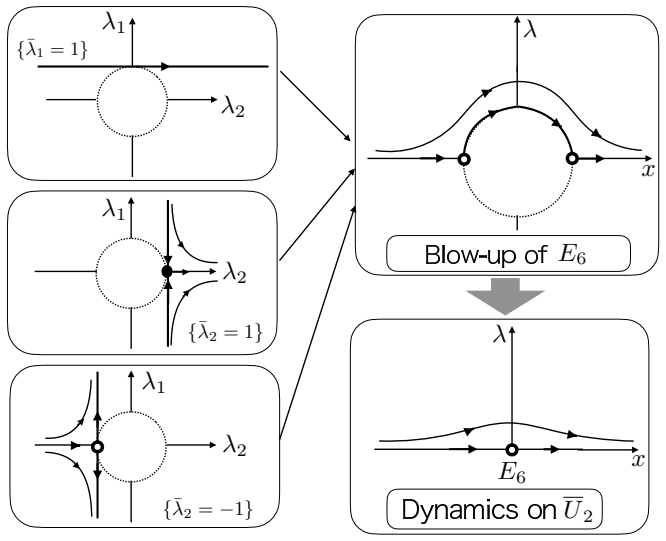
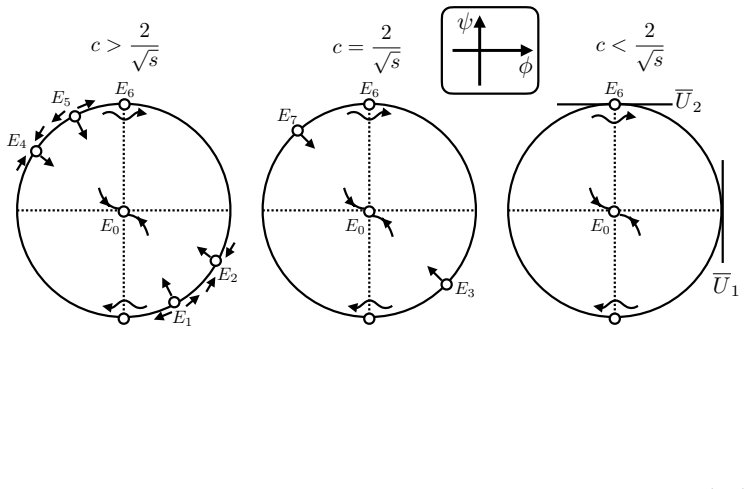
Applying Poincaré-type compactification to the two-dimensional system of ordinary differential equations satisfied by traveling wave solutions reveals the full dynamics at infinity. This yields the classification of trajectories in the phase plane, the positivity and unboundedness of front-type and sign-changing profiles, and the explicit form of the minimal speed, which is derived from information at infinity within the traveling wave system rather than from conventional linear determinacy.
What carries the argument
Poincaré-type compactification of the traveling wave ODE system, which adjoins a sphere at infinity to the phase plane and exposes the limiting behavior that fixes the minimal wave speed.
If this is right
- Front-type traveling wave profiles are positive and unbounded while sign-changing profiles are also unbounded.
- The minimal speed is given by an explicit expression read from the compactified infinity points and the saturation parameter.
- The results differ from those of conventional linear determinacy for this class of reaction terms.
- All trajectories in the phase plane, including their connections at infinity, can be classified completely.
Where Pith is reading between the lines
- The same compactification technique might be applied to other reaction-diffusion equations whose nonlinearity is linear at large values to check whether infinity always determines the minimal speed.
- Numerical integration of the original PDE could be used to test whether the analytically predicted minimal speed is attained by actual propagating fronts.
- The geometric classification at infinity may connect to questions about wave selection in systems with multiple equilibria or in higher spatial dimensions.
Load-bearing premise
The Poincaré-type compactification fully captures the relevant dynamics at infinity without missing trajectories or requiring extra assumptions on the saturation parameter for the asymptotically linear reaction term.
What would settle it
A numerical simulation or analytic construction of a traveling wave solution propagating at a speed strictly below the derived minimal value, or a bounded positive profile, would falsify the claim.
Figures


read the original abstract
This paper presents results on the unboundedness and minimal speed of traveling wave solutions for a one-dimensional spatial reaction-diffusion equation with an asymptotically linear reaction term and a saturation parameter. By applying a Poincar\'e-type compactification, we reveal the full dynamics (including infinity) of the two-dimensional system of ordinary differential equations satisfied by traveling wave solutions. This yields essential information characterizing traveling wave solutions: the classification of trajectories in the phase plane, the positivity and unboundedness of front-type and sign-changing profiles, and the explicit form of the minimal speed. This paper examines a special equation with an asymptotically linear reaction term. While, our results differ from those of conventional linear determinacy. We claim that the minimal speed is derived from information at infinity within the traveling wave system.
Editorial analysis
A structured set of objections, weighed in public.
Referee Report
Summary. This paper claims that for a one-dimensional reaction-diffusion equation with an asymptotically linear reaction term and saturation parameter, a Poincaré-type compactification applied to the traveling-wave ODE system fully classifies trajectories in the phase plane. This classification is used to establish positivity and unboundedness of front-type and sign-changing profiles and to derive an explicit minimal speed from the dynamics at infinity, with the results differing from those obtained by conventional linear determinacy.
Significance. If the orbit classification under compactification is complete and the minimal-speed derivation is rigorous, the work would be significant for providing an alternative to linear determinacy in determining wave speeds for nonlinearities where local linearization at equilibria is insufficient. The approach of extracting the minimal speed directly from infinity dynamics could apply to other asymptotically linear or saturated reaction terms.
major comments (1)
- Abstract: the central claim that the Poincaré-type compactification yields the full dynamics at infinity and an explicit minimal speed rests on the assumption that the compactified vector field for the specific asymptotically linear f(u) with saturation parameter is regular and captures all relevant orbits without omissions. No verification is provided that non-hyperbolic equilibria or additional invariant manifolds are absent, which directly affects the heteroclinic connections that set the minimal speed and the claimed departure from linear determinacy.
minor comments (2)
- The abstract and introduction would be strengthened by stating the explicit form of the reaction term and the saturation parameter, as these are essential for assessing the applicability of the compactification.
- Notation for the traveling-wave ODE system and the compactification charts should be introduced with more detail to allow readers to follow the phase-plane classification without ambiguity.
Simulated Author's Rebuttal
We thank the referee for their careful reading of our manuscript and for identifying this important point regarding the justification of the compactification analysis. We address the comment below and will incorporate revisions to strengthen the rigor of our claims.
read point-by-point responses
-
Referee: [—] Abstract: the central claim that the Poincaré-type compactification yields the full dynamics at infinity and an explicit minimal speed rests on the assumption that the compactified vector field for the specific asymptotically linear f(u) with saturation parameter is regular and captures all relevant orbits without omissions. No verification is provided that non-hyperbolic equilibria or additional invariant manifolds are absent, which directly affects the heteroclinic connections that set the minimal speed and the claimed departure from linear determinacy.
Authors: We agree that explicit verification of the regularity of the compactified vector field, hyperbolicity of equilibria, and completeness of the orbit classification is essential to support the heteroclinic connections and the minimal speed result. In the manuscript, the compactification is introduced in Section 3, where the vector field on the Poincaré sphere is derived explicitly for the given asymptotically linear f(u) with saturation, all equilibria at infinity are located, and their local behavior is analyzed to classify trajectories. However, we acknowledge that a consolidated verification step confirming the absence of non-hyperbolic equilibria (via Jacobian eigenvalue computations) and additional invariant manifolds (via analysis of the flow and possible Dulac functions or section transversality) is not presented as a single dedicated argument. We will revise the paper by adding a new subsection in Section 3 that provides these explicit computations and proofs, thereby directly justifying that the classification is complete and that the minimal speed is indeed determined by the dynamics at infinity, distinct from linear determinacy. revision: yes
Circularity Check
No significant circularity in the derivation chain
full rationale
The paper applies a standard Poincaré-type compactification to the traveling-wave ODE system to classify trajectories including at infinity, from which it extracts the minimal speed and profile properties for the given asymptotically linear reaction term. This is an external mathematical technique whose application does not reduce the claimed minimal speed to a fitted parameter or to a self-referential definition; the abstract explicitly states that results differ from linear determinacy precisely because of the infinity analysis. No load-bearing self-citation, ansatz smuggling, or renaming of known results is present in the provided text. The derivation remains self-contained against the compactified vector field.
Axiom & Free-Parameter Ledger
axioms (2)
- standard math Existence, uniqueness, and continuous dependence for solutions of the traveling-wave ODE system
- standard math Properties of Poincaré compactification that add infinity as a regular point and preserve the flow
Lean theorems connected to this paper
-
IndisputableMonolith/Cost/FunctionalEquation.leanwashburn_uniqueness_aczel contradictsthe explicit formula for the minimal speed is c∗=2/√s
-
IndisputableMonolith/Foundation/AlexanderDuality.leanalexander_duality_circle_linking unclearBy applying a Poincaré-type compactification, we reveal the full dynamics (including infinity) of the two-dimensional system
Reference graph
Works this paper leans on
-
[1]
Carr, Applications of centre manifold theory, Spring er-Verlag, New York-Berlin (1981)
J. Carr, Applications of centre manifold theory, Spring er-Verlag, New York-Berlin (1981)
work page 1981
-
[2]
F. Dumortier, J. Llibre, C.J. Art´ es, Qualitative Theory of Planar Differential Systems, Springer (2006)
work page 2006
-
[3]
J. Fernandes, L. Maia, Blow-up and bounded solutions for a semilinear parabolic problem in a saturable medium, Discrete Contin. Dyn. Syst. 41, No. 3, 1297-1318 (2021)
work page 2021
-
[4]
Y. Ichida, T.O. Sakamoto, Quasi traveling waves with que nching in a reaction- diffusion equation in the presence of negative powers nonline arity, Proc. Japan Acad. Ser. A Math Sci. 96, 1–6 (2020)
work page 2020
-
[5]
Y. Ichida, Classification of nonnegative traveling wave solutions for the 1D degenerate parabolic equations, Discrete Contin. Dyn. Syst., Ser. B, 28, no. 2, 1116–1132 (2023)
work page 2023
-
[6]
Y. Ichida, T.O. Sakamoto, Geometric approach to the bifu rcation at infinity: A case study, Qual. theory Dyn. Syst., 23 (2024), no. 3, Paper No. 109, 24p
work page 2024
-
[7]
Y. Ichida, Classification of weak and unbounded travelin g wave solutions for a Porous- Fisher-KPP equation, SN Partial differ. Equ. Appl. 6 (2025), no. 3, paper no. 25, 24 pp
work page 2025
-
[8]
Ichida, Traveling waves for a Fisher-KPP equation wit h power nonlinear degenerate diffusion, J
Y. Ichida, Traveling waves for a Fisher-KPP equation wit h power nonlinear degenerate diffusion, J . Elliptic Parabol. Equ, 11 (2025), no. 2, 1725–1746
work page 2025
-
[9]
R. Ito, H. Ninomiya, Theory of unbounded traveling wave s olutions of reaction- diffusion equations: Existence and connections to classical theory, J. Differ. Equations 456, article ID 113967, 33 p. (2026)
work page 2026
-
[10]
Kuehn, Multiple Time Scale Dynamics, Springer (2015 )
C. Kuehn, Multiple Time Scale Dynamics, Springer (2015 )
work page 2015
-
[11]
K. Matsue, On blow-up solutions of differential equation s with Poincar´ e-type com- pactificaions, SIAM J. Appl. Dyn. Syst., 17, 2249–2288 (2018)
work page 2018
-
[12]
K. Matsue, Geometric treatments and a common mechanism in finite-time singulari- ties for autonomous ODEs, J. Differential Equations, 267, 7313–7368 (2019)
work page 2019
-
[13]
S. Wiggins, Introduction to Applied Nonlinear Dynamic al Systems and Chaos, Springer-Verlag, New York, 2003. 14
work page 2003
discussion (0)
Sign in with ORCID, Apple, or X to comment. Anyone can read and Pith papers without signing in.