Recognition: 2 theorem links
· Lean TheoremSpecBlock: Block-Iterative Speculative Decoding with Dynamic Tree Drafting
Pith reviewed 2026-05-11 02:24 UTC · model grok-4.3
The pith
SpecBlock accelerates LLM inference by generating blocks of dependent tokens iteratively with hidden-state inheritance and dynamic branching.
A machine-rendered reading of the paper's core claim, the machinery that carries it, and where it could break.
Core claim
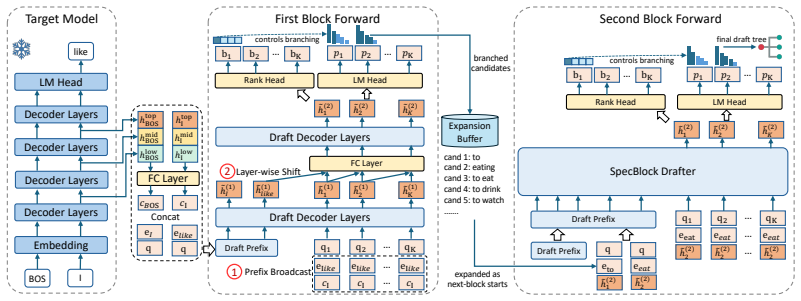
SpecBlock defines a block as K dependent token predictions produced by one drafter forward. Path dependence is maintained inside the block by injecting the previous position's hidden state into every layer and across blocks by allowing each new block to inherit the hidden state from any accepted position in the prior block. A rank head predicts per-position branching to allocate verifier budget where acceptance is likeliest, and a valid-prefix mask ensures the training loss only penalizes prefixes that could actually arise at inference time. A deployment bandit then uses free verifier signals to decide whether to update the drafter parameters only when the expected throughput gain exceeds re
What carries the argument
The block-iterative drafter with layer-wise hidden-state shift inside blocks and selective inheritance across blocks, which carries path dependence while reducing drafter call frequency.
If this is right
- Mean inference speedup rises 8-13 percent over EAGLE-3 while drafting cost drops to 44-52 percent of the baseline.
- Cost-aware online adaptation using verifier feedback widens the speedup lead to 11-19 percent.
- Verifier compute is spent more efficiently because the rank head allocates branching only where acceptance probability is high.
- Training and inference remain aligned because the valid-prefix mask excludes loss on positions that could never be reached by a valid prefix.
- The drafter's contribution to per-iteration latency shrinks because multiple dependent positions are produced per call.
Where Pith is reading between the lines
- The same inheritance pattern could be applied to other multi-step generation tasks that currently suffer from dependence loss in parallel predictors.
- If the rank head generalizes, it offers a route to replace hand-tuned tree widths in any speculative system.
- The bandit adaptation mechanism suggests a broader class of low-overhead online tuning that could be tested on non-speculative inference pipelines.
- Testing whether the block size K can be learned or scheduled dynamically would reveal whether the current fixed-block design leaves further efficiency on the table.
Load-bearing premise
Layer-wise hidden-state shifts and selective inheritance will preserve enough path dependence to keep acceptance rates high enough to offset the added mechanisms without the rank head or mask creating training-inference mismatches.
What would settle it
Measure acceptance rates and end-to-end speedup on a model whose hidden states shift rapidly across layers; if rates fall enough that the extra drafting mechanisms no longer reduce total latency, the claim is false.
Figures



read the original abstract
Speculative decoding accelerates LLM inference by drafting a tree of candidate continuations and verifying it in one target forward. Existing drafters fall into two camps with opposite weaknesses. Autoregressive drafters such as EAGLE-3 preserve dependence along each draft path but call the drafter once per tree depth, making drafting a non-trivial share of per-iteration latency. Parallel drafters cut drafter calls by predicting multiple future positions in one forward, but each position is predicted without seeing the others, producing paths the verifier rejects. In this paper, we propose SpecBlock, a block-iterative drafter that combines path dependence with cheap drafting. Each drafter forward produces K dependent positions and we call this a block. The draft tree grows through repeated block expansions. Two mechanisms explicitly carry path dependence to keep later draft positions accurate. Within each block, a layer-wise shift carries the previous position's hidden state into every decoder layer. Across blocks, each new block can start from any position of the previous block, inheriting its hidden state to extend the path. To spend verifier budget where acceptance is likely, a co-trained rank head replaces the fixed top-k tree by allocating per-position branching during drafting. To avoid training the drafter on prefixes it never produces at inference, a valid-prefix mask drops the loss at later positions once an earlier one is wrong. Beyond static drafting, a cost-aware bandit at deployment uses free verifier feedback to update the drafter selectively, only when the expected throughput gain exceeds the update cost. Experiments show that SpecBlock improves mean speedup by 8-13% over EAGLE-3 at 44-52% of its drafting cost, and cost-aware adaptation extends this lead to 11-19%.
Editorial analysis
A structured set of objections, weighed in public.
Referee Report
Summary. The manuscript proposes SpecBlock, a block-iterative speculative decoding framework for accelerating LLM inference. It generates K dependent positions per drafter forward pass (a 'block'), grows the draft tree iteratively, uses layer-wise hidden-state shifts within blocks and selective inheritance across blocks to maintain path dependence, employs a co-trained rank head for dynamic branching, and a valid-prefix mask to align training with inference. A cost-aware bandit adapts the drafter using verifier feedback. The key empirical claim is an 8-13% mean speedup improvement over EAGLE-3 at 44-52% of the drafting cost, further enhanced to 11-19% with adaptation.
Significance. If the results hold under rigorous testing, SpecBlock represents a meaningful advance in speculative decoding by bridging the gap between path-dependent autoregressive drafters and efficient parallel ones. The mechanisms for preserving dependence and the adaptive component could lead to more efficient inference systems, particularly in resource-constrained settings. The paper's emphasis on reducing drafting cost while improving speedup is practically significant.
major comments (3)
- [Abstract and Experiments] Abstract and Experiments section: The performance claims (8-13% speedup at 44-52% cost, extending to 11-19% with adaptation) are presented without reference to specific datasets, model architectures, number of trials, error bars, or ablation studies. This makes it impossible to verify the robustness of the central empirical result and whether the block-iterative design indeed offsets the mechanisms' overhead.
- [Method (block-iterative design)] Method section on block-iterative design: The claim that layer-wise hidden-state shifts within blocks and selective inheritance across blocks preserve sufficient path dependence to maintain high acceptance rates is central but lacks supporting analysis or ablations. If dependence is lost, acceptance rates could drop, negating the speedup gains even at reduced drafting cost. A concrete test, such as measuring per-position acceptance rates or comparing to ablated versions, is needed.
- [Training and Inference Alignment] Training and Inference Alignment subsection: The valid-prefix mask and co-trained rank head are intended to prevent mismatches, but the manuscript should provide evidence (e.g., loss curves or acceptance rate comparisons) that no residual training-inference discrepancy remains, as this could silently degrade the reported improvements.
minor comments (2)
- [Notation] Clarify the definition of block size K and how it interacts with the rank head parameters early in the paper.
- [Figures] Ensure that any speedup vs. cost plots include confidence intervals and label the baselines clearly.
Simulated Author's Rebuttal
We thank the referee for the constructive and detailed feedback. We address each major comment below and outline the revisions we will make to improve clarity, verifiability, and empirical support.
read point-by-point responses
-
Referee: [Abstract and Experiments] Abstract and Experiments section: The performance claims (8-13% speedup at 44-52% cost, extending to 11-19% with adaptation) are presented without reference to specific datasets, model architectures, number of trials, error bars, or ablation studies. This makes it impossible to verify the robustness of the central empirical result and whether the block-iterative design indeed offsets the mechanisms' overhead.
Authors: We agree that the abstract is a high-level summary and does not include experimental details. The Experiments section evaluates on standard benchmarks (MT-Bench, HumanEval, GSM8K) with Llama-2-7B and Llama-3-8B models, averaging over multiple random seeds. To address the concern directly, we will revise the abstract to reference the key datasets and models, and expand the Experiments section with error bars, explicit trial counts, and ablation studies that isolate the contribution of the block-iterative design versus its overhead. revision: yes
-
Referee: [Method (block-iterative design)] Method section on block-iterative design: The claim that layer-wise hidden-state shifts within blocks and selective inheritance across blocks preserve sufficient path dependence to maintain high acceptance rates is central but lacks supporting analysis or ablations. If dependence is lost, acceptance rates could drop, negating the speedup gains even at reduced drafting cost. A concrete test, such as measuring per-position acceptance rates or comparing to ablated versions, is needed.
Authors: The mechanisms are described in the Method section, but we acknowledge the absence of targeted empirical validation. In revision we will add (i) ablations that disable layer-wise shifts and selective inheritance, reporting resulting acceptance rates and speedups, and (ii) per-position acceptance-rate plots across draft depths. These will demonstrate that path dependence is preserved and that the observed cost reduction does not degrade acceptance. revision: yes
-
Referee: [Training and Inference Alignment] Training and Inference Alignment subsection: The valid-prefix mask and co-trained rank head are intended to prevent mismatches, but the manuscript should provide evidence (e.g., loss curves or acceptance rate comparisons) that no residual training-inference discrepancy remains, as this could silently degrade the reported improvements.
Authors: We will augment the subsection with direct evidence of alignment: training loss curves comparing masked versus unmasked objectives, and side-by-side acceptance-rate measurements between the trained drafter and its inference-time behavior. These additions will confirm that the valid-prefix mask and rank head eliminate residual discrepancies. revision: yes
Circularity Check
SpecBlock presents a novel block-iterative architecture with independent mechanisms that do not reduce to fitted inputs or self-citations by construction.
full rationale
The paper's core contribution is a new drafter design combining within-block layer-wise hidden-state shifts, across-block selective inheritance, a co-trained rank head, and a valid-prefix mask. These are described as explicit constructions to address limitations of prior autoregressive and parallel drafters. No equations, predictions, or experimental claims in the provided text reduce by definition to quantities fitted from the authors' own prior work or to self-citation chains. The speedup results are empirical comparisons against EAGLE-3 and other baselines, not derivations forced by the inputs. This is a standard non-circular case where the method is self-contained against external benchmarks.
Axiom & Free-Parameter Ledger
free parameters (2)
- block_size_K
- rank_head_parameters
Lean theorems connected to this paper
-
IndisputableMonolith/Foundation/Cost/FunctionalEquation.leanwashburn_uniqueness_aczel unclear?
unclearRelation between the paper passage and the cited Recognition theorem.
Each drafter forward produces K dependent positions... layer-wise shift carries the previous position’s hidden state... rank head... valid-prefix mask
-
IndisputableMonolith/Foundation/AlphaCoordinateFixation.leanJ_uniquely_calibrated_via_higher_derivative unclear?
unclearRelation between the paper passage and the cited Recognition theorem.
Experiments show that SpecBlock improves mean speedup by 8-13% over EAGLE-3 at 44-52% of its drafting cost
What do these tags mean?
- matches
- The paper's claim is directly supported by a theorem in the formal canon.
- supports
- The theorem supports part of the paper's argument, but the paper may add assumptions or extra steps.
- extends
- The paper goes beyond the formal theorem; the theorem is a base layer rather than the whole result.
- uses
- The paper appears to rely on the theorem as machinery.
- contradicts
- The paper's claim conflicts with a theorem or certificate in the canon.
- unclear
- Pith found a possible connection, but the passage is too broad, indirect, or ambiguous to say the theorem truly supports the claim.
Reference graph
Works this paper leans on
-
[1]
Fast inference from transformers via speculative decoding
Yaniv Leviathan, Matan Kalman, and Yossi Matias. Fast inference from transformers via speculative decoding. InInternational Conference on Machine Learning, pages 19274–19286. PMLR, 2023
work page 2023
-
[2]
Accelerating Large Language Model Decoding with Speculative Sampling
Charlie Chen, Sebastian Borgeaud, Geoffrey Irving, Jean-Baptiste Lespiau, Laurent Sifre, and John Jumper. Accelerating large language model decoding with speculative sampling.arXiv preprint arXiv:2302.01318, 2023
work page internal anchor Pith review arXiv 2023
-
[3]
Xupeng Miao, Gabriele Oliaro, Zhihao Zhang, Xinhao Cheng, Zeyu Wang, Zhengxin Zhang, Rae Ying Yee Wong, Alan Zhu, Lijie Yang, Xiaoxiang Shi, Chunan Shi, Zhuoming Chen, Daiyaan Arfeen, Reyna Abhyankar, and Zhihao Jia. Specinfer: Accelerating large language model serving with tree-based speculative inference and verification. InProceedings of the 29th ACM I...
work page 2024
-
[4]
Spectr: Fast speculative decoding via optimal transport
Ziteng Sun, Ananda Theertha Suresh, Jae Hun Ro, Ahmad Beirami, Himanshu Jain, and Felix Yu. Spectr: Fast speculative decoding via optimal transport. volume 36, pages 30222–30242, 2023
work page 2023
-
[5]
Yongchao Zhou, Kaifeng Lyu, Ankit Singh Rawat, Aditya Krishna Menon, Afshin Ros- tamizadeh, Sanjiv Kumar, Jean-François Kagy, and Rishabh Agarwal. Distillspec: Improving speculative decoding via knowledge distillation.arXiv preprint arXiv:2310.08461, 2023
-
[6]
Sequoia: Scalable and robust speculative decoding
Zhuoming Chen, Avner May, Ruslan Svirschevski, Yuhsun Huang, Max Ryabinin, Zhihao Jia, and Beidi Chen. Sequoia: Scalable and robust speculative decoding. volume 37, pages 129531–129563, 2024
work page 2024
-
[7]
Eagle: Speculative sampling requires rethinking feature uncertainty
Yuhui Li, Fangyun Wei, Chao Zhang, and Hongyang Zhang. Eagle: Speculative sampling requires rethinking feature uncertainty. 2024
work page 2024
-
[8]
Eagle-2: Faster inference of language models with dynamic draft trees
Yuhui Li, Fangyun Wei, Chao Zhang, and Hongyang Zhang. Eagle-2: Faster inference of language models with dynamic draft trees. pages 7421–7432, 2024
work page 2024
-
[9]
EAGLE-3: Scaling up Inference Acceleration of Large Language Models via Training-Time Test
Yuhui Li, Fangyun Wei, Chao Zhang, and Hongyang Zhang. Eagle-3: Scaling up inference acceleration of large language models via training-time test.arXiv preprint arXiv:2503.01840, 2025
work page internal anchor Pith review arXiv 2025
-
[10]
Medusa: Simple llm inference acceleration framework with multiple decoding heads
Tianle Cai, Yuhong Li, Zhengyang Geng, Hongwu Peng, Jason D Lee, Deming Chen, and Tri Dao. Medusa: Simple llm inference acceleration framework with multiple decoding heads. 2024
work page 2024
-
[11]
Learning har- monized representations for speculative sampling.arXiv preprint arXiv:2408.15766,
Lefan Zhang, Xiaodan Wang, Yanhua Huang, and Ruiwen Xu. Learning harmonized represen- tations for speculative sampling.arXiv preprint arXiv:2408.15766, 2024
-
[12]
Draft& verify: Lossless large language model acceleration via self-speculative decoding
Jun Zhang, Jue Wang, Huan Li, Lidan Shou, Ke Chen, Gang Chen, and Sharad Mehrotra. Draft& verify: Lossless large language model acceleration via self-speculative decoding. pages 11263–11282, 2024
work page 2024
-
[13]
Kanga- roo: Lossless self-speculative decoding via double early exiting,
Fangcheng Liu, Yehui Tang, Zhenhua Liu, Yunsheng Ni, Kai Han, and Yunhe Wang. Kangaroo: Lossless self-speculative decoding via double early exiting.arXiv preprint arXiv:2404.18911, 2024
-
[14]
Rest: Retrieval-based speculative decoding
Zhenyu He, Zexuan Zhong, Tianle Cai, Jason Lee, and Di He. Rest: Retrieval-based speculative decoding. pages 1582–1595, 2024
work page 2024
-
[15]
Yichao Fu, Peter Bailis, Ion Stoica, and Hao Zhang. Break the sequential dependency of llm inference using lookahead decoding.arXiv preprint arXiv:2402.02057, 2024
-
[16]
Blockwise parallel decoding for deep autoregressive models
Mitchell Stern, Noam Shazeer, and Jakob Uszkoreit. Blockwise parallel decoding for deep autoregressive models. volume 31, 2018. 10
work page 2018
-
[17]
Feng Lin, Hanling Yi, Yifan Yang, Hongbin Li, Xiaotian Yu, Guangming Lu, and Rong Xiao. Bita: Bi-directional tuning for lossless acceleration in large language models.Expert Systems with Applications, 279:127305, 2025
work page 2025
-
[18]
Zilin Xiao, Hongming Zhang, Tao Ge, Siru Ouyang, Vicente Ordonez, and Dong Yu. Paral- lelspec: Parallel drafter for efficient speculative decoding.arXiv preprint arXiv:2410.05589, 2024
-
[19]
Zihao An, Huajun Bai, Ziqiong Liu, Dong Li, and Emad Barsoum. Pard: Accelerating llm inference with low-cost parallel draft model adaptation.arXiv preprint arXiv:2504.18583, 2025
-
[20]
Fuliang Liu, Xue Li, Ketai Zhao, Yinxi Gao, Ziyan Zhou, Zhonghui Zhang, Zhibin Wang, Wanchun Dou, Sheng Zhong, and Chen Tian. Dart: Diffusion-inspired speculative decoding for fast llm inference.arXiv preprint arXiv:2601.19278, 2026
-
[21]
Hydra: Sequentially-dependent draft heads for medusa decoding
Zachary Ankner, Rishab Parthasarathy, Aniruddha Nrusimha, Christopher Rinard, Jonathan Ragan-Kelley, and William Brandon. Hydra: Sequentially-dependent draft heads for medusa decoding.arXiv preprint arXiv:2402.05109, 2024
-
[22]
Fasteagle: Cascaded drafting for accelerating speculative decoding
Haiduo Huang, Jiangcheng Song, Wenzhe Zhao, and Pengju Ren. Fasteagle: Cascaded drafting for accelerating speculative decoding. pages 4111–4115, 2026
work page 2026
-
[23]
Xiangxiang Gao, Weisheng Xie, Yiwei Xiang, and Feng Ji. Falcon: Faster and parallel inference of large language models through enhanced semi-autoregressive drafting and custom-designed decoding tree. 39(22):23933–23941, 2025
work page 2025
-
[24]
Pearl: Parallel speculative decoding with adaptive draft length.arXiv preprint arXiv:2408.11850,
Tianyu Liu, Yun Li, Qitan Lv, Kai Liu, Jianchen Zhu, Winston Hu, and Xiao Sun. Pearl: Parallel speculative decoding with adaptive draft length.arXiv preprint arXiv:2408.11850, 2024
-
[25]
Exploring and improving drafts in blockwise parallel decoding.arXiv preprint arXiv:2404.09221, 2024
Taehyeon Kim, Ananda Theertha Suresh, Kishore Papineni, Adrian Benton, and Michael Riley. Exploring and improving drafts in blockwise parallel decoding.arXiv preprint arXiv:2404.09221, 2024
-
[26]
Set block decoding is a language model inference accelerator.arXiv preprint arXiv:2509.04185,
Itai Gat, Heli Ben-Hamu, Marton Havasi, Daniel Haziza, Jeremy Reizenstein, Gabriel Synnaeve, David Lopez-Paz, Brian Karrer, and Yaron Lipman. Set block decoding is a language model inference accelerator.arXiv preprint arXiv:2509.04185, 2025
-
[27]
Recurrent drafter for fast speculative decoding in large language models
Yunfei Cheng, Aonan Zhang, Xuanyu Zhang, Chong Wang, and Yi Wang. Recurrent drafter for fast speculative decoding in large language models.arXiv preprint arXiv:2403.09919, 2024
-
[28]
Feiye Huo, Jianchao Tan, Kefeng Zhang, Xunliang Cai, and Shengli Sun. C2t: A classifier-based tree construction method in speculative decoding.arXiv preprint arXiv:2502.13652, 2025
-
[29]
Jikai Wang, Yi Su, Juntao Li, Qingrong Xia, Zi Ye, Xinyu Duan, Zhefeng Wang, and Min Zhang. Opt-tree: Speculative decoding with adaptive draft tree structure.Transactions of the Association for Computational Linguistics, 13:188–199, 2025
work page 2025
-
[30]
Dyspec: Faster speculative decoding with dynamic token tree structure.World Wide Web, 28(3):36, 2025
Yunfan Xiong, Ruoyu Zhang, Yanzeng Li, and Lei Zou. Dyspec: Faster speculative decoding with dynamic token tree structure.World Wide Web, 28(3):36, 2025
work page 2025
-
[31]
Tianyu Liu, Qitan Lv, Yuhao Shen, Xiao Sun, and Xiaoyan Sun. Talon: Confidence-aware speculative decoding with adaptive token trees.arXiv preprint arXiv:2601.07353, 2026
-
[32]
Yunlong Hou, Fengzhuo Zhang, Cunxiao Du, Xuan Zhang, Jiachun Pan, Tianyu Pang, Chao Du, Vincent YF Tan, and Zhuoran Yang. Banditspec: Adaptive speculative decoding via bandit algorithms.arXiv preprint arXiv:2505.15141, 2025
-
[33]
SpecDec++: Boosting speculative decoding via adaptive candidate lengths
Kaixuan Huang, Xudong Guo, and Mengdi Wang. SpecDec++: Boosting speculative decoding via adaptive candidate lengths. InConference on Language Modeling, 2024
work page 2024
-
[34]
Xiaoxuan Liu, Lanxiang Hu, Peter Bailis, Alvin Cheung, Zhijie Deng, Ion Stoica, and Hao Zhang. Online speculative decoding. 2023
work page 2023
-
[35]
Shrenik Bhansali and Larry Heck. Draft, verify, and improve: Toward training-aware speculative decoding.arXiv preprint arXiv:2510.05421, 2025. 11
-
[36]
Jiyoung Park, Hankyu Jang, Changseok Song, and Wookeun Jung. Tide: Temporal incremental draft engine for self-improving llm inference.arXiv preprint arXiv:2602.05145, 2026
-
[37]
When RL Meets Adaptive Speculative Training: A Unified Training-Serving System
Junxiong Wang, Fengxiang Bie, Jisen Li, Zhongzhu Zhou, Zelei Shao, Yubo Wang, Yinghui Liu, Qingyang Wu, Avner May, Sri Yanamandra, et al. When rl meets adaptive speculative training: A unified training-serving system.arXiv preprint arXiv:2602.06932, 2026
work page internal anchor Pith review Pith/arXiv arXiv 2026
-
[38]
Aaron Grattafiori, Abhimanyu Dubey, Abhinav Jauhri, Abhinav Pandey, Abhishek Kadian, Ahmad Al-Dahle, Aiesha Letman, Akhil Mathur, Alan Schelten, Alex Vaughan, et al. The llama 3 herd of models.arXiv preprint arXiv:2407.21783, 2024
work page internal anchor Pith review Pith/arXiv arXiv 2024
-
[39]
An Yang, Anfeng Li, Baosong Yang, Beichen Zhang, Binyuan Hui, Bo Zheng, Bowen Yu, Chang Gao, Chengen Huang, Chenxu Lv, et al. Qwen3 technical report.arXiv preprint arXiv:2505.09388, 2025
work page internal anchor Pith review Pith/arXiv arXiv 2025
-
[40]
Enhancing chat language models by scaling high-quality instructional conversations
Ning Ding, Yulin Chen, Bokai Xu, Yujia Qin, Shengding Hu, Zhiyuan Liu, Maosong Sun, and Bowen Zhou. Enhancing chat language models by scaling high-quality instructional conversations. InProceedings of the 2023 Conference on Empirical Methods in Natural Language Processing, pages 3029–3051, 2023
work page 2023
-
[41]
Lianmin Zheng, Wei-Lin Chiang, Ying Sheng, et al. Judging llm-as-a-judge with mt-bench and chatbot arena.Advances in Neural Information Processing Systems, 2023
work page 2023
-
[42]
Evaluating Large Language Models Trained on Code
Mark Chen, Jerry Tworek, Heewoo Jun, Qiming Yuan, Henrique Ponde De Oliveira Pinto, Jared Kaplan, Harri Edwards, Yuri Burda, Nicholas Joseph, Greg Brockman, et al. Evaluating large language models trained on code.arXiv preprint arXiv:2107.03374, 2021
work page internal anchor Pith review Pith/arXiv arXiv 2021
-
[43]
Measuring Mathematical Problem Solving With the MATH Dataset
Dan Hendrycks, Collin Burns, Saurav Kadavath, Akul Arora, Steven Basart, Eric Tang, Dawn Song, and Jacob Steinhardt. Measuring mathematical problem solving with the math dataset. arXiv preprint arXiv:2103.03874, 2021
work page internal anchor Pith review Pith/arXiv arXiv 2021
-
[44]
Stanford alpaca: An instruction-following llama model, 2023
Rohan Taori, Ishaan Gulrajani, Tianyi Zhang, Yann Dubois, Xuechen Li, Carlos Guestrin, Percy Liang, and Tatsunori B Hashimoto. Stanford alpaca: An instruction-following llama model, 2023
work page 2023
-
[45]
Tom Kwiatkowski, Jennimaria Palomaki, Olivia Redfield, Michael Collins, Ankur Parikh, Chris Alberti, Danielle Epstein, Illia Polosukhin, Jacob Devlin, Kenton Lee, et al. Natural questions: a benchmark for question answering research.Transactions of the Association for Computational Linguistics, 7:453–466, 2019
work page 2019
-
[46]
‘ python def fibonacci _recursive (n ):
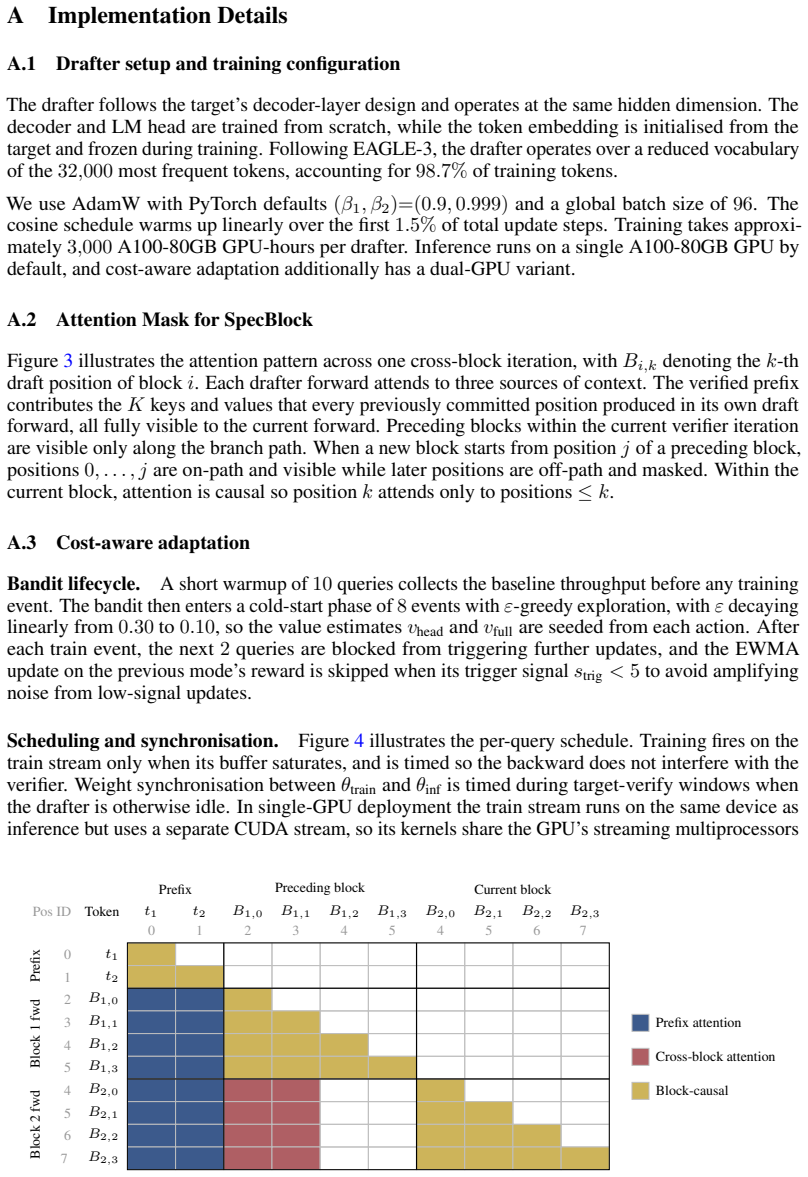
Tom Kocmi, Rachel Bawden, Ondˇrej Bojar, Anton Dvorkovich, Christian Federmann, Mark Fishel, Thamme Gowda, Yvette Graham, Roman Grundkiewicz, Barry Haddow, et al. Find- ings of the 2022 conference on machine translation (wmt22). InProceedings of the Seventh Conference on Machine Translation (WMT), pages 1–45, 2022. 12 A Implementation Details A.1 Drafter ...
work page 2022
-
[47]
Institutional review board (IRB) approvals or equivalent for research with human subjects 27 Question: Does the paper describe potential risks incurred by study participants, whether such risks were disclosed to the subjects, and whether Institutional Review Board (IRB) approvals (or an equivalent approval/review based on the requirements of your country ...
discussion (0)
Sign in with ORCID, Apple, or X to comment. Anyone can read and Pith papers without signing in.