Recognition: 2 theorem links
· Lean TheoremA Beta-GAM Hidden Markov Model for Proportion Time Series
Pith reviewed 2026-05-11 00:51 UTC · model grok-4.3
The pith
A hidden Markov model with Beta emissions and GAM means captures latent regime shifts in proportion time series.
A machine-rendered reading of the paper's core claim, the machinery that carries it, and where it could break.
Core claim
The authors establish that a hidden Markov model with Beta emissions, state-specific GAM spline means, and state-specific precisions can be estimated by penalized EM, that standard information criteria with a degeneracy check select a suitable number of states, and that the resulting model recovers transition dynamics and decodes latent states in both simulated data and Russian female-to-total mortality proportions from 1960 to 2014, where the two recovered regimes admit a demographic interpretation in terms of known mortality shocks.
What carries the argument
The Beta-GAM hidden Markov model, in which a latent Markov chain switches between regimes, each emitting Beta-distributed proportions whose mean follows a state-specific GAM spline while precision is held constant within the regime.
If this is right
- Transition probabilities and state-dependent parameters can be recovered accurately from proportion series.
- Smooth nonlinear covariate effects are accommodated without assuming linearity.
- Regime-specific variability is captured by allowing different precisions across latent states.
- Degenerate solutions are avoided by combining information criteria with a precision-based filter.
- Uncertainty in transitions and parameters is quantified by parametric bootstrap.
Where Pith is reading between the lines
- The same structure could be applied to other bounded series that exhibit both gradual covariate effects and abrupt regime changes, such as economic shares or ecological coverage proportions.
- Forecasting future proportions would follow naturally by propagating the estimated transition matrix and sampling from the state-specific GAM-Beta distributions.
- Adding external historical indicators as covariates could test whether the recovered regimes remain stable or whether they collapse into one when more context is supplied.
Load-bearing premise
The observed proportions are generated by a small number of hidden regimes that follow a Markov process, each with constant precision and a mean that is adequately described by a smooth GAM spline of the covariates.
What would settle it
If the regimes decoded from the Russian mortality series do not align with the documented shocks of the late twentieth century, or if new simulations with known parameters produce systematically inaccurate state recovery, the central modeling assumptions would be challenged.
Figures

read the original abstract
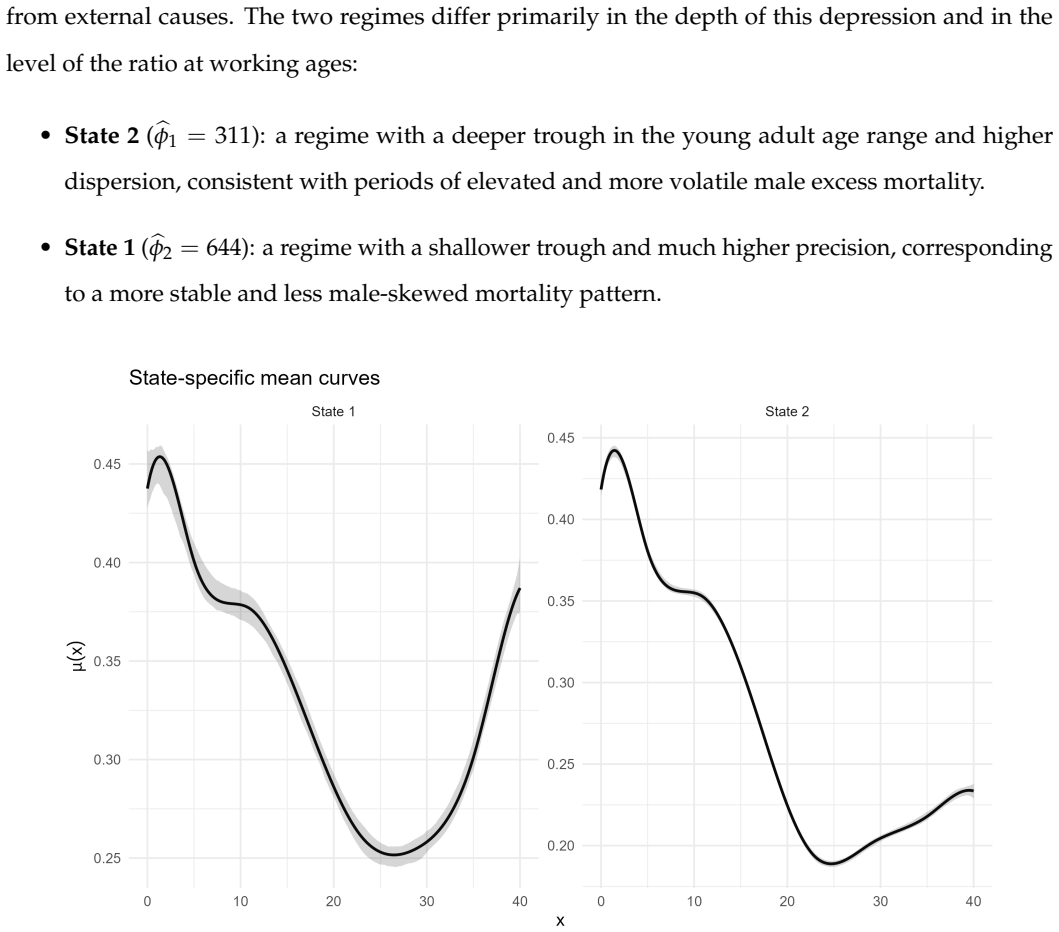
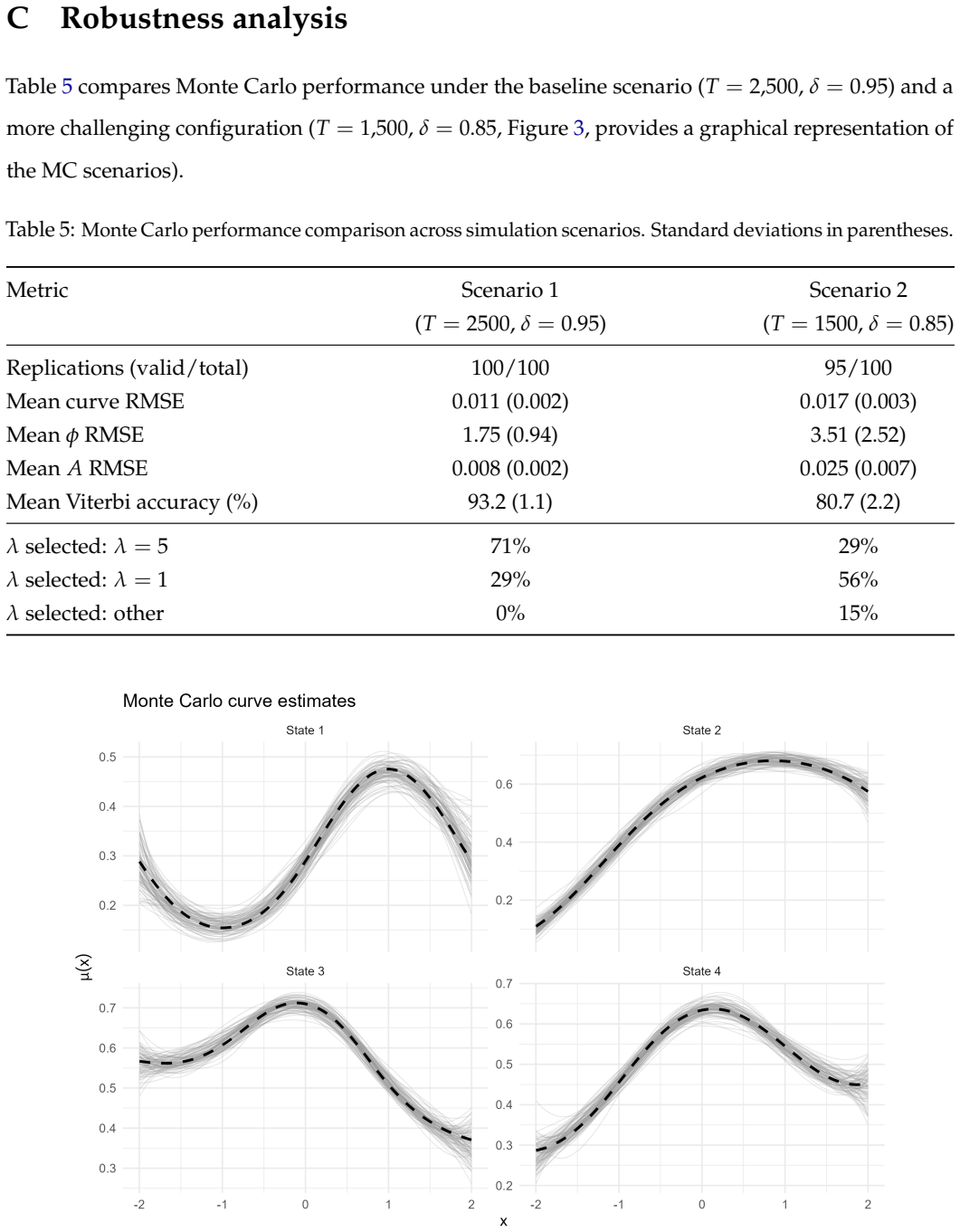
We propose a hidden Markov model for univariate proportion time series taking values in (0,1), where regime switching captures latent structural changes and the emission distribution belongs to the Beta family. In each latent state, the Beta mean is linked to covariates through a generalized additive model (GAM) with spline-based smooth functions, while the Beta precision is state-specific, enabling flexible modeling of both nonlinear covariate effects and regime-dependent variability. Estimation is carried out via a penalized expectation--maximization algorithm, combining smoothing with numerical maximization of the penalized emission likelihood. To select the number of latent states and the smoothing penalty, we implement a grid search guided by standard information criteria (Akaike Information Criterion/Bayesian Information Criterion/Integrated Completed Likelihood) with a diagnostic filter that removes degenerate solutions characterized by explosive precision estimates. Uncertainty is quantified through a parametric bootstrap procedure for transition probabilities and state-dependent parameters. Simulation results demonstrate accurate recovery of transition dynamics, state precisions, and latent-state decoding. A motivating application to Russian age-specific mortality data (1960--2014, ages 0--40) illustrates how the proposed model summarizes smooth age patterns in female-to-total mortality ratios while identifying two persistent latent regimes that admit a substantive demographic interpretation in light of the country's well-documented mortality shocks that occurred over the second half of the twentieth century.
Editorial analysis
A structured set of objections, weighed in public.
Referee Report
Summary. The paper proposes a hidden Markov model for univariate proportion time series in (0,1) with Beta emissions. In each latent state the Beta mean is modeled via a state-specific generalized additive model (GAM) using spline smooths on covariates, while the precision parameter is constant within states. Estimation proceeds via a penalized EM algorithm that incorporates smoothing penalties, with the number of states and penalty parameters selected by a grid search over AIC/BIC/ICL after discarding degenerate solutions with explosive precisions. Uncertainty for transitions and state parameters is obtained via parametric bootstrap. Simulations are used to demonstrate recovery of transition probabilities, state precisions, and latent-state sequences. The model is applied to Russian female-to-total mortality ratios (ages 0–40, 1960–2014) to recover two persistent latent regimes that are linked post hoc to documented mortality shocks.
Significance. If the generative assumptions are appropriate, the Beta-GAM HMM supplies a practical tool for regime-switching proportion data that simultaneously accommodates nonlinear covariate effects and state-dependent dispersion. The simulation evidence supports reliable recovery of the key quantities, and the mortality application shows how the framework can produce interpretable summaries of age patterns. The reliance on standard information criteria and bootstrap inference is a methodological strength that facilitates use by practitioners.
major comments (1)
- [Application to Russian mortality data] Mortality application: the claim that the decoded regimes possess substantive demographic meaning rests on post-hoc alignment with known shocks, yet the manuscript reports neither residual diagnostics, posterior predictive checks, out-of-sample log-likelihood comparisons, nor formal contrasts against a single-state Beta-GAM or non-Markov alternatives. Without these checks it is impossible to determine whether the two-regime structure is recovered from the data or imposed by the model’s flexibility.
minor comments (2)
- [Abstract] The abstract states that information criteria are used but does not indicate which criterion ultimately selected the two-state solution in the mortality example; this detail should be added for reproducibility.
- [Estimation procedure] Notation for the state-specific precision parameters and the smoothing penalty terms could be introduced earlier and used consistently throughout the estimation section.
Simulated Author's Rebuttal
We thank the referee for the constructive feedback. We agree that the mortality application would be strengthened by additional validation to support the interpretation of the latent regimes. We address this below and will revise the manuscript accordingly.
read point-by-point responses
-
Referee: [Application to Russian mortality data] Mortality application: the claim that the decoded regimes possess substantive demographic meaning rests on post-hoc alignment with known shocks, yet the manuscript reports neither residual diagnostics, posterior predictive checks, out-of-sample log-likelihood comparisons, nor formal contrasts against a single-state Beta-GAM or non-Markov alternatives. Without these checks it is impossible to determine whether the two-regime structure is recovered from the data or imposed by the model’s flexibility.
Authors: The referee correctly notes that the application section currently lacks these validation steps and relies on post-hoc alignment with historical events. We will revise the manuscript to include: (i) residual diagnostics using randomized quantile residuals for the Beta emissions to check for systematic misfit; (ii) posterior predictive checks comparing replicated time series features (e.g., regime persistence and age-pattern smoothness) to the observed data; (iii) out-of-sample log-likelihood evaluation by holding out the final 10 years and refitting on the earlier period; and (iv) formal model comparisons via AIC, BIC, and ICL against a single-state Beta-GAM and a non-Markov alternative (independent Beta-GAM fits per time point). These additions will demonstrate that the two-regime structure is supported by the data. The methodological core and simulation results are unaffected. revision: yes
Circularity Check
No significant circularity; derivation is self-contained
full rationale
The paper introduces a novel Beta-GAM HMM for proportion time series, with estimation performed via a standard penalized EM algorithm and uncertainty quantified by parametric bootstrap. Simulations demonstrate parameter recovery under the stated generative model, and the Russian mortality application is presented as illustrative with post-hoc demographic interpretation of decoded regimes. No load-bearing step reduces by the paper's own equations to a fitted quantity defined in terms of itself, nor does any central claim rest on a self-citation chain or imported uniqueness theorem. The derivation chain remains independent of its outputs.
Axiom & Free-Parameter Ledger
free parameters (3)
- number of latent states
- smoothing penalty parameters
- state-specific Beta precisions
axioms (3)
- domain assumption The observed series is generated by a finite-state homogeneous Markov chain.
- domain assumption Within each state the proportion follows a Beta distribution whose mean is a smooth function of covariates via GAM splines.
- standard math Standard regularity conditions for the penalized EM algorithm and bootstrap to be consistent.
Lean theorems connected to this paper
-
IndisputableMonolith/Cost/FunctionalEquation.leanwashburn_uniqueness_aczel unclearWe propose a hidden Markov model for univariate proportion time series taking values in (0,1), where regime switching captures latent structural changes and the emission distribution belongs to the Beta family. In each latent state, the Beta mean is linked to covariates through a generalized additive model (GAM) with spline-based smooth functions, while the Beta precision is state-specific
-
IndisputableMonolith/Foundation/RealityFromDistinction.leanreality_from_one_distinction unclearEstimation is carried out via a penalized expectation–maximization algorithm... Simulation results demonstrate accurate recovery of transition dynamics, state precisions, and latent-state decoding. A motivating application to Russian age-specific mortality data
Reference graph
Works this paper leans on
-
[1]
Ferrari and F
S. Ferrari and F. Beta regression for modelling rates and proportions , journal =. 2004 , volume =
2004
-
[2]
J. C. Douma and J. T. Weedon , title =. Methods in Ecology and Evolution , year =
-
[3]
Nocedal and S
J. Nocedal and S. J. Wright , title =. 2006 , edn =
2006
-
[4]
Basellini and S
U. Basellini and S. Kjaergaard and C. G. Camarda , title =. Insurance: Mathematics and Economics , year =
-
[5]
M. D. Pascariu and A. Lenart and Y. The maximum entropy mortality model: Forecasting mortality using statistical moments , journal =. 2019 , volume =
2019
-
[6]
Brouhns and M
N. Brouhns and M. Denuit and J. K. Vermunt , title =. Bulletin of the Swiss Association of Actuaries , year =
-
[7]
Denuit and P
M. Denuit and P. Devolder and A.-C. Goderniaux , title =. The Journal of Risk and Insurance , year =
-
[8]
Kneip and K
A. Kneip and K. Utikal , title =. Journal of the American Statistical Association: Theory and Methods , year =
-
[9]
Kokoszka and H
P. Kokoszka and H. Miao and A. Petersen and H. L. Shang , title =. International Journal of Forecasting , year =
-
[10]
Jank and G
W. Jank and G. Shmeuli and C. Plaisant and B. Shneiderman , title =. Handbook of Data Visualization , publisher =. 2008 , address =
2008
-
[11]
S. N. Wood , title =. 2017 , address =
2017
-
[12]
F. K. C. Hui and C. You and H. L. Shang and S. M\". Semiparametric regression using variational approximations , journal =. 2019 , volume =
2019
-
[13]
Methodology and Computing in Applied Probability , year =
Can, Ceren Eda and Ergun, Gul and Soyer, Refik , title =. Methodology and Computing in Applied Probability , year =
-
[14]
Markov-switching generalized additive models , journal =
Langrock, Roland and Kneib, Thomas and Glennie, Richard and Michelot, Th\'. Markov-switching generalized additive models , journal =. 2017 , volume =
2017
-
[15]
Eilers, Paul H. C. and Marx, Brian D. , title =. Statistical Science , year =
-
[16]
Eilers, Paul H. C. and Marx, Brian D. , title =. 2021 , address =
2021
-
[17]
, title =
Gray, Robert J. , title =. Journal of the American Statistical Association:. 1992 , volume =
1992
-
[18]
, title =
Zucchini, Walter and MacDonald, Iain L. , title =. 2009 , address =
2009
-
[19]
Computational Statistics , year =
Celeux, Gilles and Durand, Jean-Baptiste , title =. Computational Statistics , year =
-
[20]
Dempster, A. P. and Laird, N. M. and Rubin, D. B. , title =. Journal of the Royal Statistical Society: Series B , year =
-
[21]
Health crisis in
Shkolnikov, Vladimir and Mesl. Health crisis in. Population: An English Selection , year =
-
[22]
Zucchini and I
W. Zucchini and I. L. MacDonald and R. Langrock , title =. 2016 , edition =
2016
-
[23]
, title =
Schwarz, G. , title =. Annals of Statistics , year =
-
[24]
Viterbi, A. J. , title =. IEEE Transactions on Information Theory , year =
-
[25]
and Celeux, G
Biernacki, C. and Celeux, G. and Govaert, G. , title =. IEEE Transactions on Pattern Analysis and Machine Intelligence , year =
-
[26]
Akaike , title =
H. Akaike , title =. IEEE Transactions on Automatic Control , year =
-
[27]
and Chenet, Laurent and Shkolnikov, Vladimir M
Leon, David A. and Chenet, Laurent and Shkolnikov, Vladimir M. and Zakharov, Sergei and Shapiro, Judith and Rakhmanova, Galina and Vassin, Sergei and McKee, Martin , title =. The Lancet , year =
discussion (0)
Sign in with ORCID, Apple, or X to comment. Anyone can read and Pith papers without signing in.