Recognition: 2 theorem links
· Lean TheoremWell-Quasi-Ordering Eulerian Digraphs: Bounded Carving Width
Pith reviewed 2026-05-11 02:20 UTC · model grok-4.3
The pith
Every class of Eulerian directed graphs with bounded carving width is well-quasi-ordered by strong immersion.
A machine-rendered reading of the paper's core claim, the machinery that carries it, and where it could break.
Core claim
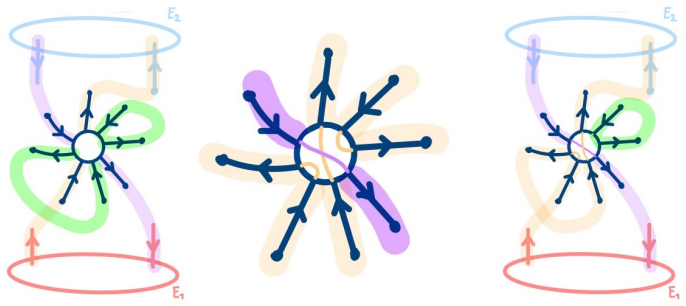
We prove that every class of Eulerian directed graphs of bounded carving width is well-quasi-ordered by strong immersion. In fact we prove a stronger result, namely that every class of Eulerian directed graphs of bounded carving width, where every vertex is additionally labeled from a well-quasi-order, fixes a linear order on its incident edges, and may impose further restrictions on how the immersion is allowed to route paths through it, is well-quasi-ordered by an adequate notion of strong immersion. To this extent we develop a framework seemingly suited to prove well-quasi-ordering for classes of Eulerian directed graphs by (strong) immersion and present a first meta theorem in that way.
What carries the argument
A framework that reduces well-quasi-ordering questions for Eulerian digraphs to properties preserved under strong immersion when carving width is bounded.
If this is right
- Any such bounded-carving-width class admits only finitely many minimal elements under strong immersion.
- The same ordering holds when vertices receive labels from an arbitrary well-quasi-order and when linear orders on incident edges are fixed.
- Routing restrictions at vertices can be added without destroying the well-quasi-ordering property.
- The result fails for Eulerian digraphs of unbounded degree even when treewidth is at most two.
- Certain restricted unbounded-degree classes are well-quasi-ordered by weak immersion but not by strong immersion.
Where Pith is reading between the lines
- The framework may supply a template for proving analogous ordering results for other width-bounded classes of directed graphs.
- The distinction drawn between strong and weak immersion suggests that algorithmic questions about immersion containment will behave differently depending on which notion is used.
- Finite obstruction sets implied by the ordering could support fixed-parameter algorithms for immersion problems restricted to bounded carving width.
Load-bearing premise
An adequate definition of strong immersion exists that respects vertex labels, linear edge orders, and arbitrary routing restrictions while still letting the well-quasi-ordering property follow from the framework.
What would settle it
An infinite sequence of Eulerian digraphs, all of bounded carving width, whose members are pairwise incomparable under the paper's notion of strong immersion would show the central claim false.
Figures



read the original abstract
We prove that every class of Eulerian directed graphs of bounded carving width (equivalently of bounded degree and treewidth) is well-quasi-ordered by strong immersion. In fact, we prove a stronger result, namely that every class of Eulerian directed graphs of bounded carving width, where every vertex is additionally labeled from a well-quasi-order, fixes a linear order on its incident edges, and may impose further restrictions on how the immersion is allowed to route paths through it, is well-quasi-ordered by an adequate notion of strong immersion. To this extent, we develop a framework seemingly suited to prove well-quasi-ordering for classes of Eulerian directed graphs by (strong) immersion and present a first meta theorem in that direction. We complement our results by observing that the class of Eulerian directed graphs of unbounded degree is \emph{not} well-quasi-ordered by \emph{strong} immersion, even if we assume the treewidth of the class to be at most two. We conclude with a dichotomy result, proving for a very restricted class of Eulerian directed graphs of unbounded degree that it is not well-quasi-ordered by strong immersion, but it is well-quasi-ordered by weak immersion.
Editorial analysis
A structured set of objections, weighed in public.
Referee Report
Summary. The manuscript proves that every class of Eulerian directed graphs of bounded carving width (equivalently, bounded degree and treewidth) is well-quasi-ordered by strong immersion. It establishes a stronger meta-theorem for classes where vertices carry labels from a WQO, incident edges have fixed linear orders, and vertices may impose arbitrary routing restrictions on immersions; the proof proceeds via a developed framework for WQO results on Eulerian digraphs under (strong) immersion. Complementary results show that unbounded-degree Eulerian digraphs are not WQO under strong immersion even at treewidth 2, and a weak-vs-strong immersion dichotomy holds for a restricted unbounded-degree subclass.
Significance. If the central claims hold, the work supplies one of the first meta-theorems for well-quasi-ordering of Eulerian digraphs under immersion, extending the landscape beyond undirected graphs and other orders. The framework for handling labels, edge orders, and vertex-specific restrictions is reusable and the negative results delineate the precise role of bounded carving width. The manuscript ships a self-contained proof structure together with explicit counter-examples, which strengthens its contribution to the field.
minor comments (3)
- [Abstract] Abstract: the phrase 'an adequate notion of strong immersion' is introduced without a forward pointer to its formal definition (presumably in the framework section); adding a one-sentence gloss or section reference would aid readers.
- [Introduction / main theorem statement] The equivalence 'bounded carving width (equivalently of bounded degree and treewidth)' is stated without a citation or short justification; a reference to the relevant lemma or standard fact would prevent any ambiguity for readers outside the immediate sub-area.
- [Dichotomy section] The final dichotomy result is presented concisely; a brief remark on whether the weak-immersion WQO extends to the labeled/ordered setting of the main theorem would clarify the scope of the positive results.
Simulated Author's Rebuttal
We thank the referee for the positive assessment of our manuscript, the recognition of its significance as one of the first meta-theorems for well-quasi-ordering Eulerian digraphs under strong immersion, and the recommendation for minor revision. The report accurately captures the main contributions, including the framework for handling labels, edge orders, and vertex restrictions, as well as the complementary negative results on unbounded-degree classes.
Circularity Check
No significant circularity in the proof structure
full rationale
The manuscript presents a direct mathematical proof of a meta-theorem establishing well-quasi-ordering for Eulerian digraphs of bounded carving width under strong immersion, including strengthened versions with vertex labels, edge orders, and routing restrictions. No equations, fitted parameters, or self-referential definitions appear; the derivation relies on a developed framework of standard graph-theoretic techniques for WQO results rather than reducing any central claim to its own inputs by construction. Complementary negative results and a weak-vs-strong dichotomy are stated separately without circular dependence. The argument is self-contained against external benchmarks in graph theory and does not invoke load-bearing self-citations or ansatzes smuggled from prior work by the same authors.
Axiom & Free-Parameter Ledger
axioms (2)
- standard math Well-quasi-orders are closed under finite products and certain relational constructions
- domain assumption Eulerian digraphs satisfy equal in-degree and out-degree at every vertex
Lean theorems connected to this paper
-
IndisputableMonolith/Foundation/RealityFromDistinction.leanreality_from_one_distinction unclear?
unclearRelation between the paper passage and the cited Recognition theorem.
We prove that every class of Eulerian directed graphs of bounded carving width ... is well-quasi-ordered by strong immersion. ... develop a framework ... meta theorem ...
-
IndisputableMonolith/Cost/FunctionalEquation.leanwashburn_uniqueness_aczel unclear?
unclearRelation between the paper passage and the cited Recognition theorem.
Ω-knitwork ... m_G ... reliable link ... well-linked ... inter-linked ...
What do these tags mean?
- matches
- The paper's claim is directly supported by a theorem in the formal canon.
- supports
- The theorem supports part of the paper's argument, but the paper may add assumptions or extra steps.
- extends
- The paper goes beyond the formal theorem; the theorem is a base layer rather than the whole result.
- uses
- The paper appears to rely on the theorem as machinery.
- contradicts
- The paper's claim conflicts with a theorem or certificate in the canon.
- unclear
- Pith found a possible connection, but the passage is too broad, indirect, or ambiguous to say the theorem truly supports the claim.
Reference graph
Works this paper leans on
-
[1]
J rgen Bang-Jensen and Gregory Gutin, editors. Classes of Directed Graphs . Springer Monographs in Mathematics . Springer International Publishing, Cham, 2018. https://doi.org/10.1007/978-3-319-71840-8 doi:10.1007/978-3-319-71840-8
-
[2]
Dan Bienstock. On embedding graphs in trees. Journal of Combinatorial Theory, Series B , 49(1):103--136, 1990
work page 1990
-
[3]
Strong immersion is a well-quasi-ordering for semicomplete digraphs
Florian Barbero, Christophe Paul, and Micha Pilipczuk. Strong immersion is a well-quasi-ordering for semicomplete digraphs. Journal of Graph Theory , 90(4):484--496, April 2019. https://doi.org/10.1002/jgt.22408 doi:10.1002/jgt.22408
-
[4]
Edge-disjoint paths in eulerian digraphs
Dario Giuliano Cavallaro, Ken-ichi Kawarabayashi, and Stephan Kreutzer. Edge-disjoint paths in eulerian digraphs. In Proceedings of the 56th Annual ACM Symposium on Theory of Computing , pages 704--715, 2024
work page 2024
-
[5]
A well-quasi-order for tournaments
Maria Chudnovsky and Paul Seymour. A well-quasi-order for tournaments. Journal of Combinatorial Theory, Series B , 101(1):47--53, 2011
work page 2011
-
[6]
Konrad K Dabrowski, Fran c ois Dross, Jisu Jeong, Mamadou Moustapha Kant \'e , O-joung Kwon, Sang-il Oum, Dani \"e l Paulusma, et al. Computing pivot-minors. arXiv preprint arXiv:2311.04656 , 2023
-
[7]
The complexity of the vertex-minor problem
Axel Dahlberg, Jonas Helsen, and Stephanie Wehner. The complexity of the vertex-minor problem. Information Processing Letters , 175:106222, 2022
work page 2022
-
[8]
R. Diestel. Graph Theory . Springer, Heidelberg, 2017. https://doi.org/10.1007/978-3-662-53622-3 doi:10.1007/978-3-662-53622-3
-
[9]
Well quasi-orders and regular languages
Aldo de Luca and Stefano Varricchio. Well quasi-orders and regular languages. Acta Informatica , 31:539--557, 1994
work page 1994
-
[10]
Two arc disjoint paths in Eulerian digraphs
Andr \'a s Frank, Toshihide Ibaraki, and Hiroshi Nagamochi. Two arc disjoint paths in Eulerian digraphs. In Algorithms and Computations ( ISAAC ) , volume 1004, pages 92--101, Berlin, Heidelberg , 1995. Springer Berlin Heidelberg . https://doi.org/10.1007/BFb0015412 doi:10.1007/BFb0015412
-
[11]
Connectivity and network flows
Andr \'a s Frank. Connectivity and network flows. Handbook of combinatorics , 1:111--177, 1995
work page 1995
-
[12]
Branch-width and well-quasi-ordering in matroids and graphs
James F Geelen, Albertus MH Gerards, and Geoff Whittle. Branch-width and well-quasi-ordering in matroids and graphs. Journal of Combinatorial Theory, Series B , 84(2):270--290, 2002
work page 2002
-
[13]
Ordering by Divisibility in Abstract Algebras
Graham Higman. Ordering by Divisibility in Abstract Algebras . Proc. of the London Mathematical Society , 2(3), 1952
work page 1952
-
[14]
The disjoint paths problem in quadratic time
Ken ichi Kawarabayashi, Yusuke Kobayashi, and Bruce Reed. The disjoint paths problem in quadratic time. Journal of Combinatorial Theory, Series B , 102(2):424--435, 2012. URL: https://www.sciencedirect.com/science/article/pii/S0095895611000712, https://doi.org/10.1016/j.jctb.2011.07.004 doi:10.1016/j.jctb.2011.07.004
-
[15]
Carl Darwin Thor Johnson. Eulerian digraph immersion . Princeton University, 2002
work page 2002
-
[16]
Thor Johnson, Neil Robertson, Paul D Seymour, and Robin Thomas. Directed tree-width. Journal of Combinatorial Theory, Series B , 82(1):138--154, 2001
work page 2001
-
[17]
Vertex-minors of graphs: A survey
Donggyu Kim and Sang-il Oum. Vertex-minors of graphs: A survey. Discrete Applied Mathematics , 351:54--73, 2024
work page 2024
-
[18]
Minor containment and disjoint paths in almost-linear time
Tuukka Korhonen, Micha Pilipczuk, and Giannos Stamoulis. Minor containment and disjoint paths in almost-linear time. In 2024 IEEE 65th Annual Symposium on Foundations of Computer Science (FOCS) , pages 53--61. IEEE, 2024
work page 2024
-
[19]
Well-quasi-ordering, the tree theorem, and vazsonyi's conjecture
Joseph B Kruskal. Well-quasi-ordering, the tree theorem, and vazsonyi's conjecture. Transactions of the American Mathematical Society , 95(2):210--225, 1960
work page 1960
-
[20]
The theory of well-quasi-ordering: A frequently discovered concept
Joseph B Kruskal. The theory of well-quasi-ordering: A frequently discovered concept. Journal of Combinatorial Theory, Series A , 13(3):297--305, 1972
work page 1972
-
[21]
Directed nowhere dense classes of graphs
Stephan Kreutzer and Siamak Tazari. Directed nowhere dense classes of graphs. In Yuval Rabani, editor, Proceedings of the Twenty-Third Annual ACM-SIAM Symposium on Discrete Algorithms , SODA 2012, Kyoto , Japan , January 17-19, 2012 , pages 1552--1562. SIAM, 2012. https://doi.org/10.1137/1.9781611973099.123 doi:10.1137/1.9781611973099.123
-
[22]
Recent progress on well-quasi-ordering graphs
Chun-Hung Liu. Recent progress on well-quasi-ordering graphs. Well-Quasi Orders in Computation, Logic, Language and Reasoning: A Unifying Concept of Proof Theory, Automata Theory, Formal Languages and Descriptive Set Theory , pages 161--188, 2020
work page 2020
-
[23]
Well-quasi-ordering digraphs with no long alternating paths by the strong immersion relation
Chun-Hung Liu and Irene Muzi. Well-quasi-ordering digraphs with no long alternating paths by the strong immersion relation. Journal of Combinatorial Theory, Series B , 158:210--251, 2023
work page 2023
-
[24]
Well-quasi-orders on embedded planar graphs
Corentin Lunel and Cl \'e ment Maria. Well-quasi-orders on embedded planar graphs. arXiv preprint arXiv:2512.04074 , 2025
-
[25]
Local structure for vertex-minors
Rose McCarty. Local structure for vertex-minors . PhD thesis, University of Waterloo, 2021
work page 2021
-
[26]
Well-quasi-order of plane minors and an application to link diagrams
Carolina Medina, Bojan Mohar, and Gelasio Salazar. Well-quasi-order of plane minors and an application to link diagrams. arXiv preprint arXiv:1905.01830 , 2019
-
[27]
Paths and topological minors in directed and undirected graphs
Irene Muzi. Paths and topological minors in directed and undirected graphs . PhD thesis, Ph. D. Dissertation, Sapienza Universita Di Roma, 2017
work page 2017
-
[28]
On well-quasi-ordering finite trees
C St JA Nash-Williams. On well-quasi-ordering finite trees. In Mathematical Proceedings of the Cambridge Philosophical Society , volume 59, pages 833--835. Cambridge University Press, 1963
work page 1963
-
[29]
Rank-width and well-quasi-ordering
Sang-il Oum. Rank-width and well-quasi-ordering. SIAM Journal on Discrete Mathematics , 22(2):666--682, 2008
work page 2008
-
[30]
Neil Robertson and Paul D Seymour. Graph minors. iv. tree-width and well-quasi-ordering. Journal of Combinatorial Theory, Series B , 48(2):227--254, 1990
work page 1990
-
[31]
N. Robertson and P.D. Seymour. Graph Minors . XIII . The Disjoint Paths Problem . Journal of Combinatorial Theory, Series B , 63(1):65--110, January 1995. https://doi.org/10.1006/jctb.1995.1006 doi:10.1006/jctb.1995.1006
-
[32]
Neil Robertson and Paul D Seymour. Graph minors. xix. well-quasi-ordering on a surface. Journal of Combinatorial Theory, Series B , 90(2):325--385, 2004
work page 2004
-
[33]
Neil Robertson and Paul D Seymour. Graph minors. xx. wagner's conjecture. Journal of Combinatorial Theory, Series B , 92(2):325--357, 2004
work page 2004
-
[34]
Neil Robertson and Paul D Seymour. Graph minors xxiii. nash-williams' immersion conjecture. J. Comb. Theory, Ser. B , 100(2):181--205, 2010
work page 2010
-
[35]
Paul D. Seymour and Robin Thomas. Call routing and the ratcatcher. Combinatorica , 14(2):217--241, 1994
work page 1994
discussion (0)
Sign in with ORCID, Apple, or X to comment. Anyone can read and Pith papers without signing in.