Recognition: no theorem link
Broken-symmetry shape discrimination on a driven Duffing ring
Pith reviewed 2026-05-11 02:05 UTC · model grok-4.3
The pith
A driven Duffing ring on a cycle graph breaks time-reversal symmetry to let one observable discriminate input shapes.
A machine-rendered reading of the paper's core claim, the machinery that carries it, and where it could break.
Core claim
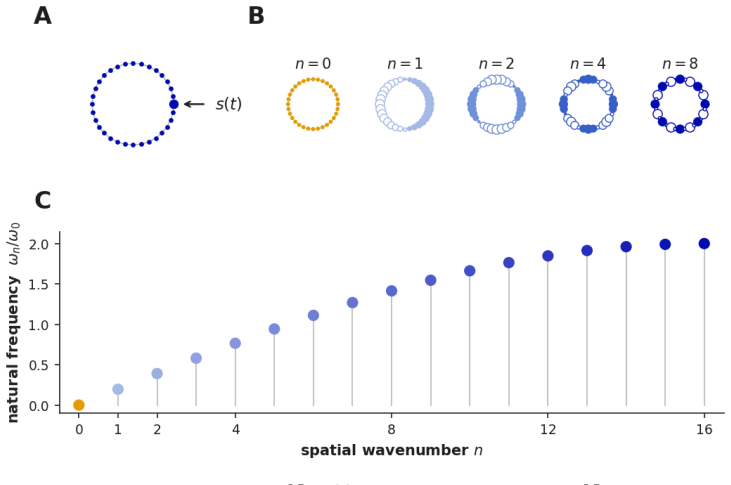
On a cycle graph substrate governed by a master equation, the linear regime sorts temporal inputs into symmetry-organized eigenmodes while the Duffing regime activates a cubic mode-mixing operation that obeys a sparse wavenumber selection rule imposed by the cycle symmetry; the resulting shape-dependent harmonics are summarised by a single observable φ₀ whose trajectory encodes the joint response of binding and dissipation, with exact π-periodicity in the shape parameter but broken time-reversal degeneracy due to dissipation, so that φ₀ remains a meaningful discriminator.
What carries the argument
The scalar observable φ₀ that summarises the Duffing ring's bound response to input shape; its symmetry structure (exact π-periodicity combined with dissipation-broken time-reversal invariance) is what makes the single number carry information about shape.
If this is right
- The linear regime produces a feature representation that matches windowed-FFT performance at high SNR and exceeds it for transient signals at low SNR.
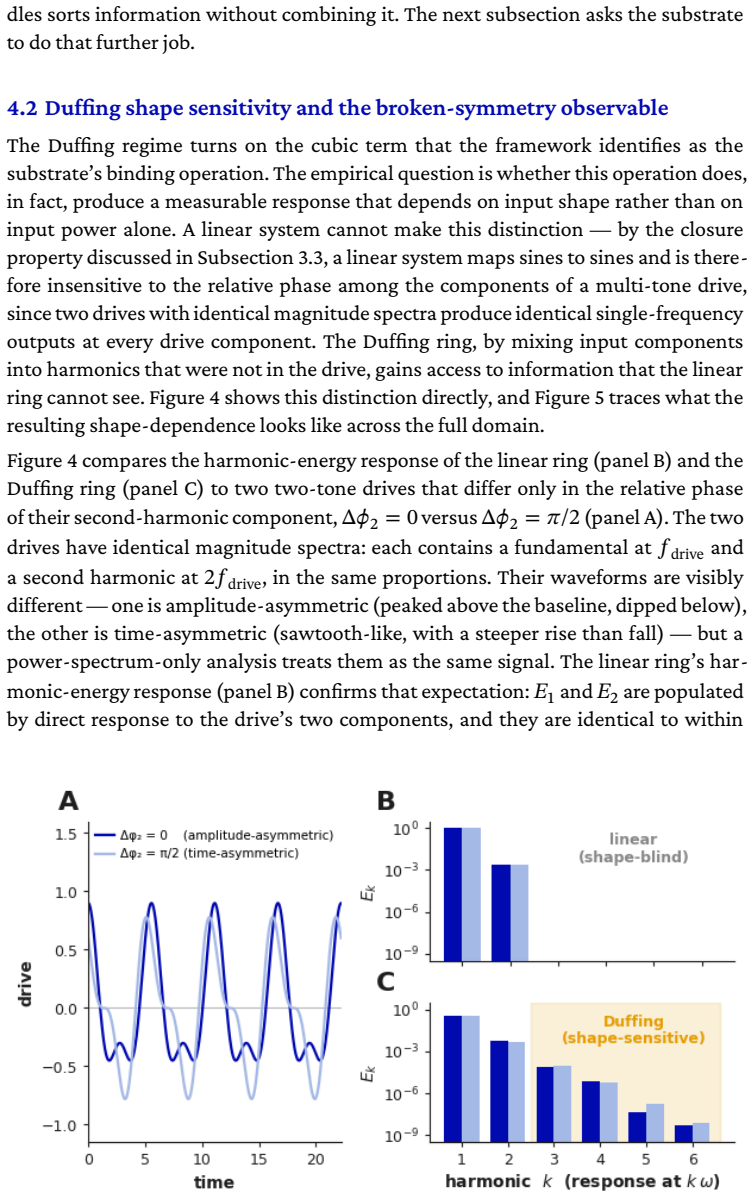
- The Duffing regime supplies shape-dependent harmonic content that linear evolution on the same substrate cannot generate.
- φ₀ remains separated from its symmetric-attractor value under additive band-limited noise down to 0 dB input SNR.
- The framework is stated for synthetic signals; the same symmetry-breaking mechanism is left open for richer drives and biological waveforms.
Where Pith is reading between the lines
- If the symmetry structure of φ₀ generalises, similar single-number readouts could be extracted from other closed nonlinear lattices without requiring explicit Fourier analysis.
- Hardware realisations using physical Duffing-like elements could implement low-overhead shape classification by monitoring only the phase and amplitude of the fundamental mode.
- The exact π-periodicity suggests that shape discrimination on this substrate is intrinsically insensitive to 180-degree inversions of the input waveform.
Load-bearing premise
The master equation and its two parameter regimes on a cycle graph of N nodes capture the essential bundling and binding behavior of more general distributed computational substrates.
What would settle it
Direct measurement of φ₀ across a range of input shapes at high SNR showing that its values collapse to a single degenerate level consistent with unbroken time-reversal symmetry, or seed-averaged means falling to the symmetric-attractor baseline at SNRs clearly above 0 dB.
Figures




read the original abstract
Distributed computational substrates rely on two elementary operations: bundling, the act of populating a shared physical medium with independently retrievable components, and binding, the act of composing components into outputs whose identity depends on their relations. We study these two primitives on the simplest closed substrate carrying a continuous symmetry, a cycle graph of N nodes, in two parameter regimes of a single master equation of motion. The linear regime sorts a temporal input across the substrate's U(1)-organised eigenmodes, providing a feature representation that matches a windowed-FFT baseline at high signal-to-noise ratio and modestly outperforms it for transient signals at low SNR. The Duffing regime activates a cubic mode-mixing operation constrained by the substrate's symmetry into a sparse selection rule on integer wavenumbers, generating shape-dependent harmonic content that the linear regime cannot produce. We identify a single-number observable, $\phi_0$, that summarises the bound representation's response to input shape, and we analyse its symmetry structure: a $\pi$-periodicity in the shape parameter is exact, while a time-reversal symmetry that would render $\phi_0$ degenerate is broken by the substrate's dissipation. The asymmetric status of these two symmetries is what licenses $\phi_0$ as a meaningful single-number observable; its trajectory across the quotient domain encodes the joint response of binding and dissipation to the input shape. Numerical experiments confirm that $\phi_0$ retains its information content under additive band-limited noise, with seed-averaged means staying clearly above the symmetric-attractor value down to 0 dB input SNR. The framework is developed on synthetic signals only; extensions to richer substrates, more elaborate drives, and real biological signals are open questions for the work that follows.
Editorial analysis
A structured set of objections, weighed in public.
Referee Report
Summary. The manuscript studies bundling and binding primitives on a cycle graph of N nodes governed by a single driven Duffing master equation in linear and nonlinear regimes. The linear regime yields eigenmode-based feature representations that match or modestly exceed windowed-FFT performance at low SNR for transients. The Duffing regime introduces symmetry-constrained cubic mode mixing that produces shape-dependent harmonic content. A scalar observable φ₀ is defined whose response to input shape is licensed by exact π-periodicity in the shape parameter together with dissipation-induced breaking of time-reversal symmetry. Numerical experiments on synthetic signals demonstrate that seed-averaged φ₀ remains statistically distinguishable from its symmetric-attractor value under additive band-limited noise down to 0 dB input SNR.
Significance. If the central numerical claim holds, the work supplies a symmetry-based, largely parameter-light mechanism for shape discrimination that exploits the interplay of nonlinearity, dissipation, and substrate topology. The explicit separation of exact versus broken symmetries and the restriction to synthetic signals provide a clean foundation for subsequent extensions to biological or hardware substrates. The approach is distinctive within physical-computing literature for grounding the observable directly in the quotient structure of the driven system rather than in learned or fitted features.
minor comments (2)
- The numerical section would benefit from an explicit statement of the precise definition of input SNR, the bandwidth of the added noise, the number of independent seeds, and the precise threshold used to declare 'clearly above' the symmetric-attractor value, ideally accompanied by error bars or confidence intervals on the reported means.
- Notation for the master equation and the definition of φ₀ should be collected in a single early section or appendix to improve readability; currently the symmetry analysis and the observable appear to be introduced across multiple paragraphs without a consolidated equation block.
Simulated Author's Rebuttal
We thank the referee for their positive summary, significance assessment, and recommendation of minor revision. The report contains no enumerated major comments, so we have no specific points to address point-by-point. We will incorporate minor editorial and clarification changes consistent with the recommendation in the revised manuscript.
Circularity Check
No significant circularity; derivation is self-contained
full rationale
The paper defines a master equation on a cycle graph of N nodes, splits it into linear and Duffing regimes, derives the single-number observable φ₀ directly from the model's U(1) symmetry (exact π-periodicity in the shape parameter) and dissipation-induced breaking of time-reversal symmetry, then confirms its noise robustness through separate numerical experiments. No equation reduces φ₀ to a fitted parameter by construction, no load-bearing claim rests on self-citation, and the symmetry analysis follows from the stated equations without importing uniqueness theorems or ansatzes from prior work by the same authors. The framework is explicitly limited to synthetic signals on this minimal substrate.
Axiom & Free-Parameter Ledger
free parameters (3)
- N (number of nodes)
- Drive amplitude and frequency
- Damping coefficient
axioms (2)
- domain assumption The substrate is a cycle graph with exact U(1) rotational symmetry.
- domain assumption The master equation accurately models the physical or computational substrate under study.
Reference graph
Works this paper leans on
-
[1]
All Together Now: Analogies between Chimera State Collapses and Epileptic Seizures
“All Together Now: Analogies between Chimera State Collapses and Epileptic Seizures.” Scien- tific Reports 6 : 23000. https:/ /doi.org/10.1038/srep23000. Boyd, R. W
-
[3]
Trends in Cognitive Sciences (2018) https://doi.org/10.1016/j.tics
“Brain Oscillations and the Importance of Waveform Shape.” Trends in Cognitive Sciences 21 (2): 137–49. https:/ /doi.org/10.1016/j.tics. 2016.12.008. Cole, S. R., and B. Voytek
-
[4]
Cycle-by-Cycle Analysis of Neural Oscillations
“Cycle-by-Cycle Analysis of Neural Oscillations.” Journal of Neurophysiology 122 (2): 849–61. https:/ /doi.org/10.1152/jn.00273.2019. Cole, S. R., R. van der Meij, E. J. Peterson, C. de Hemptinne, P. A. Starr, and B. Voytek
-
[5]
Nonsinusoidal Beta Oscillations Reflect Cortical Pathophysiology in Parkinson's Disease
“Nonsinusoidal Beta Oscillations Reflect Cortical Pathophysiology in Parkinson's Disease.” The Journal of Neuroscience 37 (18): 4830–40. https:/ /doi. org/10.1523/JNEUROSCI.2208-16.2017. Donoghue, T., N. Schaworonkow, and B. Voytek
-
[6]
Methodological Considera - tions for Studying Neural Oscillations
“Methodological Considera - tions for Studying Neural Oscillations.” European Journal of Neuroscience 55 (11–12): 3502–27. https:/ /doi.org/10.1111/ejn.15361. Enel, P., E. Procyk, R. Quilodran, and P. F. Dominey
-
[7]
Reservoir Computing Properties of Neural Dynamics in Prefrontal Cortex
“Reservoir Computing Properties of Neural Dynamics in Prefrontal Cortex.” Plos Computational Biology 12 (6): e1004967. https:/ /doi.org/10.1371/journal.pcbi.1004967. Gallou, O., J. Bartels, S. Ghosh, K. A. Schindler, J. Sarnthein, and G. Indiveri
-
[8]
“Online Epileptic Seizure Detection in Long-Term iEEG Recordings Using Mixed- Signal Neuromorphic Circuits.” In “2024 IEEE Biomedical Circuits and Systems 32 Conference (Biocas).” Special issue, 2024 IEEE Biomedical Circuits and Systems Con- ference (Biocas), 2024, 1–5. https:/ /doi.org/10.1109/biocas61083.2024.10798236. Glomb, K., J. Rué Queralt, D. Pasc...
-
[9]
Connectome Spectral Analysis to Track EEG Task Dynamics on a Subsecond Scale
“Connectome Spectral Analysis to Track EEG Task Dynamics on a Subsecond Scale.” Neuroimage 221 : 117137. https:/ /doi.org/10.1016/j.neuroimage.2020.117137. Holmes, P
-
[10]
A Nonlinear Oscillator with a Strange Attractor
“A Nonlinear Oscillator with a Strange Attractor.” Philosophical Trans- actions of the Royal Society of London a 292 (1394): 419–48. https:/ /doi.org/10.1098/ rsta.1979.0068. Hoppensteadt, F. C., and E. M. Izhikevich
-
[11]
Oscillatory Neurocomputers with Dynamic Connectivity
“Oscillatory Neurocomputers with Dynamic Connectivity.” Physical Review Letters 82 (14): 2983–86. https:/ /doi.org/ 10.1103/PhysRevLett.82.2983. Hyafil, A
- [12]
-
[13]
Reservoir computing approaches to recurrent neural network training
“Reservoir Computing Approaches to Recurrent Neural Network Training.” Computer Science Review 3 (3): 127–49. https:/ /doi.org/ 10.1016/j.cosrev.2009.03.005. Maass, W., T. Natschläger, and H. Markram
-
[14]
“Physical Reservoir Computing Enabled by Solitary Waves and Biologically Inspired Nonlinear Transformation of Input Data.” Dynamics 4 (1): 119–34. https:/ /doi.org/10.3390/dynamics4010007. Müller, E. J., B. R. Munn, K. M. Aquino, J. M. Shine, and P. A. Robinson
-
[15]
“The Music of the Hemispheres: Cortical Eigenmodes as a Physical Basis for Large- Scale Brain Activity and Connectivity Patterns.” Frontiers in Human Neuroscience 16 : 1062487. https:/ /doi.org/10.3389/fnhum.2022.1062487. Müller, M. F., C. Rummel, M. Goodfellow, and K. A. Schindler
-
[16]
“Standing Waves as an Explanation for Generic Stationary Correlation Patterns in Noninvasive EEG of Focal Onset Seizures.” Brain Connectivity 4 (2): 131–44. https:/ /doi.org/10.1089/ brain.2013.0192. Nayfeh, A. H., and D. T. Mook
-
[17]
The Brain Wave Equation: A Model for the EEG
“The Brain Wave Equation: A Model for the EEG.” Mathematical Biosciences 21 (3–4): 279–97. https:/ /doi.org/10.1016/0025-5564(74)90020-0. Pang, J. C., K. M. Aquino, M. Oldehinkel, P. A. Robinson, B. D. Fulcher, M. Breakspear, and A. Fornito
-
[18]
Geometric Constraints on Human Brain Function
“Geometric Constraints on Human Brain Function.” Nature 618 (7965): 566–74. https:/ /doi.org/10.1038/s41586-023-06098-1. 33 Plate, T. A
-
[19]
Propagation and Stability of Waves of Electrical Activity in the Cerebral Cortex
“Propagation and Stability of Waves of Electrical Activity in the Cerebral Cortex.” Physical Review E 56 (1): 826–40. https:/ /doi.org/10.1103/PhysRevE.56.826. Schindler, K. A., and A. Rahimi
-
[20]
A Primer on Hyperdimensional Computing for iEEG Seizure Detection
“A Primer on Hyperdimensional Computing for iEEG Seizure Detection.” Frontiers in Neurology 12 : 701791. https:/ /doi.org/10.3389/ fneur.2021.701791. Schindler, K. A., C. E. Elger, and K. Lehnertz
-
[21]
Increasing Synchronization May Promote Seizure Termination: Evidence from Status Epilepticus
“Increasing Synchronization May Promote Seizure Termination: Evidence from Status Epilepticus.” Clinical Neuro- physiology 118 (9): 1955–68. https:/ /doi.org/10.1016/j.clinph.2007.06.006. Schindler, K. A., H. Gast, M. Goodfellow, and C. Rummel
-
[22]
“On Seeing the Trees and the Forest: Single-Signal and Multisignal Analysis of Periictal Intracranial EEG.” Epilepsia 53 (9): 1658–68. https:/ /doi.org/10.1111/j.1528-1167.2012.03588.x. Schindler, K. A., H. Leung, C. E. Elger, and K. Lehnertz
-
[23]
Assessing Seizure Dynamics by Analysing the Correlation Structure of Multichannel Intracranial EEG
“Assessing Seizure Dynamics by Analysing the Correlation Structure of Multichannel Intracranial EEG.” Brain 130 (1): 65–77. https:/ /doi.org/10.1093/brain/awl304. Schindler, K. A., C. Rummel, R. G. Andrzejak, M. Goodfellow, F. Zubler, E. Abela, R. Wiest, C. Pollo, A. Steimer, and H. Gast
-
[24]
Ictal Time-Irreversible Intracranial EEG Signals as Markers of the Epileptogenic Zone
“Ictal Time-Irreversible Intracranial EEG Signals as Markers of the Epileptogenic Zone.” Clinical Neurophysiology 127 (9): 3051–58. https:/ /doi.org/10.1016/j.clinph.2016.07.001. Shuman, D. I., S. K. Narang, P. Frossard, A. Ortega, and P. Vandergheynst
-
[25]
“The Emerging Field of Signal Processing on Graphs: Extending High-Dimensional Data Analysis to Networks and Other Irregular Domains.” IEEE Signal Processing Magazine 30 (3): 83–98. https:/ /doi.org/10.1109/MSP.2012.2235192. Smolensky, P
-
[26]
https:/ /doi.org/10.1016/0004-3702(90)90007-M. Todri-Sanial, A., C. Delacour, M. Abernot, and F. Sabo
-
[27]
https:/ /doi.org/10.1038/s44335-024-00015-z. Xie, X., C. Cai, P. F. Damasceno, S. S. Nagarajan, and A. Raj
-
[28]
Emergence of Canonical Functional Networks from the Structural Connectome
“Emergence of Canonical Functional Networks from the Structural Connectome.” Neuroimage 237 : 118190. https:/ /doi.org/10.1016/j.neuroimage.2021.118190. Yilmaz, G., A. Seiler, O. Chételat, and K. A. Schindler
discussion (0)
Sign in with ORCID, Apple, or X to comment. Anyone can read and Pith papers without signing in.