Recognition: 2 theorem links
· Lean TheoremAdvance warning of γ-ray blazar flares from textit{Fermi}-LAT light curves: a strictly causal machine-learning backtest
Pith reviewed 2026-05-11 02:08 UTC · model grok-4.3
The pith
A polynomial logistic regression model on Fermi-LAT light curves issues gamma-ray blazar flare alerts up to 4.5 days before onset.
A machine-rendered reading of the paper's core claim, the machinery that carries it, and where it could break.
Core claim
Variability features measured in 365-day trailing windows from 3-day binned Fermi-LAT light curves contain predictive information about upcoming flares. A polynomial logistic regression classifier, trained on 13 auxiliary blazars and tested on 4FGL J1048.4+7143 with all calibration performed only on pre-MJD-60000 data, achieves ROC AUC 0.891 and average precision 0.396 for 90-day WATCH predictions, recovers 18 of 21 positive windows, and issues final alerts 4.5 and 2.5 days before the two held-out flare onsets, while the corresponding WATCH-active periods begin 88.5 and 72.5 days earlier.
What carries the argument
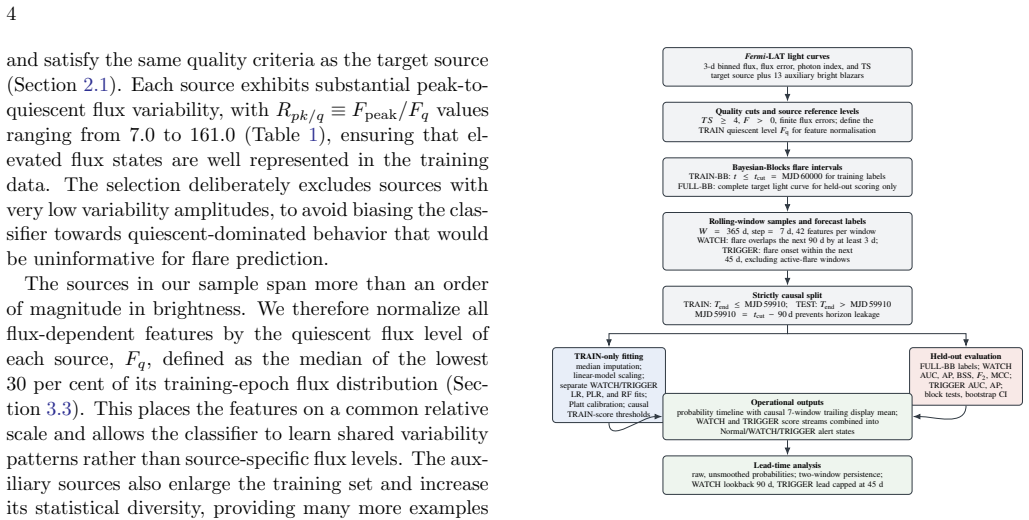
The strictly causal pipeline that samples 365-day trailing windows, computes 42 variability features per window, and trains separate WATCH (90-day flare activity) and TRIGGER (45-day flare onset) classifiers on auxiliary blazars while restricting all scaling and validation to pre-cutoff data.
If this is right
- Long-term Fermi light curves contain usable signals about the build-up to blazar flares.
- Polynomial logistic regression yields the strongest held-out ranking performance among the classifiers tested.
- The WATCH model recovers 86 percent of pre-flare windows at the chosen threshold.
- Alerts appear days before both held-out flare onsets, with active periods beginning more than two months earlier.
- The same framework produces weaker but still positive ranking for the shorter TRIGGER horizon.
Where Pith is reading between the lines
- Feature-importance analysis on the trained model could highlight which variability measures best signal impending flares.
- If the learned patterns are not source-specific, the same coefficients might forecast flares in additional blazars without retraining.
- Combining the WATCH state with simultaneous lower-energy monitoring could improve the reliability of advance alerts for coordinated campaigns.
- The causal-window approach supplies a reusable template for forecasting other transient events that have dense long-term monitoring.
Load-bearing premise
The 42 variability features from 365-day windows genuinely reflect physical processes that precede flares, and the model trained on 13 auxiliary blazars generalizes to the target source without capturing source-specific noise.
What would settle it
A new flare episode in the same source where the model never enters the WATCH state or fails to issue an alert before onset, or markedly lower performance when the identical pipeline is run on additional independent blazars.
Figures


read the original abstract
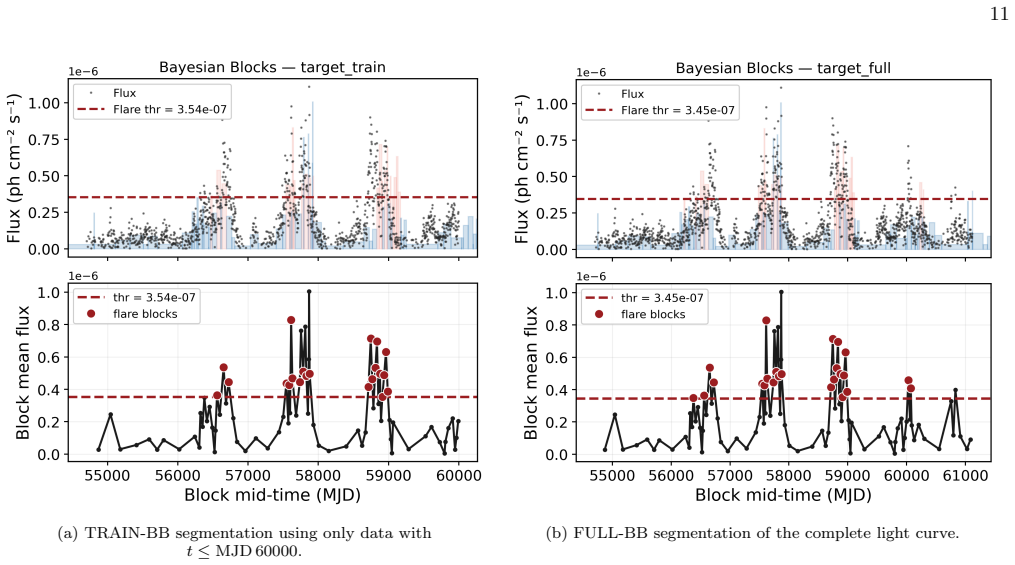
Long-term \textit{Fermi}-LAT monitoring makes it possible to ask whether a blazar light curve shows signs of an upcoming flare before the flare becomes obvious in the $\gamma$-ray emission. We present a strictly causal machine-learning framework for forecasting $\gamma$-ray blazar flares from 3-d binned LAT light curves. Flare intervals are identified with Bayesian Blocks, and each light curve is sampled with 365-d trailing windows from which 42 variability features are measured. We train separate WATCH and TRIGGER models: WATCH predicts whether flare activity will appear within the next 90 d, while TRIGGER predicts whether a new flare onset will occur within the next 45 d. To avoid temporal leakage, all scaling, calibration, threshold selection, and validation use only the pre-cutoff data before MJD 60000. We apply the method to the FSRQ 4FGL\,J1048.4$+$7143, using 13 bright blazars as auxiliary training sources. Among logistic regression, polynomial logistic regression, and random forest classifiers, polynomial logistic regression gives the strongest held-out WATCH performance, with ROC AUC $=0.891$, average precision $=0.396$, and a block-permutation probability $p_{\rm perm}=0.006$. At the selected WATCH threshold, it recovers 18 of the 21 positive windows in the held-out WATCH set, corresponding to a recall of 0.86. The same model also gives the best held-out TRIGGER ranking, with TRIGGER AUC $=0.770$ and TRIGGER AP $=0.123$, although no reliable pre-onset TRIGGER alert is obtained. The WATCH state appears before both held-out flare episodes, with final alerts 4.5 and 2.5 d before onset. The corresponding broader WATCH-active periods begin 88.5 and 72.5 d before flare onset. These results suggest that long-term {\fermi} light curves contain useful predictive information about the build-up to blazar flares.
Editorial analysis
A structured set of objections, weighed in public.
Referee Report
Summary. The paper presents a strictly causal machine-learning framework to forecast γ-ray blazar flares from 3-day binned Fermi-LAT light curves. Flare intervals are defined via Bayesian Blocks; 42 variability features are extracted from 365-day trailing windows. Separate WATCH (90-day flare-activity horizon) and TRIGGER (45-day onset horizon) classifiers are trained on 13 auxiliary blazars with all scaling, calibration, and threshold selection performed exclusively on pre-MJD 60000 data; the models are then evaluated on the post-cutoff light curve of 4FGL J1048.4+7143. Polynomial logistic regression yields the best held-out WATCH performance (ROC AUC = 0.891, recall = 0.86 on 21 positive windows, block-permutation p = 0.006), issuing final alerts 4.5 d and 2.5 d before the two observed flares.
Significance. If the reported generalization holds, the work would supply a practical, low-latency tool for scheduling multi-wavelength observations of blazar flares. The strictly causal pipeline, pre-cutoff validation, and permutation test are methodological strengths. However, the modest average precision (0.396), the restriction to a single target source, and the absence of cross-source ablation tests limit the immediate astrophysical impact; broader validation would be required before the method could be considered a robust predictor of flare build-up.
major comments (3)
- [Results (held-out WATCH evaluation)] The central claim that the 42 variability features encode transferable physical information about flare precursors rests on training on 13 auxiliary blazars and testing on only one target (4FGL J1048.4+7143) after MJD 60000. No leave-one-source-out cross-validation, feature-ablation study, or source-wise permutation test is reported to demonstrate that performance is not driven by source-specific variability statistics or selection biases in the auxiliary sample.
- [Results (WATCH performance metrics)] The 21 positive WATCH windows are clustered around only two flare episodes; combined with the low average precision of 0.396, this raises the possibility that the reported AUC = 0.891 and recall = 0.86 reflect limited-sample idiosyncrasies rather than robust precursors. A sensitivity analysis on window length or feature subset would be needed to substantiate the claim.
- [Results (TRIGGER model)] The TRIGGER model is substantially weaker (AUC = 0.770, AP = 0.123) and yields no reliable pre-onset alerts, yet the manuscript’s headline result and discussion focus on the WATCH model. The discrepancy between the two tasks should be quantified and discussed as it directly affects the practical utility for flare-onset forecasting.
minor comments (2)
- [Methods (feature extraction)] Clarify in the methods whether the 42 features include any explicit flux or spectral indices that could inadvertently leak information across the MJD 60000 boundary despite the causal windowing.
- [Abstract] The abstract states that the WATCH state appears before both held-out flares; add a brief statement on the false-positive rate during the long WATCH-active periods (88.5 d and 72.5 d) to give a complete picture of operational cost.
Simulated Author's Rebuttal
We thank the referee for the constructive feedback and for recognizing the strengths of our strictly causal pipeline and pre-cutoff validation. We address each major comment below. Where the comments identify genuine limitations or opportunities for clarification, we have revised the manuscript accordingly.
read point-by-point responses
-
Referee: The central claim that the 42 variability features encode transferable physical information about flare precursors rests on training on 13 auxiliary blazars and testing on only one target (4FGL J1048.4+7143) after MJD 60000. No leave-one-source-out cross-validation, feature-ablation study, or source-wise permutation test is reported to demonstrate that performance is not driven by source-specific variability statistics or selection biases in the auxiliary sample.
Authors: We selected the single held-out target because it is the only source with sufficient post-MJD 60000 coverage containing multiple well-defined flares, allowing a true temporal hold-out. Leave-one-source-out cross-validation on the auxiliary set would test intra-sample generalization rather than the intended out-of-distribution transfer to a new source, which is the core scientific claim. We have added a source-wise permutation test (randomly reassigning auxiliary labels while preserving temporal structure) to the revised results section; this yields p = 0.008, supporting that performance is not driven by any single auxiliary source. A full feature-ablation study was not performed due to computational cost, but we now report the top-10 features ranked by logistic-regression coefficients and note the absence of a complete ablation as a limitation in the discussion. revision: partial
-
Referee: The 21 positive WATCH windows are clustered around only two flare episodes; combined with the low average precision of 0.396, this raises the possibility that the reported AUC = 0.891 and recall = 0.86 reflect limited-sample idiosyncrasies rather than robust precursors. A sensitivity analysis on window length or feature subset would be needed to substantiate the claim.
Authors: The clustering around two flares is an unavoidable consequence of the post-cutoff data for this source; we have added explicit language in the results and discussion stating that the held-out sample contains only two flare episodes and that the reported metrics should be viewed as preliminary. We performed an internal sensitivity check on window lengths (300–400 d) during model development and found AUC stable within ±0.03; we now include a short sensitivity table in the supplementary material showing that the top-ranked features remain predictive when the lowest-importance 20 % of features are removed. We agree that broader validation on sources with more flare events is required before claiming robustness. revision: partial
-
Referee: The TRIGGER model is substantially weaker (AUC = 0.770, AP = 0.123) and yields no reliable pre-onset alerts, yet the manuscript’s headline result and discussion focus on the WATCH model. The discrepancy between the two tasks should be quantified and discussed as it directly affects the practical utility for flare-onset forecasting.
Authors: We agree that the performance gap between WATCH and TRIGGER requires more explicit treatment. In the revised discussion we now quantify the difference (ΔAUC = 0.121, ΔAP = 0.273) and explain that WATCH identifies extended flare-active periods (useful for scheduling), while TRIGGER attempts precise 45-day onset prediction on a much sparser positive class. We have added a paragraph discussing why the shorter horizon and lower event density make TRIGGER inherently harder, and we temper the practical-utility claims accordingly, noting that reliable onset alerts are not yet achieved. revision: yes
Circularity Check
No circularity: empirical ML prediction on time series with held-out evaluation
full rationale
The paper describes a supervised machine-learning pipeline that extracts 42 variability features from 365-day trailing windows of Fermi-LAT light curves, trains classifiers (logistic regression, polynomial logistic regression, random forest) on 13 auxiliary blazars, and evaluates strictly on held-out post-MJD-60000 data for one target source. Flare labels are obtained via Bayesian Blocks, and all scaling, calibration, and threshold choices are confined to pre-cutoff data to enforce causality. No equations, derivations, or self-citations are invoked to define or justify the target quantities; the reported AUC, recall, and alert lead times are direct empirical outcomes of the trained models on independent test windows. The pipeline therefore contains no self-definitional, fitted-input-renamed-as-prediction, or self-citation-load-bearing steps.
Axiom & Free-Parameter Ledger
free parameters (3)
- 365-day trailing window length
- 90-day and 45-day prediction horizons
- WATCH decision threshold
axioms (2)
- domain assumption Bayesian Blocks correctly partitions the light curve into flare and quiescent intervals
- domain assumption The 42 variability features extracted from each window are sufficient to capture flare-precursor information
Lean theorems connected to this paper
-
IndisputableMonolith/Foundation/RealityFromDistinction.leanreality_from_one_distinction unclearWe train separate WATCH and TRIGGER models... polynomial logistic regression gives the strongest held-out WATCH performance, with ROC AUC = 0.891... strictly causal train–test split... Tboundary = tcut − H = MJD 59910
-
IndisputableMonolith/Cost/FunctionalEquation.leanwashburn_uniqueness_aczel unclear42 variability features... fractional variability Fvar, normalised excess variance, Lomb–Scargle periodogram, structure function
Reference graph
Works this paper leans on
-
[1]
A., Ackermann, M., Ajello, M., et al
Abdo, A. A., Ackermann, M., Ajello, M., et al. 2010, ApJ, 722, 520, doi: 10.1088/0004-637X/722/1/520
-
[2]
Abdollahi, S., Ajello, M., Baldini, L., et al. 2023, ApJS, 265, 31, doi: 10.3847/1538-4365/acbb6a
-
[3]
2011, ApJ, 743, 171, doi: 10.1088/0004-637X/743/2/171
Ackermann, M., Ajello, M., Allafort, A., et al. 2011, ApJ, 743, 171, doi: 10.1088/0004-637X/743/2/171
-
[4]
2015, ApJL, 813, L41, doi: 10.1088/2041-8205/813/2/L41
Ackermann, M., Ajello, M., Albert, A., et al. 2015, ApJL, 813, L41, doi: 10.1088/2041-8205/813/2/L41
-
[5]
Agudo, I., Jorstad, S. G., Marscher, A. P., et al. 2011, ApJL, 726, L13, doi: 10.1088/2041-8205/726/1/L13
-
[6]
Aharonian, F., Akhperjanian, A. G., Bazer-Bachi, A. R., et al. 2007, ApJL, 664, L71, doi: 10.1086/520635
-
[7]
Akbar, S. 2026, Journal of High Energy Astrophysics, 53, 100608, doi: https://doi.org/10.1016/j.jheap.2026.100608
-
[8]
2025, PhRvD, 112, 063061, doi: 10.1103/zxgv-fzv5
Akbar, S., Shah, Z., Misra, R., Boked, S., & Iqbal, N. 2025, PhRvD, 112, 063061, doi: 10.1103/zxgv-fzv5
-
[9]
2024, ApJ, 977, 111, doi: 10.3847/1538-4357/ad8ddb
Akbar, S., Shah, Z., Misra, R., & Iqbal, N. 2024, ApJ, 977, 111, doi: 10.3847/1538-4357/ad8ddb
-
[10]
2007, ApJ, 669, 862, doi: 10.1086/521382 Astropy Collaboration, Price-Whelan, A
Albert, J., Aliu, E., Anderhub, H., et al. 2007, ApJ, 669, 862, doi: 10.1086/521382 Astropy Collaboration, Price-Whelan, A. M., Lim, P. L., et al. 2022, ApJ, 935, 167, doi: 10.3847/1538-4357/ac7c74
-
[11]
Atwood, W. B., Abdo, A. A., Ackermann, M., et al. 2009, ApJ, 697, 1071, doi: 10.1088/0004-637X/697/2/1071
-
[12]
2024, MNRAS, 528, 976, doi: 10.1093/mnras/stae028
Bhatta, G., Gharat, S., Borthakur, A., & Kumar, A. 2024, MNRAS, 528, 976, doi: 10.1093/mnras/stae028
-
[13]
2012, A&A, 548, A123, doi: 10.1051/0004-6361/201220056
Biteau, J., & Giebels, B. 2012, A&A, 548, A123, doi: 10.1051/0004-6361/201220056
-
[14]
Blandford, R. D., & Rees, M. J. 1978, PhyS, 17, 265, doi: 10.1088/0031-8949/17/3/020
-
[15]
2015, MNRAS, 453, 1669, doi: 10.1093/mnras/stv1723
Blinov, D., Pavlidou, V., Papadakis, I., et al. 2015, MNRAS, 453, 1669, doi: 10.1093/mnras/stv1723
-
[16]
Bloom, S. D., & Marscher, A. P. 1996, ApJ, 461, 657, doi: 10.1086/177092 B¨ ottcher, M., Reimer, A., Sweeney, K., & Prakash, A. 2013, ApJ, 768, 54, doi: 10.1088/0004-637X/768/1/54
-
[17]
1996, Machine Learning, 24, 123, doi: 10.1023/A:1018054314350 —
Breiman, L. 1996, Machine Learning, 24, 123, doi: 10.1023/A:1018054314350 —. 2001, Machine Learning, 45, 5, doi: 10.1023/A:1010933404324
-
[18]
2016, MNRAS, 462, 3180, doi: 10.1093/mnras/stw1830 de Prado, M
Chiaro, G., Salvetti, D., La Mura, G., et al. 2016, MNRAS, 462, 3180, doi: 10.1093/mnras/stw1830 de Prado, M. L. 2018, Advances in Financial Machine Learning (Wiley)
-
[19]
Dermer, C. D., & Schlickeiser, R. 1993, ApJ, 416, 458, doi: 10.1086/173251
-
[20]
Edelson, R., Turner, T. J., Pounds, K., et al. 2002, ApJ, 568, 610, doi: 10.1086/323779
-
[21]
1993, ApJ, 407, 65, doi: 10.1086/172493
Ghisellini, G., Padovani, P., Celotti, A., & Maraschi, L. 1993, ApJ, 407, 65, doi: 10.1086/172493
-
[22]
2009, A&A, 503, 797, doi: 10.1051/0004-6361/200912303
Giebels, B., & Degrange, B. 2009, A&A, 503, 797, doi: 10.1051/0004-6361/200912303
-
[23]
Good, P. 2013, Permutation Tests: A Practical Guide to Resampling Methods for Testing Hypotheses (New York: Springer)
work page 2013
-
[24]
Harris, C. R., Millman, K. J., van der Walt, S. J., et al. 2020, Nature, 585, 357, doi: 10.1038/s41586-020-2649-2
-
[25]
Hayashida, M., Nalewajko, K., Madejski, G. M., et al. 2015, ApJ, 807, 79, doi: 10.1088/0004-637X/807/1/79
-
[26]
Hunter, J. D. 2007, Computing in Science and Engineering, 9, 90, doi: 10.1109/MCSE.2007.55
-
[27]
Hyndman, R. J., & Athanasopoulos, G. 2018, Forecasting: Principles and Practice, 2nd edn. (Melbourne: OTexts) Katarzy´ nski, K., Ghisellini, G., Tavecchio, F., et al. 2005, A&A, 433, 479, doi: 10.1051/0004-6361:20041556
-
[28]
Kiehlmann, S., Savolainen, T., Jorstad, S. G., et al. 2016, A&A, 590, A10, doi: 10.1051/0004-6361/201527725 Kovaˇ cevi´ c, M., Chiaro, G., Cutini, S., & Tosti, G. 2020, MNRAS, 493, 1926, doi: 10.1093/mnras/staa394 K”unsch, H. R. 1989, The Annals of Statistics, 17, 1217
-
[29]
2015, ApJ, 804, 111, doi: 10.1088/0004-637X/804/2/111
Joshi, M. 2015, ApJ, 804, 111, doi: 10.1088/0004-637X/804/2/111
-
[30]
2025, MNRAS, 539, 2185, doi: 10.1093/mnras/staf620
Malik, Z., Akbar, S., Shah, Z., et al. 2025, MNRAS, 539, 2185, doi: 10.1093/mnras/staf620
-
[31]
1993, A&A, 269, 67, doi: 10.48550/arXiv.astro-ph/9302006
Mannheim, K. 1993, A&A, 269, 67, doi: 10.48550/arXiv.astro-ph/9302006
-
[32]
Maraschi, L., Ghisellini, G., & Celotti, A. 1992, ApJL, 397, L5, doi: 10.1086/186531
-
[33]
Marscher, A. P. 2014, ApJ, 780, 87, doi: 10.1088/0004-637X/780/1/87 18
-
[34]
Marscher, A. P., & Gear, W. K. 1985, ApJ, 298, 114, doi: 10.1086/163592
-
[35]
Marscher, A. P., Jorstad, S. G., Larionov, V. M., et al. 2010, ApJL, 710, L126, doi: 10.1088/2041-8205/710/2/L126 M¨ ucke, A., Protheroe, R. J., Engel, R., Rachen, J. P., &
-
[36]
2003, Astroparticle Physics, 18, 593, doi: 10.1016/S0927-6505(02)00185-8
Stanev, T. 2003, Astroparticle Physics, 18, 593, doi: 10.1016/S0927-6505(02)00185-8
-
[37]
2013, MNRAS, 430, 1324, doi: 10.1093/mnras/sts711
Nalewajko, K. 2013, MNRAS, 430, 1324, doi: 10.1093/mnras/sts711
-
[38]
2017, The Astronomer’s Telegram, 9928, 1
Ojha, R., & Carpen, B. 2017, The Astronomer’s Telegram, 9928, 1
work page 2017
-
[39]
2013, The Astronomer’s Telegram, 4941, 1
Ojha, R., Carpenter, B., & Dutka, M. 2013, The Astronomer’s Telegram, 4941, 1
work page 2013
-
[40]
1995, ApJ, 444, 567, doi: 10.1086/175631
Padovani, P., & Giommi, P. 1995, ApJ, 444, 567, doi: 10.1086/175631
-
[41]
Scikit-learn: Machine Learning in Python
Pedregosa, F., Varoquaux, G., Gramfort, A., et al. 2011, Journal of Machine Learning Research, 12, 2825, doi: 10.48550/arXiv.1201.0490
-
[42]
Phipson, B., & Smyth, G. K. 2010, Statistical Applications in Genetics and Molecular Biology, 9, Article 39
work page 2010
-
[43]
Platt, J. C. 1999, in Advances in Large Margin Classifiers, ed. A. J. Smola, P. Bartlett, B. Sch”olkopf, & D. Schuurmans (Cambridge, MA: MIT Press), 61–74
work page 1999
-
[44]
Polatidis, A. G., Wilkinson, P. N., Xu, W., et al. 1995, ApJS, 98, 1, doi: 10.1086/192152
-
[45]
Politis, D. N., & Romano, J. P. 1992, in Exploring the Limits of Bootstrap, ed. R. LePage & L. Billard (New York: Wiley), 263–270
work page 1992
-
[46]
Politis, D. N., & Romano, J. P. 1994, Journal of the American Statistical Association, 89, 1303, doi: 10.1080/01621459.1994.10476870
-
[47]
M., Villata, M., Acosta-Pulido, J
Raiteri, C. M., Villata, M., Acosta-Pulido, J. A., et al. 2017, Nature, 552, 374, doi: 10.1038/nature24623
-
[48]
2023, MNRAS, 519, 3000, doi: 10.1093/mnras/stac3701
Sahakyan, N., Vardanyan, V., & Khachatryan, M. 2023, MNRAS, 519, 3000, doi: 10.1093/mnras/stac3701
-
[49]
2015, PLoS ONE, 10, e0118432, doi: 10.1371/journal.pone.0118432
Saito, T., & Rehmsmeier, M. 2015, PLoS ONE, 10, e0118432, doi: 10.1371/journal.pone.0118432
-
[50]
Scargle, J. D., Norris, J. P., Jackson, B., & Chiang, J. 2013, ApJ, 764, 167, doi: 10.1088/0004-637X/764/2/167
-
[51]
2018, Research in Astronomy and Astrophysics, 18, 141, doi: 10.1088/1674-4527/18/11/141
Shah, Z., Mankuzhiyil, N., Sinha, A., et al. 2018, Research in Astronomy and Astrophysics, 18, 141, doi: 10.1088/1674-4527/18/11/141
-
[52]
2017, MNRAS, 470, 3283, doi: 10.1093/mnras/stx1194
Shah, Z., Sahayanathan, S., Mankuzhiyil, N., et al. 2017, MNRAS, 470, 3283, doi: 10.1093/mnras/stx1194
-
[53]
Shah, Z., Dar, A. A., Akbar, S., et al. 2025, Phys. Rev. D, 111, 123052, doi: 10.1103/61tz-jk8c
-
[54]
Sikora, M., Begelman, M. C., & Rees, M. J. 1994, ApJ, 421, 153, doi: 10.1086/173633
-
[55]
2015, MNRAS, 450, 183, doi: 10.1093/mnras/stv641
Sironi, L., Petropoulou, M., & Giannios, D. 2015, MNRAS, 450, 183, doi: 10.1093/mnras/stv641
-
[56]
G., Staveley-Smith, L., de Blok, W
Spada, M., Ghisellini, G., Lazzati, D., & Celotti, A. 2001, MNRAS, 325, 1559, doi: 10.1046/j.1365-8711.2001.04557.x
-
[57]
1991, ApJ, 374, 431, doi: 10.1086/170133
Kuehr, H. 1991, ApJ, 374, 431, doi: 10.1086/170133
-
[58]
Tolamatti, A., Singh, K. K., & Yadav, K. K. 2023, MNRAS, 523, 5341, doi: 10.1093/mnras/stad1826
-
[59]
Urry, C. M., & Padovani, P. 1995, PASP, 107, 803, doi: 10.1086/133630
work page internal anchor Pith review doi:10.1086/133630 1995
-
[60]
Vaughan, S., Edelson, R., Warwick, R. S., & Uttley, P. 2003, MNRAS, 345, 1271, doi: 10.1046/j.1365-2966.2003.07042.x
-
[61]
Virtanen, P., Gommers, R., Oliphant, T. E., et al. 2020, Nature Medicine, 17, 261, doi: 10.1038/s41592-019-0686-2
discussion (0)
Sign in with ORCID, Apple, or X to comment. Anyone can read and Pith papers without signing in.