Recognition: no theorem link
Beyond the conventional Emery model: crucial role of long-range hopping for cuprate superconductivity
Pith reviewed 2026-05-11 02:52 UTC · model grok-4.3
The pith
Long-range hoppings beyond the standard three parameters are required in the Emery model to produce the quantitatively correct superconducting phase diagram and proper d-wave order parameter for cuprates.
A machine-rendered reading of the paper's core claim, the machinery that carries it, and where it could break.
Core claim
Using the dynamical vertex approximation on an Emery model that incorporates long-range hoppings, the authors obtain a superconducting dome whose doping range and transition temperatures align with cuprate experiments, together with a d-wave order parameter of the expected symmetry; the same calculations performed with only the three conventional hopping amplitudes fail to achieve either outcome.
What carries the argument
Dynamical vertex approximation applied to the extended Emery model that includes oxygen-copper and oxygen-oxygen hoppings beyond nearest and next-nearest neighbors.
If this is right
- The superconducting dome appears at the doping levels observed in cuprates only after long-range terms are restored.
- The d-wave symmetry of the order parameter emerges correctly solely when hoppings beyond the usual three parameters are retained.
- Models limited to nearest- and next-nearest-neighbor hoppings systematically misrepresent the quantitative location and extent of the superconducting region.
Where Pith is reading between the lines
- Effective low-energy theories of cuprates may need to retain longer-range hoppings rather than integrating them out.
- Comparisons with angle-resolved photoemission data could test whether the longer-range terms improve the predicted Fermi-surface shape and gap anisotropy.
- Similar extensions might be required in related models of other strongly correlated superconductors.
Load-bearing premise
The dynamical vertex approximation captures the essential physics of the extended Emery model and the specific long-range hopping amplitudes chosen are representative of real cuprate materials.
What would settle it
A calculation or experiment showing that an Emery model restricted to only the three conventional hoppings already produces both the correct superconducting dome and d-wave order parameter would falsify the claim.
Figures




read the original abstract
The Emery model is the quintessential model for cuprate superconductors. In his eponymous paper, Emery only considered the next-nearest-neighbor oxygen-copper hopping. Later, also the relevance of nearest- and next-nearest oxygen-oxygen hoppings has been pointed out. Using dynamical vertex approximation, we find a superconducting dome consistent with cuprates. However, long-range hoppings beyond the three conventional hopping parameters are necessary for the quantitatively correct phase diagram and for a proper d-wave order parameter.
Editorial analysis
A structured set of objections, weighed in public.
Referee Report
Summary. The manuscript applies the dynamical vertex approximation (DVA) to an extended Emery model for cuprate superconductors. It reports that the conventional three hopping parameters (t_pd, t_pp, t_pp') produce a superconducting dome, but that additional long-range hopping terms are required to achieve quantitative agreement with the experimental cuprate phase diagram and to obtain a proper d-wave order parameter.
Significance. If the central claim holds after validation, the work would demonstrate that minimal hopping models are quantitatively insufficient for cuprate superconductivity and that longer-range processes must be retained in effective models. This could shift modeling practices toward more realistic Hamiltonians and highlight the utility of DVA for capturing non-local pairing correlations in strongly correlated systems.
major comments (2)
- [§4] §4 (results on the conventional three-parameter Emery model): The claim that long-range hoppings are necessary for a quantitatively correct phase diagram and proper d-wave order parameter presupposes that DVA faithfully reproduces the physics of the restricted model (i.e., that d-wave superconductivity is suppressed or the dome is incorrect without the extra terms). No cross-checks against exact diagonalization, QMC, or DMFT on the standard Emery model at comparable dopings and U values are reported, leaving open the possibility that the differential effect of long-range terms compensates for method limitations rather than revealing new physics.
- [Methods] Methods section on hopping parameters: The specific numerical values adopted for the long-range hopping amplitudes are presented without derivation, error estimates, or sensitivity analysis. It is unclear whether they originate from ab initio downfolding, experimental fitting, or ad-hoc choice; without this information the assertion of 'necessity' for quantitative agreement cannot be isolated from parameter tuning.
minor comments (2)
- [Figures] Figure captions and axis labels in the phase-diagram plots should explicitly state the doping range and temperature grid used, as well as any finite-size or frequency cutoffs employed in the DVA.
- [Abstract] The abstract states the central result but supplies no details on how long-range amplitudes were selected or on approximation validity; a brief sentence on these points would improve clarity for readers.
Simulated Author's Rebuttal
We thank the referee for the careful reading and constructive comments. We respond point by point to the major remarks, indicating where the manuscript will be revised.
read point-by-point responses
-
Referee: §4 (results on the conventional three-parameter Emery model): The claim that long-range hoppings are necessary for a quantitatively correct phase diagram and proper d-wave order parameter presupposes that DVA faithfully reproduces the physics of the restricted model (i.e., that d-wave superconductivity is suppressed or the dome is incorrect without the extra terms). No cross-checks against exact diagonalization, QMC, or DMFT on the standard Emery model at comparable dopings and U values are reported, leaving open the possibility that the differential effect of long-range terms compensates for method limitations rather than revealing new physics.
Authors: We acknowledge that the manuscript does not contain new direct benchmarks of DVA against ED, QMC or DMFT for the three-parameter Emery model at the dopings and interaction strengths considered here. Prior publications have validated DVA for d-wave superconductivity in the Hubbard and Emery models against these methods, and we will add explicit citations together with a short discussion of the method’s known accuracy and limitations. The observed improvement in d-wave symmetry upon inclusion of long-range terms is internally consistent within our DVA calculations; we will revise §4 and the discussion to make this methodological context clearer. revision: partial
-
Referee: Methods section on hopping parameters: The specific numerical values adopted for the long-range hopping amplitudes are presented without derivation, error estimates, or sensitivity analysis. It is unclear whether they originate from ab initio downfolding, experimental fitting, or ad-hoc choice; without this information the assertion of 'necessity' for quantitative agreement cannot be isolated from parameter tuning.
Authors: The long-range hopping amplitudes were obtained from ab initio downfolding of DFT calculations, following the procedure described in the cited references. We will expand the methods section to state the origin explicitly, quote the numerical values, provide the relevant references, and include a brief sensitivity analysis showing that the reported necessity of these terms and the shape of the superconducting dome remain robust under moderate variations of the long-range amplitudes. revision: yes
Circularity Check
No significant circularity detected
full rationale
The paper applies dynamical vertex approximation to the Emery model, first with the conventional three hopping parameters and then with added long-range terms, reporting that only the latter yields a quantitatively correct superconducting dome and d-wave order parameter. This is a direct numerical comparison between two Hamiltonian variants rather than any self-definitional loop, fitted parameter renamed as prediction, or load-bearing self-citation. No equations or claims in the abstract reduce the central result to its own inputs by construction; the derivation remains an independent computational study of model extensions.
Axiom & Free-Parameter Ledger
free parameters (1)
- long-range hopping amplitudes
axioms (1)
- domain assumption Dynamical vertex approximation provides a sufficiently accurate treatment of correlations in the extended Emery model
Reference graph
Works this paper leans on
-
[1]
and infinite-layer nickelates [35], even successfully predicting the experimental phase diagram [36]. The approximation underlying the diagrammatic extensions arXiv:2605.07739v1 [cond-mat.str-el] 8 May 2026 2 relies on the momentum-independence of theirreducible vertex. This assumption is justified over a wide param- eter range; however, at very small dop...
work page internal anchor Pith review Pith/arXiv arXiv doi:10.55776/i5398 2026
- [2]
-
[3]
N. Gauquelin, D. G. Hawthorn, G. A. Sawatzky, R. Liang, D. A. Bonn, W. N. Hardy, and G. A. Botton, Atomic scale real-space mapping of holes in YBa2Cu3O6+δ, Nat. Commun.5, 4275 (2014)
work page 2014
-
[4]
M. Jurkutat, D. Rybicki, O. P. Sushkov, G. V. M. Williams, A. Erb, and J. Haase, Distribution of electrons and holes in cuprate superconductors as determined from 17O and 63Cu nuclear magnetic resonance, Phys. Rev. B 90, 140504 (2014)
work page 2014
-
[5]
C. T. Chen, F. Sette, Y. Ma, M. S. Hybertsen, E. B. Stechel, W. M. C. Foulkes, M. Schulter, S.-W. Cheong, A. S. Cooper, L. W. Rupp, B. Batlogg, Y. L. Soo, Z. H. Ming, A. Krol, and Y. H. Kao, Electronic states in La2−xSrxCuO4+δ probed by soft-x-ray absorption, Phys. Rev. Lett.66, 104 (1991)
work page 1991
-
[6]
V. J. Emery, Theory of high–T c superconductivity in ox- ides, Phys. Rev. Lett.58, 2794 (1987)
work page 1987
-
[7]
J. G. Bednorz and K. A. M¨ uller, Possible high t c su- perconductivity in the Ba-La-Cu-O system, Z. Phys. B Condens. Matter64, 189 (1986)
work page 1986
-
[8]
A. Damascelli, Z. Hussain, and Z.-X. Shen, Angle- resolved photoemission studies of the cuprate supercon- ductors, Rev. Mod. Phys.75, 473 (2003)
work page 2003
-
[9]
E. Gull and A. Millis, Numerical models come of age, Nature Phys.11, 808 (2015)
work page 2015
-
[10]
M. Qin, T. Sch¨ afer, S. Andergassen, P. Corboz, and E. Gull, The hubbard model: A computational perspec- tive, Annu. Rev. Condens. Matter Phys.13, 275 (2022)
work page 2022
-
[11]
D. P. Arovas, E. Berg, S. A. Kivelson, and S. Raghu, The hubbard model, Annu. Rev. Condens. Matter Phys.13, 239 (2022)
work page 2022
- [12]
-
[13]
M. B. Z¨ olfl, T. Maier, T. Pruschke, and J. Keller, Elec- tronic properties of CuO 2-planes: A DMFT study, Eur. Phys. J. B13, 47 (2000)
work page 2000
- [14]
-
[15]
P. Hansmann, N. Parragh, A. Toschi, G. Sangiovanni, and K. Held, Importance ofd–pCoulomb interaction for highT c cuprates and other oxides, New J. Phys.16, 33009 (2014)
work page 2014
-
[16]
X.-J. Han, P. Werner, and C. Honerkamp, Investiga- tion of the effective interactions for the emery model by the constrained random-phase approximation and con- strained functional renormalization group, Phys. Rev. B 103, 125130 (2021)
work page 2021
-
[17]
Hubbard vs. Emery model: spectra, transport and relevance for cuprates
J. Vuˇ ciˇ cevi´ c and R. ˇZitko, Hubbard vs. Emery model: spectra, transport and relevance for cuprates 10.48550/arXiv.2604.08085 (2026)
work page internal anchor Pith review Pith/arXiv arXiv doi:10.48550/arxiv.2604.08085 2026
- [18]
-
[19]
L. Fratino, P. S´ emon, G. Sordi, and A.-M. S. Tremblay, Pseudogap and superconductivity in two-dimensional doped charge-transfer insulators, Phys. Rev. B93, 245147 (2016)
work page 2016
-
[20]
N. Kowalski, S. S. Dash, P. S´ emon, D. S´ en´ echal, and A.-M. S. Tremblay, Oxygen hole content, charge-transfer gap, covalency, and cuprate superconductivity, Proc. Natl. Acad. Sci. U.S.A.118, e2106476118 (2021)
work page 2021
-
[21]
P. Mai, G. Balduzzi, S. Johnston, R. T. Scalettar, and T. A. Maier, Orbital structure of the effective pair- ing interaction in the high-temperature superconducting cuprates, npj Quantum Materials6, 26 (2021)
work page 2021
-
[22]
P. Mai, G. Balduzzi, S. Johnston, and T. A. Maier, Pair- ing correlations in the cuprates: A numerical study of the three-band Hubbard model, Phys. Rev. B103, 144514 (2021)
work page 2021
- [23]
-
[24]
G. L. Reaney, N. Kowalski, A.-M. S. Tremblay, and G. Sordi, Charge gap and charge redistribution among copper and oxygen orbitals in the normal state of the emery model, Phys. Rev. B112, 125106 (2025)
work page 2025
- [25]
-
[28]
B. Bacq-Labreuil, B. Lacasse, A.-M. S. Tremblay, D. S´ en´ echal, and K. Haule, Towards an ab initio theory of high-temperature superconductors: a study of multilayer cuprates (2025), arXiv:2410.10019 [cond-mat.str-el]
-
[29]
E. W. Huang, C. B. Mendl, S. Liu, S. Johnston, H.-C. Jiang, B. Moritz, and T. P. Devereaux, Numerical evi- dence of fluctuating stripes in the normal state of high-Tc cuprate superconductors, Science358, 1161 (2017)
work page 2017
-
[30]
P. Mai, B. Cohen-Stead, T. A. Maier, and S. John- ston, Fluctuating charge-density-wave correlations in the three-band hubbard model, Proc. Natl. Acad. Sci. U.S.A. 121, e2408717121 (2024)
work page 2024
-
[32]
G. Rohringer, H. Hafermann, A. Toschi, A. A. Katanin, A. E. Antipov, M. I. Katsnelson, A. I. Lichtenstein, A. N. Rubtsov, and K. Held, Diagrammatic routes to nonlocal correlations beyond dynamical mean field theory, Rev. Mod. Phys.90, 25003 (2018)
work page 2018
- [33]
-
[34]
A. A. Katanin, A. Toschi, and K. Held, Comparing perti- nent effects of antiferromagnetic fluctuations in the two- and three-dimensional Hubbard model, Phys. Rev. B80, 75104 (2009)
work page 2009
-
[35]
M. Kitatani, T. Sch¨ afer, H. Aoki, and K. Held, Why the critical temperature of high-T c cuprate superconductors is so low: The importance of the dynamical vertex struc- ture, Phys. Rev. B99, 41115 (2019)
work page 2019
-
[36]
M. Kitatani, L. Si, O. Janson, R. Arita, Z. Zhong, and K. Held, Nickelate superconductors – a renaissance of the one-band Hubbard model, npj Quantum Materials5, 59 (2020)
work page 2020
-
[37]
K. Lee, B. Y. Wang, M. Osada, B. H. Goodge, T. C. Wang, Y. Lee, S. Harvey, W. J. Kim, Y. Yu, C. Murthy, S. Raghu, L. F. Kourkoutis, and H. Y. Hwang, Linear- in-temperature resistivity for optimally superconducting (Nd, Sr)NiO2, Nature619, 288 (2023)
work page 2023
-
[38]
Y. Yu, S. Iskakov, E. Gull, K. Held, and F. Krien, Pairing boost from enhanced spin-fermion coupling in the pseu- dogap regime, Phys. Rev. B112, L041105 (2025)
work page 2025
-
[39]
E. Pavarini, I. Dasgupta, T. Saha-Dasgupta, O. Jepsen, and O. K. Andersen, Band-structure trend in hole-doped cuprates and correlation witht cmax, Phys. Rev. Lett.87, 047003 (2001)
work page 2001
- [40]
-
[41]
J. P. Perdew, K. Burke, and M. Ernzerhof, Generalized gradient approximation made simple, Phys. Rev. Lett. 77, 3865 (1996)
work page 1996
- [42]
-
[43]
N. Marzari, A. A. Mostofi, J. R. Yates, I. Souza, and D. Vanderbilt, Maximally localized wannier functions: Theory and applications, Rev. Mod. Phys.84, 1419 (2012)
work page 2012
-
[44]
J. Kuneˇ s, R. Arita, P. Wissgott, A. Toschi, H. Ikeda, and K. Held, Wien2wannier: From linearized augmented plane waves to maximally localized Wannier functions, Comp. Phys. Comm.181, 1888 (2010)
work page 2010
-
[45]
G. Pizzi, V. Vitale, R. Arita, S. Bl¨ ugel, F. Freimuth, G. G´ eranton, M. Gibertini, D. Gresch, C. Johnson, T. Koretsune, J. Iba˜ nez-Azpiroz, H. Lee, J.-M. Lihm, D. Marchand, A. Marrazzo, Y. Mokrousov, J. I. Mustafa, Y. Nohara, Y. Nomura, L. Paulatto, S. Ponc´ e, T. Pon- weiser, J. Qiao, F. Th¨ ole, S. S. Tsirkin, M. Wierzbowska, N. Marzari, D. Vanderbi...
work page 2020
-
[46]
F. Aryasetiawan, M. Imada, A. Georges, G. Kotliar, S. Biermann, and A. I. Lichtenstein, Frequency- dependent local interactions and low-energy effective models from electronic structure calculations, Phys. Rev. B70, 195104 (2004)
work page 2004
-
[47]
O. S. Bariˇ si´ c and S. Bariˇ si´ c, High-energy anomalies in covalent high-Tc cuprates with large HubbardU d on cop- per, Physica B: Condensed Matter460, 141 (2015)
work page 2015
-
[48]
C. Gauvin-Ndiaye, J. Leblanc, S. Marin, N. Martin, D. Lessnich, and A.-M. S. Tremblay, Two-particle self- consistent approach for multiorbital models: Application to the emery model, Phys. Rev. B109, 165111 (2024)
work page 2024
-
[49]
Y. Peng and M. Jiang, Interplay between hubbard in- teraction and charge transfer energy in the three-orbital emery model: Implications for cuprates and nickelates, Phys. Rev. B112, 235147 (2025)
work page 2025
-
[50]
M. Wallerberger, A. Hausoel, P. Gunacker, A. Kowal- ski, N. Parragh, F. Goth, K. Held, and G. Sangiovanni, w2dynamics: Local one- and two-particle quantities from dynamical mean field theory, Comp. Phys. Comm.235, 388 (2019)
work page 2019
- [51]
-
[52]
M. Kitatani, R. Arita, T. Sch¨ afer, and K. Held, Strongly correlated superconductivity with long-range spatial fluc- tuations, Journal of Physics: Materials5, 034005 (2022)
work page 2022
-
[53]
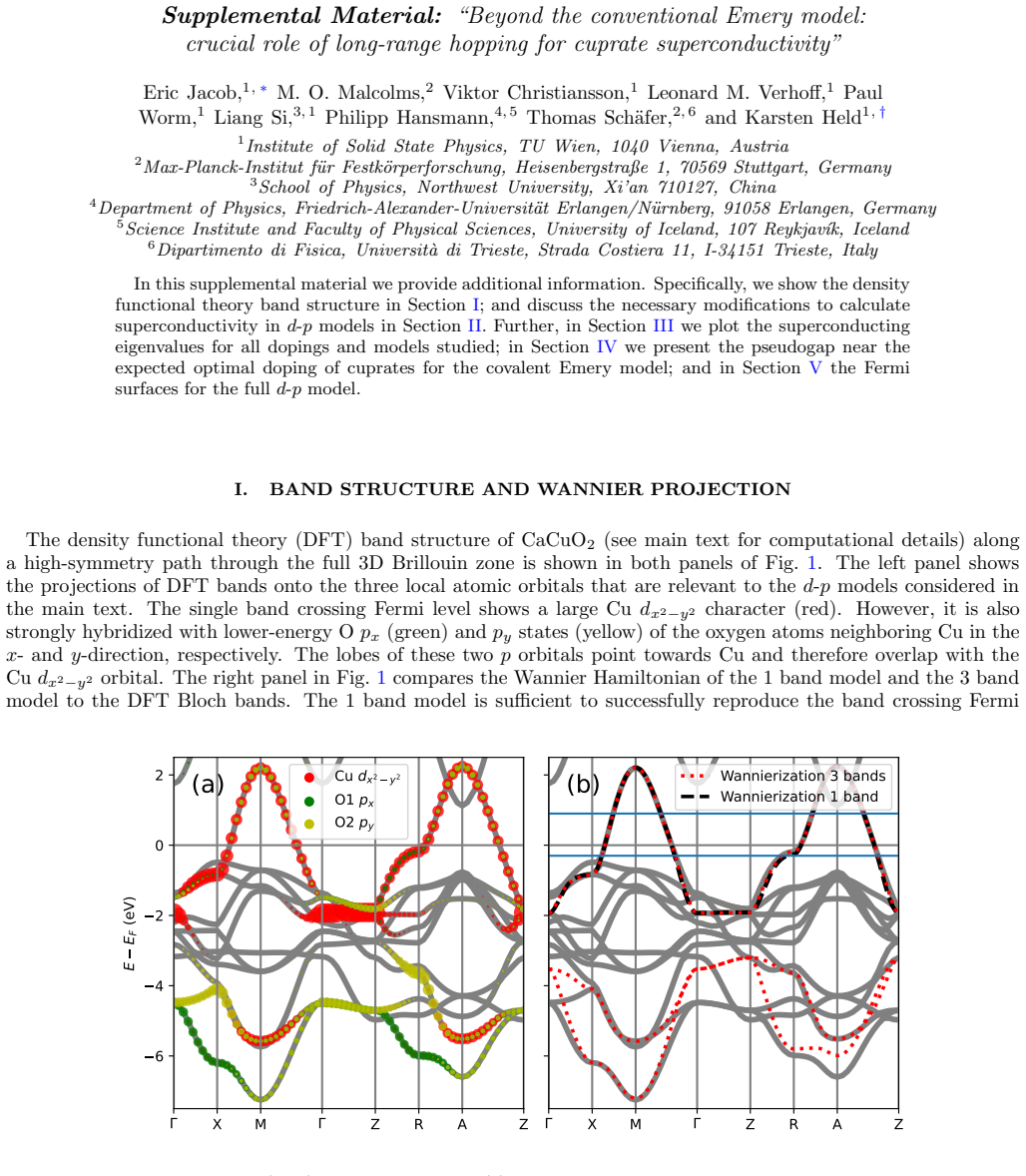
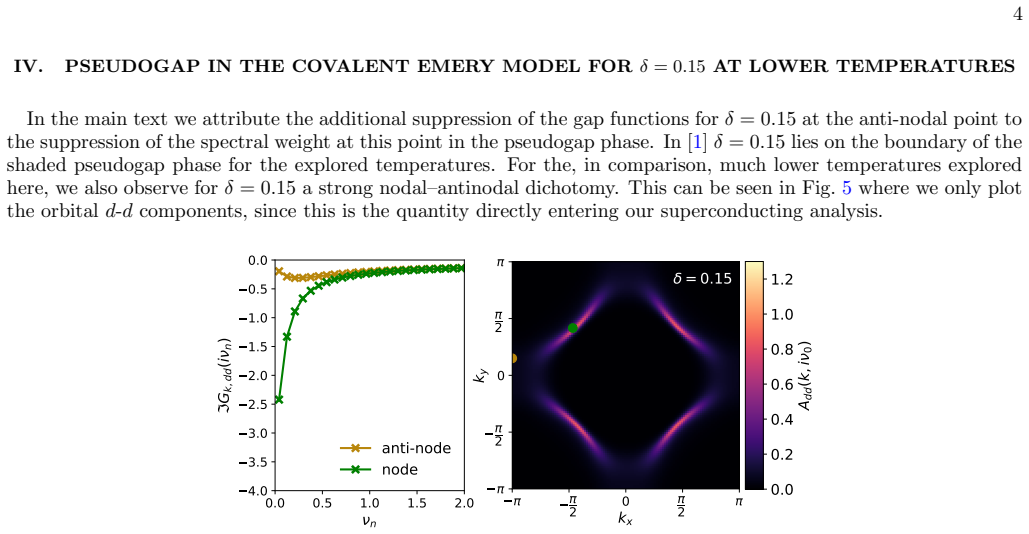
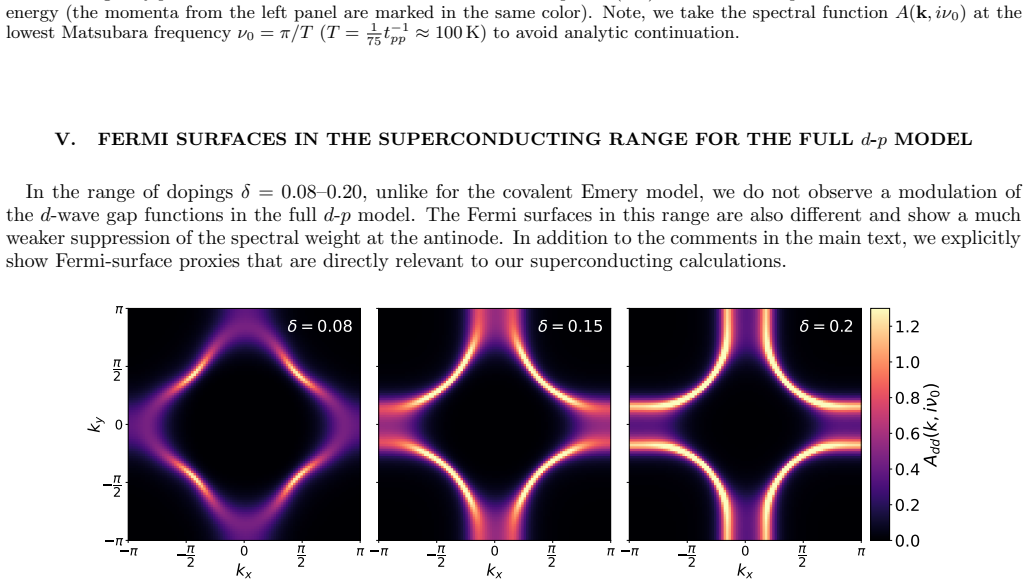
The supplemental material available at [URL will be in- serted by publisher] provides further information on the DFT band structure, the superconducting calculations, the superconducting eigenvalue curves to obtainT c, the pseudogap in the covalent Emery model near the cuprate optimal doping, and the Fermi surfaces of the fulld-p model; and includes the f...
-
[54]
R. S. Markiewicz, S. Sahrakorpi, M. Lindroos, H. Lin, and A. Bansil, One-band tight-binding model parametrization of the high-T c cuprates including the ef- fect ofk z dispersion, Phys. Rev. B72, 054519 (2005)
work page 2005
- [55]
-
[56]
Note that the minor deviation of the fulld-pmodel (2D) from the DFT-Wannier bands originates from the hop- pings in thez-direction which are neglected
-
[57]
M. Kitatani, L. Si, P. Worm, J. M. Tomczak, R. Arita, and K. Held, Optimizing superconductivity: From 7 cuprates via nickelates to palladates (2023)
work page 2023
-
[58]
Y. Gao, W. Wu, Z. Liu, K. Held, and L. Si, Topotactical hydrogen induced single-bandd-wave superconductivity in la2nio4, Phys. Rev. Lett.135, 026002 (2025)
work page 2025
-
[59]
W. Wu, E. Jacob, V. Christiansson, Y. Gao, Z. Zeng, K. Held, and L. Si, Single-band fluorides akin to infinite- layer cuprate superconductors, npj Quantum Materials 10.1038/s41535-025-00831-x (2026)
-
[60]
Let us also note, that we observe a competingp-wave eigenvalue for this parameter set
This effect is possibly somewhat exaggerated in ladder DΓA, since the (three-leg) vertex can become enhanced (k-dependent) promoting superconductivity further into the pseudogap regime, see [37] where this effect was ob- served, albeit at a considerably smaller doping. Let us also note, that we observe a competingp-wave eigenvalue for this parameter set
-
[61]
B. Raveau, Mechanisms generating layered cuprates and oxycarbonates: Classification, inHigh-Tc Superconduc- tivity 1996: Ten Years after the Discovery(Springer,
work page 1996
-
[62]
D. Di Castro, C. Cantoni, F. Ridolfi, C. Aruta, A. Tebano, N. Yang, and G. Balestrino, High-T c super- conductivity at the interface between the cacuo 2 and srtio3 insulating oxides, Phys. Rev. Lett.115, 147001 (2015)
work page 2015
- [63]
-
[64]
D. Di Castro, C. Aruta, A. Tebano, D. Innocenti, M. Mi- nola, M. Moretti Sala, W. Prellier, O. Lebedev, and G. Balestrino, Tc up to 50 k in superlattices of insulat- ing oxides, Superconductor Science and Technology27, 044016 (2014)
work page 2014
-
[65]
I. M. Vishik, W. S. Lee, F. Schmitt, B. Moritz, T. Sasagawa, S. Uchida, K. Fujita, S. Ishida, C. Zhang, T. P. Devereaux, and Z. X. Shen, Doping-dependent nodal Fermi velocity of the high-temperature supercon- ductor Bi 2Sr2CaCu2O8+δ revealed using high-resolution angle-resolved photoemission spectroscopy, Phys. Rev. Lett.104, 207002 (2010)
work page 2010
-
[66]
I. K. Drozdov, I. Pletikosi´ c, C.-K. Kim, K. Fujita, G. D. Gu, J. C. S. Davis, P. D. Johnson, I. Boˇ zovi´ c, and T. Valla, Phase diagram of Bi 2Sr2CaCu2O8+δ revisited, Nat. Commun.9, 5210 (2018). Supplemental Material:“Beyond the conventional Emery model: crucial role of long-range hopping for cuprate superconductivity” Eric Jacob, 1,∗ M. O. Malcolms, 2...
work page 2018
- [67]
-
[68]
M. Kitatani, T. Sch¨ afer, H. Aoki, and K. Held, Why the critical temperature of high-Tc cuprate superconductors is so low: The importance of the dynamical vertex structure, Phys. Rev. B99, 41115 (2019)
work page 2019
discussion (0)
Sign in with ORCID, Apple, or X to comment. Anyone can read and Pith papers without signing in.