Recognition: no theorem link
Vibe coding before the trend
Pith reviewed 2026-05-11 01:58 UTC · model grok-4.3
The pith
Student reflections from early AI coding challenges reveal shifts from syntax to higher-order thinking and AI viewed as a partner.
A machine-rendered reading of the paper's core claim, the machinery that carries it, and where it could break.
Core claim
Through vibe coding challenges conducted across multiple student groups, the authors found that participants reported AI tools moving their focus from memorizing syntax to engaging in higher-order thinking and evaluation. They framed AI proficiency as a career necessity and described working with AI as a collaborative partnership instead of a replacement. Non-technical students expressed the strongest appreciation for how these tools lowered barriers to participation in coding tasks.
What carries the argument
Analysis of student reflections after the vibe coding challenges to extract five recurring patterns in cognitive focus, skill development, career attitudes, AI relationship framing, and accessibility perceptions.
If this is right
- AI integration in coding activities can redirect student effort toward critical evaluation and higher-order skills.
- Students across programs come to regard AI proficiency as a required professional competency.
- Framing AI use as partnership supports continued skill building rather than dependency.
- AI tools provide particular accessibility gains for students without prior technical training.
Where Pith is reading between the lines
- The observed patterns may support wider trials of AI-assisted tasks in non-computing disciplines to test similar effects.
- Educators could design curricula that build on the partnership framing to combine AI assistance with independent evaluation practice.
- If accessibility benefits generalize, such approaches might help broaden participation in technical fields among diverse student groups.
Load-bearing premise
Self-reported reflections from the participating student groups accurately capture genuine shifts in thinking and attitudes without distortion from the classroom setting, social desirability, or selection effects.
What would settle it
A controlled follow-up experiment that measures actual student problem-solving approaches before and after similar AI use, or that collects anonymous long-term outcome data, and finds no evidence of the reported changes in focus or attitudes would falsify the patterns.
Figures


read the original abstract
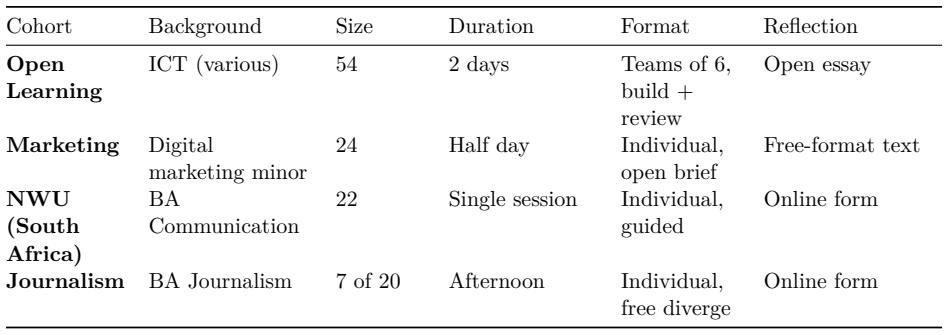
Early 2025 we ran a series of vibe coding challenges across four different student cohorts. The cohorts included 54 ICT students, 24 digital marketing students, and 7 journalism students at Fontys University of Applied Sciences (Netherlands), and 22 BA Communication students at North-West University (South Africa). From the student reflections, five major patterns emerged. Students reported that AI tools shifted their focus from syntax to higher-order thinking; they also described a skill shift from memorizing to evaluating; they viewed AI proficiency as career-essential; they framed their relationship with AI as partnership rather than replacement; and finally non-technical students showed the strongest appreciation for the accessibility these tools provide. This practitioner report documents what we observed during the classroom experiments, we reflect on how the landscape has shifted in the year since, and shares practical lessons for educators considering similar experiments. We present the observations as what they are: patterns from practice, not proven conclusions, in the beleif that sharing early stage experiences contributes to the overall field of AI and education.
Editorial analysis
A structured set of objections, weighed in public.
Referee Report
Summary. The manuscript reports on a series of 'vibe coding challenges' conducted in early 2025 with four small student cohorts (54 ICT students, 24 digital marketing students, and 7 journalism students at Fontys University of Applied Sciences; 22 BA Communication students at North-West University). From post-activity reflections, the authors identify five patterns: AI tools shifting focus from syntax to higher-order thinking; a skill shift from memorizing to evaluating; AI proficiency viewed as career-essential; AI framed as a partnership rather than replacement; and non-technical students showing the strongest appreciation for accessibility. The work is explicitly positioned as a practitioner report documenting observed patterns from practice, along with reflections on the evolving landscape and practical lessons for educators, rather than as proven or generalizable conclusions.
Significance. If the reported patterns accurately reflect the collected reflections, the paper offers timely, cross-disciplinary documentation of student experiences with AI tools in educational settings. This can inform educators experimenting with similar approaches and contributes to the early literature on AI integration in computing and communication curricula by highlighting attitudinal and cognitive shifts. The cautious framing as observational patterns from specific cohorts is appropriate and avoids overclaiming, which strengthens its utility as a prompt for further research.
major comments (1)
- Abstract: The statement that 'five major patterns emerged' from the student reflections is central to the paper's contribution, yet no details are provided on the analytical process used to identify or validate these patterns (e.g., thematic coding procedure, number of analysts, inter-rater checks, or steps to mitigate interpretive bias). Without this, it is difficult to assess the reliability of the listed patterns as more than anecdotal summaries.
minor comments (1)
- Abstract: Typo in the final sentence ('beleif' should be 'belief').
Simulated Author's Rebuttal
We thank the referee for their constructive feedback and recommendation of minor revision. The manuscript is positioned as an observational practitioner report, and we welcome the opportunity to clarify the process by which the patterns were identified.
read point-by-point responses
-
Referee: Abstract: The statement that 'five major patterns emerged' from the student reflections is central to the paper's contribution, yet no details are provided on the analytical process used to identify or validate these patterns (e.g., thematic coding procedure, number of analysts, inter-rater checks, or steps to mitigate interpretive bias). Without this, it is difficult to assess the reliability of the listed patterns as more than anecdotal summaries.
Authors: We agree that the abstract would benefit from greater transparency on pattern identification. Because the work is framed as a practitioner report of early classroom experiments rather than a formal qualitative study, the five patterns were identified through iterative collaborative review of the full set of student reflections by the author team. No structured thematic coding protocol, independent coders, inter-rater reliability checks, or explicit bias-mitigation steps were applied. We will revise the abstract to state this explicitly and add a brief subsection in the full text describing the reflective process and its limitations. revision: yes
Circularity Check
No significant circularity
full rationale
The paper is a purely descriptive practitioner report documenting observed patterns in student reflections from four small cohorts. It contains no equations, derivations, fitted parameters, uniqueness theorems, or self-citations that serve as load-bearing premises. The authors explicitly frame their contribution as 'patterns from practice, not proven conclusions' and limit claims to direct descriptions of what students reported in the specific experimental context, with no reduction of any result to prior inputs by construction.
Axiom & Free-Parameter Ledger
axioms (1)
- domain assumption Student self-reflections provide reliable evidence of cognitive and attitudinal changes induced by AI tools
Reference graph
Works this paper leans on
-
[1]
Accessed: 2026-05-08. Andrej Karpathy. There’s a new kind of coding i call "vibe coding". https://x.com/karpathy/statu s/1886192184808149383, February
-
[2]
Post on X (Twitter), accessed: 2026-05-08. 10
work page 2026
discussion (0)
Sign in with ORCID, Apple, or X to comment. Anyone can read and Pith papers without signing in.