Recognition: 2 theorem links
· Lean TheoremBeam-Aware Radio Map Estimation With Physics-Consistent Parametric Modeling for Unknown Multiple Satellites
Pith reviewed 2026-05-11 02:54 UTC · model grok-4.3
The pith
Physics-consistent parametric modeling unifies active satellite identification with continuous radio map reconstruction from RSS data.
A machine-rendered reading of the paper's core claim, the machinery that carries it, and where it could break.
Core claim
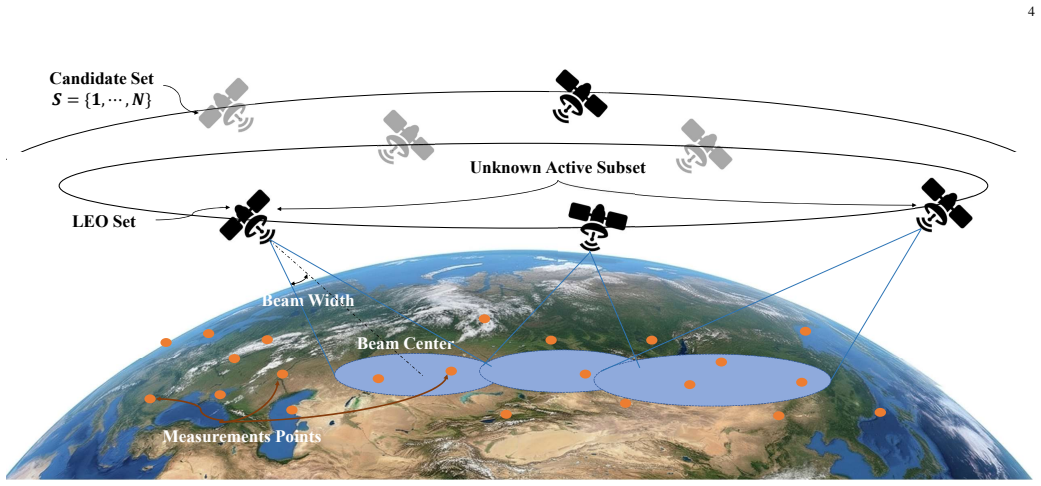
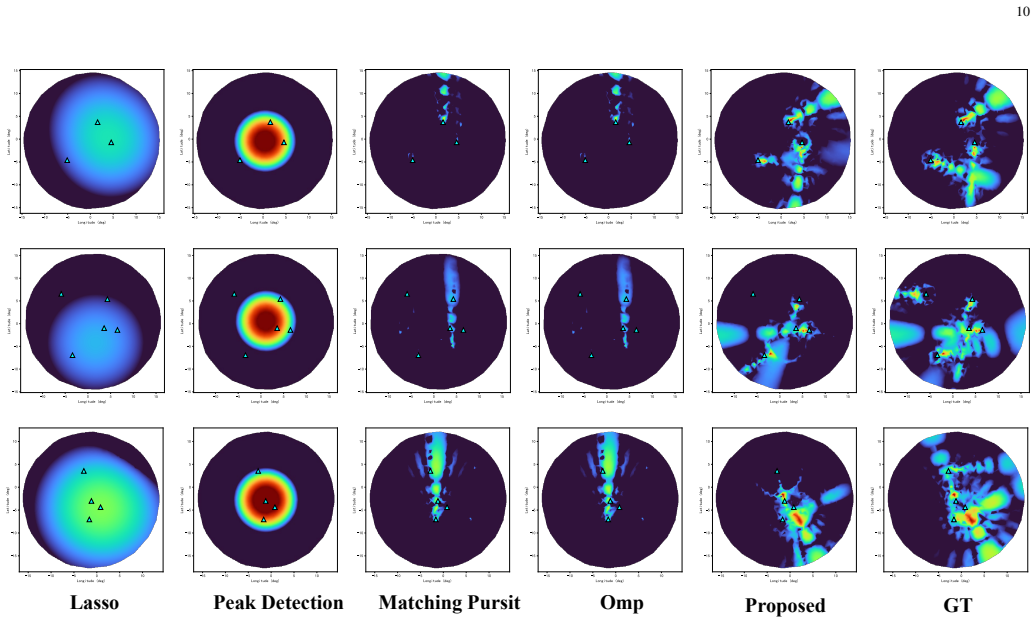
The beam-aware radio map estimation framework unifies active satellite identification and RSS field reconstruction through physics-consistent parametric modeling. An interpretable structural prior links geometry and beam shaping to spatial RSS formation, and an adaptive model order selection strategy infers the number of active satellites from measurements by balancing fit and complexity. This produces higher RSS spatial correlation, lower RMSE, and improved F1 score across varying SNR, total satellite count, and active satellite count.
What carries the argument
Physics-consistent parametric modeling that links satellite geometry and beam shaping directly to the spatial formation of the received signal strength field, paired with adaptive model order selection to infer the active satellite count.
If this is right
- The approach resolves the inverse problem of radio map construction when active satellites are unknown.
- It delivers consistently higher spatial correlation and lower RMSE in the reconstructed RSS field.
- It improves F1 score for identifying which satellites are active.
- Performance remains stable when noise levels, total satellites, or active satellites change.
Where Pith is reading between the lines
- The same parametric structure could apply to estimating maps from other moving transmitters where beam effects matter.
- Integration with real-time measurement streams might support dynamic interference avoidance in satellite systems.
- Testing against actual orbital data with unmodeled atmospheric effects would reveal limits of the geometry-beam prior.
Load-bearing premise
The structural prior connecting geometry and beam shaping to RSS formation stays valid and sufficient to solve the underdetermined problem despite unknown satellites, unobservable beams, and noise.
What would settle it
A controlled test with known active satellites and measured beam patterns where the framework's estimated radio map shows large deviation from ground-truth field values or selects the wrong number of satellites.
Figures


read the original abstract
Satellite networks with dense low Earth orbit (LEO) constellations rely on aggressive spectrum reuse, making co-channel interference a dominant and rapidly varying factor that limits link availability and complicates spectrum sharing and compliance. Satellite radio map (RM) construction is therefore essential for interference cognition, yet it is challenging because the active satellite set is unknown, beam footprints and pointing are not directly observable, and received signal strength (RSS) measurements are difficult to calibrate under coupled link budget variations and noise. These latent uncertainties yield a severely underdetermined inverse problem with strong signature coherence, where existing methods often trade detection recall for precision and still fail to recover a faithful continuous RSS field. This paper proposes a beam-aware RM estimation framework that unifies active satellite identification and RSS field reconstruction through physics-consistent parametric modeling. An interpretable structural prior links geometry and beam shaping to spatial RSS formation, and an adaptive model order selection strategy infers the number of active satellites from measurements by balancing fit and complexity. Extensive experiments across varying signal to noise ratio (SNR), total satellite count, and active satellite count demonstrate consistently higher RSS spatial correlation, lower root mean squared error (RMSE), and improved F1 score, validating the proposed approach for interference-aware satellite RM construction in satellite networks.
Editorial analysis
A structured set of objections, weighed in public.
Referee Report
Summary. The paper proposes a beam-aware radio map estimation framework for LEO satellite networks with unknown active satellites. It unifies active satellite identification and continuous RSS field reconstruction via physics-consistent parametric modeling that links geometry and beam shaping to spatial RSS formation, plus an adaptive model-order selection strategy that infers the number of active satellites by balancing fit and complexity. Experiments across varying SNR, total satellite count, and active satellite count are reported to yield higher RSS spatial correlation, lower RMSE, and improved F1 scores relative to existing methods.
Significance. If the central claims are substantiated, the work would be significant for interference cognition and spectrum sharing in dense LEO constellations, where unknown active satellites and unobservable beams create a severely underdetermined inverse problem. The interpretable structural prior offers a principled alternative to purely data-driven approaches and could support practical deployment. The paper does not report machine-checked proofs or open reproducible code, so the strength rests on the empirical validation.
major comments (3)
- [Abstract and experimental results] Abstract and experimental results section: the claim of consistently superior performance (higher spatial correlation, lower RMSE, improved F1) is asserted without specification of the baselines, data exclusion rules, error bars, or sensitivity to post-hoc modeling choices. This information is load-bearing for assessing whether the method resolves the underdetermined problem described in the introduction.
- [Method (adaptive model order selection)] Adaptive model order selection (method section): the criterion balances fit and complexity on the same RSS measurements used for reconstruction. This raises a circularity risk for the inferred satellite count and RSS field; independent external benchmarks or hold-out validation are needed to confirm the selection does not simply reproduce quantities defined by the fitted parametric model.
- [Core modeling section] Physics-consistent parametric modeling (core modeling section): the structural prior linking geometry, beam shaping, and RSS is presented as sufficient to resolve the inverse problem despite unknown active satellites, unobservable footprints, and coupled link-budget variations. No sensitivity analysis or mismatch experiments are shown to demonstrate that deviations from the assumed parametric form do not re-render the problem ill-posed or degrade order selection.
minor comments (1)
- [Notation and preliminaries] Notation for beam-shaping parameters and link-budget terms could be consolidated in a single table for clarity.
Simulated Author's Rebuttal
We thank the referee for the constructive feedback. We provide point-by-point responses to the major comments below, indicating where revisions have been made to strengthen the manuscript.
read point-by-point responses
-
Referee: [Abstract and experimental results] Abstract and experimental results section: the claim of consistently superior performance (higher spatial correlation, lower RMSE, improved F1) is asserted without specification of the baselines, data exclusion rules, error bars, or sensitivity to post-hoc modeling choices. This information is load-bearing for assessing whether the method resolves the underdetermined problem described in the introduction.
Authors: We agree that explicit details on baselines, data handling, and statistical reporting are necessary for rigorous evaluation. In the revised manuscript, the experimental section now specifies all baselines (including their parameter settings and implementations), clarifies data exclusion and preprocessing rules, includes error bars as standard deviations across Monte Carlo trials, and adds a sensitivity study to post-hoc modeling choices such as regularization weights. revision: yes
-
Referee: [Method (adaptive model order selection)] Adaptive model order selection (method section): the criterion balances fit and complexity on the same RSS measurements used for reconstruction. This raises a circularity risk for the inferred satellite count and RSS field; independent external benchmarks or hold-out validation are needed to confirm the selection does not simply reproduce quantities defined by the fitted parametric model.
Authors: The selection criterion incorporates an explicit complexity penalty to guard against overfitting. To address the circularity concern directly, the revised manuscript includes hold-out validation experiments: a subset of RSS measurements is reserved exclusively for validating the selected model order and reconstructed field, with results reported to demonstrate generalization beyond the fitting data. revision: yes
-
Referee: [Core modeling section] Physics-consistent parametric modeling (core modeling section): the structural prior linking geometry, beam shaping, and RSS is presented as sufficient to resolve the inverse problem despite unknown active satellites, unobservable footprints, and coupled link-budget variations. No sensitivity analysis or mismatch experiments are shown to demonstrate that deviations from the assumed parametric form do not re-render the problem ill-posed or degrade order selection.
Authors: We acknowledge that robustness to model mismatch warrants explicit examination. The revised manuscript adds controlled mismatch experiments that perturb beam parameters and link-budget assumptions outside the exact parametric form; these results show that performance and order selection remain stable under moderate deviations, with a discussion of limitations under severe mismatches. revision: yes
Circularity Check
No significant circularity detected
full rationale
The paper's central derivation relies on a physics-consistent parametric model that links satellite geometry and beam shaping to RSS formation as an interpretable structural prior, combined with standard adaptive model-order selection (balancing fit and complexity) to infer the number of active satellites. This is not self-definitional or a fitted input renamed as prediction, because the method is evaluated against independent simulated ground-truth data across controlled variations in SNR, satellite counts, and noise; the reported improvements in correlation, RMSE, and F1 are measured externally rather than by construction. No load-bearing self-citations, uniqueness theorems imported from the authors, or ansatz smuggling appear in the abstract or description. The approach is self-contained against its own benchmarks and does not reduce the claimed unification or inference to tautological re-fitting of the inputs.
Axiom & Free-Parameter Ledger
free parameters (2)
- model order selection threshold
- beam shaping parameters
axioms (1)
- domain assumption Physics-consistent parametric modeling accurately links geometry and beam shaping to spatial RSS formation even when beams and active set are unknown.
Lean theorems connected to this paper
-
IndisputableMonolith/Cost/FunctionalEquation.leanwashburn_uniqueness_aczel unclear?
unclearRelation between the paper passage and the cited Recognition theorem.
We adopt a beam-aware parametric forward model … g(θm;ϕs)=sinc²(a(βs)Δθaz)sinc²(a(βs)Δθel) … BIC(RSS,n,p)=plogn+nlog(RSS/n)
-
IndisputableMonolith/Foundation/RealityFromDistinction.leanreality_from_one_distinction unclear?
unclearRelation between the paper passage and the cited Recognition theorem.
adaptive model order selection strategy infers the number of active satellites … balancing fit and complexity
What do these tags mean?
- matches
- The paper's claim is directly supported by a theorem in the formal canon.
- supports
- The theorem supports part of the paper's argument, but the paper may add assumptions or extra steps.
- extends
- The paper goes beyond the formal theorem; the theorem is a base layer rather than the whole result.
- uses
- The paper appears to rely on the theorem as machinery.
- contradicts
- The paper's claim conflicts with a theorem or certificate in the canon.
- unclear
- Pith found a possible connection, but the passage is too broad, indirect, or ambiguous to say the theorem truly supports the claim.
Reference graph
Works this paper leans on
-
[1]
X. Wang, K. Tao, N. Cheng, Z. Yin, Z. Li, Y . Zhang, and X. Shen, “RadioDiff: An effective generative diffusion model for sampling- free dynamic radio map construction,”IEEE Trans. Cognit. Commun. Networking, Early Access, pp. 1–13, 2024
work page 2024
-
[2]
A Tutorial on Learning-Based Radio Map Construction: Data, Paradigms, and Physics-Awareness
X. Wang, Y . Pan, and N. Cheng, “A tutorial on learning-based radio map construction: Data, paradigms, and physics-awareness,”arXiv preprint arXiv:2603.17499, 2026
work page internal anchor Pith review Pith/arXiv arXiv 2026
-
[3]
6G omni-scenario on-demand services provisioning: vision, technology and prospect(in chinese),
N. Cheng, F. Chen, W. Chen, Z. Cheng, Q. Yang, C. Li, and X. Shen, “6G omni-scenario on-demand services provisioning: vision, technology and prospect(in chinese),”Sci Sin Inform, vol. 54, pp. 1025–1054,, 2024
work page 2024
-
[4]
Radio map-based 3d path planning for cellular- connected uav,
S. Zhang and R. Zhang, “Radio map-based 3d path planning for cellular- connected uav,”IEEE Trans. Wireless Commun., vol. 20, no. 3, pp. 1975–1989, 2020
work page 1975
-
[5]
Radiodiff-inverse: Diffusion enhanced bayesian inverse estimation for isac radio map construction,
X. Wang, Z. Fang, N. Cheng, R. Sun, H. Zhou, Z. Su, Z. Li, and X. Shen, “Radiodiff-inverse: Diffusion enhanced bayesian inverse estimation for isac radio map construction,”IEEE Transactions on Wireless Communications, vol. 25, pp. 14 611–14 626, 2026
work page 2026
-
[6]
Toward environment-aware 6G communications via channel knowledge map,
Y . Zeng and X. Xu, “Toward environment-aware 6G communications via channel knowledge map,”IEEE Wireless Commun., vol. 28, no. 3, pp. 84–91, 2021
work page 2021
-
[7]
Toward immersive communications in 6G,
X. Shen, J. Gao, M. Li, C. Zhou, S. Hu, M. He, and W. Zhuang, “Toward immersive communications in 6G,”Frontiers Comput. Science, vol. 4, p. 1068478, 2023
work page 2023
-
[8]
Multi-agent reinforcement learning for task offloading in crowd-edge computing,
S. Yao, M. Wang, J. Ren, T. Xia, W. Wang, K. Xu, M. Xu, and H. Zhang, “Multi-agent reinforcement learning for task offloading in crowd-edge computing,”IEEE Transactions on Mobile Computing, vol. 24, no. 10, pp. 9289–9302, 2025
work page 2025
-
[9]
Ocean: Optional capability-based en route acknowledgement in network layer,
S. Yao, S. Fu, Q. Li, Z. Liu, Y . Cai, Y . Zhang, and K. Xu, “Ocean: Optional capability-based en route acknowledgement in network layer,” IEEE Transactions on Dependable and Secure Computing, 2025. 13
work page 2025
-
[10]
X. Wang, L. Fu, N. Cheng, R. Sun, T. Luan, W. Quan, and K. Aldubaikhy, “Joint flying relay location and routing optimization for 6G UA V–IoT networks: A graph neural network-based approach,”Remote Sens., vol. 14, no. 17, p. 4377, 2022
work page 2022
-
[11]
Integrated Sensing and Communications: Toward Dual- Functional Wireless Networks for 6G and Beyond,
F. Liu, Y . Cui, C. Masouros, J. Xu, T. X. Han, Y . C. Eldar, and S. Buzzi, “Integrated Sensing and Communications: Toward Dual- Functional Wireless Networks for 6G and Beyond,”IEEE J. Sel. Areas Commun., vol. 40, no. 6, pp. 1728–1767, 2022
work page 2022
-
[12]
Space/aerial-assisted computing offloading for IoT applications: A learning-based approach,
N. Cheng, F. Lyu, W. Quan, C. Zhou, H. He, W. Shi, and X. Shen, “Space/aerial-assisted computing offloading for IoT applications: A learning-based approach,”IEEE J. Select. Areas Commun., vol. 37, no. 5, pp. 1117–1129, 2019
work page 2019
-
[13]
RadioMapMotion: A Dataset and Baseline for Proactive Spatio-Temporal Radio Environment Prediction,
H. Jia, N. Cheng, and X. Wang, “Radiomapmotion: A dataset and baseline for proactive spatio-temporal radio environment prediction,” Arxiv Preprint Arxiv:2511.17526, 2025
-
[14]
A tutorial on extremely large-scale MIMO for 6G: Fundamentals, signal processing, and applications,
Z. Wang, J. Zhang, H. Du, D. Niyato, S. Cui, B. Ai, M. Debbah, K. B. Letaief, and H. V . Poor, “A tutorial on extremely large-scale MIMO for 6G: Fundamentals, signal processing, and applications,”IEEE Commun. Surveys Tuts., vol. 26, no. 3, pp. 1560–1605, 2024
work page 2024
-
[15]
Next generation 5G wireless networks: A comprehensive survey,
M. Agiwal, A. Roy, and N. Saxena, “Next generation 5G wireless networks: A comprehensive survey,”IEEE Commun. Surveys Tuts., vol. 18, no. 3, pp. 1617–1655, 2016
work page 2016
-
[16]
Non-terrestrial networks in the 6g era: Challenges and opportunities,
M. Giordani and M. Zorzi, “Non-terrestrial networks in the 6g era: Challenges and opportunities,”IEEE Netw., vol. 35, no. 2, pp. 244–251, 2020
work page 2020
-
[17]
I. Del Portillo, B. G. Cameron, and E. F. Crawley, “A technical comparison of three low earth orbit satellite constellation systems to provide global broadband,”Acta Astronautica, vol. 159, pp. 123–135, 2019
work page 2019
-
[18]
Z. Lin, Z. Ni, L. Kuang, C. Jiang, and Z. Huang, “Multi-satellite beam hopping based on load balancing and interference avoidance for ngso satellite communication systems,”IEEE Trans. Commun., vol. 71, no. 1, pp. 282–295, 2022
work page 2022
-
[19]
Interference mitigation techniques for broadband satellite systems,
L. Cottatellucci, M. Debbah, G. Gallinaro, R. Mueller, M. Neri, and R. Rinaldo, “Interference mitigation techniques for broadband satellite systems,” in24th AIAA International Communications Satellite Systems Conference, 2006, p. 5348
work page 2006
-
[20]
Satellite cognitive communications: Interference modeling and techniques selection,
S. K. Sharma, S. Chatzinotas, and B. Ottersten, “Satellite cognitive communications: Interference modeling and techniques selection,” in 2012 6th Advanced satellite multimedia systems conference (ASMS) and 12th signal processing for space communications workshop (SPSC). IEEE, 2012, pp. 111–118
work page 2012
-
[21]
Spectrum sharing and inter- ference management for 6g leo satellite-terrestrial network integration,
N. Heydarishahreza, T. Han, and N. Ansari, “Spectrum sharing and inter- ference management for 6g leo satellite-terrestrial network integration,” IEEE Commun. Surveys & Tuts., vol. 27, no. 5, pp. 2794–2825, 2024
work page 2024
-
[22]
X. Hu, Y . Zhang, X. Liao, Z. Liu, W. Wang, and F. M. Ghannouchi, “Dynamic beam hopping method based on multi-objective deep reinforce- ment learning for next generation satellite broadband systems,”IEEE Trans. Broadcasting, vol. 66, no. 3, pp. 630–646, 2020
work page 2020
-
[23]
L. Lei, E. Lagunas, Y . Yuan, M. G. Kibria, S. Chatzinotas, and B. Ottersten, “Beam illumination pattern design in satellite networks: Learning and optimization for efficient beam hopping,”IEEE Access, vol. 8, pp. 136 655–136 667, 2020
work page 2020
-
[24]
Ray techniques in electromagnetics,
G. A. Deschamps, “Ray techniques in electromagnetics,”Proc. IEEE, vol. 60, no. 9, pp. 1022–1035, 1972
work page 1972
-
[25]
D. S. Jones,The theory of electromagnetism. Elsevier, 2013
work page 2013
-
[26]
Active learning for estimating reachable sets for systems with unknown dynamics,
A. Chakrabarty, C. Danielson, S. Di Cairano, and A. Raghunathan, “Active learning for estimating reachable sets for systems with unknown dynamics,”IEEE Trans. Cybernetics, vol. 52, no. 4, pp. 2531–2542, 2020
work page 2020
-
[27]
H.-H. Choi, G. Park, K. Heo, and K. Lee, “Joint optimization of beam placement and transmit power for multibeam leo satellite communication systems,”IEEE Internet Things J., vol. 11, no. 8, pp. 14 804–14 813, 2023
work page 2023
-
[28]
Satellite over satellite (sos) network: A novel architecture for satellite network,
J. Lee and S. Kang, “Satellite over satellite (sos) network: A novel architecture for satellite network,” inProceedings IEEE INFOCOM
-
[29]
nineteenth annual joint conference of the IEEE computer and communications societies (cat
conference on computer communications. nineteenth annual joint conference of the IEEE computer and communications societies (cat. no. 00CH37064), vol. 1. IEEE, 2000, pp. 315–321
work page 2000
-
[30]
RadioUNet: Fast radio map estimation with convolutional neural networks,
R. Levie, C ¸. Yapar, G. Kutyniok, and G. Caire, “RadioUNet: Fast radio map estimation with convolutional neural networks,”IEEE Trans. Wireless Commun., vol. 20, no. 6, pp. 4001–4015, 2021
work page 2021
-
[31]
X. Wang, Q. Zhang, N. Cheng, R. Sun, Z. Li, S. Cui, and X. Shen, “Radiodiff-k2: Helmholtz equation informed generative diffusion model for multi-path aware radio map construction,”IEEE J. Sel. Areas Commun., vol. 44, pp. 2318–2333, 2026
work page 2026
-
[32]
Deeprem: Deep-learning-based radio environment map estimation from sparse measurements,
A. Chaves-Villota and C. A. Viteri-Mera, “Deeprem: Deep-learning-based radio environment map estimation from sparse measurements,”IEEE Access, vol. 11, pp. 48 697–48 714, 2023
work page 2023
-
[33]
A tutorial on environment-aware communications via channel knowledge map for 6G,
Y . Zeng, J. Chen, J. Xu, D. Wu, X. Xu, S. Jin, X. Gao, D. Gesbert, S. Cui, and R. Zhang, “A tutorial on environment-aware communications via channel knowledge map for 6G,”IEEE Commun. Surveys Tuts., vol. 26, no. 3, pp. 1478–1519, 2024
work page 2024
- [34]
-
[35]
Group sparse lasso for cognitive network sensing robust to model uncertainties and outliers,
E. Dall’Anese, J. A. Bazerque, and G. B. Giannakis, “Group sparse lasso for cognitive network sensing robust to model uncertainties and outliers,” Physical Commun., vol. 5, no. 2, pp. 161–172, 2012
work page 2012
-
[36]
J. Wang, Q. Zhu, Z. Lin, Q. Wu, Y . Huang, X. Cai, W. Zhong, and Y . Zhao, “Sparse bayesian learning-based 3-d radio environment map construction—sampling optimization, scenario-dependent dictionary construction, and sparse recovery,”IEEE Trans. Cogn. Commun. Netw., vol. 10, no. 1, pp. 80–93, 2024
work page 2024
-
[37]
Compressive sensing-based 3d spectrum extrapolation for iot coverage in obstructed urban areas,
K. Yin, S. Fang, and F. Chu, “Compressive sensing-based 3d spectrum extrapolation for iot coverage in obstructed urban areas,”Electronics, vol. 14, no. 21, p. 4177, 2025
work page 2025
-
[38]
Multiple source localization via local radio map construction in urban environments,
Q. Zhang, H. Tang, W. Chen, Z. Song, and J. Wang, “Multiple source localization via local radio map construction in urban environments,” IEEE Trans. Cogn. Commun. Netw., vol. 12, pp. 3468–3481, 2026
work page 2026
discussion (0)
Sign in with ORCID, Apple, or X to comment. Anyone can read and Pith papers without signing in.