Recognition: 2 theorem links
· Lean TheoremNeural network quantum states in the grand canonical ensemble
Pith reviewed 2026-05-11 01:57 UTC · model grok-4.3
The pith
A neural network architecture represents bosonic states in Fock space to enable variational calculations in the grand canonical ensemble.
A machine-rendered reading of the paper's core claim, the machinery that carries it, and where it could break.
Core claim
The central claim is that a suitably constructed neural network can faithfully represent symmetric bosonic many-body states in Fock space; when optimized with Monte Carlo sampling and geometric methods under a chemical potential, the resulting variational states recover accurate energies and permit direct extraction of one-body reduced density matrices for first-principles calculation of condensate fractions and density profiles.
What carries the argument
A neural quantum state architecture that directly encodes symmetric bosonic wavefunctions in Fock space, supplemented by Monte Carlo sampling and geometric optimization to converge to the physical boson number.
If this is right
- Condensate fractions and radial density profiles become accessible from first principles in grand-canonical bosonic systems.
- Competitive variational energies are obtained for one- and two-dimensional bosonic lattices and continuous systems.
- The approach extends variational Monte Carlo to open systems where particle number is controlled by chemical potential rather than fixed.
- One-body reduced density matrices can be estimated accurately enough to extract measurable observables without additional post-processing.
Where Pith is reading between the lines
- The same Fock-space representation could be adapted to study Bose-Einstein condensation in inhomogeneous trapping potentials.
- Combining the architecture with existing fermionic neural states might enable simulations of Bose-Fermi mixtures in the grand canonical ensemble.
- The method opens a route to numerical prediction of measurable quantities in experimental setups where particle number fluctuates, such as optical lattices with reservoir coupling.
Load-bearing premise
The neural architecture can faithfully represent the symmetric bosonic states in Fock space and Monte Carlo sampling plus geometric optimization reliably converges to the physical boson number set by the chemical potential.
What would settle it
On a solvable bosonic model such as the one-dimensional Bose-Hubbard chain at known chemical potential, the method would be falsified if the sampled average particle number deviates systematically from the exact grand-canonical value or if the extracted condensate fraction disagrees with exact diagonalization results beyond statistical error.
Figures


read the original abstract
Variational Monte Carlo calculations have recently reached state-of-the-art accuracy in the approximation of ground state properties of quantum many-body systems. Making use of flexible neural quantum states and automatic differentiation has bypassed traditional computational obstacles such as reliance on basis sets. In this paper, we propose a neural quantum state architecture capable of representing symmetric bosonic wavefunctions in Fock space, enabling the study of systems with variable particle number. By supplementing our variational state with Monte Carlo sampling and geometric optimization, we demonstrate competitive variational energies across an array of one- and two-dimensional systems, converging to the physical boson number under a set chemical potential. Our approach enables accurate estimates of one-body reduced density matrices, opening access to observables such as condensate fractions and radial density profiles from first principles. Our method opens the door to numerical predictions of key measurable quantities in practical grand canonical systems.
Editorial analysis
A structured set of objections, weighed in public.
Referee Report
Summary. The manuscript introduces a neural quantum state architecture for representing symmetric bosonic wavefunctions in Fock space, enabling variational Monte Carlo calculations in the grand canonical ensemble. The method combines Monte Carlo sampling with geometric optimization to approximate ground states at a fixed chemical potential, yielding competitive energies for 1D and 2D systems and accurate one-body reduced density matrices for observables like condensate fractions.
Significance. If validated, this approach significantly extends neural network quantum states to variable particle number systems, which is important for modeling physical systems with particle fluctuations such as ultracold bosons. The access to one-body density matrices from first principles is a notable strength, potentially allowing predictions of measurable quantities without canonical constraints. The paper credits the flexible ansatz and optimization for bypassing traditional basis set limitations.
major comments (2)
- [Section 3] Section 3 (Neural Architecture): The proposed architecture is claimed to faithfully represent symmetric bosonic states across particle-number sectors in Fock space, but no formal expressivity analysis or benchmarks on small systems with known exact solutions are provided to support this. This is central to the grand-canonical claim.
- [Section 5] Section 5 (Numerical Results): The results state convergence to the physical boson number set by the chemical potential, yet lack explicit diagnostics such as plots of average particle number versus chemical potential or checks against fluctuation-dissipation relations to confirm the ensemble is grand canonical rather than trapped in a fixed-N sector.
minor comments (2)
- The abstract claims 'competitive energies' and 'accurate' 1-RDMs without referencing specific error metrics or comparisons in the main text; adding quantitative tables would improve clarity.
- [Figure captions] Some figure captions could be expanded to include the specific system parameters and chemical potential values used.
Simulated Author's Rebuttal
We thank the referee for their positive summary and constructive major comments. We address each point below and will revise the manuscript accordingly to strengthen the presentation of the grand-canonical aspects.
read point-by-point responses
-
Referee: [Section 3] Section 3 (Neural Architecture): The proposed architecture is claimed to faithfully represent symmetric bosonic states across particle-number sectors in Fock space, but no formal expressivity analysis or benchmarks on small systems with known exact solutions are provided to support this. This is central to the grand-canonical claim.
Authors: We agree that a formal expressivity analysis is absent and would be difficult to provide rigorously for this class of neural architectures. The ansatz in Section 3 is constructed by design to enforce bosonic symmetry and to operate directly in Fock space, thereby spanning multiple particle-number sectors without canonical constraints. To address the referee's concern, we will add explicit numerical benchmarks on small systems with known exact solutions (e.g., few-boson Hubbard models) in the revised manuscript, showing faithful reproduction of ground states across sectors. revision: yes
-
Referee: [Section 5] Section 5 (Numerical Results): The results state convergence to the physical boson number set by the chemical potential, yet lack explicit diagnostics such as plots of average particle number versus chemical potential or checks against fluctuation-dissipation relations to confirm the ensemble is grand canonical rather than trapped in a fixed-N sector.
Authors: The current results demonstrate that the variational optimization at fixed chemical potential yields the physically expected particle number, with the Monte Carlo sampling procedure permitting fluctuations in N. We acknowledge that more explicit diagnostics would better confirm the grand-canonical character. In the revision we will add plots of average particle number versus chemical potential together with checks against fluctuation-dissipation relations (where analytically accessible) to rule out trapping in a fixed-N sector. revision: yes
Circularity Check
No circularity: variational ansatz and Monte Carlo optimization are independent of computed observables.
full rationale
The paper defines a new neural architecture for symmetric bosonic Fock-space states, optimizes it variationally via Monte Carlo sampling and geometric descent to a target chemical potential, and then extracts 1-RDMs and derived observables (condensate fraction, density profiles) directly from the resulting wavefunction. None of these steps reduce by construction to the fitted parameters or to a self-citation chain; the architecture is an ansatz, the optimization is a standard variational procedure, and the observables are post-processing of the sampled state. No equations equate a reported prediction to an input quantity by definition, and no load-bearing uniqueness theorem or ansatz is smuggled via prior self-citation. The derivation chain is therefore self-contained.
Axiom & Free-Parameter Ledger
axioms (2)
- standard math Variational principle: the expectation value of the Hamiltonian provides an upper bound to the ground-state energy
- domain assumption Neural networks with appropriate symmetry can represent bosonic states in Fock space
Lean theorems connected to this paper
-
IndisputableMonolith/Cost/FunctionalEquation.leanwashburn_uniqueness_aczel unclearwe propose a neural quantum state architecture capable of representing symmetric bosonic wavefunctions in Fock space, enabling the study of systems with variable particle number... supplemented... with Monte Carlo sampling and geometric optimization
-
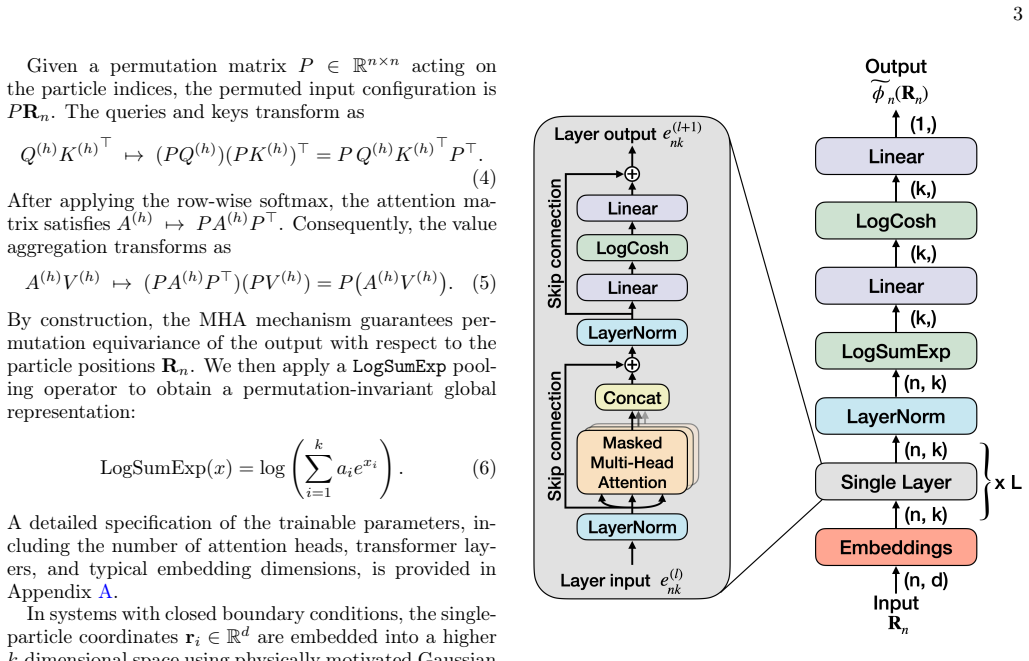
IndisputableMonolith/Foundation/ArithmeticFromLogic.leanabsolute_floor_iff_bare_distinguishability unclearThe variational ansatz is used to parametrize each n-particle wave function ϕn(Rn) using a common neural network architecture... masked multi-head self-attention (MHA) layer
Reference graph
Works this paper leans on
-
[1]
One-dimensional case Another valuable numerical benchmark for assessing whether both the DS and TF architectures can learn the ground state of a one-dimensional system with long- range interactions and periodic boundary conditions is the Calogero–Sutherland model. The model describes particles confined on a ring of circumferenceL, interact- ing via a two-...
-
[2]
Two-dimensional case An analytical extension of the original one-dimensional Calogero–Sutherland model to two dimensions is pre- sented in Ref. [38]. The corresponding Hamiltonian de- scribes a system ofN bosons confined within an isotropic harmonic potential, V (r) = ω2r2, (26) and interacting through an inverse-square two-body po- tential, W (2) CS (r, ...
-
[3]
176 (Springer, Berlin, Hei- delberg, 2013)
Adolfo Avella and Ferdinando Mancini, eds., Strongly Correlated Systems: Numerical Methods , Springer Series in Solid-State Sciences, Vol. 176 (Springer, Berlin, Hei- delberg, 2013)
work page 2013
-
[4]
How To Use Neural Networks To Investigate Quantum Many-Body Physics,
Juan Carrasquilla and Giacomo Torlai, “How To Use Neural Networks To Investigate Quantum Many-Body Physics,” PRX Quantum2, 040201 (2021)
work page 2021
-
[5]
Solvingthequan- tum many-body problem with artificial neural networks,
GiuseppeCarleoandMatthiasTroyer,“Solvingthequan- tum many-body problem with artificial neural networks,” Science 355, 602–606 (2017)
work page 2017
- [6]
-
[7]
Nicoli, Paolo Stornati, Rouven Koch, Miriam Büttner, Robert Okuła, Gorka Muñoz-Gil, Rodrigo A
Anna Dawid, Julian Arnold, Borja Requena, Alexan- der Gresch, Marcin Płodzień, Kaelan Donatella, Kim A. Nicoli, Paolo Stornati, Rouven Koch, Miriam Büttner, Robert Okuła, Gorka Muñoz-Gil, Rodrigo A. Vargas- Hernández, Alba Cervera-Lierta, Juan Carrasquilla, Ve- dran Dunjko, Marylou Gabrié, Patrick Huembeli, Evert van Nieuwenburg, Filippo Vicentini, Lei Wa...
- [8]
-
[9]
Neural- network quantum states for many-body physics,
Matija Medvidović and Javier Robledo Moreno, “Neural- network quantum states for many-body physics,” The European Physical Journal Plus 139, 631 (2024), arXiv:2402.11014 [cond-mat]
-
[10]
From Architectures to Applica- tions: A Review of Neural Quantum States,
Hannah Lange, Anka Van de Walle, Atiye Abedinnia, and Annabelle Bohrdt, “From Architectures to Applica- tions: A Review of Neural Quantum States,” (2024), arXiv:2402.09402
-
[11]
Variational benchmarks for quan- tum many-body problems,
Dian Wu, Riccardo Rossi, Filippo Vicentini, Nikita As- trakhantsev, Federico Becca, Xiaodong Cao, Juan Car- rasquilla, Francesco Ferrari, Antoine Georges, Mohamed Hibat-Allah, Masatoshi Imada, Andreas M. Läuchli, Guglielmo Mazzola, Antonio Mezzacapo, Andrew Mil- lis, Javier Robledo Moreno, Titus Neupert, Yusuke No- mura, Jannes Nys, Olivier Parcollet, Ric...
work page 2024
-
[12]
Ab initio solution of the many-electron Schrödinger equation with deep neural networks,
David Pfau, James S. Spencer, Alexander G. D. G. Matthews, and W. M. C. Foulkes, “Ab initio solution of the many-electron Schrödinger equation with deep neural networks,” Physical Review Research2, 033429 (2020)
work page 2020
-
[13]
Deep- neural-network solution of the electronic Schrödinger equation,
Jan Hermann, Zeno Schätzle, and Frank Noé, “Deep- neural-network solution of the electronic Schrödinger equation,” Nature Chemistry12, 891–897 (2020)
work page 2020
-
[14]
Ingrid von Glehn, James S. Spencer, and David Pfau, “A Self-Attention Ansatz for Ab-initio Quantum Chem- istry,” (2023), arXiv:2211.13672 [physics]
-
[15]
An ab initio foundation model of wavefunctions that accu- rately describes chemical bond breaking,
Adam Foster, Zeno Schätzle, P. Bernát Szabó, Lixue Cheng, Jonas Köhler, Gino Cassella, Nicholas Gao, Jiawei Li, Frank Noé, and Jan Hermann, “An ab initio foundation model of wavefunctions that accu- rately describes chemical bond breaking,” (2025), arXiv:2506.19960 [physics]
-
[16]
Ab initio quantum chem- istry with neural-network wavefunctions,
Jan Hermann, James Spencer, Kenny Choo, Antonio Mezzacapo, W. M. C. Foulkes, David Pfau, Giuseppe Carleo, and Frank Noé, “Ab initio quantum chem- istry with neural-network wavefunctions,” Nature Re- views Chemistry7, 692–709 (2023)
work page 2023
-
[17]
Message-passing neural quantum states for the homogeneous electron gas,
Gabriel Pescia, Jannes Nys, Jane Kim, Alessandro Lo- vato, and Giuseppe Carleo, “Message-passing neural quantum states for the homogeneous electron gas,” Phys- ical Review B110, 035108 (2024)
work page 2024
-
[18]
Neural-network quan- tum states for ultra-cold Fermi gases,
Jane Kim, Gabriel Pescia, Bryce Fore, Jannes Nys, Giuseppe Carleo, Stefano Gandolfi, Morten Hjorth- Jensen, and Alessandro Lovato, “Neural-network quan- tum states for ultra-cold Fermi gases,” Communications Physics 7, 148 (2024)
work page 2024
-
[19]
Conor Smith, Yixiao Chen, Ryan Levy, Yubo Yang, Miguel A. Morales, and Shiwei Zhang, “Unified Vari- ational Approach Description of Ground-State Phases of the Two-Dimensional Electron Gas,” Physical Review Letters 133, 266504 (2024)
work page 2024
-
[20]
Neural Wave Functions for Superflu- ids,
Wan Tong Lou, Halvard Sutterud, Gino Cassella, W. M. C. Foulkes, Johannes Knolle, David Pfau, and James S. Spencer, “Neural Wave Functions for Superflu- ids,” Physical Review X14, 021030 (2024)
work page 2024
-
[21]
Hidden-nucleons neural-network quan- tum states for the nuclear many-body problem,
Alessandro Lovato, Corey Adams, Giuseppe Carleo, and Noemi Rocco, “Hidden-nucleons neural-network quan- tum states for the nuclear many-body problem,” Phys. Rev. Res.4, 043178 (2022)
work page 2022
-
[22]
Ab-initio variational wave func- tions for the time-dependent many-electron Schrödinger equation,
Jannes Nys, Gabriel Pescia, Alessandro Sinibaldi, and Giuseppe Carleo, “Ab-initio variational wave func- tions for the time-dependent many-electron Schrödinger equation,” Nature Communications 15, 9404 (2024), 10 arXiv:2403.07447 [cond-mat]
-
[23]
Markus Schmitt and Markus Heyl, “Simulating dynam- ics of correlated matter with neural quantum states,” (2025), arXiv:2506.03124 [quant-ph]
-
[24]
On the fluctuations of the number of atoms in the conden- sate,
Maciej B. Kruk, Piotr Kulik, Malthe F. Andersen, Pi- otr Deuar, Mariusz Gajda, Krzysztof Pawłowski, Emilia Witkowska, Jan J. Arlt, and Kazimierz Rzążewski, “On the fluctuations of the number of atoms in the conden- sate,” Reports on Progress in Physics88, 106401 (2025), arXiv:2502.10880 [cond-mat]
-
[25]
Observa- tion of Grand-Canonical Number Statistics in a Pho- ton Bose-Einstein Condensate,
Julian Schmitt, Tobias Damm, David Dung, Frank Vewinger, Jan Klaers, and Martin Weitz, “Observa- tion of Grand-Canonical Number Statistics in a Pho- ton Bose-Einstein Condensate,” Physical Review Letters 112, 030401 (2014)
work page 2014
-
[26]
Exciton–polariton condensates,
Tim Byrnes, Na Young Kim, and Yoshihisa Yamamoto, “Exciton–polariton condensates,” Nature Physics10, 803–813 (2014)
work page 2014
-
[27]
Neural-network quantum states for periodic systems in continuous space,
Gabriel Pescia, Jiequn Han, Alessandro Lovato, Jianfeng Lu, and Giuseppe Carleo, “Neural-network quantum states for periodic systems in continuous space,” Phys- ical Review Research4, 023138 (2022)
work page 2022
-
[28]
Neural network solutions of bosonic quantum systems in one dimension,
Paulo F. Bedaque, Hersh Kumar, and Andy Sheng, “Neural network solutions of bosonic quantum systems in one dimension,” Physical Review C109, 034004 (2024)
work page 2024
-
[29]
Synergybetweendeep neural networks and the variational monte carlo method for small 4HeN clusters,
WilliamFreitasandS.A.Vitiello,“Synergybetweendeep neural networks and the variational monte carlo method for small 4HeN clusters,” Quantum7, 1209 (2023)
work page 2023
-
[30]
Vari- ational Neural-Network Ansatz for Continuum Quan- tum Field Theory,
John M. Martyn, Khadijeh Najafi, and Di Luo, “Vari- ational Neural-Network Ansatz for Continuum Quan- tum Field Theory,” Physical Review Letters131, 081601 (2023)
work page 2023
-
[31]
Observation of a One-Dimensional Tonks-Girardeau Gas,
Toshiya Kinoshita, Trevor Wenger, and David S. Weiss, “Observation of a One-Dimensional Tonks-Girardeau Gas,” Science305, 1125–1128 (2004)
work page 2004
-
[32]
Toshiya Kinoshita, Trevor Wenger, and David S. Weiss, “A quantum Newton’s cradle,” Nature440, 900–903 (2006)
work page 2006
-
[33]
Ashish Vaswani, Noam Shazeer, Niki Parmar, Jakob Uszkoreit, Llion Jones, Aidan N. Gomez, Lukasz Kaiser, and Illia Polosukhin, “Attention Is All You Need,” (2017), arXiv:1706.03762
work page internal anchor Pith review Pith/arXiv arXiv 2017
-
[34]
An Image is Worth 16x16 Words: Transformers for Image Recognition at Scale
Alexey Dosovitskiy, Lucas Beyer, Alexander Kolesnikov, Dirk Weissenborn, Xiaohua Zhai, Thomas Unterthiner, Mostafa Dehghani, Matthias Minderer, Georg Heigold, Sylvain Gelly, Jakob Uszkoreit, and Neil Houlsby, “An Image is Worth 16x16 Words: Transformers for Image Recognition at Scale,” (2020), arXiv:2010.11929
work page internal anchor Pith review Pith/arXiv arXiv 2020
-
[35]
Kyle Sprague and Stefanie Czischek, “Variational Monte Carlo with Large Patched Transformers,” Communica- tions Physics7, 90 (2024), arXiv:2306.03921 [quant-ph]
-
[36]
Transformer variational wave functions for frus- trated quantum spin systems,
Luciano Loris Viteritti, Riccardo Rende, and Federico Becca, “Transformer variational wave functions for frus- trated quantum spin systems,” Physical Review Letters 130, 236401 (2023), arXiv:2211.05504 [cond-mat]
-
[37]
Exact Analysis of an Interacting Bose Gas. I. The General Solution and the Ground State,
Elliott H. Lieb and Werner Liniger, “Exact Analysis of an Interacting Bose Gas. I. The General Solution and the Ground State,” Physical Review130, 1605–1616 (1963)
work page 1963
-
[38]
F. Calogero, “Solution of the One-Dimensional N-Body Problems with Quadratic and/or Inversely Quadratic Pair Potentials,” Journal of Mathematical Physics12, 419–436 (1971)
work page 1971
-
[39]
Exact Results for a Quantum Many- Body Problem in One Dimension,
Bill Sutherland, “Exact Results for a Quantum Many- Body Problem in One Dimension,” Physical Review A4, 2019–2021 (1971)
work page 2019
-
[40]
Three integrable Hamiltonian systems con- nected with isospectral deformations,
J Moser, “Three integrable Hamiltonian systems con- nected with isospectral deformations,” Advances in Mathematics 16, 197–220 (1975)
work page 1975
-
[41]
A quantum many- body problem in two dimensions: Ground state,
Avinash Khare and Koushik Ray, “A quantum many- body problem in two dimensions: Ground state,” Physics Letters A230, 139–143 (1997)
work page 1997
-
[42]
Jimmy Lei Ba, Jamie Ryan Kiros, and Geoffrey E. Hin- ton, “Layer Normalization,” (2016), arXiv:1607.06450
work page internal anchor Pith review Pith/arXiv arXiv 2016
-
[43]
Green function monte carlo with stochastic reconfiguration,
Sandro Sorella, “Green function monte carlo with stochastic reconfiguration,” Physical Review Letters80, 4558–4561 (1998), arXiv:cond-mat/9803107
-
[44]
Empowering deep neural quantum states through efficient optimization,
Ao Chen and Markus Heyl, “Empowering deep neural quantum states through efficient optimization,” Nature Physics 20, 1476–1481 (2024)
work page 2024
-
[45]
Quantum correlations and degeneracy of identical bosonsinatwo-dimensionalharmonictrap,
Pere Mujal, Enric Sarlé, Artur Polls, and Bruno Juliá- Díaz, “Quantum correlations and degeneracy of identical bosonsinatwo-dimensionalharmonictrap,” PhysicalRe- view A96, 043614 (2017)
work page 2017
-
[46]
Bose-Einstein Con- densation and Liquid Helium,
Oliver Penrose and Lars Onsager, “Bose-Einstein Con- densation and Liquid Helium,” Physical Review104, 576–584 (1956)
work page 1956
-
[47]
Accurate compu- tation of quantum excited states with neural networks,
David Pfau, Simon Axelrod, Halvard Sutterud, Ingrid Von Glehn, and James S. Spencer, “Accurate compu- tation of quantum excited states with neural networks,” Science 385, eadn0137 (2024)
work page 2024
-
[48]
N. V. Prokof’ev, B. V. Svistunov, and I. S. Tupitsyn, “Exact, complete, and universal continuous-time world- line Monte Carlo approach to the statistics of discrete quantum systems,” Journal of Experimental and Theo- retical Physics87, 310–321 (1998)
work page 1998
-
[49]
M. Boninsegni, N. V. Prokof’ev, and B. V. Svistunov, “WormalgorithmanddiagrammaticMonteCarlo: Anew approach to continuous-space path integral Monte Carlo simulations,” Physical Review E74, 036701 (2006)
work page 2006
-
[50]
Worm Algorithm for Continuous-Space Path In- tegral Monte Carlo Simulations,
Massimo Boninsegni, Nikolay Prokof’ev, and Boris Svis- tunov, “Worm Algorithm for Continuous-Space Path In- tegral Monte Carlo Simulations,” Physical Review Let- ters 96, 070601 (2006)
work page 2006
-
[51]
Taming the Dynamical Sign Problem in Real-Time Evolution of Quantum Many-Body Prob- lems,
Guy Cohen, Emanuel Gull, David R. Reichman, and Andrew J. Millis, “Taming the Dynamical Sign Problem in Real-Time Evolution of Quantum Many-Body Prob- lems,” Physical Review Letters115, 266802 (2015)
work page 2015
-
[52]
Towards the cold atom analog false vacuum,
Jonathan Braden, Matthew C. Johnson, Hiranya V. Peiris, and Silke Weinfurtner, “Towards the cold atom analog false vacuum,” Journal of High Energy Physics 2018, 14 (2018)
work page 2018
-
[53]
Transient Supersolid Properties in an Ar- ray of Dipolar Quantum Droplets,
Fabian Böttcher, Jan-Niklas Schmidt, Matthias Wen- zel, Jens Hertkorn, Mingyang Guo, Tim Langen, and Tilman Pfau, “Transient Supersolid Properties in an Ar- ray of Dipolar Quantum Droplets,” Physical Review X9, 011051 (2019)
work page 2019
-
[54]
Long-Lived and Transient Supersolid Behaviors in Dipolar Quantum Gases,
L. Chomaz, D. Petter, P. Ilzhöfer, G. Natale, A. Traut- mann, C. Politi, G. Durastante, R. M. W. van Bijnen, A. Patscheider, M. Sohmen, M. J. Mark, and F. Fer- laino, “Long-Lived and Transient Supersolid Behaviors in Dipolar Quantum Gases,” Physical Review X9, 021012 (2019)
work page 2019
-
[55]
Dipolar physics: A review of experiments with magnetic quantum gases,
Lauriane Chomaz, Igor Ferrier-Barbut, Francesca Fer- laino, Bruno Laburthe-Tolra, Benjamin L Lev, and Tilman Pfau, “Dipolar physics: A review of experiments with magnetic quantum gases,” Reports on Progress in Physics 86, 026401 (2022). 11
work page 2022
-
[56]
JAX: Com- posable transformations of Python+NumPy programs,
James Bradbury, Roy Frostig, Peter Hawkins, Matthew James Johnson, Chris Leary, Dougal Maclau- rin, George Necula, Adam Paszke, Jake VanderPlas, Skye Wanderman-Milne, and Qiao Zhang, “JAX: Com- posable transformations of Python+NumPy programs,” (2018)
work page 2018
-
[57]
Flax: A neural network library and ecosystem for JAX,
Jonathan Heek, Anselm Levskaya, Avital Oliver, Mar- vin Ritter, Bertrand Rondepierre, Andreas Steiner, and Marc van Zee, “Flax: A neural network library and ecosystem for JAX,” (2020)
work page 2020
-
[58]
DeepMind, Igor Babuschkin, Kate Baumli, Alison Bell, Surya Bhupatiraju, Jake Bruce, Peter Buchlovsky, David Budden, Trevor Cai, Aidan Clark, Ivo Danihelka, An- toine Dedieu, Claudio Fantacci, Jonathan Godwin, Chris Jones, Ross Hemsley, Tom Hennigan, Matteo Hessel, Shaobo Hou, Steven Kapturowski, Thomas Keck, Iurii Kemaev, Michael King, Markus Kunesch, Len...
work page 2020
-
[59]
Charles R. Harris, K. Jarrod Millman, Stéfan J. van der Walt, Ralf Gommers, Pauli Virtanen, David Cour- napeau, Eric Wieser, Julian Taylor, Sebastian Berg, Nathaniel J. Smith, Robert Kern, Matti Picus, Stephan Hoyer, Marten H. van Kerkwijk, Matthew Brett, Al- lan Haldane, Jaime Fernández del Río, Mark Wiebe, Pearu Peterson, Pierre Gérard-Marchant, Kevin S...
-
[60]
SciPy 1.0: Funda- mental algorithms for scientific computing in Python,
Pauli Virtanen, Ralf Gommers, Travis E. Oliphant, Matt Haberland, Tyler Reddy, David Cournapeau, Evgeni Burovski, Pearu Peterson, Warren Weckesser, Jonathan Bright, Stéfan J. van der Walt, Matthew Brett, Joshua Wilson, K. Jarrod Millman, Nikolay Mayorov, Andrew R. J. Nelson, Eric Jones, Robert Kern, Eric Larson, C. J. Carey, İlhan Polat, Yu Feng, Eric W. ...
work page 2020
-
[61]
Matplotlib: A 2D graphics environ- ment,
John D. Hunter, “Matplotlib: A 2D graphics environ- ment,” Computing in Science and Engineering9, 99–104 (2007)
work page 2007
-
[62]
Neural network quantum states in the grand canonical ensemble,
Anton Hul, “Neural network quantum states in the grand canonical ensemble,”
-
[63]
Quantum Monte Carlo simulations of solids,
W. M. C. Foulkes, L. Mitas, R. J. Needs, and G. Ra- jagopal, “Quantum Monte Carlo simulations of solids,” Reviews of Modern Physics73, 33–83 (2001)
work page 2001
-
[64]
Federico Becca and Sandro Sorella, Quantum Monte Carlo Approaches for Correlated Systems (Cambridge University Press, Cambridge, 2017)
work page 2017
-
[65]
Adam: A method for stochastic optimization,
Diederik P. Kingma and Jimmy Lei Ba, “Adam: A method for stochastic optimization,” in3rd International Conference on Learning Representations, ICLR 2015 - Conference Track Proceedings (International Conference on Learning Representations, ICLR, 2015)
work page 2015
-
[66]
(Academic Press, New York, 1991)
Madan Lal Mehta,Random Matrices, 2nd ed. (Academic Press, New York, 1991). Appendix A: Architecture In this work, we propose an alternative neural network ansatz, based on the well-known Transformer (TF) archi- tecture, originally introduced as a deep learning model in 2017 [30]. The core mechanism that learns correlations by assigning weights to each pai...
work page 1991
-
[67]
Cutoff Factor The cutoff factor is used to enforce closed boundary conditions within the system. These conditions require that the n-particle wave function vanishes as any particle approaches the boundary of the system. To satisfy this constraint, the ansatz is multiplied by a factor that ensures the wave function tends to zero at the boundaries. In the o...
-
[68]
Particle number distribution factor We additionally incorporate a parameterizable regularization factorqn into the n-particle wave function to ensure a well-behaved particle-number distribution. This factor is defined as a smoothed rectangular pulse that decays 13 exponentially outside a central window: qn = 1 1 + e−s(n−c1) · 1 1 + es(n−c2) , 0 ≤ c1 ≤ c2,...
-
[69]
Jastrow Factor In some of the models considered in this work, the two-body interaction potentialW (ri, rj) diverges for a config- uration Rn in which two particles approach one another,ri → rj. For the exact ground-state wave function, this divergence is typically canceled by a corresponding divergence in the kinetic energy. However, since the ansatz is o...
-
[70]
Particle Number Density The particle number density can be expressed as: n(r) = 1 ⟨Ψ|Ψ⟩ ⟨Ψ| ˆψ†(r) ˆψ(r)|Ψ⟩ = 1 ⟨Ψ|Ψ⟩ ⟨Ψ| Z dr′ δ(r′ − r) ˆψ†(r′) ˆψ(r′)|Ψ⟩ = 1 ⟨Ψ|Ψ⟩ ∞X n=0 Z dnr |φn(rn)|2 nX i=1 δ(r − ri) = 1 ⟨Ψ|Ψ⟩ ∞X n=0 nX i=1 Z dn\ir |φn(rn|ri = r)|2 = E n∼Pn nX i=1 E rn\i∼| ¯φn\i|2 |φn(rn|ri = r)|2 R dri|φn(rn)|2 ! , (F1) where the second expectation...
-
[71]
One-body Density Matrix In studying the ground state of a bosonic system, another very useful observable is the so-called one-body density matrix (OBDM), ρ(r, r′), which can be expressed in terms of the particle creation and annihilation operators as ρ(r, r′) = 1 ⟨Ψ|Ψ⟩ ⟨Ψ| ˆψ†(r′) ˆψ(r)|Ψ⟩ (F2) 19 At zero-temperature, off-diagonal long-range order (ODLRO)...
discussion (0)
Sign in with ORCID, Apple, or X to comment. Anyone can read and Pith papers without signing in.