Recognition: no theorem link
Differentiable Ray Tracing with Gaussians for Unified Radio Propagation Simulation and View Synthesis
Pith reviewed 2026-05-11 02:33 UTC · model grok-4.3
The pith
Embedding 3D Gaussian Splatting primitives into ray tracing enables joint RF propagation simulation and photorealistic view synthesis from images alone.
A machine-rendered reading of the paper's core claim, the machinery that carries it, and where it could break.
Core claim
By embedding Gaussian primitives into a hardware-accelerated ray tracing structure, the framework computes physically meaningful multi-bounce radio paths and channel impulse responses directly from visual-only 3D Gaussian Splatting reconstructions while preserving real-time, high-fidelity novel view synthesis.
What carries the argument
Embedding of 3D Gaussian Splatting primitives into a hardware-accelerated ray tracing structure that supports both optical compositing and deterministic RF path tracing with attenuation and delay.
If this is right
- Point-to-point RF path computation becomes possible between arbitrary 3D locations inside an image-reconstructed scene.
- Physically interpretable channel impulse responses can be obtained without building separate meshes for radio simulation.
- The same spatial representation supports both differentiable RF simulation and real-time photorealistic rendering.
- Cross-modal consistency between visual appearance and electromagnetic propagation is demonstrated on visual-only inputs.
Where Pith is reading between the lines
- Scene reconstruction pipelines could be extended to jointly optimize visual and RF fidelity by back-propagating errors from both domains.
- The approach suggests that image-based models may eventually replace manual digital-twin construction for wireless planning in indoor or urban environments.
- Material estimation from appearance could be folded into the same differentiable pipeline to reduce reliance on assumed material libraries.
Load-bearing premise
Gaussian primitives placed in the ray tracer accurately encode the scene geometry and material properties needed for correct multi-bounce RF paths without any additional calibration.
What would settle it
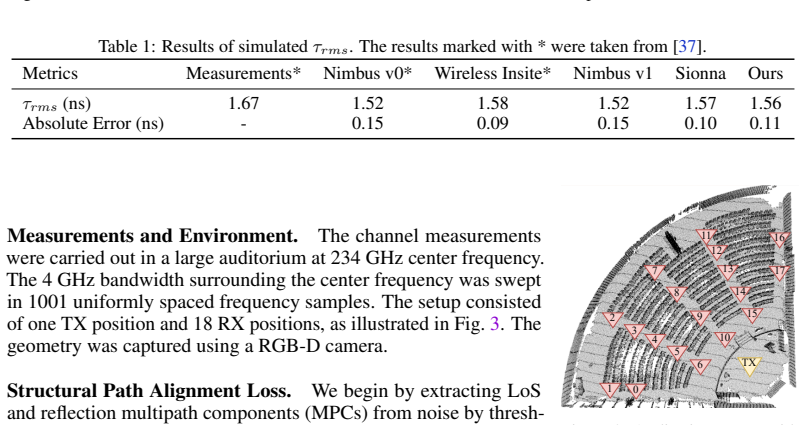
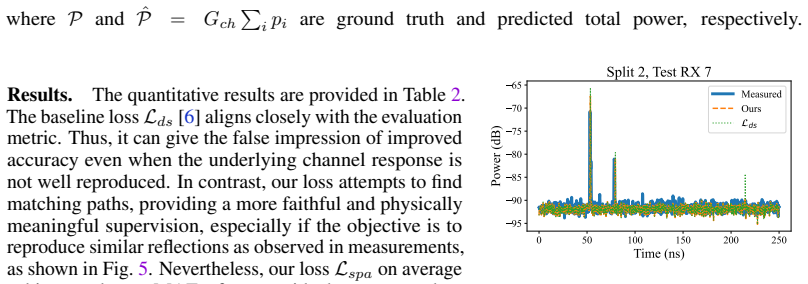
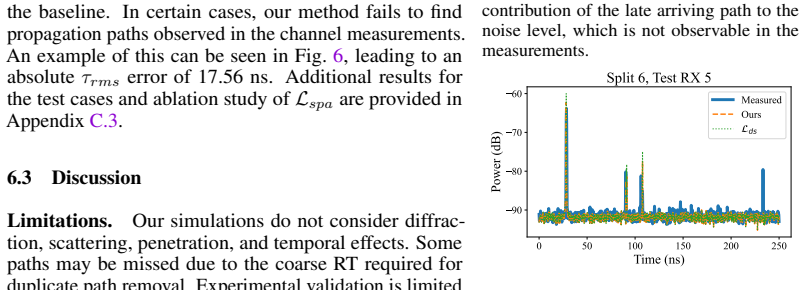
Compare the channel impulse responses extracted by the Gaussian ray tracer against ground-truth measurements taken in the same physical scene or against a conventional mesh-based RF simulator on identical geometry.
Figures




read the original abstract
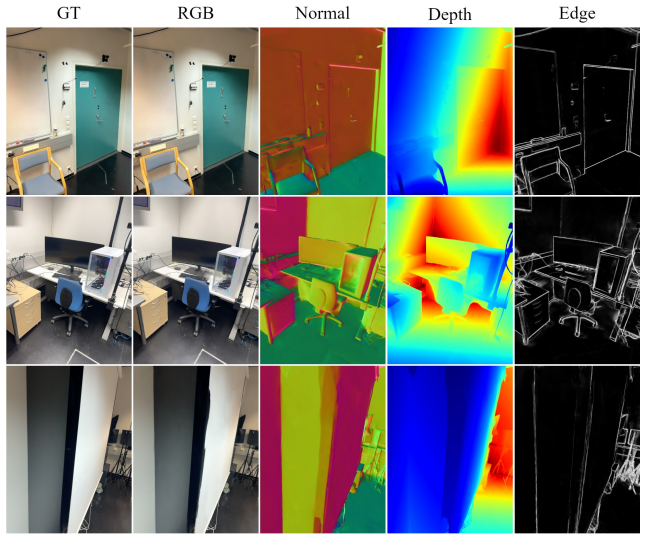
Explicit neural representations such as 3D Gaussian Splatting (3DGS) enable high-fidelity and real-time novel view synthesis, yet optimize for alpha-composited optical appearance rather than ray-intersectable geometry. In contrast, radio-frequency (RF) digital twins require deterministic multi-bounce paths, where the geometry dictates trajectories and their associated attenuation and delay. We introduce a framework enabling differentiable RF propagation simulation directly within visually reconstructed neural scenes, allowing point-to-point path computation between arbitrary 3D locations while preserving high-quality visual rendering. Unlike conventional RF simulation pipelines that rely on manually constructed meshes, we embed Gaussian primitives into a hardware-accelerated ray tracing structure as the underlying spatial representation. By extracting physically meaningful channel impulse responses from visual-only reconstructions, we provide cross-modal evidence that neural reconstructions can serve as unified spatial representations for both electromagnetic propagation simulation and photorealistic view synthesis.
Editorial analysis
A structured set of objections, weighed in public.
Referee Report
Summary. The paper introduces a framework that embeds 3D Gaussian Splatting primitives into a hardware-accelerated ray-tracing structure, enabling differentiable computation of multi-bounce RF paths (including delay and attenuation) directly inside scenes reconstructed from RGB images alone. It claims this yields physically meaningful channel impulse responses while preserving real-time photorealistic view synthesis, thereby providing a unified spatial representation for both electromagnetic propagation and visual rendering without requiring manually constructed meshes.
Significance. If validated, the approach would reduce the cost of building RF digital twins by reusing visual reconstructions, offering cross-modal evidence that neural scene representations can support deterministic physics-based simulation. The hardware ray-tracing integration and differentiability are practical strengths; however, the significance is currently limited by the absence of demonstrated physical fidelity for material-dependent effects.
major comments (2)
- [Abstract and §3] Abstract and §3 (method overview): the central claim that 'physically meaningful channel impulse responses' are extracted from visual-only reconstructions is load-bearing, yet the description provides no mechanism for assigning or inferring RF material parameters (permittivity, conductivity, roughness) from RGB-optimized Gaussians; without this, extracted delays and attenuations risk being artifacts of the visual loss rather than electromagnetic simulation.
- [§4] §4 (ray-tracing embedding): the use of soft, alpha-blended Gaussian ellipsoids for intersection and normal computation is not shown to produce the hard dielectric boundaries required for correct reflection coefficients and multi-bounce paths; the paper must demonstrate that the resulting geometry yields deterministic, physically accurate trajectories rather than approximate splat intersections.
minor comments (2)
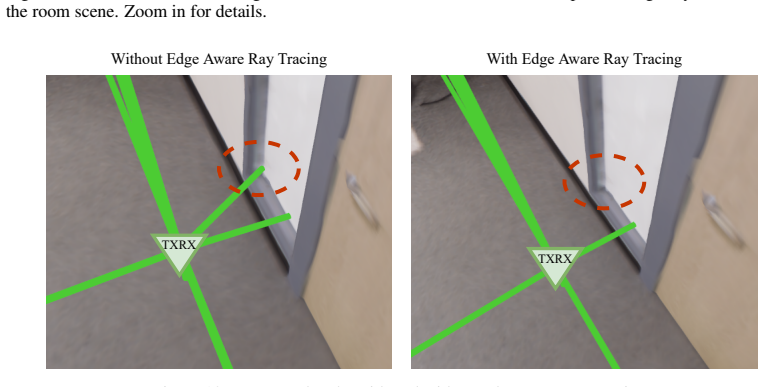
- [Figure 2 and §5] Figure 2 and §5 (experiments): add quantitative comparison of simulated CIRs against ground-truth measurements or ray-tracing on explicit meshes to substantiate the 'physically meaningful' claim.
- [§3.2] Notation in §3.2: define the mapping from Gaussian covariance to surface normal and intersection point explicitly, including any approximation used for hardware acceleration.
Simulated Author's Rebuttal
We thank the referee for the constructive comments on our manuscript. We address each major comment point by point below, clarifying our approach and indicating planned revisions to improve precision and validation.
read point-by-point responses
-
Referee: [Abstract and §3] Abstract and §3 (method overview): the central claim that 'physically meaningful channel impulse responses' are extracted from visual-only reconstructions is load-bearing, yet the description provides no mechanism for assigning or inferring RF material parameters (permittivity, conductivity, roughness) from RGB-optimized Gaussians; without this, extracted delays and attenuations risk being artifacts of the visual loss rather than electromagnetic simulation.
Authors: We agree that the manuscript requires greater clarity on this distinction. Our framework computes deterministic multi-bounce paths and delays directly from the explicit 3D Gaussian geometry via hardware ray tracing; attenuations and reflection coefficients are then derived using user-specified or default material parameters applied to the intersected surfaces. No mechanism for inferring permittivity, conductivity, or roughness from RGB-optimized Gaussians is present, as the visual reconstruction does not encode electromagnetic properties. The term 'physically meaningful' refers specifically to the use of ray-traced trajectories on the reconstructed scene rather than implicit or learned propagation models. We will revise the abstract and §3 to explicitly state these assumptions, note that material assignment is orthogonal to the geometric representation, and emphasize that path computation is independent of the visual optimization loss after the initial reconstruction. revision: partial
-
Referee: [§4] §4 (ray-tracing embedding): the use of soft, alpha-blended Gaussian ellipsoids for intersection and normal computation is not shown to produce the hard dielectric boundaries required for correct reflection coefficients and multi-bounce paths; the paper must demonstrate that the resulting geometry yields deterministic, physically accurate trajectories rather than approximate splat intersections.
Authors: We acknowledge the need for explicit validation of the intersection model. Although alpha blending is used only for the differentiable visual renderer, the RF simulation treats each Gaussian as a hard ellipsoid surface for ray intersection tests within the hardware-accelerated structure, yielding deterministic hit points and surface normals for reflection coefficient computation. To demonstrate physical accuracy, we will add quantitative comparisons in the revised §4 and experiments section: path trajectories, bounce counts, and resulting channel impulse responses will be evaluated against reference simulations performed on manually constructed meshes of the same environments. Visualizations of intersection points and normals will also be included to confirm the hard-boundary behavior. revision: yes
Circularity Check
No circularity: new embedding framework is independently proposed
full rationale
The paper's derivation chain consists of introducing a novel embedding of 3D Gaussian primitives into a hardware-accelerated ray-tracing structure, then using that structure to compute point-to-point RF paths and extract CIRs. This is presented as an extension of existing 3DGS (cited externally) rather than a reduction of any output to fitted inputs or self-referential definitions. No equation or claim reduces a 'prediction' to a parameter fit by construction, nor does any load-bearing step rely on a self-citation chain that itself assumes the target result. The central claim of cross-modal evidence is grounded in the proposed unified representation and its implementation, making the work self-contained against external benchmarks.
Axiom & Free-Parameter Ledger
axioms (1)
- domain assumption Gaussian primitives embedded in ray tracing structures can represent geometry sufficiently for accurate multi-bounce RF propagation including attenuation and delay
Reference graph
Works this paper leans on
-
[1]
Bernhard Kerbl, Georgios Kopanas, Thomas Leimkühler, and George Drettakis. 3d gaussian splatting for real-time radiance field rendering.ACM Transactions on Graphics, 42(4), 2023
work page 2023
-
[2]
2d gaussian splatting for geometrically accurate radiance fields
Binbin Huang, Zehao Yu, Anpei Chen, Andreas Geiger, and Shenghua Gao. 2d gaussian splatting for geometrically accurate radiance fields. InACM SIGGRAPH 2024 Conference Papers, pages 1–11, 2024
work page 2024
-
[3]
Danpeng Chen, Hai Li, Weicai Ye, Yifan Wang, Weijian Xie, Shangjin Zhai, Nan Wang, Haomin Liu, Hujun Bao, and Guofeng Zhang. Pgsr: Planar-based gaussian splatting for efficient and high-fidelity surface reconstruction.IEEE Transactions on Visualization and Computer Graphics, 31(9):6100–6111, 2024
work page 2024
-
[4]
Dn-splatter: Depth and normal priors for gaussian splatting and meshing
Matias Turkulainen, Xuqian Ren, Iaroslav Melekhov, Otto Seiskari, Esa Rahtu, and Juho Kannala. Dn-splatter: Depth and normal priors for gaussian splatting and meshing. In2025 IEEE/CVF Winter Conference on Applications of Computer Vision (WACV), pages 2421–2431. IEEE, 2025
work page 2025
-
[5]
ITU-R P.2040.https://www.itu.int/rec/R-REC-P.2040/en. Accessed: 01.03.2026
work page 2040
-
[6]
Jakob Hoydis, Fayçal Aït Aoudia, Sebastian Cammerer, Florian Euchner, Merlin Nimier-David, Stephan Ten Brink, and Alexander Keller. Learning radio environments by differentiable ray tracing.IEEE Transactions on Machine Learning in Communications and Networking, 2: 1527–1539, 2024
work page 2024
-
[7]
Shuaifeng Jiang, Qi Qu, Xiaqing Pan, Abhishek K Agrawal, Richard Newcombe, and Ahmed Alkhateeb. Learnable wireless digital twins: Reconstructing electromagnetic field with neural representations.IEEE Open Journal of the Communications Society, 6:1568–1590, 2025
work page 2025
-
[8]
Fayçal Aït Aoudia, Jakob Hoydis, Merlin Nimier-David, Baptiste Nicolet, Sebastian Cammerer, and Alexander Keller. Sionna rt: Technical report.arXiv preprint arXiv:2504.21719, 2025
-
[9]
Nerf: Representing scenes as neural radiance fields for view synthesis
Ben Mildenhall, Pratul P Srinivasan, Matthew Tancik, Jonathan T Barron, Ravi Ramamoor- thi, and Ren Ng. Nerf: Representing scenes as neural radiance fields for view synthesis. Communications of the ACM, 65(1):99–106, 2021
work page 2021
-
[10]
Antoine Guédon and Vincent Lepetit. Sugar: Surface-aligned gaussian splatting for efficient 3d mesh reconstruction and high-quality mesh rendering. InProceedings of the IEEE/CVF Conference on Computer Vision and Pattern Recognition, pages 5354–5363, 2024
work page 2024
-
[11]
Gaussianshader: 3d gaussian splatting with shading functions for reflective surfaces
Yingwenqi Jiang, Jiadong Tu, Yuan Liu, Xifeng Gao, Xiaoxiao Long, Wenping Wang, and Yuexin Ma. Gaussianshader: 3d gaussian splatting with shading functions for reflective surfaces. InProceedings of the IEEE/CVF Conference on Computer Vision and Pattern Recognition, pages 5322–5332, 2024
work page 2024
-
[12]
Relightable 3d gaussians: Realistic point cloud relighting with brdf decomposition and ray tracing
Jian Gao, Chun Gu, Youtian Lin, Zhihao Li, Hao Zhu, Xun Cao, Li Zhang, and Yao Yao. Relightable 3d gaussians: Realistic point cloud relighting with brdf decomposition and ray tracing. InEuropean Conference on Computer Vision, pages 73–89. Springer, 2024. 10
work page 2024
-
[13]
arXiv preprint arXiv:2412.15867 , year=
Chun Gu, Xiaofei Wei, Zixuan Zeng, Yuxuan Yao, and Li Zhang. Irgs: Inter-reflective gaussian splatting with 2d gaussian ray tracing.arXiv preprint arXiv:2412.15867, 2024
-
[14]
Jiajun Tang, Fan Fei, Zhihao Li, Xiao Tang, Shiyong Liu, Youyu Chen, Binxiao Huang, Zhenyu Chen, Xiaofei Wu, and Boxin Shi. Spectre-gs: Modeling highly specular surfaces with reflected nearby objects by tracing rays in 3d gaussian splatting. InProceedings of the Computer Vision and Pattern Recognition Conference, pages 16133–16142, 2025
work page 2025
-
[15]
Nicolas Moenne-Loccoz, Ashkan Mirzaei, Or Perel, Riccardo de Lutio, Janick Martinez Esturo, Gavriel State, Sanja Fidler, Nicholas Sharp, and Zan Gojcic. 3d gaussian ray tracing: Fast tracing of particle scenes.ACM Transactions on Graphics (TOG), 43(6):1–19, 2024
work page 2024
-
[16]
Envgs: Modeling view-dependent appearance with environment gaussian
Tao Xie, Xi Chen, Zhen Xu, Yiman Xie, Yudong Jin, Yujun Shen, Sida Peng, Hujun Bao, and Xiaowei Zhou. Envgs: Modeling view-dependent appearance with environment gaussian. In Proceedings of the Computer Vision and Pattern Recognition Conference, pages 5742–5751, 2025
work page 2025
-
[17]
Winert: Towards neural ray tracing for wireless channel modelling and differentiable simulations
Tribhuvanesh Orekondy, Pratik Kumar, Shreya Kadambi, Hao Ye, Joseph Soriaga, and Arash Behboodi. Winert: Towards neural ray tracing for wireless channel modelling and differentiable simulations. InThe Eleventh International Conference on Learning Representations, 2023
work page 2023
-
[18]
Nerf2: Neural radio-frequency radiance fields
Xiaopeng Zhao, Zhenlin An, Qingrui Pan, and Lei Yang. Nerf2: Neural radio-frequency radiance fields. InProceedings of the 29th Annual International Conference on Mobile Computing and Networking, pages 1–15, 2023
work page 2023
-
[19]
Newrf: a deep learning framework for wireless radiation field reconstruction and channel prediction
Haofan Lu, Christopher Vattheuer, Baharan Mirzasoleiman, and Omid Abari. Newrf: a deep learning framework for wireless radiation field reconstruction and channel prediction. In Proceedings of the 41st International Conference on Machine Learning, ICML’24. JMLR.org, 2024
work page 2024
-
[20]
Wrf-gs: Wireless radiation field reconstruction with 3d gaussian splatting
Chaozheng Wen, Jingwen Tong, Yingdong Hu, Zehong Lin, and Jun Zhang. Wrf-gs: Wireless radiation field reconstruction with 3d gaussian splatting. InIEEE INFOCOM 2025-IEEE Conference on Computer Communications, pages 1–10. IEEE, 2025
work page 2025
-
[21]
Chaozheng Wen, Jingwen Tong, Yingdong Hu, Zehong Lin, and Jun Zhang. Neural repre- sentation for wireless radiation field reconstruction: A 3d gaussian splatting approach.IEEE Transactions on Wireless Communications, 2025
work page 2025
-
[22]
Kang Yang, Gaofeng Dong, Sijie Ji, Wan Du, and Mani Srivastava. Gsrf: Complex-valued 3d gaussian splatting for efficient radio-frequency data synthesis.arXiv preprint arXiv:2502.01826, 2025
-
[23]
Lihao Zhang, Haijian Sun, Samuel Berweger, Camillo Gentile, and Rose Qingyang Hu. Rf- 3dgs: Wireless channel modeling with radio radiance field and 3d gaussian splatting.IEEE Transactions on Wireless Communications, 25:10419–10433, 2026
work page 2026
-
[24]
Wataru Okamura, Rikisenia Lukita, Gilbert Ching, Yuki Matsuyama, Yukiko Kishiki, Zhihang Chen, Kentaro Saito, and Jun-ichi Takada. Simplification method of 3d point cloud data for ray trace simulation in indoor environment.IEICE Communications Express, 9(6):182–187, 2020
work page 2020
-
[25]
Mingjie Pang, Han Wang, Kaiwei Lin, and Hai Lin. A gpu-based radio wave propagation prediction with progressive processing on point cloud.IEEE Antennas and Wireless Propagation Letters, 20(6):1078–1082, 2021
work page 2021
-
[26]
From 3d point cloud data to ray-tracing multi-band simulations in industrial scenario
Han Niu, Diego Dupleich, Yanneck Völker-Schöneberg, Alexander Ebert, Robert Müller, Joseph Eichinger, Alexander Artemenko, Giovanni Del Galdo, and Reiner S Thomä. From 3d point cloud data to ray-tracing multi-band simulations in industrial scenario. In2022 IEEE 95th V ehicular Technology Conference:(VTC2022-Spring), pages 1–5. IEEE, 2022
work page 2022
-
[27]
Norisato Suga, Yoshihiro Maeda, and Koya Sato. Indoor radio map construction via ray tracing with rgb-d sensor-based 3d reconstruction: Concept and experiments in wlan systems.IEEE Access, 11:24863–24874, 2023. 11
work page 2023
-
[28]
Environment- driven mmwave beamforming for multi-user immersive applications
Ahmad Kamari, Nan Wu, Hemant Kumar Narsani, Bo Han, and Parth Pathak. Environment- driven mmwave beamforming for multi-user immersive applications. InProceedings of the 1st ACM Workshop on Mobile Immersive Computing, Networking, and Systems, pages 268–275, 2023
work page 2023
-
[29]
Guozhen Xia, Chen Zhou, Fubin Zhang, Zeyu Cui, Chengkai Liu, Hao Ji, Xinmiao Zhang, Zhengyu Zhao, and Yin Xiao. Path loss prediction in urban environments with sionna-rt based on accurate propagation scene models at 2.8 ghz.IEEE Transactions on Antennas and Propagation, 72(10):7986–7997, 2024
work page 2024
-
[30]
Norisato Suga, Naoya Yoshida, Ryotaro Gozono, Yoshihiro Maeda, and Koya Sato. Rgb-d sensor-aided radio map estimation using materials classification.IEEE Wireless Communica- tions Letters, 2025
work page 2025
-
[31]
Sionna rt: Differentiable ray tracing for radio propagation modeling
Jakob Hoydis, Fayçal Aït Aoudia, Sebastian Cammerer, Merlin Nimier-David, Nikolaus Binder, Guillermo Marcus, and Alexander Keller. Sionna rt: Differentiable ray tracing for radio propagation modeling. In2023 IEEE Globecom Workshops (GC Wkshps), pages 317–321. IEEE, 2023
work page 2023
-
[32]
https://www.remcom.com/wireless-insite-em-propagation-software
Wireless Insite. https://www.remcom.com/wireless-insite-em-propagation-software . Accessed: 01.03.2026
work page 2026
-
[33]
Simulating specular reflections for point cloud geometrical database of the environment
Usman Tahir Virk, Jean-Frederic Wagen, and Katsuyuki Haneda. Simulating specular reflections for point cloud geometrical database of the environment. In2015 Loughborough Antennas & Propagation Conference (LAPC), pages 1–5. IEEE, 2015
work page 2015
-
[34]
Jan Järveläinen, Katsuyuki Haneda, and Aki Karttunen. Indoor propagation channel simulations at 60 ghz using point cloud data.IEEE Transactions on Antennas and Propagation, 64(10): 4457–4467, 2016
work page 2016
-
[35]
Point cloud ray-launching simulations of indoor multipath channels at 60 ghz
Pasi Koivumäki and Katsuyuki Haneda. Point cloud ray-launching simulations of indoor multipath channels at 60 ghz. In2022 IEEE 33rd Annual International Symposium on Personal, Indoor and Mobile Radio Communications (PIMRC), pages 01–07. IEEE, 2022
work page 2022
-
[36]
Pasi Koivumäki, Aki Karttunen, and Katsuyuki Haneda. Ray-optics simulations of outdoor-to- indoor multipath channels at 4 and 14 ghz.IEEE Transactions on Antennas and Propagation, 71(7):6046–6059, 2023
work page 2023
-
[37]
Niklas Vaara, Pekka Sangi, Miguel Bordallo López, and Janne Heikkilä. Ray launching-based computation of exact paths with noisy dense point clouds.IEEE Transactions on Antennas and Propagation, 2025
work page 2025
-
[38]
Niklas Vaara, Pekka Sangi, Miguel Bordallo López, and Janne Heikkilä. Differentiable high- performance ray tracing-based simulation of radio propagation with point clouds.IEEE Anten- nas and Wireless Propagation Letters, pages 1–5, 2026. doi: 10.1109/LAWP.2026.3670638
-
[39]
Radio propagation modelling: To differentiate or to deep learn, that is the question,
Stefanos Bakirtzis, Paul Almasan, José Suárez-Varela, Gabriel O Ferreira, Michail Kalntis, An- dré Felipe Zanella, Ian Wassell, and Andra Lutu. Radio propagation modelling: To differentiate or to deep learn, that is the question.arXiv preprint arXiv:2509.19337, 2025
-
[40]
Oriane Siméoni, Huy V V o, Maximilian Seitzer, Federico Baldassarre, Maxime Oquab, Cijo Jose, Vasil Khalidov, Marc Szafraniec, Seungeun Yi, Michaël Ramamonjisoa, et al. Dinov3. arXiv preprint arXiv:2508.10104, 2025
work page internal anchor Pith review Pith/arXiv arXiv 2025
-
[41]
Scene parsing through ade20k dataset
Bolei Zhou, Hang Zhao, Xavier Puig, Sanja Fidler, Adela Barriuso, and Antonio Torralba. Scene parsing through ade20k dataset. InProceedings of the IEEE conference on computer vision and pattern recognition, pages 633–641, 2017
work page 2017
-
[42]
Zehao Yu, Torsten Sattler, and Andreas Geiger. Gaussian opacity fields: Efficient and compact surface reconstruction in unbounded scenes.arXiv preprint arXiv:2404.10772, 2024
-
[43]
MoGe-2: Accurate Monocular Geometry with Metric Scale and Sharp Details
Ruicheng Wang, Sicheng Xu, Yue Dong, Yu Deng, Jianfeng Xiang, Zelong Lv, Guangzhong Sun, Xin Tong, and Jiaolong Yang. Moge-2: Accurate monocular geometry with metric scale and sharp details.arXiv preprint arXiv:2507.02546, 2025. 12
work page internal anchor Pith review arXiv 2025
-
[44]
slang-torch.https://github.com/shader-slang/slang-torch. Accessed: 01.03.2026
work page 2026
-
[45]
Initial results on d band channel measurements in los and nlos office corridor environment
Joonas Kokkoniemi, Veikko Hovinen, Klaus Nevala, and Markku Juntti. Initial results on d band channel measurements in los and nlos office corridor environment. In2022 16th European Conference on Antennas and Propagation (EuCAP), pages 1–5. IEEE, 2022
work page 2022
-
[46]
Absgs: Recovering fine details in 3d gaussian splatting
Zongxin Ye, Wenyu Li, Sidun Liu, Peng Qiao, and Yong Dou. Absgs: Recovering fine details in 3d gaussian splatting. InProceedings of the 32nd ACM International Conference on Multimedia, pages 1053–1061, 2024
work page 2024
-
[47]
Citygaussianv2: Efficient and geometrically accurate reconstruction for large-scale scenes
Yang Liu, Chuanchen Luo, Zhongkai Mao, Junran Peng, and Zhaoxiang Zhang. Citygaussianv2: Efficient and geometrically accurate reconstruction for large-scale scenes. InThe Thirteenth International Conference on Learning Representations, 2025. URL https://openreview. net/forum?id=a3ptUbuzbW
work page 2025
-
[48]
Lukas Radl, Michael Steiner, Mathias Parger, Alexander Weinrauch, Bernhard Kerbl, and Markus Steinberger. Stopthepop: Sorted gaussian splatting for view-consistent real-time rendering.ACM Transactions on Graphics (TOG), 43(4):1–17, 2024
work page 2024
-
[49]
Bs3d: Building-scale 3d reconstruction from rgb-d images
Janne Mustaniemi, Juho Kannala, Esa Rahtu, Li Liu, and Janne Heikkilä. Bs3d: Building-scale 3d reconstruction from rgb-d images. InScandinavian Conference on Image Analysis, pages 551–565. Springer, 2023
work page 2023
-
[50]
Mip-nerf: A multiscale representation for anti-aliasing neural radiance fields
Jonathan T Barron, Ben Mildenhall, Matthew Tancik, Peter Hedman, Ricardo Martin-Brualla, and Pratul P Srinivasan. Mip-nerf: A multiscale representation for anti-aliasing neural radiance fields. InProceedings of the IEEE/CVF international conference on computer vision, pages 5855–5864, 2021
work page 2021
-
[51]
Peter Hedman, Julien Philip, True Price, Jan-Michael Frahm, George Drettakis, and Gabriel Brostow. Deep blending for free-viewpoint image-based rendering.ACM Transactions on Graphics (ToG), 37(6):1–15, 2018
work page 2018
-
[52]
Arno Knapitsch, Jaesik Park, Qian-Yi Zhou, and Vladlen Koltun. Tanks and temples: Bench- marking large-scale scene reconstruction.ACM Transactions on Graphics (ToG), 36(4):1–13, 2017
work page 2017
-
[53]
Pixelwise view selection for unstructured multi-view stereo
Johannes Lutz Schönberger, Enliang Zheng, Marc Pollefeys, and Jan-Michael Frahm. Pixelwise view selection for unstructured multi-view stereo. InEuropean Conference on Computer Vision (ECCV), 2016
work page 2016
-
[54]
Structure-from-motion revisited
Johannes Lutz Schönberger and Jan-Michael Frahm. Structure-from-motion revisited. In Conference on Computer Vision and Pattern Recognition (CVPR), 2016
work page 2016
-
[55]
S. Umeyama. Least-squares estimation of transformation parameters between two point patterns. IEEE Transactions on Pattern Analysis and Machine Intelligence, 13(4):376–380, 1991. doi: 10.1109/34.88573
-
[56]
Julian Straub, Thomas Whelan, Lingni Ma, Yufan Chen, Erik Wijmans, Simon Green, Jakob J. Engel, Raul Mur-Artal, Carl Ren, Shobhit Verma, Anton Clarkson, Mingfei Yan, Brian Budge, Yajie Yan, Xiaqing Pan, June Yon, Yuyang Zou, Kimberly Leon, Nigel Carter, Jesus Briales, Tyler Gillingham, Elias Mueggler, Luis Pesqueira, Manolis Savva, Dhruv Batra, Hauke M. S...
work page internal anchor Pith review arXiv 1906
discussion (0)
Sign in with ORCID, Apple, or X to comment. Anyone can read and Pith papers without signing in.