Recognition: 1 theorem link
· Lean TheoremCktFormalizer: Autoformalization of Natural Language into Circuit Representations
Pith reviewed 2026-05-13 07:28 UTC · model grok-4.3
The pith
CktFormalizer routes LLM hardware specs through dependent types in Lean to produce designs that survive full synthesis and routing.
A machine-rendered reading of the paper's core claim, the machinery that carries it, and where it could break.
Core claim
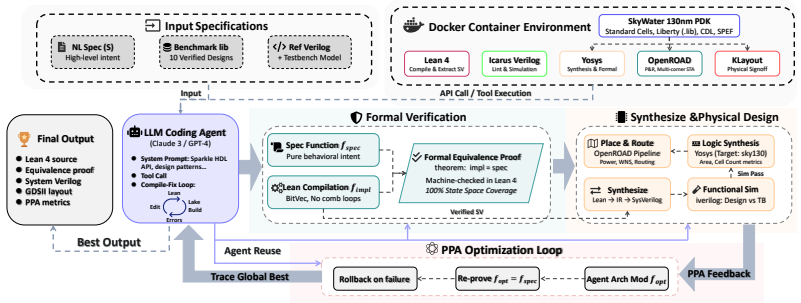
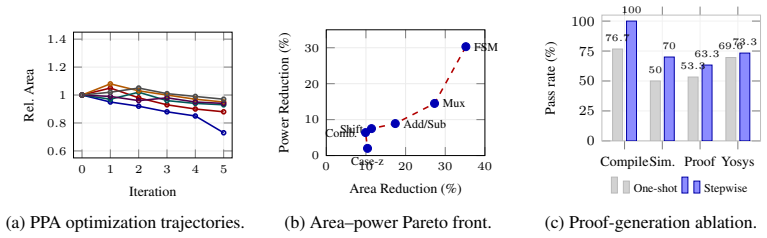
CktFormalizer embeds hardware generation in a dependently-typed HDL within Lean 4, where dependent types encode bit-width constraints, case coverage, and acyclicity to turn defects into compile-time errors. This allows iterative repair by the agent, producing designs that are structurally free of defects causing silent backend failures. The approach achieves simulation pass rates competitive with direct Verilog generation while ensuring 95-100 percent of designs complete the full synthesis, place-and-route, DRC, and LVS flow. It further constructs machine-checked equivalence proofs and supports closed-loop PPA optimization with up to 35 percent area and 30 percent power reductions while main
What carries the argument
The dependently-typed HDL embedded in Lean 4 that encodes hardware constraints as types to enable compile-time verification, repair guidance, and proof construction.
Load-bearing premise
That the dependent-type encoding in Lean correctly captures every hardware defect that can cause silent backend failures and that the LLM can be guided to repair all such defects without introducing new ones.
What would settle it
Generate designs on a new benchmark set using the framework, then run those that pass Lean checking through a standard synthesis and place-and-route tool to check whether any still fail physical design steps.
Figures




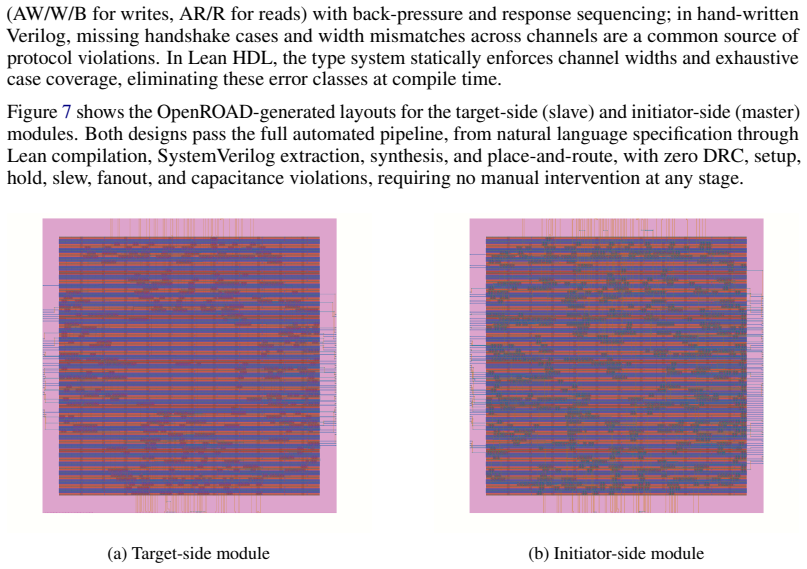


read the original abstract
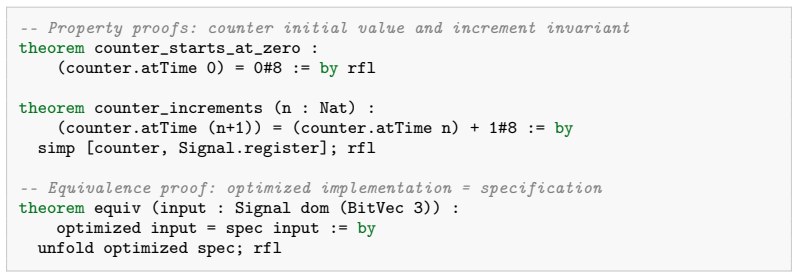
LLMs can generate hardware descriptions from natural language specifications, but the resulting Verilog often contains width mismatches, combinational loops, and incomplete case logic that pass syntax checks yet fail in synthesis or silicon. We present CktFormalizer, a framework that redirects LLM-driven hardware generation through a dependently-typed HDL embedded in Lean 4. Lean serves three roles: (i) type checker:dependent types encode bit-width constraints, case coverage, and acyclicity, turning hardware defects into compile-time errors that guide iterative repair; (ii) correctness firewall:compiled designs are structurally free of defects that cause silent backend failures (the baseline loses 20% of correct designs during synthesis and routing; CktFormalizer preserves all of them); (iii) proof assistant:the agent constructs machine-checked equivalence proofs over arbitrary input sequences and parameterized widths, beyond the reach of bounded SMT-based checking. On VerilogEval (156 problems), RTLLM (50 problems), and ResBench (56 problems), CktFormalizer achieves simulation pass rates competitive with direct Verilog generation while delivering substantially higher backend realizability: 95--100% of compiled designs complete the full synthesis, place-and-route, DRC, and LVS flow. A closed-loop PPA optimization stage yields up to 35% area reduction and 30% power reduction through validated architecture exploration, with automated theorem proof ensuring that each optimized variant remains functionally equivalent to its formal specification.
Editorial analysis
A structured set of objections, weighed in public.
Referee Report
Summary. The paper introduces CktFormalizer, a framework that redirects LLM hardware generation through a dependently-typed HDL in Lean 4. Lean acts as type checker (encoding bit-widths, case coverage, acyclicity), correctness firewall (preventing silent backend failures), and proof assistant (machine-checked equivalence proofs). On VerilogEval (156 problems), RTLLM (50), and ResBench (56), it reports simulation pass rates competitive with direct Verilog generation but 95-100% full synthesis/P&R/DRC/LVS success (vs. baseline losing ~20%), plus up to 35% area and 30% power reductions via verified PPA optimization.
Significance. If the central claims hold, the work demonstrates a practical integration of dependent types and proof assistants with LLM-driven hardware generation, providing a compile-time firewall that substantially improves backend realizability while preserving functional correctness via machine-checked proofs. This could meaningfully advance reliable autoformalization for digital design, especially if the type encoding generalizes beyond the reported benchmarks.
major comments (2)
- [Abstract] Abstract: The claim that 'compiled designs are structurally free of defects that cause silent backend failures' (with baseline losing 20%) rests on encoding only three properties (width constraints, case coverage, acyclicity). No explicit mapping or completeness argument is given showing that all synthesis/P&R/DRC/LVS failure modes reduce to these type errors; defects such as inferred latches or untyped fanout congestion may evade detection while simulation passes remain competitive.
- [§5] §5 (Experimental Evaluation): The reported simulation pass rates and 95-100% backend success lack details on baseline Verilog generation implementations, experimental controls, number of designs excluded from the 156/50/56 problems, or statistical significance. This information is load-bearing for assessing whether the realizability gains are attributable to the Lean firewall rather than selection effects.
minor comments (2)
- [Abstract] The PPA optimization results (35% area, 30% power) are stated without specifying the exact baseline architecture or number of variants explored per design.
- [§3] Notation for the dependent-type encoding of acyclicity and case coverage could be illustrated with a small concrete example early in the manuscript to aid readability.
Simulated Author's Rebuttal
We thank the referee for the constructive feedback. We address each major comment below and describe the revisions we will incorporate to improve clarity and rigor.
read point-by-point responses
-
Referee: [Abstract] Abstract: The claim that 'compiled designs are structurally free of defects that cause silent backend failures' (with baseline losing 20%) rests on encoding only three properties (width constraints, case coverage, acyclicity). No explicit mapping or completeness argument is given showing that all synthesis/P&R/DRC/LVS failure modes reduce to these type errors; defects such as inferred latches or untyped fanout congestion may evade detection while simulation passes remain competitive.
Authors: We appreciate this observation. The three properties were selected because they capture the dominant sources of silent backend failures in our LLM-generated Verilog designs. We do not claim or prove that these properties exhaustively cover every possible synthesis, P&R, DRC, or LVS failure mode, as constructing such a complete mapping lies outside the paper's scope. In the revised manuscript we will (i) rephrase the abstract to state that the approach 'substantially reduces' rather than 'structurally free of' such defects and (ii) add a short limitations paragraph in §5 that explicitly lists other potential issues (e.g., inferred latches, fanout congestion) and notes that they remain detectable by downstream tools. revision: yes
-
Referee: [§5] §5 (Experimental Evaluation): The reported simulation pass rates and 95-100% backend success lack details on baseline Verilog generation implementations, experimental controls, number of designs excluded from the 156/50/56 problems, or statistical significance. This information is load-bearing for assessing whether the realizability gains are attributable to the Lean firewall rather than selection effects.
Authors: We agree that these details are essential. In the revised §5 we will add: (1) a precise description of the baseline (identical LLM, same prompt template, direct Verilog output); (2) experimental controls (fixed seeds, temperature, and model version); (3) confirmation that all 156/50/56 problems were attempted with zero exclusions; and (4) statistical reporting including 95% confidence intervals on success rates. These additions will make clear that the observed realizability gains are attributable to the Lean firewall rather than selection. revision: yes
Circularity Check
No circularity: claims rest on external Lean type checker and benchmark empirics
full rationale
The derivation chain consists of (1) encoding hardware constraints as dependent types in Lean 4 for widths/coverage/acyclicity, (2) using the external Lean checker to reject invalid designs, and (3) reporting empirical simulation-pass and full-flow synthesis success rates on VerilogEval/RTLLM/ResBench. None of these steps reduce by construction to the paper's own fitted parameters, self-defined quantities, or self-citation chains. The 'correctness firewall' assertion is an empirical claim about the three enumerated checks, not a definitional equivalence. No equations, ansatzes, or uniqueness theorems are smuggled via self-citation. The central results are falsifiable against external benchmarks and Lean's independent type system.
Axiom & Free-Parameter Ledger
Lean theorems connected to this paper
-
IndisputableMonolith/Foundation/AbsoluteFloorClosure.leanreality_from_one_distinction unclear?
unclearRelation between the paper passage and the cited Recognition theorem.
dependent types encode bit-width constraints, case coverage, and acyclicity... compiled designs are structurally free of defects that cause silent backend failures
What do these tags mean?
- matches
- The paper's claim is directly supported by a theorem in the formal canon.
- supports
- The theorem supports part of the paper's argument, but the paper may add assumptions or extra steps.
- extends
- The paper goes beyond the formal theorem; the theorem is a base layer rather than the whole result.
- uses
- The paper appears to rely on the theorem as machinery.
- contradicts
- The paper's claim conflicts with a theorem or certificate in the canon.
- unclear
- Pith found a possible connection, but the passage is too broad, indirect, or ambiguous to say the theorem truly supports the claim.
Reference graph
Works this paper leans on
-
[1]
Christiaan Baaij, Matthijs Kooijman, Jan Kuper, Arjan Boeijink, and Marco Gerards
URLhttps://api.semanticscholar.org/CorpusID:210937106. Christiaan Baaij, Matthijs Kooijman, Jan Kuper, Arjan Boeijink, and Marco Gerards. C λash: Structural descriptions of synchronous hardware using Haskell.EUROMICRO DSD, pages 714– 721, 2010. Jonathan Bachrach, Huy V o, Brian Richards, Yunsup Lee, Andrew Waterman, Rimas Avižienis, John Wawrzynek, and Kr...
-
[2]
Synthesis feedback— reports the current pipeline status (compile, SV extraction, lint, simulation, synthesis) together with synthesis error context (tailed from Yosys/ORFS logs, up to 2,500 characters), and instructs the agent to edit the Lean source while preserving functional behavior
-
[3]
PPA optimization feedback— presents the current PPA vector (area, cell count, WNS, power), a history table of all prior iterations, and an optimization focus (timing closure if WNS <0 , area reduction otherwise). The agent is instructed to define both a _spec (original) and an optimized variant, prove equivalence via Lean tactics (unfold, ext, simp, bv_om...
-
[4]
Architecture exploration feedback— tabulates all candidates (description, simulation pass, verified status, area, cells, WNS, power) and optional area/latency constraints, then suggests architectural dimensions to explore (parallelism, pipelining, resource sharing)
-
[5]
13 Table 5: Structure of the CIRCFORMALIZERagent system prompt (∼345 lines)
Direct SystemVerilog feedback— used when optimizing exported Verilog rather than Lean source; includes the current SystemVerilog code, PPA metrics, and history, with instructions to preserve the module interface and output a complete SystemVerilog-2012 module. 13 Table 5: Structure of the CIRCFORMALIZERagent system prompt (∼345 lines). Section Content Rol...
work page 2012
-
[6]
Read and edit ‘Generated/<prob_id>.lean‘
-
[7]
Preserve the problem behavior and public interface
-
[8]
Use ‘lean_check‘ to verify Lean compilation and Verilog extraction
-
[9]
Keep ‘#synthesizeVerilog‘ on the implementation function
-
[10]
The external evaluator will rerun simulation and synthesis
Write the final repaired file. The external evaluator will rerun simulation and synthesis. Feedback Prompt 2: Lean PPA optimization ## PPA Optimization Feedback -- Iteration <i> Your implementation for ‘<prob_id>‘ passed functional simulation and synthesis. Now optimize the design for better PPA (Power, Performance, Area). ### Current PPA Metrics - Area: ...
-
[11]
Read your current ‘Generated/<prob_id>.lean‘
-
[12]
Use ‘lean_proof_step‘ to define both ‘<name>_spec‘ (original) and ‘<name>‘ (optimized), and note the returned environment number
-
[13]
Use ‘lean_proof_step(env=<env>)‘ to state ‘theorem <name>_equiv : <name> = <name>_spec := by sorry‘
-
[14]
Replace ‘sorry‘ with tactics (‘unfold‘, ‘ext‘, ‘simp‘, ‘bv_omega‘) until no goals remain
-
[15]
If equivalence cannot be proved, do not optimize; keep the original design
-
[16]
Write the final code and verify with ‘lean_check‘
-
[17]
‘#synthesizeVerilog‘ must reference the optimized implementation. 15 Feedback Prompt 3: Architecture exploration ## Architecture Exploration -- Candidate <k> Your task: write a COMPLETELY DIFFERENT architecture for ‘<prob_id>‘. Do NOT tweak the existing implementation -- write a new one from scratch. ### Candidates So Far | # | Description | Sim | Verifie...
discussion (0)
Sign in with ORCID, Apple, or X to comment. Anyone can read and Pith papers without signing in.