Recognition: 2 theorem links
· Lean TheoremCan I Check What I Designed? Mapping Security Design DSLs to Code Analyzers
Pith reviewed 2026-05-11 02:48 UTC · model grok-4.3
The pith
Security design languages connect to code analyzers through surprisingly few shared concepts.
A machine-rendered reading of the paper's core claim, the machinery that carries it, and where it could break.
Core claim
The authors establish that design-level security DSLs and implementation-level code analyzers have few commonalities in their security concepts. Checks in analyzers tend to be specified using very general weakness descriptions, which in turn generate a large number of non-obvious potential relationships with design DSL elements. Even security experts find this mapping difficult to handle due to the resulting complexity. By building the SecLan model from shared concepts identified across 66 DSLs and 559 checks from 36 analyzers, and validating it with experts, the work supplies an empirical basis for understanding the abstraction gap between design and implementation.
What carries the argument
The SecLan model, which captures the security concepts common to both design DSLs and code analyzers and serves as the foundation for mapping and analyzing their relationships.
If this is right
- Designers can better evaluate how implementation vulnerabilities impact their high-level security specifications using the identified mappings.
- Analyzer developers may improve the specificity of their checks to reduce ambiguity in relating them to designs.
- Researchers gain a starting point for developing automated tools that bridge the design-implementation security gap.
- Practitioners receive guidance on which design elements are likely covered by existing code checks and which are not.
Where Pith is reading between the lines
- Integrated environments that allow checking code against design models directly could reduce reliance on manual mapping.
- The general weakness descriptions may reflect a broader issue in how security standards are written, suggesting a need for more precise taxonomies.
- Extending this analysis to emerging DSLs for cloud or AI systems could reveal if the gap persists in new domains.
- The findings imply that security assurance requires coordinated advances in both design languages and analysis techniques rather than isolated improvements.
Load-bearing premise
The chosen collection of 66 DSLs and 36 analyzers, together with the assessments from the consulted security experts, represent the full range of security design and analysis practices.
What would settle it
Finding a substantially larger number of direct, obvious correspondences between specific design DSL concepts and precise analyzer checks in an expanded study would indicate that the commonalities are greater than reported.
Figures







read the original abstract
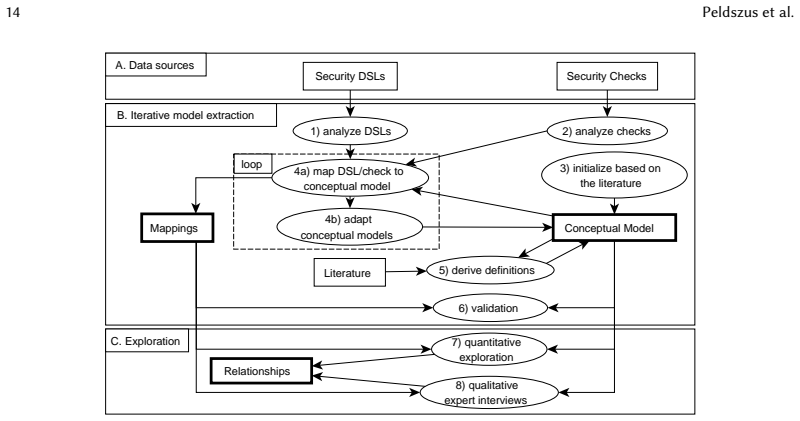
When assessing the potential impact of code-level vulnerabilities, e.g., discovered by automated analyzers, it is essential to consider them in the context of the system's security design. However, this is a challenging task due to the abstraction gap between security design, often specified using security DSLs, and implementation. As we will show, even security experts lack a complete understanding of this relationship. Intrigued by this gap (and the general disconnect between secure design and secure implementation) we present a study of 66 design-level security DSLs and 559 security checks from 36 code-level analyzers. We identify what concepts are common to both and capture them in the SecLan model, which has been validated by 22 security experts. Based on this, we investigate the relationship between DSLs and analyzers quantitatively and explore it qualitatively together with 9 security experts. We learn that there are few commonalities between design-level and implementation-level security; security checks are often described by overly general weaknesses, resulting in many non-obvious potential relationships between security DSLs and analyzers; and even security experts are overwhelmed by this complexity. We provide an empirical basis that helps practitioners and researchers better understand the gap and serves as a first step toward bridging it.
Editorial analysis
A structured set of objections, weighed in public.
Referee Report
Summary. The manuscript reports on an empirical study involving 66 security design DSLs and 559 security checks from 36 code-level analyzers. It derives a SecLan model of common concepts validated by 22 security experts, then quantitatively maps the DSLs to analyzer checks and qualitatively explores the relationships with 9 experts. The key findings are that there are few commonalities between design-level and implementation-level security, that security checks are often described using overly general weaknesses leading to many non-obvious potential relationships, and that even security experts are overwhelmed by this complexity. The work positions itself as providing an empirical basis to understand the gap between secure design and secure implementation.
Significance. Should the central findings prove robust, this paper makes a meaningful contribution by systematically documenting the disconnect between security design languages and code analysis tools. The SecLan model provides a concrete artifact for future research, and the observation that general weakness descriptions create mapping ambiguities offers a clear target for improving analyzer precision or design DSL expressiveness. The expert involvement lends practical weight to the conclusions, potentially influencing how practitioners approach security from design to implementation.
major comments (2)
- [§3] §3 (Data Collection): The selection criteria, search protocol, and inclusion/exclusion rules for the 66 DSLs and 36 analyzers are not documented with sufficient detail or reproducibility (e.g., no explicit coverage of GitHub, academic venues, or commercial tools). This is load-bearing for the central claim of 'few commonalities' because the observed sparsity in mappings and 'many non-obvious potential relationships' could be an artifact of convenience sampling rather than representative of the field.
- [§5] §5 (Quantitative Mapping): The reported overlap statistics and classification of relationships as 'non-obvious' lack sensitivity analysis to alternative interpretations of 'commonality' or to different expert mappings; without this, the quantitative support for the headline findings remains vulnerable to post-hoc interpretation.
minor comments (2)
- [Abstract] Abstract: The forward reference 'as we will show' should be replaced with a direct statement of results to improve standalone readability.
- [SecLan model] SecLan model section: Provide a brief appendix or table listing the exact concepts extracted from the 66 DSLs to make the derivation more transparent.
Simulated Author's Rebuttal
We thank the referee for the thoughtful and constructive comments on our manuscript. We address each of the major comments below and outline the revisions we will make to improve the clarity, reproducibility, and robustness of our study.
read point-by-point responses
-
Referee: [§3] §3 (Data Collection): The selection criteria, search protocol, and inclusion/exclusion rules for the 66 DSLs and 36 analyzers are not documented with sufficient detail or reproducibility (e.g., no explicit coverage of GitHub, academic venues, or commercial tools). This is load-bearing for the central claim of 'few commonalities' because the observed sparsity in mappings and 'many non-obvious potential relationships' could be an artifact of convenience sampling rather than representative of the field.
Authors: We agree that the documentation of our data collection process requires more detail to ensure reproducibility and to allow assessment of potential sampling biases. In the revised version of the manuscript, we will expand §3 to include a comprehensive description of the search protocol, including the specific sources searched (academic venues, GitHub, commercial tool repositories), the search terms used, and the explicit inclusion and exclusion criteria applied to select the 66 security design DSLs and 36 code analyzers. We will also provide a table or list summarizing the selected items and the rationale for inclusion where relevant. This revision will strengthen the foundation for our claims regarding the limited commonalities observed. revision: yes
-
Referee: [§5] §5 (Quantitative Mapping): The reported overlap statistics and classification of relationships as 'non-obvious' lack sensitivity analysis to alternative interpretations of 'commonality' or to different expert mappings; without this, the quantitative support for the headline findings remains vulnerable to post-hoc interpretation.
Authors: We acknowledge the value of sensitivity analysis for validating the quantitative results. In the revised manuscript, we will add a sensitivity analysis subsection in §5. This will include testing the overlap statistics under alternative interpretations of commonality (such as requiring exact concept matches versus semantic similarity) and examining how the classification of 'non-obvious' relationships varies with different groupings or subsets of the expert mappings from the 9 experts consulted. We will report the range of outcomes to demonstrate the robustness of our headline findings on the sparsity of mappings and the challenges posed by overly general weakness descriptions. revision: yes
Circularity Check
No circularity: empirical mapping of external DSLs and analyzers
full rationale
The paper performs a survey-based empirical study: it collects 66 existing security design DSLs and 559 checks from 36 code analyzers, extracts common concepts into the SecLan model, validates the model with 22 experts, and then performs quantitative mapping plus qualitative exploration with 9 experts. No derivation chain, equations, fitted parameters, or predictions are present that could reduce to the authors' own inputs or self-citations. The central claims rest on external artifacts and independent expert validation rather than self-referential definitions or load-bearing prior work by the same authors. Selection bias concerns affect generalizability but do not create circularity in the reported analysis.
Axiom & Free-Parameter Ledger
axioms (2)
- domain assumption The 66 design-level security DSLs and 36 code-level analyzers (yielding 559 checks) are representative of the broader security design and analysis landscape.
- domain assumption Validation and exploration by 22 and 9 security experts sufficiently captures the accuracy of the SecLan model and the nature of DSL-analyzer relationships.
invented entities (1)
-
SecLan model
no independent evidence
Lean theorems connected to this paper
-
IndisputableMonolith/Foundation/RealityFromDistinction.leanreality_from_one_distinction unclear?
unclearRelation between the paper passage and the cited Recognition theorem.
We present a study of 66 design-level security DSLs and 559 security checks from 36 code-level analyzers... synthesize the SecLan model... quantitative analysis of the relationship between security DSLs and security analyzers
-
IndisputableMonolith/Cost/FunctionalEquation.leanwashburn_uniqueness_aczel unclear?
unclearRelation between the paper passage and the cited Recognition theorem.
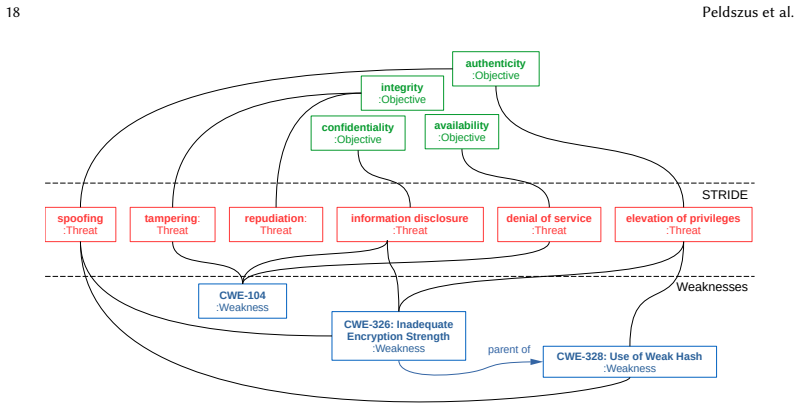
SecLan consists of four sub-models... Security Model... System Model... Sec DSL Description... Sec Analyzer Description
What do these tags mean?
- matches
- The paper's claim is directly supported by a theorem in the formal canon.
- supports
- The theorem supports part of the paper's argument, but the paper may add assumptions or extra steps.
- extends
- The paper goes beyond the formal theorem; the theorem is a base layer rather than the whole result.
- uses
- The paper appears to rely on the theorem as machinery.
- contradicts
- The paper's claim conflicts with a theorem or certificate in the canon.
- unclear
- Pith found a possible connection, but the passage is too broad, indirect, or ambiguous to say the theorem truly supports the claim.
Reference graph
Works this paper leans on
-
[1]
Jenny Abramov, Arnon Sturm, and Peretz Shoval. 2012. Evaluation of the Pattern-based method for Secure De- velopment (PbSD): A controlled experiment. Information and Software Technology (IST) 54, 9 (2012), 1029–1043. 44 Peldszus et al. https://doi.org/10.1016/J.INFSOF.2012.04.001
-
[2]
Gail-Joon Ahn, Seung-Phil Hong, and Michael E Shin. 2002. Reconstructing a formal security model. Information and Software Technology (IST) (2002)
work page 2002
-
[3]
Gail-Joon Ahn and Hongxin Hu. 2007. Towards realizing a formal RBAC model in real systems. In Symposium on Access Control Models and Technologies
work page 2007
-
[4]
Cartesian vs. Radial – A Comparative Evaluation of Two Visualization Tools
Wolfgang Ahrendt, Bernhard Beckert, Richard Bubel, Reiner Hähnle, Peter H. Schmitt, and Mattias Ulbrich. 2016. Deductive Software Verification – The KeY Book– From Theory to Practice. Springer. https://doi.org/10.1007/978- 3-319-49812-6
-
[5]
Masoom Alam, Michael Hafner, and Ruth Breu. 2007. Model-Driven Security Engineering for Trust Management in SECTET. Journal of Software (2007)
work page 2007
- [6]
-
[7]
Julia H. Allen, Sean Barnum, Robert J. Ellison, Gary McGraw, and Nancy R. Mead. 2008.Software Security Engineering. Pearson Education
work page 2008
-
[8]
José Bacelar Almeida, Manuel Barbosa, Gilles Barthe, Arthur Blot, Benjamin Grégoire, Vincent Laporte, Tiago Oliveira, Hugo Pacheco, Benedikt Schmidt, and Pierre-Yves Strub. 2017. Jasmin: High-Assurance and High-Speed Cryptography. In Conference on Computer and Communications Security (CCS). 1807–1823. https://doi.org/10. 1145/3133956.3134078
-
[9]
Mohamed Almorsy and John Grundy. 2014. SecDSVL: A Domain-Specific Visual Language to Support Enterprise Security Modelling. In Australian Software Engineering Conference
work page 2014
-
[10]
Mohamed Almorsy, John Grundy, and Amani S. Ibrahim. 2013. Automated software architecture security risk analysis using formalized signatures. In International Conference on Software Engineering (ICSE). 662–671. https: //doi.org/10.1109/ICSE.2013.6606612
-
[11]
Abdulrahman Alnaim, Ahmed Alwakeel, and Eduardo B. Fernandez. 2019. A Misuse Pattern for Compromising VMs via Virtual Machine Escape in NFV. In Proceedings of the 14th International Conference on Availability, Reliability and Security (Canterbury, CA, United Kingdom) (ARES ’19). Association for Computing Machinery, New York, NY, USA, Article 77, 6 pages. ...
-
[12]
Ludovic Apvrille and Yves Roudier. 2013. SysML-Sec: A SysML Environment for the Design and Development of Secure Embedded Systems. In Asia-Pacific Council on Systems Engineering Conference (APCOSEC)
work page 2013
-
[13]
Oluwasefunmi Tale Arogundade, Olutimi Onilede, Sanjay Misra, Olusola Abayomi-Alli, Modupe Odusami, and Jonathan Oluranti. 2021. From Modeling to Code Generation: An Enhanced and Integrated Approach. In Innovations in Information and Communication Technologies (IICT). 421–427. https://doi.org/10.1007/978-3-030-66218-9_50
-
[14]
Philippe Arteau. 2022. Find Security Bugs. https://find-sec-bugs.github.io/ last accessed February 10 th, 2025
work page 2022
-
[15]
Steven Arzt, Siegfried Rasthofer, Christian Fritz, Eric Bodden, Alexandre Bartel, Jacques Klein, Yves Le Traon, Damien Octeau, and Patrick McDaniel. 2014. FlowDroid: Precise Context, Flow, Field, Object-Sensitive and Lifecycle-Aware Taint Analysis for Android Apps. In Conference on Programming Language Design and Implementation (PLDI). 259–269. https://do...
-
[16]
Dejan Baca, Kai Petersen, Bengt Carlsson, and Lars Lundberg. 2009. Static Code Analysis to Detect Software Security Vulnerabilities - Does Experience Matter?. In International Conference on Availability, Reliability and Security (ARES). 804–810. https://doi.org/10.1109/ARES.2009.163
-
[17]
Chase Baker and Michael Shin. 2012. Mapping of Security Concerns in Design to Security Aspects in Code. In International Conference on Software Security and Reliability (SERE). 102–110. https://doi.org/10.1109/SERE-C. 2012.20
-
[18]
Musard Balliu, Daniel Schoepe, and Andrei Sabelfeld. 2017. We Are Family: Relating Information-Flow Trackers. In European Symposium on Research in Computer Security (ESORICS). 124–145
work page 2017
-
[19]
Djonathan Barros, Sven Peldszus, Wesley K. G. Assunção, and Thorsten Berger. 2022. Editing Support for Software Languages: Implementation Practices in Language Server Protocols. In International Conference on Model Driven Engineering Languages and Systems (MODELS). 232–243. https://doi.org/10.1145/3550355.3552452
-
[20]
Len Bass, Paul Clements, and Rick Kazman. 2003. Software Architecture In Practice. Addison-Wesley Longman
work page 2003
-
[21]
Benoit Baudry, Franck Fleurey, Tejeddine Mouelhi, and Yves Le Traon. 2008. A Model-Based Framework for Security Policy Specification, Deployment and Testing. InInternational Conference on Model Driven Engineering Languages and Systems (MODELS)
work page 2008
-
[22]
Thorsten Berger, Rolf-Helge Pfeiffer, Reinhard Tartler, Steffen Dienst, Krzysztof Czarnecki, Andrzej Wasowski, and Steven She. 2014. Variability Mechanisms in Software Ecosystems. Information and Software Technology (IST) 56, 11 (2014), 1520–1535. https://doi.org/10.1016/j.infsof.2014.05.005
-
[23]
Lorenzo Bettini. 2016. Implementing DSLs with Xtext and Xtend (2 ed.). Packt Publishing. Can I Check What I Designed? Mapping Security Design DSLs to Code Analyzers 45
work page 2016
-
[24]
Simon Bischof. 2022. JOANA (Java Object-sensitive ANAlysis) Project Page. https://pp.ipd.kit.edu/projects/joana/ last accessed February 10th, 2025
work page 2022
-
[25]
Julien Brunel, David Chemouil, Laurent Rioux, Mohamed Bakkali, and Frederique Vallee. 2014. A Viewpoint- Based Approach for Formal Safety & Security Assessment of System Architectures. In Workshop on Model-Driven Engineering, Verification and Validation
work page 2014
-
[26]
Carol C. Burt, Barrett R. Bryant, Rajeev R. Raje, Andrew Olson, and Mikhail Auguston. 2003. Model Driven Security: Unification of Authorization Models for Fine-Grain Access Control. In International Enterprise Distributed Object Computing
work page 2003
-
[27]
Marianne Busch, Nora Koch, and Santiago Suppan. 2014. Modeling Security Features of Web Applications
work page 2014
-
[28]
Marianne Busch and Martin Wirsing. 2015. An Ontology for Secure Web Applications. International Journal of Software and Informatics 9, 2 (2015), 233–258
work page 2015
-
[29]
Cristiano Calcagno, Dino Distefano, Jeremy Dubreil, Dominik Gabi, Pieter Hooimeijer, Martino Luca, Peter O’Hearn, Irene Papakonstantinou, Jim Purbrick, and Dulma Rodriguez. 2015. Moving Fast with Software Verification. InNASA Formal Methods, Klaus Havelund, Gerard Holzmann, and Rajeev Joshi (Eds.). Springer International Publishing, Cham, 3–11
work page 2015
-
[30]
Brian Chess and Jacob West. 2007. Secure Programming with Static Analysis. Pearson Education
work page 2007
-
[31]
Manuel Clavel, Viviane Torres da Silva, Christiano Braga, and Marina Egea. 2008. Model-Driven Security in Practice: An Industrial Experience. In European Conference on Model Driven Architecture - Foundations and Applications (CMDA-FA). 326–337. https://doi.org/10.1007/978-3-540-69100-6_{2}{2}
-
[32]
Common Weakness Enumeration. 2006. CWE-200: Exposure of Sensitive Information to an Unauthorized Actor. https://cwe.mitre.org/data/definitions/200.html
work page 2006
-
[33]
Crispan Cowan, Calton Pu, Dave Maier, Jonathan Walpole, Peat Bakke, Steve Beattie, Aaron Grier, Perry Wagle, Qian Zhang, and Heather Hinton. 1998. StackGuard: Automatic Adaptive Detection and Prevention of Buffer-Overflow Attacks. In USENIX Security Symposium
work page 1998
-
[34]
Lirong Dai and Kendra Cooper. 2006. Modeling and performance analysis for security aspects. Science of Computer Programming 61, 1 (2006), 58–71
work page 2006
-
[35]
Paloma Diaz, Ignacio Aedo, Daniel Sanz, and Alessio Malizia. 2008. A model-driven approach for the visual specifica- tion of Role-Based Access Control policies in web systems. In Symposium on Visual Languages and Human-Centric Computing
work page 2008
-
[36]
Seacord, David Svoboda, and Kazuya Togashi
Chad Dougherty, Kirk Sayre, Robert C. Seacord, David Svoboda, and Kazuya Togashi. 2009. Secure Design Patterns. Technical Report CMU/SEI-2009-TR-010. CERT Program
work page 2009
-
[37]
Jürgen Ebert and Daniel Bildhauer. 2010. Reverse Engineering Using Graph Queries. In Graph Transformations and Model-Driven Engineering – Essays Dedicated to Manfred Nagl on the Occasion of his 65th Birthday. Springer, 335–362. https://doi.org/10.1007/978-3-642-17322-6_{1}{5}
-
[38]
Matthew Eby, Jan Werner, Gabor Karsai, and Akos Ledeczi. 2007. Integrating Security Modeling into Embedded System Design. In International Conference and Workshops on the Engineering of Computer-Based Systems (ECBS)
work page 2007
-
[39]
Eclipse Foundation. 2024. CogniCrypt Website. https://eclipse.dev/cognicrypt/ last accessed February 10 th, 2025
work page 2024
-
[40]
Anne Edmundson, Brian Holtkamp, Emanuel Rivera, Matthew Finifter, Adrian Mettler, and David A. Wagner. 2013. An Empirical Study on the Effectiveness of Security Code Review. In International Symposium on Engineering Secure Software and Systems (ESSoS). 197–212. https://doi.org/10.1007/978-3-642-36563-8_{1}{4}
-
[41]
Manuel Egele, David Brumley, Yanick Fratantonio, and Christopher Kruegel. 2013. An empirical study of cryptographic misuse in android applications. In Conference on Computer & Communications Security (CCS)
work page 2013
-
[42]
Yehia Elrakaiby, Moussa Amrani, and Yves Le Traon. 2014. Security@Runtime: A Flexible MDE Approach to Enforce Fine-grained Security Policies. In International Symposium on Engineering Secure Software and Systems (ESSoS)
work page 2014
-
[43]
Sascha Fahl, Marian Harbach, Thomas Muders, Lars Baumgärtner, Bernd Freisleben, and Matthew Smith. 2012. Why eve and mallory love android: an analysis of android SSL (in)security. In Conference on Computer and Communications Security (CCS)
work page 2012
-
[44]
Eduardo Fernandez-Medina, Juan Trujillo, Rodolfo Villarroel, and Mario Piattini. 2007. Developing secure data warehouses with a UML extension. Information Systems 32 (2007), 826–856. Issue 6
work page 2007
-
[45]
Torsten Fink, Manuel Koch, and Karl Pauls. 2006. An MDA approach to Access Control Specifications Using MOF and UML Profiles. In Electronic Notes in Theoretical Computer Science
work page 2006
-
[46]
Jyoti Gajrani, Meenakshi Tripathi, Vijay Laxmi, Gaurav Somani, Akka Zemmari, and Manoj Singh Gaur. 2020. Vulvet: Vetting of Vulnerabilities in Android Apps to Thwart Exploitation.Digital Threats: Research and Practice 1, 2 (2020)
work page 2020
-
[47]
Johannes Geismann, Bastian Haverkamp, and Eric Bodden. 2021. Ensuring Threat-Model Assumptions by Using Static Codeanalyses. In International Workshop on Model-Driven Engineering for Software Architecture
work page 2021
-
[48]
Geri Georg, Kyriakos Anastasakis, Behzad Bordbar, Siv Hilde Houmb, Indrakshi Ray, and Manachai Toahchoodee
-
[49]
Transactions on Software 46 Peldszus et al
Verification and Trade-Off Analysis of Security Properties in UML System Models. Transactions on Software 46 Peldszus et al. Engineering (TSE) (2010)
work page 2010
-
[50]
Christopher Gerking and David Schubert. 2019. Component-Based Refinement and Verification of Information- Flow Security Policies for Cyber-Physical Microservice Architectures. In International Conference on Software Architecture (ICSA)
work page 2019
-
[51]
Christopher Gerking, David Schubert, and Eric Bodden. 2018. Model Checking the Information Flow Security of Real-Time Systems. In Engineering Secure Software and Systems (ESSoS)
work page 2018
-
[52]
Dennis Giffhorn and Christian Hammer. 2008. Precise Analysis of Java Programs Using JOANA. In International Working Conference on Source Code Analysis and Manipulation (SCAM). 267–268. https://doi.org/10.1109/SCAM. 2008.17
-
[53]
Massimiliano Giordano, Giuseppe Polese, Giuseppe Scanniello, and Genoveffa Tortora. 2010. A system for visual role-based policy modelling. Journal of Visual Languages & Computing (2010)
work page 2010
-
[54]
GitHub. 2024. CodeQL Website. https://codeql.github.com/ last accessed February 10 th, 2025
work page 2024
-
[55]
GitHub. 2025. Dependabot
work page 2025
-
[56]
Hassan Gomaa and Michael Eonsuk Shin. 2006. Software Requirements and Architecture Modeling for Evolving Non-secure Applications into Secure Applications. Science of Computer Programming 66 (2006), 60–70. Issue 1
work page 2006
-
[57]
Google. 2024. ErrorProne Website. https://errorprone.info/ last accessed February 10 th, 2025
work page 2024
-
[58]
Simon Greiner. 2018. A Framework for Non-Interference in Component-Based Systems. Ph. D. Dissertation. Karl- sruher Institut für Technologie (KIT). https://doi.org/10.5445/IR/1000082042
-
[59]
Simon Greiner, Martin Mohr, and Bernhard Beckert. 2017. Modular Verification of Information Flow Security in Component-Based Systems. In International Conference on Software Engineering and Formal Methods (SEFM). 300–315. https://doi.org/10.1007/978-3-319-66197-1_19
-
[60]
Linda Ariani Gunawan, Peter Herrmann, and Frank Alexander Kraemer. 2009. Towards the Integration of Security Aspects into System Development Using Collaboration-Oriented Models. In International Conference on Security Technology
work page 2009
-
[61]
Linda Ariani Gunawan, Frank Alexander Kraemer, and Peter Herrmann. 2011. A Tool-Supported Method for the Design and Implementation of Secure Distributed Applications. In International Symposium on Engineering Secure Software and Systems (ESSoS)
work page 2011
-
[62]
Sebastian Hahner. 2024. Architecture-Based and Uncertainty-Aware Confidentiality Analysis. Dissertation. Karl- sruhe Institute of Technology (KIT), Karlsruhe, Germany
work page 2024
-
[63]
Stolee, and Christopher Parnin
Sarah Heckman, Kathryn T. Stolee, and Christopher Parnin. 2018. 10+ Years of Teaching Software Engineering with iTrust: the Good, the Bad, and the Ugly. InInternational Conference on Software Engineering: Software Engineering Education and Training (ICSE-SEET). 1–4. https://doi.org/10.1145/3183377.3183393
-
[64]
Rogardt Heldal and Fredrik Hultin. 2003. Bridging Model-Based and Language-Based Security. In European Symposium on Research in Computer Security (ESORICS)
work page 2003
-
[65]
Kevin Hermann, Sven Peldszus, Jan-Philipp Steghöfer, and Thorsten Berger. 2025. An Exploratory Study on the Engineering of Security Features. In International Conference on Software Engineering (ICSE). 2470–2482. https: //doi.org/10.1109/ICSE55347.2025.00184
-
[66]
Angela Sasse, and Alena Naiakshina
Kevin Hermann, Simon Schneider, Catherine Tony, Asli Yardim, Sven Peldszus, Thorsten Berger, Riccardo Scandariato, M. Angela Sasse, and Alena Naiakshina. 2025. A Taxonomy of Functional Security Features and How They Can Be Located. Empirical Software Engineering (EMSE) 30, 117 (2025). https://doi.org/10.1007/s10664-025-10649-7
-
[67]
Almut Herzog, Nahid Shahmehri, and Claudiu Duma. 2007. An Ontology of Information Security. International Journal of Information Security and Privacy (IJISP) 1, 4 (2007), 1–23. https://doi.org/10.4018/jisp.2007100101
-
[68]
Bernhard Hoisl, Stefan Sobernig, and Mark Strembeck. 2012. Modeling and enforcing secure object flows in process- driven SOAs: an integrated model-driven approach. Software & Systems Modeling (2012)
work page 2012
-
[69]
Jose-Miguel Horcas, Mónica Pinto, and Lidia Fuentes. 2015. An Automatic Process for Weaving Functional Quality Attributes Using a Software Product Line Approach. Journal of Systems and Software 112 (2015)
work page 2015
-
[70]
Jose-Miguel Horcas, Mónica Pinto, Lidia Fuentes, Wissam Mallouli, and Edgardo Montes de Oca. 2016. An approach for deploying and monitoring dynamic security policies. Computers & Security (2016)
work page 2016
-
[71]
Katherine Hough and Jonathan Bell. 2022. A Practical Approach for Dynamic Taint Tracking with Control-flow Relationships. Transactions Software Engineering and Methodology (TOSEM) 31, 2 (2022), 26:1–26:43. https: //doi.org/10.1145/3485464
-
[72]
Yih-Chun Hu, Adrian Perrig, and David B. Johnson. 2003. Packet Leashes: A Defense Against Wormhole Attacks in Wireless Networks. In Joint Conference of the IEEE Computer and Communications Societies (INFOCOM). 1976–
work page 2003
-
[73]
https://doi.org/10.1109/INFCOM.2003.1209219
-
[74]
Akram Idani and Yves Ledru. 2015. B for Modeling Secure Information Systems – The B4MSecure Platform. In International Conference on Formal Engineering Methods (ICFEM). 312–318. https://doi.org/10.1007/978-3-319- 25423-4_20 Can I Check What I Designed? Mapping Security Design DSLs to Code Analyzers 47
-
[75]
Nasif Imtiaz, Seaver Thorn, and Laurie Williams. 2021. A Comparative Study of Vulnerability Reporting by Software Composition Analysis Tools. In International Symposium on Empirical Software Engineering and Measurement (ESEM). https://doi.org/10.1145/3475716.3475769
-
[76]
ISO/IEC JTC 1/SC 27. 2009. Common Criteria for Information Technology Security Evaluation. International Stan- dard ISO/IEC 15408. International Organization for Standardization (ISO)
work page 2009
-
[77]
ISO/IEC/IEEE. 2011. Systems and Software Engineering – Architecture Description. Standard 42010:2011. https: //doi.org/10.1109/IEEESTD.2011.6129467
-
[78]
ISO/SAE 21434:2021. 2021. Road vehicles — Cybersecurity engineering . International Standard ISO/SAE 21434. International Organization for Standardization (ISO)
work page 2021
-
[79]
Henner Jakob, Nicolas Loriant, and Charles Consel. 2009. An aspect-oriented approach to securing distributed systems. In International conference on Pervasive services (ICPS)
work page 2009
-
[80]
Paul Jansen. 2025. TIOBE Index for January 2025. https://www.tiobe.com/tiobe-index/ last accessed February 10 th, 2025
work page 2025
discussion (0)
Sign in with ORCID, Apple, or X to comment. Anyone can read and Pith papers without signing in.