Recognition: 2 theorem links
· Lean TheoremParametric ROC Analysis and Optimal Cutoff Selection under Scale Mixtures of Skew-Normal Distributions: A Decision-Theoretic Framework with Asymptotic Inference
Pith reviewed 2026-05-11 02:00 UTC · model grok-4.3
The pith
Optimal biomarker cutoffs minimizing weighted misclassification risk exist uniquely under monotone likelihood ratios in scale-mixture skew-normal models and admit consistent asymptotically normal estimators.
A machine-rendered reading of the paper's core claim, the machinery that carries it, and where it could break.
Core claim
The authors show that the optimal cutoff for a weighted misclassification risk under SMSN models satisfies a likelihood ratio equation that generalizes the Youden index, exists and is unique when the likelihood ratio is monotone, and that the maximum-likelihood plug-in estimator of this cutoff is consistent and asymptotically normal with a closed-form variance whose central component is the local derivative of the estimating equation.
What carries the argument
The weighted misclassification risk functional, minimized by solving the likelihood-ratio threshold equation derived from the group-specific SMSN densities.
If this is right
- The plug-in estimator obtained from separate maximum likelihood fits to each group is consistent for the optimal cutoff.
- The estimator is asymptotically normal, allowing construction of Wald confidence intervals with closed-form variance.
- The local slope of the estimating equation at the cutoff provides a diagnostic for local identifiability.
- Monte Carlo experiments confirm that the asymptotic approximation is accurate across various scenarios.
- In the SARS-CoV-2 application, the proposed cutoff differs from the Youden threshold and reduces estimated risk by up to 63% under asymmetric costs.
Where Pith is reading between the lines
- If the monotone likelihood ratio condition holds, similar decision-theoretic cutoffs could be derived for other parametric families with flexible tails.
- The framework implies that practitioners should verify the monotonicity of the fitted likelihood ratio before relying on the optimality guarantee.
- Extensions to multivariate biomarkers or time-to-event outcomes could follow by generalizing the risk functional.
- The closed-form variance suggests efficient computation in software for real-time diagnostic applications.
Load-bearing premise
The biomarker distributions in the two groups must be members of the scale-mixtures-of-skew-normal family and the likelihood ratio between them must be monotone.
What would settle it
A large independent validation sample in which the numerically computed weighted risk at the plug-in cutoff exceeds the risk at nearby candidate thresholds would show that the claimed global minimizer has not been located.
Figures


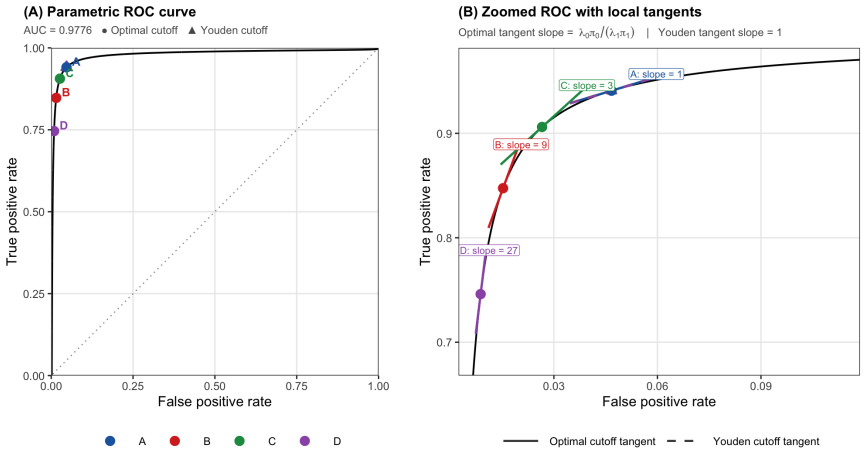
read the original abstract
We study an optimal threshold functional arising in binary classification for continuous biomarkers. While the ROC curve summarizes discriminatory performance across all thresholds, practical threshold selection must also account for disease prevalence and asymmetric misclassification costs. The classical Youden index corresponds to a symmetric special case and may therefore be suboptimal in realistic decision settings. In addition, biomarker distributions in serological and immunological studies often display skewness and heavy tails, making Gaussian ROC models inadequate. We develop a parametric framework for ROC analysis and optimal cutoff selection under the family of scale mixtures of skew-normal (SMSN) distributions, including the skew-normal and skew-t models. The ROC curve and AUC are estimated by plug-in maximum likelihood from separate group fits. The optimal cutoff is defined as the minimiser of a weighted misclassification risk, which yields a likelihood ratio equation extending the Youden criterion. Under a monotone likelihood ratio condition, we establish existence, uniqueness, and global optimality of the cutoff. We further study its local regularity as an implicitly defined functional of the model parameter and derive consistency, asymptotic normality, and a closed-form plug-in variance estimator. A central term in this variance is the local slope of the estimating equation at the optimal threshold, which acts as a local identifiability diagnostic. Monte Carlo experiments across six scenarios show that the asymptotic approximation is accurate and that Wald confidence intervals attain near nominal coverage. An application to SARS-CoV-2 serological data illustrates that the proposed cutoff can differ substantially from the Youden threshold and may reduce estimated misclassification risk by up to 63% under asymmetric decision settings.
Editorial analysis
A structured set of objections, weighed in public.
Referee Report
Summary. The paper develops a parametric framework for ROC analysis and optimal cutoff selection for continuous biomarkers under scale mixtures of skew-normal (SMSN) distributions, including skew-normal and skew-t models. The optimal cutoff is defined as the minimizer of a weighted misclassification risk (extending the Youden index), with existence, uniqueness, and global optimality established under a monotone likelihood ratio (MLR) condition on the group-specific densities. The plug-in maximum-likelihood estimator is shown to be consistent and asymptotically normal, with a closed-form variance estimator whose key term is the local slope of the estimating equation (serving as an identifiability diagnostic). Monte Carlo experiments across six scenarios support the accuracy of the asymptotic normal approximation and near-nominal coverage of Wald intervals. The method is illustrated on SARS-CoV-2 serological data, where the proposed cutoff can differ from the Youden threshold and reduce estimated misclassification risk under asymmetric costs.
Significance. If the SMSN modeling assumptions and MLR condition hold, the work supplies a flexible decision-theoretic approach to threshold selection that properly incorporates prevalence and asymmetric misclassification costs while accommodating skewness and heavy tails common in serological biomarkers. The closed-form asymptotic variance estimator and the Monte Carlo validation of its performance are practical strengths that facilitate inference without resampling. The framework extends classical ROC methods in a manner that could be directly useful for diagnostic test evaluation in immunology and related fields.
major comments (2)
- [Theoretical development (implicit-function theorem and delta-method arguments)] Theoretical development (implicit-function theorem and delta-method arguments): The abstract and theoretical sections invoke the implicit-function theorem and delta method to obtain asymptotic normality and the closed-form variance but supply no explicit statement of the required regularity conditions (e.g., continuous differentiability of the estimating equation with respect to the cutoff, non-vanishing local slope at the optimum, and standard regularity for MLE consistency in the SMSN family). These conditions are load-bearing for the asymptotic claims and should be stated precisely.
- [Application to SARS-CoV-2 serological data] Application to SARS-CoV-2 serological data: The application reports fitted SMSN parameters and the resulting cutoff value but does not verify that the estimated distributions satisfy the monotone likelihood ratio condition over the observed biomarker range. Because existence, uniqueness, and global optimality of the cutoff are proved conditionally on MLR, the absence of this verification means the optimality guarantee does not necessarily apply to the reported empirical cutoff, even though the plug-in estimator itself remains well-defined.
minor comments (2)
- [Monte Carlo section] Monte Carlo section: While the text states that Wald intervals attain near-nominal coverage across the six scenarios, a supplementary table or figure displaying the empirical coverage rates (and perhaps average interval lengths) for each scenario and sample size would make the validation more transparent and reproducible.
- [Notation] Notation: The weighted misclassification risk and the resulting likelihood-ratio estimating equation are central; defining them with explicit symbols (rather than inline descriptions) in the main text would improve readability for readers who are not already familiar with the decision-theoretic formulation.
Simulated Author's Rebuttal
We thank the referee for the careful and constructive review. The comments identify important gaps in the presentation of regularity conditions and in the empirical verification of a key assumption. We address each point below and will incorporate the suggested revisions into the next version of the manuscript.
read point-by-point responses
-
Referee: Theoretical development (implicit-function theorem and delta-method arguments): The abstract and theoretical sections invoke the implicit-function theorem and delta method to obtain asymptotic normality and the closed-form variance but supply no explicit statement of the required regularity conditions (e.g., continuous differentiability of the estimating equation with respect to the cutoff, non-vanishing local slope at the optimum, and standard regularity for MLE consistency in the SMSN family). These conditions are load-bearing for the asymptotic claims and should be stated precisely.
Authors: We agree that the regularity conditions underlying the implicit-function theorem and delta-method arguments should be stated explicitly. In the revised manuscript we will add a dedicated subsection (in Section 3) that lists the precise assumptions required: (i) continuous differentiability of the estimating equation with respect to the cutoff in a neighborhood of the optimum, (ii) a non-vanishing local slope at the solution (already appearing in the variance formula as an identifiability diagnostic), and (iii) the standard regularity conditions for consistency and asymptotic normality of the MLE in the SMSN family, including identifiability, compactness of the parameter space, and domination conditions permitting interchange of differentiation and integration. We will cite the relevant theorems on M-estimators and implicitly defined functionals to support these claims. This addition will make the asymptotic results fully rigorous without changing any of the main theorems or proofs. revision: yes
-
Referee: Application to SARS-CoV-2 serological data: The application reports fitted SMSN parameters and the resulting cutoff value but does not verify that the estimated distributions satisfy the monotone likelihood ratio condition over the observed biomarker range. Because existence, uniqueness, and global optimality of the cutoff are proved conditionally on MLR, the absence of this verification means the optimality guarantee does not necessarily apply to the reported empirical cutoff, even though the plug-in estimator itself remains well-defined.
Authors: We concur that the MLR condition is essential for invoking the existence, uniqueness, and global optimality results in the application. In the revised manuscript we will add an explicit verification step to the SARS-CoV-2 data analysis. Using the fitted SMSN parameters, we will evaluate the likelihood-ratio function on a dense grid spanning the observed biomarker range, confirm its monotonicity (or report any departures), and include a supplementary figure displaying the ratio. The text will then state whether the condition holds and, if so, that the optimality guarantees therefore apply to the reported cutoff; if not, we will qualify the interpretation accordingly. This change directly addresses the referee’s concern while preserving the plug-in estimator’s validity. revision: yes
Circularity Check
No circularity: claims are conditional on explicit assumptions and use standard asymptotic derivations
full rationale
The derivation defines the optimal cutoff explicitly as the minimizer of weighted misclassification risk, yielding a likelihood-ratio estimating equation. Existence, uniqueness and global optimality are then established conditionally on the monotone likelihood ratio property of the two fitted SMSN densities—an external assumption, not a derived or fitted quantity. Asymptotic normality and the closed-form variance estimator follow from the implicit-function theorem applied to this estimating equation; the local slope term is introduced as an identifiability diagnostic, not as a re-expression of the cutoff itself. No load-bearing self-citations, ansatzes smuggled via prior work, or renaming of known results appear in the provided chain. The plug-in estimator is standard MLE consistency under the parametric model, rendering the overall argument self-contained against external benchmarks.
Axiom & Free-Parameter Ledger
axioms (2)
- domain assumption Biomarker measurements in each group follow a scale mixture of skew-normal distribution.
- domain assumption The likelihood ratio between the two group densities is monotone.
Lean theorems connected to this paper
-
IndisputableMonolith/Cost/FunctionalEquation.leanwashburn_uniqueness_aczel echoes?
echoesECHOES: this paper passage has the same mathematical shape or conceptual pattern as the Recognition theorem, but is not a direct formal dependency.
Under a monotone likelihood ratio condition, we establish existence, uniqueness, and global optimality of the cutoff... Λ(c∗(θ);θ) := f1(c∗;θ1)/f0(c∗;θ0) = λ0π0/λ1π1
-
IndisputableMonolith/Foundation/Cost.leanJcost_pos_of_ne_one unclear?
unclearRelation between the paper passage and the cited Recognition theorem.
the optimal cutoff is defined as the minimiser of a weighted misclassification risk
What do these tags mean?
- matches
- The paper's claim is directly supported by a theorem in the formal canon.
- supports
- The theorem supports part of the paper's argument, but the paper may add assumptions or extra steps.
- extends
- The paper goes beyond the formal theorem; the theorem is a base layer rather than the whole result.
- uses
- The paper appears to rely on the theorem as machinery.
- contradicts
- The paper's claim conflicts with a theorem or certificate in the canon.
- unclear
- Pith found a possible connection, but the passage is too broad, indirect, or ambiguous to say the theorem truly supports the claim.
Reference graph
Works this paper leans on
-
[1]
Communications in Statistics--Simulation and Computation , volume=
Maximum likelihood estimation of the parameters of the skew normal and skew t distributions , author=. Communications in Statistics--Simulation and Computation , volume=. 2012 , publisher=
work page 2012
- [2]
- [3]
- [4]
-
[5]
Azzalini, A. and Capitanio, A. , title =. Journal of the Royal Statistical Society: Series B , volume =. 2003 , doi =
work page 2003
-
[6]
Fluss, R. and Faraggi, D. and Reiser, B. , title =. Biometrical Journal , volume =
-
[7]
Lachos, V. H. and Ghosh, P. and Arellano-Valle, R. B. , title =. Statistica Sinica , volume =
-
[8]
McIntosh, M. W. and Pepe, M. S. , title =. Biometrics , volume =
-
[9]
Metz, C. E. , title =. Seminars in Nuclear Medicine , volume =
-
[10]
Pepe, M. S. , title =
-
[11]
Perkins, N. J. and Schisterman, E. F. , title =. American Journal of Epidemiology , volume =
-
[12]
Schisterman, E. F. and Perkins, N. J. and Liu, A. and Bondell, H. , title =. Epidemiology , volume =
-
[13]
Youden, W. J. , title =. Cancer , volume =
-
[14]
Zweig, M. H. and Campbell, G. , title =. Clinical Chemistry , volume =
-
[15]
Journal of Mathematical Psychology , year =
Bamber, Donald , title =. Journal of Mathematical Psychology , year =
-
[16]
Hanley, James A. and McNeil, Barbara J. , title =. Radiology , year =
-
[17]
DeLong, Elizabeth R. and DeLong, David M. and Clarke-Pearson, Daniel L. , title =. Biometrics , year =
-
[18]
Dorfman, Donald D. and Alf, Edward , title =. Journal of Mathematical Psychology , year =
-
[19]
Metz, Charles E. and Herman, Betsy A. and Shen, Jiang , title =. Statistics in Medicine , year =
-
[20]
Wang, J. and Genton, Marc G. , title =. Scandinavian Journal of Statistics , year =
-
[21]
Andrews, D. F. and Mallows, C. L. , title =. Journal of the Royal Statistical Society: Series B , year =
-
[22]
Rudin, Walter , title =
- [23]
- [24]
- [25]
-
[26]
Dias-Domingues, Tiago and Mouri. Classification methods for the serological status based on mixtures of skew-normal and skew- t distributions , journal =. 2024 , volume =
work page 2024
-
[27]
Analysis of antibody data using skew-normal and skew- t mixture models , journal =
Dias-Domingues, Tiago and Mouri. Analysis of antibody data using skew-normal and skew- t mixture models , journal =. 2024 , volume =
work page 2024
-
[28]
Rosado, J. and Pelleau, S. and Cockram, C. and Merkling, S. H. and Nekkab, N. and Demeret, C. and Meola, A. and Kerneis, S. and Terrier, B. and Fafi-Kremer, S. and others , title =. The Lancet Microbe , year =
-
[29]
Greiner, M. and Pfeiffer, D. and Smith, R. D. , title =. Preventive Veterinary Medicine , year =
discussion (0)
Sign in with ORCID, Apple, or X to comment. Anyone can read and Pith papers without signing in.