Recognition: no theorem link
Uncertainty Quantification for Cardiac Shape Reconstruction with Deep Signed Distance Functions via MCMC methods
Pith reviewed 2026-05-11 02:39 UTC · model grok-4.3
The pith
A Bayesian DeepSDF model with MCMC sampling produces both accurate cardiac reconstructions and calibrated uncertainty from sparse point clouds.
A machine-rendered reading of the paper's core claim, the machinery that carries it, and where it could break.
Core claim
We propose a probabilistic framework for uncertainty-aware cardiac shape reconstruction that combines Deep Signed Distance Functions (DeepSDFs) with Markov Chain Monte Carlo (MCMC) sampling. Cardiac geometries are modeled implicitly as zero-level sets of a neural network conditioned on learned latent codes, enabling multi-surface reconstruction of the left and right ventricles. By interpreting the reconstruction loss as a log-likelihood, we perform Bayesian inference in the latent space to obtain both maximum a posteriori (MAP) and posterior-sampled reconstructions.
What carries the argument
DeepSDF network outputting signed distances conditioned on latent codes, with MCMC used to sample from the posterior over those codes when the reconstruction loss is treated as a log-likelihood.
If this is right
- The same latent-space posterior yields both a point estimate (MAP) and an ensemble of plausible alternative shapes.
- Uncertainty estimates are produced directly in the space of implicit surfaces without requiring additional post-processing.
- Multi-surface models of left and right ventricles are obtained from a single conditioned network.
- The approach works with sparse or noisy input point clouds typical of clinical imaging.
Where Pith is reading between the lines
- The framework could be applied to other organs where signed-distance representations are already used, provided a suitable reconstruction loss can be defined.
- Downstream tasks such as finite-element simulations of cardiac mechanics could draw directly from the posterior samples rather than from a single deterministic mesh.
- If the learned latent prior fails to capture certain anatomical variations, the resulting uncertainty bands may be too narrow even when MCMC mixing is perfect.
Load-bearing premise
The reconstruction loss between the DeepSDF output and the input point cloud can be directly interpreted as a log-likelihood, permitting valid Bayesian posterior sampling over the latent codes.
What would settle it
On a held-out test set with known ground-truth surfaces, check whether the empirical coverage of the posterior-sampled shapes matches the nominal credible intervals; systematic under- or over-coverage would falsify the calibration claim.
Figures


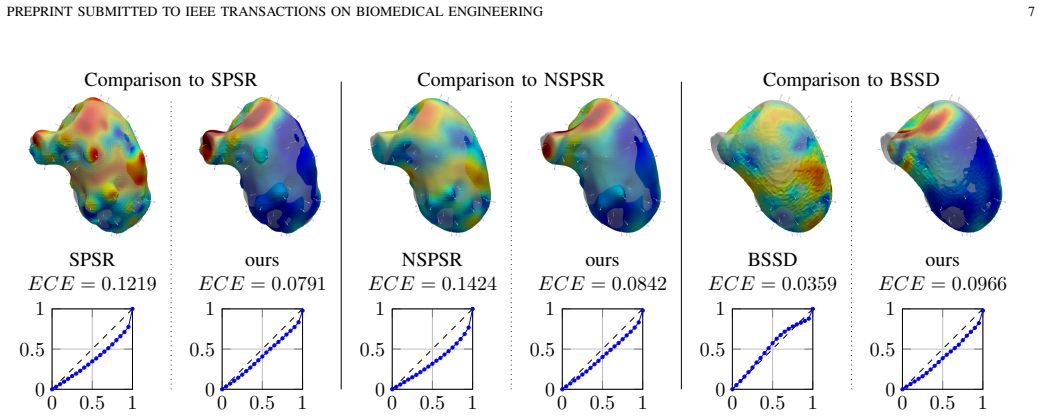

read the original abstract
Atlas-based approaches allow high-quality, patient-specific shape reconstructions of cardiac anatomy from sparse and/or noisy data such as point clouds. However, these methods are mainly prior-driven, so the impact of uncertainty can be large, limiting their clinical reliability. We propose a probabilistic framework for uncertainty-aware cardiac shape reconstruction that combines Deep Signed Distance Functions (DeepSDFs) with Markov Chain Monte Carlo (MCMC) sampling. Cardiac geometries are modeled implicitly as zero-level sets of a neural network conditioned on learned latent codes, enabling multi-surface reconstruction of the left and right ventricles. By interpreting the reconstruction loss as a log-likelihood, we perform Bayesian inference in the latent space to obtain both maximum a posteriori (MAP) and posterior-sampled reconstructions. Experiments on a public cardiac dataset show that our approach produces accurate reconstructions and well-calibrated uncertainty estimates.
Editorial analysis
A structured set of objections, weighed in public.
Referee Report
Summary. The manuscript proposes a probabilistic framework for uncertainty-aware cardiac shape reconstruction by combining Deep Signed Distance Functions (DeepSDF) with Markov Chain Monte Carlo (MCMC) sampling. Cardiac geometries are represented implicitly as zero-level sets of a neural network conditioned on latent codes, allowing multi-surface reconstruction of the ventricles. The reconstruction loss is interpreted as a log-likelihood to enable Bayesian inference over the latent codes, yielding both MAP estimates and posterior samples. Experiments on a public cardiac dataset are claimed to demonstrate accurate reconstructions and well-calibrated uncertainty estimates.
Significance. A method that provides reliable uncertainty quantification for cardiac shape models from sparse data could enhance clinical decision-making by highlighting regions of high uncertainty. However, the potential impact is currently undermined by the absence of quantitative evidence supporting the calibration claims and by the unexamined assumptions in the likelihood model.
major comments (2)
- Abstract: The statement that the approach 'produces accurate reconstructions and well-calibrated uncertainty estimates' is presented without any supporting quantitative metrics, comparisons to baselines, calibration plots, or explanation of how calibration was evaluated.
- Proposed likelihood model: Treating the DeepSDF reconstruction loss as -log p(data | z) for MCMC sampling assumes a specific noise model (e.g., i.i.d. Gaussian on SDF values) that is not derived from the cardiac point-cloud acquisition process or imaging characteristics; no checks for posterior predictive coverage are described.
minor comments (1)
- Abstract: The abstract could benefit from specifying the public dataset used and the exact metrics for accuracy and calibration.
Simulated Author's Rebuttal
We thank the referee for the constructive comments, which help clarify the presentation of our probabilistic framework. We address each major comment below and indicate the corresponding revisions.
read point-by-point responses
-
Referee: Abstract: The statement that the approach 'produces accurate reconstructions and well-calibrated uncertainty estimates' is presented without any supporting quantitative metrics, comparisons to baselines, calibration plots, or explanation of how calibration was evaluated.
Authors: The abstract provides a high-level overview; the supporting quantitative results (reconstruction accuracy metrics such as surface-to-surface distances and Dice coefficients, baseline comparisons, and calibration evaluation via reliability diagrams and coverage probabilities) appear in the Experiments section. To address the concern directly, we will revise the abstract to include key numerical results and a concise description of the calibration assessment procedure. revision: yes
-
Referee: Proposed likelihood model: Treating the DeepSDF reconstruction loss as -log p(data | z) for MCMC sampling assumes a specific noise model (e.g., i.i.d. Gaussian on SDF values) that is not derived from the cardiac point-cloud acquisition process or imaging characteristics; no checks for posterior predictive coverage are described.
Authors: The likelihood is defined by interpreting the DeepSDF reconstruction loss under an i.i.d. Gaussian noise model on the signed distance values, a standard modeling choice in the implicit representation literature that enables tractable MCMC sampling in latent space. While this is an approximation rather than a derivation from cardiac imaging physics or point-cloud acquisition details, we will expand the Methods section to explicitly discuss the assumption and its limitations. We will also add posterior predictive coverage diagnostics in the Experiments section to provide empirical validation of the likelihood model. revision: yes
Circularity Check
No circularity in the derivation chain
full rationale
The paper models cardiac shapes via DeepSDF conditioned on latent codes and treats the reconstruction loss as a log-likelihood to perform MCMC sampling over the latent posterior. This is an explicit probabilistic modeling assumption rather than a reduction of the output uncertainty to the input fit by construction. No equations equate the claimed posterior samples or calibration metrics to quantities defined solely by the training loss itself. The approach follows standard Bayesian practice for latent-variable models; any questions about likelihood misspecification or empirical calibration belong to correctness rather than circularity.
Axiom & Free-Parameter Ledger
free parameters (2)
- latent code dimension
- MCMC sampling parameters
axioms (1)
- domain assumption Reconstruction loss can be interpreted as a log-likelihood
Reference graph
Works this paper leans on
-
[1]
Deepsdf: Learning continuous signed distance functions for shape representation,
J. J. Park, P. Florence, J. Straub, R. Newcombe, and S. Lovegrove, “Deepsdf: Learning continuous signed distance functions for shape representation,” in2019 IEEE/CVF Conference on Computer Vision and Pattern Recognition (CVPR), pp. 165–174, 2019
work page 2019
-
[2]
Learning smooth neural functions via lipschitz regularization,
H.-T. D. Liu, F. Williams, A. Jacobson, S. Fidler, and O. Litany, “Learning smooth neural functions via lipschitz regularization,” inACM SIGGRAPH 2022 Conference Proceedings, Association for Computing Machinery, 2022
work page 2022
-
[3]
Implicit neural representations for medical imaging segmentation,
M. O. Khan and Y . Fang, “Implicit neural representations for medical imaging segmentation,” inInternational Conference on Medical Image Computing and Computer-Assisted Intervention, pp. 433–443, Springer, 2022
work page 2022
-
[4]
J. Sander, B. D. de V os, S. Bruns, N. Planken, M. A. Viergever, T. Leiner, and I. I ˇsgum, “Reconstruction and completion of high-resolution 3d cardiac shapes using anisotropic cmri segmentations and continuous implicit neural representations,”Computers in Biology and Medicine, vol. 164, p. 107266, 2023
work page 2023
-
[5]
Shape of my heart: Cardiac models through learned signed distance functions,
J. Verh ¨ulsdonk, T. Grandits, F. S. Costabal, T. Pinetz, R. Krause, A. Auricchio, G. Haase, S. Pezzuto, and A. Effland, “Shape of my heart: Cardiac models through learned signed distance functions,” inMedical Imaging with Deep Learning, pp. 1584–1605, PMLR, 2024
work page 2024
-
[6]
Sdf4chd: Generative modeling of cardiac anatomies with congenital heart defects,
F. Kong, S. Stocker, P. S. Choi, M. Ma, D. B. Ennis, and A. L. Marsden, “Sdf4chd: Generative modeling of cardiac anatomies with congenital heart defects,”Medical Image Analysis, vol. 97, p. 103293, 2024
work page 2024
-
[7]
Mcmc using hamiltonian dynamics,
R. M. Nealet al., “Mcmc using hamiltonian dynamics,”Handbook of markov chain monte carlo, vol. 2, no. 11, p. 2, 2011
work page 2011
-
[8]
The no-u-turn sampler: adaptively setting path lengths in hamiltonian monte carlo.,
M. D. Hoffman, A. Gelman,et al., “The no-u-turn sampler: adaptively setting path lengths in hamiltonian monte carlo.,”J. Mach. Learn. Res., vol. 15, no. 1, pp. 1593–1623, 2014
work page 2014
-
[9]
4d myocardium reconstruction with decoupled motion and shape model,
X. Yuan, C. Liu, and Y . Wang, “4d myocardium reconstruction with decoupled motion and shape model,” inProceedings of the IEEE/CVF International Conference on Computer Vision, pp. 21252–21262, 2023
work page 2023
-
[10]
Spatio- temporal neural distance fields for conditional generative modeling of the heart,
K. Sørensen, P. Diez, J. Margeta, Y . El Youssef, M. Pham, J. J. Pedersen, T. K¨uhl, O. de Backer, K. Kofoed, O. Camara,et al., “Spatio- temporal neural distance fields for conditional generative modeling of the heart,” inInternational Conference on Medical Image Computing and Computer-Assisted Intervention, pp. 422–432, Springer, 2024
work page 2024
-
[11]
A personalized time-resolved 3d mesh generative model for unveiling normal heart dynamics,
M. Qiao, K. A. McGurk, S. Wang, P. M. Matthews, D. P. O’Regan, and W. Bai, “A personalized time-resolved 3d mesh generative model for unveiling normal heart dynamics,”Nature Machine Intelligence, pp. 1– 12, 2025
work page 2025
-
[12]
Efficient mcmc sampling with implicit shape representations,
J. Chang and J. W. Fisher, “Efficient mcmc sampling with implicit shape representations,” inCVPR 2011, pp. 2081–2088, IEEE, 2011
work page 2011
-
[13]
Stochastic poisson surface reconstruction,
S. Sell ´an and A. Jacobson, “Stochastic poisson surface reconstruction,” ACM Transactions on Graphics (TOG), vol. 41, no. 6, pp. 1–12, 2022
work page 2022
-
[14]
Neural stochastic poisson surface recon- struction,
S. Sell ´an and A. Jacobson, “Neural stochastic poisson surface recon- struction,” SA ’23, (New York, NY , USA), Association for Computing Machinery, 2023
work page 2023
-
[15]
Uncertainty and variability in point cloud surface data,
M. Pauly, N. J. Mitra, and L. J. Guibas, “Uncertainty and variability in point cloud surface data,” inEurographics symposium on point-based graphics, vol. 84, 2004
work page 2004
-
[16]
A survey of medical point cloud shape learning: Registration, reconstruction and variation,
T. Zhang, Z. Liang, and B. Wang, “A survey of medical point cloud shape learning: Registration, reconstruction and variation,”arXiv preprint arXiv:2508.03057, 2025
-
[17]
Deepssm: a deep learning framework for statistical shape modeling from raw images,
R. Bhalodia, S. Y . Elhabian, L. Kavan, and R. T. Whitaker, “Deepssm: a deep learning framework for statistical shape modeling from raw images,” inInternational Workshop on Shape in Medical Imaging, pp. 244–257, Springer, 2018
work page 2018
-
[18]
Uncertain-deepssm: From images to probabilistic shape models,
J. Adams, R. Bhalodia, and S. Elhabian, “Uncertain-deepssm: From images to probabilistic shape models,” inInternational Workshop on Shape in Medical Imaging, pp. 57–72, Springer, 2020
work page 2020
-
[19]
From images to probabilistic anatomical shapes: A deep variational bottleneck approach,
J. Adams and S. Elhabian, “From images to probabilistic anatomical shapes: A deep variational bottleneck approach,” inInternational Con- ference on Medical Image Computing and Computer-Assisted Interven- tion, pp. 474–484, Springer, 2022
work page 2022
-
[20]
J. Adams and S. Y . Elhabian, “Fully bayesian vib-deepssm,” inInterna- tional Conference on Medical Image Computing and Computer-Assisted Intervention, pp. 346–356, Springer, 2023
work page 2023
-
[21]
P. Du and J.-X. Wang, “Reducing geometric uncertainty in computational hemodynamics by deep learning-assisted parallel-chain mcmc,”Journal of biomechanical engineering, vol. 144, no. 12, p. 121009, 2022
work page 2022
-
[22]
The importance of uncertainty quantifica- tion in model reproducibility,
V . V olodina and P. Challenor, “The importance of uncertainty quantifica- tion in model reproducibility,”Philosophical Transactions of the Royal Society A, vol. 379, no. 2197, p. 20200071, 2021
work page 2021
-
[23]
Repulsive deep ensembles are bayesian,
F. D’Angelo and V . Fortuin, “Repulsive deep ensembles are bayesian,” Advances in Neural Information Processing Systems, vol. 34, pp. 3451– 3465, 2021
work page 2021
-
[24]
A public manifold left/right ventricular database,
T. Grandits, J. Verh ¨ulsdonk, F. Sahli Costabal, T. Pinetz, A. Effland, and S. Pezzuto, “A public manifold left/right ventricular database,” May 2024
work page 2024
-
[25]
M. Strocchi, C. M. Augustin, M. A. F. Gsell, E. Karabelas, A. Neic, K. Gillette, O. Razeghi, A. J. Prassl, E. J. Vigmond, J. M. Behar, J. S. Gould, B. Sidhu, C. A. Rinaldi, M. J. Bishop, G. Plank, and S. A. Niederer, “A Publicly Available Virtual Cohort of Four-chamber Heart Meshes for Cardiac Electro-mechanics Simulations,” June 2020. Type: dataset
work page 2020
-
[26]
Virtual cohort of adult healthy four- chamber heart meshes from CT images,
C. Rodero, M. Strocchi, M. Marciniak, S. Longobardi, J. Whitaker, M. D. O’Neill, K. Gillette, C. Augustin, G. Plank, E. J. Vigmond, P. Lamata, and S. A. Niederer, “Virtual cohort of adult healthy four- chamber heart meshes from CT images,” Mar. 2021. Type: dataset
work page 2021
-
[27]
Adam: A method for stochastic optimization,
D. P. Kingma and J. Ba, “Adam: A method for stochastic optimization,” The International Conference on Learning Representations (ICLR), 2015
work page 2015
-
[28]
Pyro: Deep universal probabilistic programming,
E. Bingham, J. P. Chen, M. Jankowiak, F. Obermeyer, N. Pradhan, T. Karaletsos, R. Singh, P. A. Szerlip, P. Horsfall, and N. D. Goodman, “Pyro: Deep universal probabilistic programming,”J. Mach. Learn. Res., vol. 20, pp. 28:1–28:6, 2019
work page 2019
-
[29]
F. Vasconcelos, B. He, N. Singh, and Y . W. Teh, “Uncertainr: Uncertainty quantification of end-to-end implicit neural representations for computed tomography,”arXiv preprint arXiv:2202.10847, 2022
-
[30]
I. K. Bazionis and P. S. Georgilakis, “Review of deterministic and probabilistic wind power forecasting: Models, methods, and future research,”Electricity, vol. 2, no. 1, pp. 13–47, 2021
work page 2021
-
[31]
A Conceptual Introduction to Hamiltonian Monte Carlo
M. Betancourt, “A conceptual introduction to hamiltonian monte carlo,” arXiv preprint arXiv:1701.02434, 2017. PREPRINT SUBMITTED TO IEEE TRANSACTIONS ON BIOMEDICAL ENGINEERING 9
work page Pith review arXiv 2017
-
[32]
Bayesian 3d shape reconstruction from noisy points and normals,
E. Pujol and A. Chica, “Bayesian 3d shape reconstruction from noisy points and normals,”Computer Graphics F orum, vol. 44, no. 5, p. e70201, 2025
work page 2025
discussion (0)
Sign in with ORCID, Apple, or X to comment. Anyone can read and Pith papers without signing in.