Recognition: no theorem link
TRAS: An Interactive Software for Tracing Tree Ring Cross Sections
Pith reviewed 2026-05-11 02:46 UTC · model grok-4.3
The pith
TRAS software combines automatic detection with an interactive interface to trace tree rings in wood cross sections while cutting manual work to about 20 percent.
A machine-rendered reading of the paper's core claim, the machinery that carries it, and where it could break.
Core claim
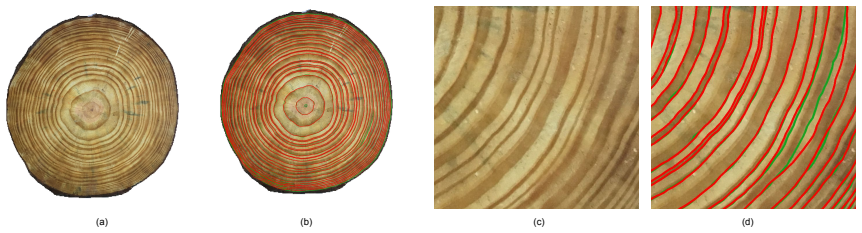
TRAS integrates the classical CS-TRD algorithm with two deep-learning detectors, DeepCS-TRD and INBD, into a single interface that lets users refine automatic ring boundaries, remove false positives, add missing rings, and compute metrics such as earlywood and latewood areas and equivalent ring widths, achieving an F-score of 81.0 percent and 86.4 percent precision with DeepCS-TRD on 18 expertly annotated Pinus taeda images while reducing manual corrections to roughly 20 percent of boundaries and producing ring-width measurements that agree with CooRecorder at r greater than 0.99.
What carries the argument
The TRAS graphical interface that overlays automatic detections from multiple algorithms and supports direct user edits to produce final ring delineations and derived dendrochronological measurements.
If this is right
- Common detection mistakes near knots or from jump propagation become simple to fix in the post-processing interface.
- Users obtain earlywood-latewood area and perimeter measurements in addition to standard ring widths without extra tools.
- The same corrected delineations support both one-dimensional widths and custom path-based measurements.
- The open-source code runs on all major desktop operating systems, allowing consistent results across different laboratories.
Where Pith is reading between the lines
- Large existing image archives of wood samples could now be processed at scales previously limited by manual effort.
- The software's modular design of interchangeable detectors could support rapid testing of newer segmentation models on the same interface.
- Standardized output formats from TRAS might help build shared public datasets of ring measurements across research groups.
Load-bearing premise
The 18 annotated images of one pine species capture the full range of image quality, ring patterns, and artifacts that appear in real research collections, and user corrections do not introduce new systematic measurement errors.
What would settle it
A test set of at least 20 new cross-section images from several tree species and imaging conditions, with independent expert annotations, that yields either an F-score below 70 percent after corrections or a correlation below 0.95 on ring-width measurements compared with CooRecorder.
Figures




read the original abstract
Tree ring marking remains a key step in dendrometry and dendrochronology, but it is often performed manually, making the process time-consuming, subjective, and difficult to scale to large image datasets. We present the Tree Ring Analyzer Suite (TRAS), an open-source graphical software for automatic delineation, manual correction, and measurement of tree rings in wood cross-sectional images. TRAS integrates three complementary detection algorithms: the classical image-processing method CS-TRD and two deep-learning approaches, DeepCS-TRD and INBD. The interface allows users to refine automatic detections, remove false positives, and manually add missing rings. It also computes dendrochronological metrics such as earlywood and latewood areas, ring perimeter, equivalent ring width, and custom path-based ring-width measurements. TRAS was evaluated on 18 expertly annotated Pinus taeda L. cross-section images. DeepCS-TRD achieved the best automatic detection performance, with an F-score of 81.0% and precision of 86.4%. Automatic detection reduced the required manual correction effort to approximately 20% of ring boundaries. For one-dimensional ring-width measurements, TRAS showed excellent agreement with CooRecorder ($r > 0.99$). Common detection errors, such as jump propagation or false positives near knots, were easily corrected through the postprocessing interface. TRAS provides a flexible and reproducible solution for tree-ring analysis on Windows, macOS, and Linux. Code is available at the https://hmarichal93.github.io/tras.
Editorial analysis
A structured set of objections, weighed in public.
Referee Report
Summary. The manuscript presents TRAS, an open-source graphical software for automatic delineation, manual correction, and measurement of tree rings in wood cross-section images. It integrates three detection algorithms (classical CS-TRD and deep-learning DeepCS-TRD and INBD), allows user refinement of detections, and computes dendrochronological metrics including earlywood/latewood areas and ring widths. Evaluation on 18 expertly annotated Pinus taeda L. images shows DeepCS-TRD achieving the highest automatic performance (F-score 81.0%, precision 86.4%), with automatic detection reducing manual correction effort to ~20% of ring boundaries and 1D ring-width measurements agreeing closely with CooRecorder (r > 0.99).
Significance. If the results hold under broader conditions, TRAS offers a practical, reproducible, and cross-platform tool that could meaningfully reduce the time and subjectivity of manual tree-ring tracing in dendrochronology while preserving expert oversight. The open-source release, integration of complementary methods, and high agreement on 1D measurements are clear strengths that support adoption for scaling analyses.
major comments (2)
- [Evaluation / Results] The central performance and effort-reduction claims (F-score 81.0%, precision 86.4%, ~20% manual effort) rest exclusively on a held-out test set of 18 images from a single species (Pinus taeda L.). This narrow and homogeneous dataset does not adequately test robustness to inter-species variation, ring wedging, knots, cracks, or differing image quality, which are common in practice and directly affect the claim that TRAS delivers reliable, scalable tree-ring analysis.
- [Evaluation / Results] The manuscript does not report cross-species validation, external test sets, or quantitative analysis of how post-correction measurements might retain systematic biases (e.g., consistent under- or over-estimation near anomalies). Without such evidence, the assertion that manual corrections via the interface produce scientifically reliable outputs remains insufficiently supported.
minor comments (3)
- [Abstract] The abstract and evaluation section would benefit from explicit quantification of the frequency and types of detection errors (e.g., jump propagation, false positives near knots) and their effect on final metrics after correction.
- [Methods] Training details for DeepCS-TRD and INBD (dataset composition, splits, hyperparameters, and confirmation that the 18 test images were strictly held out) should be expanded to allow independent assessment of the reported metrics.
- Figure captions and the interface description could include more concrete examples of before/after correction states to illustrate the claimed ease of fixing common errors.
Simulated Author's Rebuttal
We thank the referee for the constructive comments and the recognition of TRAS's practical strengths as an interactive, open-source tool. We address the major comments point by point below, acknowledging the dataset limitations while clarifying the manuscript's scope and proposed revisions.
read point-by-point responses
-
Referee: The central performance and effort-reduction claims (F-score 81.0%, precision 86.4%, ~20% manual effort) rest exclusively on a held-out test set of 18 images from a single species (Pinus taeda L.). This narrow and homogeneous dataset does not adequately test robustness to inter-species variation, ring wedging, knots, cracks, or differing image quality, which are common in practice and directly affect the claim that TRAS delivers reliable, scalable tree-ring analysis.
Authors: We agree that the quantitative evaluation is restricted to 18 Pinus taeda L. images and does not include cross-species testing. The manuscript does not claim broad robustness across species or conditions; instead, it presents TRAS as an interactive platform that combines automatic detection with user-driven correction to handle anomalies such as knots and ring wedging (explicitly noted in the results where false positives near knots are described as easily corrected). The reported ~20% effort reduction and r > 0.99 agreement with CooRecorder are specific to this dataset. We will add a 'Limitations and Future Work' subsection to explicitly state the single-species scope, describe the variations present in the test images, and outline plans for multi-species evaluation. revision: partial
-
Referee: The manuscript does not report cross-species validation, external test sets, or quantitative analysis of how post-correction measurements might retain systematic biases (e.g., consistent under- or over-estimation near anomalies). Without such evidence, the assertion that manual corrections via the interface produce scientifically reliable outputs remains insufficiently supported.
Authors: We acknowledge that cross-species validation, external test sets, and quantitative post-correction bias analysis are not provided. The manuscript focuses on the feasibility of the interactive workflow rather than claiming bias-free outputs; it reports that common errors (jump propagation, false positives near knots) are readily addressed via the GUI and that final 1D measurements match CooRecorder closely. No systematic bias quantification was performed on the current data. We will revise the discussion to include a qualitative assessment of observed error types and their correction, plus a clearer statement that expert oversight remains essential for scientific reliability. We will also add a commitment to incorporate bias analysis and diverse datasets in future releases. revision: partial
Circularity Check
No circularity: empirical software evaluation with no derivation chain
full rationale
The paper presents TRAS as an interactive software integrating three existing detection algorithms (CS-TRD, DeepCS-TRD, INBD) and evaluates performance via direct comparison to expert annotations on 18 Pinus taeda images plus agreement with the external CooRecorder tool. No equations, first-principles derivations, parameter fittings, or predictions are claimed; metrics such as F-score 81.0% and r > 0.99 are reported as empirical outcomes. No self-citations serve as load-bearing uniqueness theorems, and no ansatz or renaming of known results occurs. The analysis is therefore self-contained against external benchmarks without any reduction of outputs to inputs by construction.
Axiom & Free-Parameter Ledger
Reference graph
Works this paper leans on
-
[1]
Soule, P.T., Knapp, P.A., Maxwell, J.T., & Mitchell, T.J. (2021). A comparison of the climate response of longleaf pine (*Pinus palustris* Mill.) trees among standardized measures of earlywood, latewood, adjusted latewood, and totalwood radial growth. Trees, 35. https://doi.org/10.1007/s00468-021-02093-z
-
[2]
Griffin, D., Woodhouse, C.A., Meko, D.M., Stahle, D.W., Faulstich, H.L., Carrillo, C., Touchan, R., Castro, C.L., & Leavitt, S.W. (2013). North American monsoon precipitation reconstructed from tree-ring latewood. Geophysical Research Letters, 40(5), 954--958. https://doi.org/10.1002/grl.50184
-
[3]
Labrecque-Foy, J.-P., Angers-Blondin, S., Ropars, P., Simard, M., & Boudreau, S. (2023). The use of basal area increment to preserve the multi-decadal climatic signal in shrub growth ring chronologies: A case study of *Betula glandulosa* in a rapidly warming environment. Atmosphere, 14(2), Article 319. https://doi.org/10.3390/atmos14020319
-
[4]
Fabijańska, A., & Danek, M. (2018). DeepDendro – A tree rings detector based on a deep convolutional neural network. Computers and Electronics in Agriculture, 150, 353–363. https://doi.org/10.1016/j.compag.2018.05.005
-
[5]
Poláček, M., Arizpe, A., Hüther, P., Weidlich, L., Steindl, S., & Swarts, K. (2023). Automation of tree‐ring detection and measurements using deep learning. Methods in Ecology and Evolution, 14(9), 2233–2242. https://doi.org/10.1111/2041-210x.14183
-
[6]
Garcia-Hidalgo, M. (2022). CaptuRING: A do-it-yourself tool for wood sample digitization. Methods in Ecology and Evolution, 13(6), 1185--1191. https://doi.org/10.1111/2041-210X.13847
-
[7]
N., Serrana, A., Profumo, L., & Randall, G
Marichal, H., Passarella, D., Lucas, C., Casaravilla, V., Rocha Galli, M. N., Serrana, A., Profumo, L., & Randall, G. (2023). UruDendro, a public dataset of 64 cross-section images and manual annual ring delineations of Pinus taeda. Zenodo. https://doi.org/10.5281/zenodo.15110647
-
[8]
Power, C. C., Marichal, H., Treier, U. A., Resente, G., Normand, S., & Randall, G. (2025, April). Dataset of 50 cross-section images and manual annual ring delineations of Salix glauca from Western Greenland. Zenodo. https://doi.org/10.5281/zenodo.15311335
-
[9]
Kim, D., Ko, C., & Kim, D. (2023). Method for detecting tree ring boundary in conifers and broadleaf trees using Mask R-CNN and linear interpolation. Dendrochronologia, 79, 126088. https://doi.org/10.1016/j.dendro.2023.126088
-
[10]
Constantz, B. M., Port, A. A., & Senock, R. S. (2021). Comparing automatically generated and manually measured tree-ring transects of growth trends with Hawaiian sandalwood as an example species. Dendrochronologia, 68, 125831. https://doi.org/10.1016/j.dendro.2021.125831
-
[11]
Shi, J., Xiang, W., Liu, Q., & Shah, S. (2019). MtreeRing: An R package with graphical user interface for automatic measurement of tree ring widths using image processing techniques. Dendrochronologia, 58, 125644. https://doi.org/10.1016/j.dendro.2019.125644
-
[12]
Maxwell, R. S., & Larsson, L.-A. (2021). Measuring tree-ring widths using the CooRecorder software application. Dendrochronologia, 67, 125841. https://doi.org/10.1016/j.dendro.2021.125841
-
[13]
Marichal, H., Passarella, D., & Randall, G. (2025). CS-TRD: A Cross Sections Tree Ring Detection Method. Image Processing On Line, 15:78-107. https://doi.org/10.5201/ipol.2025.485
-
[14]
Marichal, H., Passarella, D., & Randall, G. (2025). Automatic Wood Pith Detector: Local Orientation Estimation and Robust Accumulation. In A. Antonacopoulos, S. Chaudhuri, S. Bhattacharya, & U. Pal (Eds.), Pattern Recognition (pp. 1--15). Cham: Springer Nature Switzerland. Available at: http://github.com/hmarichal93/apd
work page 2025
-
[15]
Gillert, A., Resente, G., Anadon-Rosell, A., Wilmking, M., & von Lukas, U. F. (2023, June). Iterative Next Boundary Detection for Instance Segmentation of Tree Rings in Microscopy Images of Shrub Cross Sections. In Proceedings of the IEEE/CVF Conference on Computer Vision and Pattern Recognition (CVPR) (pp. 14540--14548)
work page 2023
- [16]
-
[17]
Ronneberger, O., Fischer, P., & Brox, T. (2015). U-Net: Convolutional Networks for Biomedical Image Segmentation. arXiv preprint. http://arxiv.org/pdf/1505.04597
work page internal anchor Pith review Pith/arXiv arXiv 2015
-
[18]
Qin, X., Zhang, Z., Huang, C., Dehghan, M., Zaiane, O. R., & Jagersand, M. (2020). U2-Net: Going deeper with nested U-structure for salient object detection. Pattern Recognition, 106, 107404. http://dx.doi.org/10.1016/j.patcog.2020.107404
-
[19]
Wada, K. (2024). Labelme: Image Polygonal Annotation with Python. Zenodo. https://doi.org/10.5281/zenodo.5711226
-
[20]
Nesmachnow. (2019). Cluster-UY: Collaborative Scientific High Performance Computing in Uruguay. In Torres (Ed.), Supercomputing (pp. 188–202). Cham: Springer International Publishing
work page 2019
-
[21]
N., Serrana, A., Profumo, L., & Randall, G
Marichal, H., Passarella, D., Lucas, C., Casaravilla, V., Rocha Galli, M. N., Serrana, A., Profumo, L., & Randall, G. (2025). UruDendro, a public dataset of 64 cross-section images and manual annual ring delineations of Pinus taeda L.. Annals of Forest Science, 82, 1, 25. https://doi.org/10.1186/s13595-025-01296-5
-
[22]
Zhou, H., Feng, R., Huang, H., Lin, E., & Yu, J. (2012). Method of tree-ring image analysis for dendrochronology. Optical Engineering, 51(7), 077202. https://doi.org/10.1117/1.OE.51.7.077202
-
[23]
Kennel, P., Borianne, P., & Subsol, G. (2015). An automated method for tree-ring delineation based on active contours guided by DT-CWT complex coefficients in photographic images: Application to Abies alba wood slice images. Computers and Electronics in Agriculture, 118, 204--214. https://doi.org/10.1016/j.compag.2015.09.009
-
[24]
INIA. (2023). Open database: Meteorological data. Tacuarembo Station. http://www.inia.uy/gras
work page 2023
-
[25]
Taylor, T. N., Taylor, E. L., & Krings, M. (2009). 7 - Introduction to Vascular Plant Morphology and Anatomy. In T. N. Taylor, E. L. Taylor, & M. Krings (Eds.), Paleobotany (Second Edition) (pp. 201--222). London: Academic Press. https://doi.org/10.1016/B978-0-12-373972-8.00007-3
-
[26]
Marichal, H., Casaravilla, V., Power, C., Mello, K., Mazarino, J., Lucas, C., Profumo, L., Passarella, D., & Randall, G. (2025). DeepCS-TRD, a Deep Learning-based Cross-Section Tree Ring Detector. In International Conference on Image Analysis and Processing (ICIAP 2025), pages 29-41. https://doi.org/10.1007/978-3-032-10185-3_3
-
[27]
The GIMP Development Team. (2025). GNU Image Manipulation Program (GIMP), Version 3.0.2. Community, Free Software (license GPLv3). https://gimp.org/
work page 2025
-
[28]
Longuetaud, F., Pot, G., Mothe, F., Barthelemy, A., Decelle, R., Delconte, F., Ge, X., Guillaume, G., Mancini, T., Ravoajanahary, T., Butaud, J.-C., Collet, R., Debled-Rennesson, I., Marcon, B., Ngo, P., & Roux, B. (2022). Traceability and quality assessment of Douglas fir (Pseudotsuga menziesii (Mirb.) Franco) logs: the TreeTrace\_Douglas database. Annal...
work page 2022
-
[29]
Beck, H. E., Zimmermann, N. E., McVicar, T. R., Vergopolan, N., Berg, A., & Wood, E. F. (2018). Present and future Köppen-Geiger climate classification maps at 1-km resolution. Scientific Data, 5, 180214. https://doi.org/10.1038/sdata.2018.214
-
[30]
Wu, F., Huang, Y., Benes, B., Warner, C. C., & Gazo, R. (2024). Automated tree ring detection of common Indiana hardwood species through deep learning: Introducing a new dataset of annotated images. Information Processing in Agriculture, 11(4), 552--558. https://doi.org/10.1016/j.inpa.2023.10.002
-
[31]
I., Resente, G., Wilmking, M., & Olano, J
García-Hidalgo, M., García-Pedrero, Á., Rozas, V., Sanguesa-Barreda, G., García-Cervigón, A. I., Resente, G., Wilmking, M., & Olano, J. M. (2024). Tree ring segmentation using UNEt TRansformer neural network on stained microsections for quantitative wood anatomy. Frontiers in Plant Science, 14. https://doi.org/10.3389/fpls.2023.1327163
-
[32]
A., Pederson, N., Pfister, H., Wei, D., Yao, L., & Richardson, A
Rademacher, T., Seyednasrollah, B., Basler, D., Cheng, J., Mandra, T., Miller, E., Lin, Z., Orwig, D. A., Pederson, N., Pfister, H., Wei, D., Yao, L., & Richardson, A. D. (2021). The Wood Image Analysis and Dataset (WIAD): Open-access visual analysis tools to advance the ecological data revolution. Methods in Ecology and Evolution, 12(12), 2379--2387. htt...
-
[33]
Getreuer, P. (2011). Linear Methods for Image Interpolation. Image Processing On Line, 1, 238--259. https://doi.org/10.5201/ipol.2011.g_lmii
-
[34]
Gillies, S., van der Wel, C., Van den Bossche, J., Taves, M. W., Arnott, J., Ward, B. C., & others. (2023, October). Shapely (Version 2.0.2) [Software]. Zenodo. https://doi.org/10.5281/zenodo.5597138
-
[35]
Marichal, H., Blanco, J., Passarella, D., & Randall, G. (2025). UruDendro4: A Benchmark Dataset for Automatic Tree-Ring Detection in Cross-Section Images of Pinus taeda L. In 15th IEEE International Conference on Pattern Recognition Systems (ICPRS 2025), pages 1--7. https://doi.org/10.1109/ICPRS66293.2025.11302831
discussion (0)
Sign in with ORCID, Apple, or X to comment. Anyone can read and Pith papers without signing in.