Recognition: 2 theorem links
· Lean TheoremECNUClaw: A Learner-Profiled Intelligent Study Companion Framework for K-12 Personalized Education
Pith reviewed 2026-05-11 01:51 UTC · model grok-4.3
The pith
A framework extracts signals from each student dialogue turn to update a five-dimension learner profile and adapt the study companion's responses in real time.
A machine-rendered reading of the paper's core claim, the machinery that carries it, and where it could break.
Core claim
The framework constructs and maintains a five-dimension learner profile by extracting signals from student-companion dialogues at each turn. These profile updates feed directly into an adaptive strategy engine that adjusts the companion's guidance intensity, encouragement frequency, and learning scaffolding in real time.
What carries the argument
The five-dimension learner profile updated from dialogue signals, serving as input to the adaptive strategy engine for response modifications.
Load-bearing premise
Signals from ordinary student dialogues are sufficient to reliably update all five learner profile dimensions and that the resulting real-time adjustments produce better learning than non-adaptive companions.
What would settle it
A controlled comparison of student learning gains or engagement levels when using the adaptive companion versus a non-adaptive version, showing no significant difference.
Figures
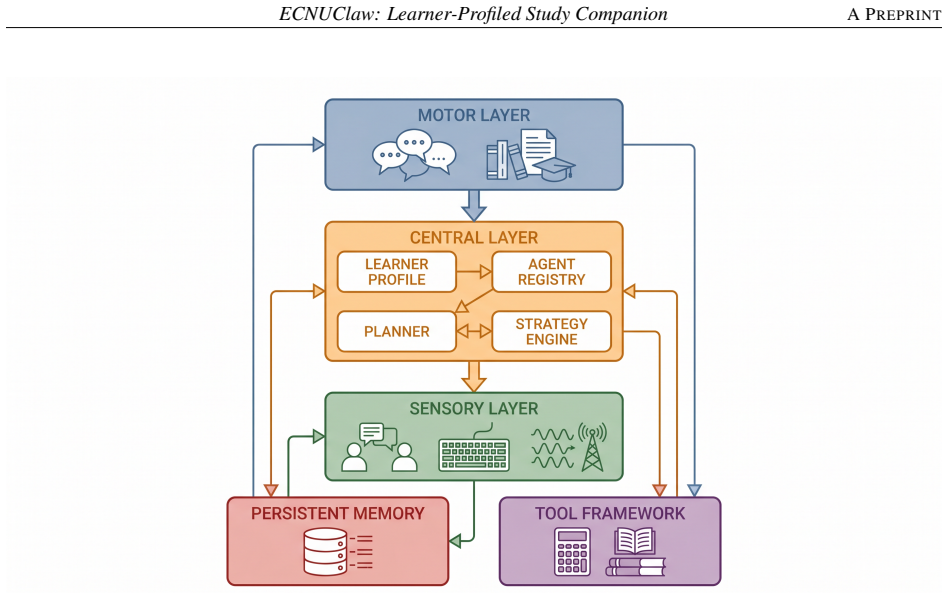


read the original abstract
We introduce ECNUClaw, an open-source framework for building learner-profiled intelligent study companions in K-12 education. The system constructs and maintains a five-dimension learner profile -- covering cognitive, behavioral, emotional, metacognitive, and contextual dimensions -- by extracting signals from student-companion dialogues at each turn. Profile updates feed directly into an adaptive strategy engine that adjusts the companion's guidance intensity, encouragement frequency, and Bloom's taxonomy scaffolding in real time. The framework design draws on three theoretical strands from the Chinese educational technology literature: Zhang's Digital Portrait Three-Layer Framework for learner assessment, the Education Brain model for educational system architecture, and the Human-AI Collaborative IQ concept for companion design philosophy. ECNUClaw is implemented in Python and supports seven Chinese LLM providers through a unified OpenAI-compatible adapter layer. We describe the system architecture, the profiling and adaptation mechanisms, and discuss limitations and next steps. The source code is available at https://github.com/bushushu2333/ECNUClaw.
Editorial analysis
A structured set of objections, weighed in public.
Referee Report
Summary. The paper presents ECNUClaw, an open-source Python-based framework for developing intelligent study companions tailored for K-12 personalized education. Central to the framework is the construction and maintenance of a five-dimensional learner profile encompassing cognitive, behavioral, emotional, metacognitive, and contextual aspects, derived from signals in student-companion dialogues at each interaction turn. These profile updates drive an adaptive strategy engine that dynamically adjusts the companion's guidance intensity, encouragement frequency, and scaffolding according to Bloom's taxonomy. The design incorporates three theoretical models from Chinese educational technology research: Zhang's Digital Portrait Three-Layer Framework, the Education Brain model, and the Human-AI Collaborative IQ concept. The implementation supports seven Chinese LLM providers through a unified adapter layer, with the source code publicly available on GitHub.
Significance. Should the framework function as described, it provides a valuable, reproducible resource for the HCI and educational technology communities by offering a concrete integration of learner profiling with real-time adaptive dialogue systems. The open-source release and support for multiple LLMs facilitate experimentation and extension, particularly for researchers interested in culturally contextualized approaches to personalized learning. Credit is due for the public code availability, which enables direct inspection and reuse of the implementation details.
Simulated Author's Rebuttal
We thank the referee for the positive assessment of ECNUClaw, the recognition of its value as an open-source resource for HCI and educational technology, and the recommendation for minor revision. No specific major comments were raised in the report.
Circularity Check
No significant circularity
full rationale
The paper is a system architecture description for the ECNUClaw framework. It specifies how a five-dimension learner profile is extracted from dialogues and fed into an adaptation engine, but presents no equations, fitted parameters, or derived predictions that reduce to the framework's own outputs. Foundations are drawn from external cited models (Zhang's Digital Portrait, Education Brain, Human-AI Collaborative IQ), and the work emphasizes implementability with released Python code rather than any self-referential derivation or empirical claim that loops back to its inputs. No self-definitional, fitted-prediction, or self-citation-load-bearing steps are present.
Axiom & Free-Parameter Ledger
axioms (3)
- domain assumption Zhang's Digital Portrait Three-Layer Framework for learner assessment
- domain assumption Education Brain model for educational system architecture
- domain assumption Human-AI Collaborative IQ concept for companion design philosophy
Lean theorems connected to this paper
-
IndisputableMonolith/Foundation/RealityFromDistinction.leanreality_from_one_distinction unclear?
unclearRelation between the paper passage and the cited Recognition theorem.
The system constructs and maintains a five-dimension learner profile... by extracting signals from student-companion dialogues at each turn. Profile updates feed directly into an adaptive strategy engine...
-
IndisputableMonolith/Cost/FunctionalEquation.leanwashburn_uniqueness_aczel unclear?
unclearRelation between the paper passage and the cited Recognition theorem.
HEADS base template establishes the companion’s behavioral rules... Never give direct answers. Use Socratic questioning...
What do these tags mean?
- matches
- The paper's claim is directly supported by a theorem in the formal canon.
- supports
- The theorem supports part of the paper's argument, but the paper may add assumptions or extra steps.
- extends
- The paper goes beyond the formal theorem; the theorem is a base layer rather than the whole result.
- uses
- The paper appears to rely on the theorem as machinery.
- contradicts
- The paper's claim conflicts with a theorem or certificate in the canon.
- unclear
- Pith found a possible connection, but the passage is too broad, indirect, or ambiguous to say the theorem truly supports the claim.
Reference graph
Works this paper leans on
-
[1]
Qingyun Wu and Gagan Bansal and Jieyu Zhang and Yiran Wu and Beibin Li and Erkang Zhu and Li Jiang and Xiaoyun Zhang and Shaokun Zhang and Jiale Liu and others , journal=. AutoGen: Enabling Next-Gen
-
[2]
DeepTutor: Towards Agentic Personalized Tutoring
DeepTutor: A Deep Reinforcement Learning Framework for Full Lifecycle Personalized Tutoring , author=. arXiv preprint arXiv:2604.26962 , year=
work page internal anchor Pith review Pith/arXiv arXiv
-
[3]
arXiv preprint arXiv:2601.04219 , year=
AgentTutor: Intelligent Tutoring with Autonomous Pedagogical Agents , author=. arXiv preprint arXiv:2601.04219 , year=
-
[4]
Abercrombie, Gavin and LaViolette, Nicole and Spirling, Arthur and Tan, Chenhao , journal=. Socratic Questioning by
- [5]
-
[6]
Review of Educational Research , volume=
Effectiveness of Intelligent Tutoring Systems: A Meta-Analytic Review , author=. Review of Educational Research , volume=
-
[7]
Journal of Computer Assisted Learning , volume=
Intelligent Tutoring Systems: A Systematic Review , author=. Journal of Computer Assisted Learning , volume=
-
[8]
New Directions for Teaching and Learning , volume=
The Socratic Method as an Approach to Teaching and Learning , author=. New Directions for Teaching and Learning , volume=
-
[9]
Frontiers of Computer Science , year=
A Survey on Large Language Model based Autonomous Agents , author=. Frontiers of Computer Science , year=
-
[10]
Holmes, Wayne and Bialik, Maya and Fadel, Charles , journal=. Safety Considerations for
-
[11]
China Educational Technology , number=
Comprehensive Quality Assessment Based on Digital Portraits: Framework, Indicators, Model, and Application , author=. China Educational Technology , number=
-
[12]
Open Education Research , number=
Ecological Architecture and Application Scenarios of Artificial Intelligence Education Brain , author=. Open Education Research , number=
-
[13]
The Underlying Logic and Possible Paths of
Zhang, Zhi , journal=. The Underlying Logic and Possible Paths of
-
[14]
China Educational Technology , number=
Construction of Multi-Source and Multi-Dimensional Comprehensive Quality Evaluation Model Based on Big Data , author=. China Educational Technology , number=
-
[15]
China Educational Technology , number=
Construction of Research Learning Student Portrait Based on Visualized Learning Analytics , author=. China Educational Technology , number=
-
[16]
Open Education Research , number=
Core Concepts and Technical Implementation of Intelligent Digital Textbook System , author=. Open Education Research , number=
-
[17]
Taxonomy of Educational Objectives: The Classification of Educational Goals , author=
-
[18]
Mind in Society: The Development of Higher Psychological Processes , author=
-
[19]
Mindset: The New Psychology of Success , author=
-
[20]
Journal of Educational Psychology , volume=
Self-Regulated Learning , author=. Journal of Educational Psychology , volume=
-
[21]
Handbook of Self-Regulation , pages=
The Role of Goal Orientation in Self-Regulated Learning , author=. Handbook of Self-Regulation , pages=
-
[22]
IEEE Transactions on Education , volume=
AutoTutor: An Intelligent Tutoring System with Mixed-Initiative Dialogue , author=. IEEE Transactions on Education , volume=
-
[23]
Journal of the Learning Sciences , volume=
Cognitive Tutors: Lessons Learned , author=. Journal of the Learning Sciences , volume=
-
[24]
Learning and Individual Differences , volume=
ChatGPT for Good? On Opportunities and Challenges of Large Language Models for Education , author=. Learning and Individual Differences , volume=
-
[25]
Education in the Era of Generative Artificial Intelligence (
Baidoo-Anu, Daniel and Owusu Ansah, Leticia , journal=. Education in the Era of Generative Artificial Intelligence (
-
[26]
Intelligence Unleashed: An Argument for the Value of
Luckin, Rose and Holmes, Wayne and Griffiths, Mark and Forcier, Laurie Burch , journal=. Intelligence Unleashed: An Argument for the Value of
-
[27]
Self-Efficacy: The Exercise of Control , author=
-
[28]
Theory Into Practice , volume=
Becoming a Self-Regulated Learner: An Overview , author=. Theory Into Practice , volume=
-
[29]
Visible Learning: A Synthesis of Over 800 Meta-Analyses Relating to Achievement , author=
-
[30]
How People Learn: Brain, Mind, Experience, and School , author=
-
[31]
Jabbour, Jason and Kleinbard, Kai and Miller, Olivia and Haussman, Robert and Reddi, Vijay Janapa , journal=. SocratiQ: A Generative
discussion (0)
Sign in with ORCID, Apple, or X to comment. Anyone can read and Pith papers without signing in.