Recognition: 1 theorem link
· Lean TheoremGapped 1/9 Magnetization Plateau in the Anisotropic Kagome Antiferromagnet Y-kapellasite
Pith reviewed 2026-05-11 01:59 UTC · model grok-4.3
The pith
Y-kapellasite shows a gapped 1/9 magnetization plateau with ordered local spins and suppressed fluctuations.
A machine-rendered reading of the paper's core claim, the machinery that carries it, and where it could break.
Core claim
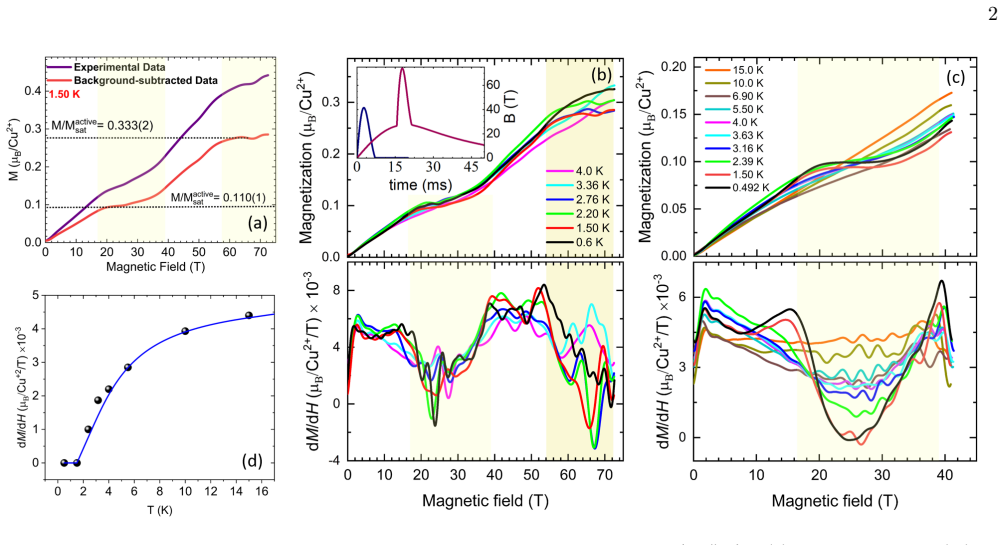
In Y-kapellasite the 1/9 magnetization plateau is accompanied by an ordered local spin configuration, a strong suppression of low-energy spin fluctuations and activated behavior, consistent with a gapped fractional state. This plateau forms part of a hierarchy of fractional features that also includes the 1/3 plateau, and its characteristics differ from those reported in YCu3(OH)6Br2[Br1-y(OH)y], implying a surprising robustness of the 1/9 state to the details of the underlying magnetism.
What carries the argument
High-field 35Cl NMR spectra combined with pulsed-field magnetization measurements, which together map the local spin configuration, fluctuation spectrum, and temperature dependence across the plateau.
If this is right
- The 1/9 plateau corresponds to an ordered gapped fractional magnetization state.
- Low-energy spin fluctuations are strongly suppressed inside the plateau region.
- Magnetic susceptibility exhibits activated temperature dependence consistent with an energy gap.
- The 1/9 state appears alongside 1/3 and weaker fractional features in a field-induced hierarchy.
- The gapped character remains stable despite differences in exchange interactions between materials.
Where Pith is reading between the lines
- Similar gapped fractional plateaus may exist in other kagome compounds whose interaction strengths differ from those studied here.
- Microscopic modeling of the ordered spin pattern at 1/9 filling could be tested by comparing predicted NMR shifts with the measured spectra.
- High-field experiments on additional anisotropic kagome magnets would clarify whether the observed hierarchy of plateaus is generic.
Load-bearing premise
The NMR line shapes and susceptibility behavior are taken to indicate a unique ordered gapped fractional state rather than disorder, inhomogeneous fields, or alternative dynamical regimes.
What would settle it
A measurement showing gapless excitations or the absence of local spin order at the 1/9 plateau, for example via specific-heat or neutron-scattering experiments, would falsify the gapped fractional interpretation.
Figures


read the original abstract
Fractional magnetization plateaus provide a sensitive probe of many-body spin states in frustrated quantum magnets, yet their microscopic origin in kagome antiferromagnets remains unresolved. This is particularly true of the mysterious $1/9$ plateau, which is predicted by theory but infrequently observed in experiment. Here, we investigate this problem in the $S = 1/2$ anisotropic kagome antiferromagnet Y-kapellasite, Y$_3$Cu$_9$(OH)$_{19}$Cl$_8$, using pulsed-field magnetization measurements on single crystals and high-field $^{35}$Cl NMR. We identify a hierarchy of field-induced fractional features, including $1/3$ and $1/9$ plateaus, as well as a weaker low-field feature. Analysis of the NMR spectra and the magnetic susceptibility across the $1/9$ plateau demonstrate that it is accompanied by an ordered local spin configuration, a strong suppression of low-energy spin fluctuations and activated behavior, consistent with a gapped fractional state. These features differ from those in the only other material YCu$_3$(OH)$_6$Br$_2$[Br$_{1-y}$(OH)$_y$] in which this plateau is observed, implying a surprising robustness of the $1/9$ state to the details of the underlying magnetism.
Editorial analysis
A structured set of objections, weighed in public.
Referee Report
Summary. The manuscript reports pulsed-field magnetization measurements on single crystals of the anisotropic S=1/2 kagome antiferromagnet Y-kapellasite, Y3Cu9(OH)19Cl8, together with high-field 35Cl NMR. It identifies a hierarchy of field-induced fractional magnetization features, including clear 1/3 and 1/9 plateaus plus a weaker low-field feature. Analysis of the NMR line shapes and the temperature dependence of susceptibility and relaxation rates across the 1/9 plateau is used to argue for an ordered local spin configuration, strong suppression of low-energy fluctuations, and activated behavior, interpreted as consistent with a gapped fractional many-body state. The features are contrasted with those in the related compound YCu3(OH)6Br2[Br1-y(OH)y].
Significance. If the central interpretation is substantiated, the work supplies rare experimental evidence for a microscopically ordered, gapped 1/9 plateau in a kagome antiferromagnet, a state long predicted by theory but seldom realized. The use of complementary single-crystal magnetization and NMR techniques, together with the reported robustness of the plateau to variations in the underlying exchange parameters, would strengthen the case that fractional plateaus can serve as clean probes of many-body spin states in frustrated magnets.
major comments (3)
- [Abstract; NMR spectra and susceptibility analysis] The abstract and the NMR/susceptibility analysis sections state that the data are 'consistent with' an ordered gapped fractional state, yet no quantitative comparison is provided to simulated line shapes or relaxation rates expected from static inhomogeneity, disorder-induced local moments, or field-gradient broadening. These alternatives are known to produce similar line broadening and apparent activation in other kagome compounds; without such discrimination the uniqueness of the ordered fractional interpretation is not established.
- [Magnetic susceptibility and NMR relaxation data] The claim of 'strong suppression of low-energy spin fluctuations and activated behavior' across the 1/9 plateau rests on the temperature dependence of susceptibility and NMR relaxation, but the manuscript supplies neither error bars on the extracted gap, nor fits to alternative functional forms (e.g., power-law or disorder-broadened regimes), nor a direct comparison of relaxation rates inside versus outside the plateau that would quantify the suppression.
- [Magnetization data and discussion of fractional features] The hierarchy of fractional features (1/3, 1/9, and weaker low-field feature) is presented as supporting the 1/9 plateau's many-body character, but the text does not show how the observed plateau widths or critical fields are compared against theoretical predictions for the anisotropic kagome model, leaving open whether the 1/9 feature is uniquely tied to the proposed gapped state or could arise from classical or disordered mechanisms.
minor comments (2)
- [Figures showing NMR spectra] Figure captions for the NMR spectra should explicitly state the temperature and field values at which each trace was recorded and whether the spectra are normalized to the same integrated intensity.
- [Experimental methods] The manuscript would benefit from a brief statement of the single-crystal alignment precision and the estimated field inhomogeneity in the pulsed-field setup, as these directly affect the interpretation of line widths.
Simulated Author's Rebuttal
We thank the referee for their thorough review and valuable suggestions. We have carefully considered each comment and revised the manuscript to enhance the quantitative aspects of our analysis and comparisons. Our responses to the major comments are as follows.
read point-by-point responses
-
Referee: [Abstract; NMR spectra and susceptibility analysis] The abstract and the NMR/susceptibility analysis sections state that the data are 'consistent with' an ordered gapped fractional state, yet no quantitative comparison is provided to simulated line shapes or relaxation rates expected from static inhomogeneity, disorder-induced local moments, or field-gradient broadening. These alternatives are known to produce similar line broadening and apparent activation in other kagome compounds; without such discrimination the uniqueness of the ordered fractional interpretation is not established.
Authors: We agree that providing quantitative comparisons to alternative scenarios would further strengthen our claims. In the revised manuscript, we have added a discussion in the NMR analysis section where we estimate the expected line broadening due to field gradients and compare it to the observed spectra. We also reference studies on similar kagome systems showing that disorder-induced moments typically lead to different temperature dependencies than observed here. While full numerical simulations of line shapes are beyond the scope of the current work, these additions help discriminate against the alternatives and support the consistency with an ordered state. revision: partial
-
Referee: [Magnetic susceptibility and NMR relaxation data] The claim of 'strong suppression of low-energy spin fluctuations and activated behavior' across the 1/9 plateau rests on the temperature dependence of susceptibility and NMR relaxation, but the manuscript supplies neither error bars on the extracted gap, nor fits to alternative functional forms (e.g., power-law or disorder-broadened regimes), nor a direct comparison of relaxation rates inside versus outside the plateau that would quantify the suppression.
Authors: We have revised the relevant sections to include error bars on the fitted gap value from the susceptibility and NMR relaxation data. Additionally, we now present a direct comparison of the relaxation rates at fields inside and outside the 1/9 plateau, demonstrating a significant suppression within the plateau. In the supplementary material, we include fits to both activated and power-law forms, showing that the activated behavior provides a better description of the data across the temperature range studied. revision: yes
-
Referee: [Magnetization data and discussion of fractional features] The hierarchy of fractional features (1/3, 1/9, and weaker low-field feature) is presented as supporting the 1/9 plateau's many-body character, but the text does not show how the observed plateau widths or critical fields are compared against theoretical predictions for the anisotropic kagome model, leaving open whether the 1/9 feature is uniquely tied to the proposed gapped state or could arise from classical or disordered mechanisms.
Authors: The hierarchy is discussed in the context of supporting many-body effects, but we acknowledge the benefit of explicit theoretical comparisons. We have added a new figure panel and accompanying text that compares the observed critical fields and plateau widths to theoretical predictions from the anisotropic kagome antiferromagnet model. This comparison shows good agreement with the expected positions for the 1/9 plateau in the gapped state, distinguishing it from classical predictions which do not account for the observed gaps. revision: yes
Circularity Check
No circularity: purely experimental report with direct measurements
full rationale
The paper presents pulsed-field magnetization data and high-field 35Cl NMR spectra on Y-kapellasite. Claims about the 1/9 plateau rest on observed line shapes, susceptibility suppression, and activated temperature dependence. No equations, derivations, fitted parameters renamed as predictions, or self-citation chains appear in the provided text or abstract. The analysis is self-contained against external benchmarks (raw spectra and magnetization curves), with no reduction of results to prior inputs by construction. This matches the default expectation for experimental reports.
Axiom & Free-Parameter Ledger
axioms (1)
- domain assumption NMR spectra reflect local spin environments in a manner that distinguishes ordered configurations from fluctuating ones
Reference graph
Works this paper leans on
-
[1]
Gapped 1/9 Magnetization Plateau in the Anisotropic Kagome Antiferromagnet Y-kapellasite
Physikalisches Institut, Universit¨ at Stuttgart, Pfaffenwaldring 57, 70569 Stuttgart, Germany 8National High Magnetic Field Laboratory (NHMFL), Los Alamos National Laboratory, Los Alamos, NM, USA (Dated: May 11, 2026) Fractional magnetization plateaus provide a sensitive probe of many-body spin states in frustrated quantum magnets, yet their microscopic ...
work page internal anchor Pith review Pith/arXiv arXiv 2026
-
[2]
H. K. Yoshida, Frustrated kagome antiferromagnets un- der high magnetic fields, Journal of the Physical Society of Japan91, 101003 (2022)
work page 2022
- [3]
-
[4]
S. Nishimoto, N. Shibata, and C. Hotta, Controlling frus- trated liquids and solids with an applied field in a kagome Heisenberg antiferromagnet, Nature communications4, 2287 (2013)
work page 2013
- [5]
-
[6]
Z. Zeng, X. Ma, S. Wu, H.-F. Li, Z. Tao, X. Lu, X.-h. Chen, J.-X. Mi, S.-J. Song, G.-H. Cao, G. Che, K. Li, G. Li, H. Luo, Z. Y. Meng, and S. Li, Possible Dirac quantum spin liquid in the kagome quantum antiferro- magnet YCu3(OH)6Br2[Brx(OH)1−x], Phys. Rev. B105, L121109 (2022)
work page 2022
- [7]
-
[8]
Y. Haraguchi, J.-i. Yamaura, A. Matsuo, K. Kindo, and H. A. Katori, One-third magnetization plateau in a spin-1 kagome magnet BaNi3(AsO4)2(OH)2, Phys. Rev. Mater. 9, 054408 (2025)
work page 2025
-
[9]
T. Ono, H. Tanaka, H. Aruga Katori, F. Ishikawa, H. Mi- tamura, and T. Goto, Magnetization plateau in the frus- trated quantum spin system Cs2CuBr4, Phys. Rev. B67, 104431 (2003)
work page 2003
- [10]
-
[11]
H. Ishikawa, M. Yoshida, K. Nawa, M. Jeong, S. Kr¨ amer, M. Horvati´ c, C. Berthier, M. Takigawa, M. Akaki, A. Miyake, M. Tokunaga, K. Kindo, J. Yamaura, Y. Okamoto, and Z. Hiroi, One-Third Magnetization Plateau with a Preceding Novel Phase in Volborthite, Phys. Rev. Lett.114, 227202 (2015)
work page 2015
-
[12]
L. Chen, J.-H. Chung, M. B. Stone, A. I. Kolesnikov, B. Winn, V. O. Garlea, D. L. Abernathy, B. Gao, M. Au- gustin, E. J. G. Santos, and P. Dai, Magnetic Field Effect on Topological Spin Excitations in CrI3, Phys. Rev. X11, 031047 (2021)
work page 2021
- [13]
-
[14]
H. Ueda, H. A. Katori, H. Mitamura, T. Goto, and H. Takagi, Magnetic-Field Induced Transition to the 1/2 Magnetization Plateau State in the Geometrically Frus- trated Magnet CdCr 2O4, Phys. Rev. Lett.94, 047202 (2005)
work page 2005
- [15]
- [16]
-
[17]
E. Kermarrec, A. Zorko, F. Bert, R. H. Colman, B. Koteswararao, F. Bouquet, P. Bonville, A. Hillier, A. Amato, J. van Tol, A. Ozarowski, A. S. Wills, and P. Mendels, Spin dynamics and disorder effects in the S=1/2 kagome Heisenberg spin-liquid phase of kapella- site, Physical Review B90, 205103 (2014)
work page 2014
-
[18]
B. F˚ ak, E. Kermarrec, L. Messio, B. Bernu, C. Lhuil- lier, F. Bert, P. Mendels, B. Koteswararao, F. Bouquet, J. Ollivier, A. D. Hillier, A. Amato, R. H. Colman, and A. S. Wills, Kapellasite: A Kagome Quantum Spin Liq- uid with Competing Interactions, Phys. Rev. Lett.109, 037208 (2012). 6
work page 2012
- [19]
- [20]
-
[21]
M. Kato, H. K. Yoshida, R. Kumar, and Y. Ihara, Magnetic Excitations in the 1/3 Plateau State in InCu3(OH)6Cl3, Journal of the Physical Society of Japan 94, 083704 (2025)
work page 2025
-
[22]
M. Kato, Y. Narumi, K. Morita, Y. Matsushita, S. Fukuoka, S. Yamashita, Y. Nakazawa, M. Oda, H. Hayashi, K. Yamaura,et al., One-third magnetization plateau in Quantum Kagome antiferromagnet, Commu- nications Physics7, 424 (2024)
work page 2024
-
[23]
X. Chen, S.-J. Ran, T. Liu, C. Peng, Y.-Z. Huang, and G. Su, Thermodynamics of spin-1/2 Kagome Heisen- berg antiferromagnet: algebraic paramagnetic liquid and finite-temperature phase diagram, Science Bulletin63, 1545 (2018)
work page 2018
-
[24]
G. Zheng, D. Zhang, Y. Zhu, K.-W. Chen, A. Chan, K. Jenkins, B. Kang, Z. Zeng, A. Xu, D. Ratkovski, J. Blawat, A. F. Bangura, J. Singleton, P. A. Lee, S. Li, and L. Li, Thermodynamic evidence of fermionic behav- ior in the vicinity of one-ninth plateau in a kagome anti- ferromagnet, Phys. Rev. X15, 021076 (2025)
work page 2025
- [25]
- [26]
-
[27]
D. Chatterjee, P. Puphal, Q. Barth´ elemy, J. Willwa- ter, S. S¨ ullow, C. Baines, S. Petit, E. Ressouche, J. Ol- livier, K. M. Zoch, C. Krellner, M. Parzer, A. Riss, F. Garmroudi, A. Pustogow, P. Mendels, E. Kermarrec, and F. Bert, From spin liquid to magnetic ordering in the anisotropic kagome Y-kapellasite Y 3Cu9(OH)19Cl8 : A single-crystal study, Phys...
work page 2023
-
[28]
T. Biesner, S. Roh, A. Razpopov, J. Willwater, S. S¨ ullow, Y. Li, K. M. Zoch, M. Medarde, J. Nuss, D. Gorbunov, Y. Skourski, A. Pustogow, S. E. Brown, C. Krellner, R. Valent´ ı, P. Puphal, and M. Dressel, Multi-Center Magnon Excitations Open the Entire Brillouin Zone to Terahertz Magnetometry of Quantum Magnets, Ad- vanced Quantum Technologies5, 2200023 (2022)
work page 2022
-
[29]
D. Chatterjee, P. Doleˇ zal, F. Abbruciati, T. Biesner, K. M. Zoch, R. Khasanov, S. S. Islam, G. Kaur, S. Roh, F. Capitani, J. E. F. S. Rodrigues, G. Gar- barino, C. Krellner, P. Mendels, E. Kermarrec, M. Dres- sel, B. Wehinger, A. Pustogow, F. Bert, and P. Puphal, Emergence of a Fluctuating Ground State in Y- Kapellasite under Pressure, Phys. Rev. Lett.1...
work page 2026
-
[30]
J. Wang, M. Spitaler, Y.-S. Su, K. M. Zoch, C. Krellner, P. Puphal, S. E. Brown, and A. Pustogow, Controlled frustration release on the kagome lattice by uniaxial- strain tuning, Phys. Rev. Lett.131, 256501 (2023)
work page 2023
-
[31]
J. Liu, L. Yuan, X. Li, B. Li, K. Zhao, H. Liao, and Y. Li, Gapless spin liquid behavior in a kagome Heisenberg an- tiferromagnet with randomly distributed hexagons of al- ternate bonds, Phys. Rev. B105, 024418 (2022). END MA TTER Magnetization dataB⊥c: To complement the B∥cmagnetization data, we also present measurements forB⊥cin Fig. 4. Similar 1/9 and ...
work page 2022
discussion (0)
Sign in with ORCID, Apple, or X to comment. Anyone can read and Pith papers without signing in.