Recognition: 2 theorem links
· Lean TheoremTTCD:Transformer Integrated Temporal Causal Discovery from Non-Stationary Time Series Data
Pith reviewed 2026-05-12 01:34 UTC · model grok-4.3
The pith
A transformer framework discovers both contemporaneous and lagged causal relations in non-stationary time series by distilling signals through decoder reconstruction.
A machine-rendered reading of the paper's core claim, the machinery that carries it, and where it could break.
Core claim
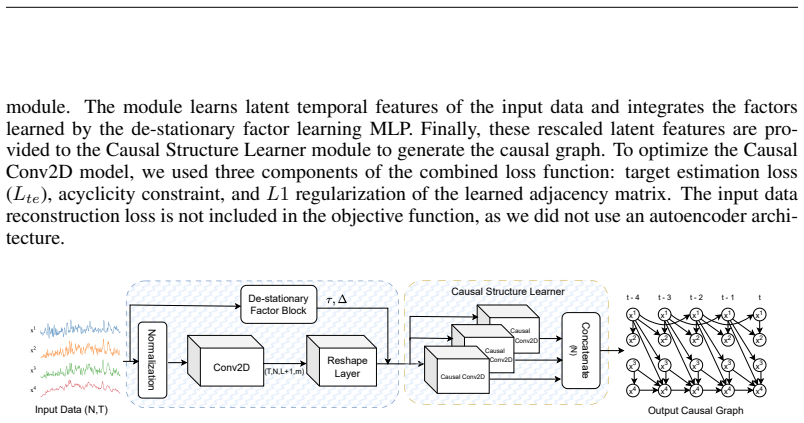
TTCD is an end-to-end framework that learns contemporaneous and lagged causal relations from non-stationary time series through a Non-Stationary Feature Learner combining temporal and frequency-domain attention with dynamic profiling, followed by a Causal Structure Learner that infers the graph from signals distilled via the transformer decoder's reconstruction process, which mitigates noise and spurious correlations while preserving meaningful dependencies without assumptions on noise distributions or data generation.
What carries the argument
Reconstruction-guided causal signal distillation, which isolates essential causal signals by leveraging the transformer decoder's reconstruction of the input data to filter noise and spurious correlations before causal graph inference.
If this is right
- The approach can recover causal structures in settings with nonlinear relations and distribution changes without relying on conditional independence tests.
- It produces more accurate and consistent results than prior methods on synthetic, benchmark, and real-world datasets.
- The method identifies both immediate and time-delayed relations while reducing the impact of noise.
- It offers a unified solution for causal discovery that avoids strong statistical assumptions on the data.
Where Pith is reading between the lines
- If the distillation works as described, the method could extend to other domains with shifting time series such as climate or financial data where ground-truth causal graphs are partially known.
- The reconstruction step might reduce the need for separate preprocessing stages in causal pipelines.
- Testing the framework on data with controlled change points could reveal how well the dynamic profiling captures shifts.
Load-bearing premise
The transformer decoder reconstruction process can reliably separate true causal dependencies from noise and spurious correlations without introducing new biases or needing assumptions about noise or how the data was generated.
What would settle it
Apply TTCD to synthetic non-stationary time series generated from a known causal graph with added high noise levels and distribution shifts, then measure whether the recovered graph matches the known structure in accuracy metrics.
Figures


read the original abstract
The widespread availability of complex time series data in various domains such as environmental science, epidemiology, and economics demands robust causal discovery methods that can identify intricate contemporaneous and lagged relationships in non-stationary, nonlinear, and noisy settings. Existing constraint-based methods often rely heavily on conditional independence tests that degrade for limited data samples and complex distributions, while score-based methods impose strong statistical assumptions. Recent methods address special cases such as change point detection or distribution shifts, but struggle to provide a unified solution. We propose the Transformer Integrated Temporal Causal Discovery (TTCD) Framework, a novel end-to-end approach that learns contemporaneous and lagged causal relations from non-stationary time series. TTCD introduces a Non-Stationary Feature Learner integrating temporal and frequency-domain attention with dynamic non-stationarity profiling, and a custom Causal Structure Learner. A key innovation is reconstruction-guided causal signal distillation, to distill essential causal signals through the reconstruction process of the transformer decoder, which mitigates noise and spurious correlations while preserving meaningful dependencies. The Causal Structure Learner operates on distilled reconstructed signals to infer the underlying causal graph without restrictive assumptions on noise distributions or data generation processes. Experiments on synthetic, benchmark, and real world datasets show that TTCD consistently outperforms state-of-the-art baselines in both accuracy and consistency with domain knowledge, demonstrating the approach's effectiveness for causal discovery in challenging real world contexts.
Editorial analysis
A structured set of objections, weighed in public.
Referee Report
Summary. The paper proposes the TTCD framework, an end-to-end transformer-based method for learning contemporaneous and lagged causal relations from non-stationary time series. It introduces a Non-Stationary Feature Learner combining temporal/frequency attention with dynamic profiling, a Causal Structure Learner, and a key component called reconstruction-guided causal signal distillation that uses the transformer decoder's reconstruction process to extract causal signals while suppressing noise and spurious correlations. The method claims to operate without restrictive assumptions on noise or data generation, with experiments showing consistent outperformance over baselines on synthetic, benchmark, and real-world data.
Significance. If the reconstruction step can be shown to isolate causal structure rather than merely statistical dependencies, the approach would address a longstanding gap in causal discovery for non-stationary, nonlinear, and noisy time series by providing a unified, assumption-light alternative to constraint- and score-based methods. The integration of frequency-domain attention and end-to-end learning is a potentially useful direction, though the current manuscript provides no derivations, ablations, or identifiability results to support the central distillation claim.
major comments (3)
- [Abstract] Abstract: The claim that 'reconstruction-guided causal signal distillation' 'mitigates noise and spurious correlations while preserving meaningful dependencies' is presented as a key innovation without any equation, loss formulation, or proof showing that the decoder reconstruction objective (typically MSE or similar) distinguishes causal edges from non-causal associations such as common-cause confounders or non-stationary artifacts. This leaves the separation as an unverified modeling assumption.
- [Method] Method description (Causal Structure Learner): The statement that the learner 'operates on distilled reconstructed signals to infer the underlying causal graph without restrictive assumptions on noise distributions or data generation processes' is circular with respect to the training objective; no explicit causal regularization, intervention constraint, or identifiability argument is supplied to force the reconstruction to prefer causal over correlational explanations.
- [Experiments] Experiments: The abstract asserts 'consistent outperformance' on synthetic, benchmark, and real-world datasets, yet supplies no referenced ablation studies, error bars, or quantitative results demonstrating the isolated contribution of the distillation step versus a standard transformer reconstruction baseline. This makes the empirical support for the central claim difficult to evaluate.
minor comments (2)
- [Abstract] The abstract introduces several new terms ('Non-Stationary Feature Learner', 'reconstruction-guided causal signal distillation') without immediate reference to prior related transformer causal discovery work; a short related-work paragraph would improve context.
- [Method] Notation for lagged versus contemporaneous relations and the precise form of the reconstruction loss should be defined explicitly in the method section to allow reproducibility.
Simulated Author's Rebuttal
We thank the referee for the constructive feedback on TTCD. The comments highlight important areas where the presentation of the distillation mechanism, its theoretical grounding, and empirical validation can be strengthened. We address each major comment point by point below, indicating the specific revisions we will make.
read point-by-point responses
-
Referee: [Abstract] Abstract: The claim that 'reconstruction-guided causal signal distillation' 'mitigates noise and spurious correlations while preserving meaningful dependencies' is presented as a key innovation without any equation, loss formulation, or proof showing that the decoder reconstruction objective (typically MSE or similar) distinguishes causal edges from non-causal associations such as common-cause confounders or non-stationary artifacts. This leaves the separation as an unverified modeling assumption.
Authors: We agree that the abstract states the claim at a high level without supporting equations or proofs. The current manuscript explains the distillation conceptually in the method section via the decoder's reconstruction process but does not supply a formal loss formulation or proof that it separates causal edges from confounders or artifacts. We will revise the abstract to provide a concise reference to the reconstruction objective and add a detailed description of the distillation loss (including any regularization terms) in the method section. We will also include a limitations discussion noting the absence of theoretical identifiability guarantees. revision: yes
-
Referee: [Method] Method description (Causal Structure Learner): The statement that the learner 'operates on distilled reconstructed signals to infer the underlying causal graph without restrictive assumptions on noise distributions or data generation processes' is circular with respect to the training objective; no explicit causal regularization, intervention constraint, or identifiability argument is supplied to force the reconstruction to prefer causal over correlational explanations.
Authors: We acknowledge that the current phrasing can appear circular without additional detail on the objective. The manuscript does not include explicit causal regularization terms, intervention-based constraints, or an identifiability argument beyond the end-to-end reconstruction. We will revise the method section to explicitly describe the training objective, clarify how the Non-Stationary Feature Learner and decoder interact during distillation, and note that the approach relies on empirical separation rather than formal guarantees. The claim of operating without restrictive assumptions will be qualified accordingly. revision: yes
-
Referee: [Experiments] Experiments: The abstract asserts 'consistent outperformance' on synthetic, benchmark, and real-world datasets, yet supplies no referenced ablation studies, error bars, or quantitative results demonstrating the isolated contribution of the distillation step versus a standard transformer reconstruction baseline. This makes the empirical support for the central claim difficult to evaluate.
Authors: We agree that the experiments section does not currently reference ablation studies isolating the distillation component or provide direct comparisons to a standard transformer reconstruction baseline with error bars. We will add these elements in the revision, including new ablation results on synthetic data with error bars from multiple runs and a comparison against a vanilla transformer autoencoder to quantify the distillation's contribution. The abstract will be updated to reference these supporting results. revision: yes
- Lack of formal derivations or identifiability results demonstrating that the reconstruction-guided distillation isolates causal structure rather than statistical dependencies or non-stationary artifacts.
Circularity Check
No significant circularity in the derivation chain
full rationale
The paper proposes TTCD as a novel end-to-end framework combining a Non-Stationary Feature Learner and Causal Structure Learner, with reconstruction-guided causal signal distillation presented as an architectural innovation rather than a first-principles mathematical derivation. The abstract describes the reconstruction process as distilling causal signals but does not provide equations or a derivation chain that reduces this claim to a self-definition, fitted input, or self-citation by construction. No load-bearing steps reduce the central claims to tautological inputs; the method is instead validated externally via experiments on synthetic, benchmark, and real-world datasets, rendering it self-contained against external benchmarks.
Axiom & Free-Parameter Ledger
axioms (2)
- domain assumption Transformer attention mechanisms can jointly capture temporal and frequency-domain features while profiling non-stationarity
- ad hoc to paper The transformer decoder reconstruction process preserves meaningful causal dependencies while removing noise and spurious correlations
invented entities (3)
-
Non-Stationary Feature Learner
no independent evidence
-
reconstruction-guided causal signal distillation
no independent evidence
-
Causal Structure Learner
no independent evidence
Lean theorems connected to this paper
-
IndisputableMonolith/Cost/FunctionalEquation.leanwashburn_uniqueness_aczel unclear?
unclearRelation between the paper passage and the cited Recognition theorem.
reconstruction-guided causal signal distillation... MSE loss Lr = 1/T Σ||X - X̂||²₂ (Eq. 5); Causal Conv2D layers with acyclicity h(Wt)=tr(e^{Wt⊙Wt})-n
-
IndisputableMonolith/Foundation/ArithmeticFromLogic.leanreality_from_one_distinction unclear?
unclearRelation between the paper passage and the cited Recognition theorem.
Non-Stationary Feature Learner with temporal/frequency attention and de-stationary factors
What do these tags mean?
- matches
- The paper's claim is directly supported by a theorem in the formal canon.
- supports
- The theorem supports part of the paper's argument, but the paper may add assumptions or extra steps.
- extends
- The paper goes beyond the formal theorem; the theorem is a base layer rather than the whole result.
- uses
- The paper appears to rely on the theorem as machinery.
- contradicts
- The paper's claim conflicts with a theorem or certificate in the canon.
- unclear
- Pith found a possible connection, but the passage is too broad, indirect, or ambiguous to say the theorem truly supports the claim.
Reference graph
Works this paper leans on
-
[1]
Scaling Learning Algorithms Towards
Bengio, Yoshua and LeCun, Yann , booktitle =. Scaling Learning Algorithms Towards
-
[2]
and Osindero, Simon and Teh, Yee Whye , journal =
Hinton, Geoffrey E. and Osindero, Simon and Teh, Yee Whye , journal =. A Fast Learning Algorithm for Deep Belief Nets , volume =
- [3]
-
[4]
Clancey, William J. Communication, Simulation, and Intelligent Agents: Implications of Personal Intelligent Machines for Medical Education. Proceedings of the Eighth International Joint Conference on Artificial Intelligence (IJCAI-83)
-
[5]
Classification Problem Solving
Clancey, William J. Classification Problem Solving. Proceedings of the Fourth National Conference on Artificial Intelligence
- [6]
-
[7]
New Ways to Make Microcircuits Smaller---Duplicate Entry
Robinson, Arthur L. New Ways to Make Microcircuits Smaller---Duplicate Entry. Science
-
[8]
Clancey and Glenn Rennels , abstract =
Diane Warner Hasling and William J. Clancey and Glenn Rennels , abstract =. Strategic explanations for a diagnostic consultation system , journal =. 1984 , issn =. doi:https://doi.org/10.1016/S0020-7373(84)80003-6 , url =
-
[9]
Hasling, Diane Warner and Clancey, William J. and Rennels, Glenn R. and Test, Thomas. Strategic Explanations in Consultation---Duplicate. The International Journal of Man-Machine Studies
-
[10]
Poligon: A System for Parallel Problem Solving
Rice, James. Poligon: A System for Parallel Problem Solving
-
[11]
Transfer of Rule-Based Expertise through a Tutorial Dialogue
Clancey, William J. Transfer of Rule-Based Expertise through a Tutorial Dialogue
-
[12]
The Engineering of Qualitative Models
Clancey, William J. The Engineering of Qualitative Models
- [13]
- [14]
-
[15]
Patricia S. Abril and Robert Plant. The patent holder's dilemma: Buy, sell, or troll?. Communications of the ACM. 2007. doi:10.1145/1188913.1188915
-
[16]
Deciding equivalances among conjunctive aggregate queries
Sarah Cohen and Werner Nutt and Yehoshua Sagic. Deciding equivalances among conjunctive aggregate queries. doi:10.1145/1219092.1219093
-
[17]
Special issue: Digital Libraries. 1996
work page 1996
-
[18]
Understanding Policy-Based Networking
David Kosiur. Understanding Policy-Based Networking. 2001
work page 2001
-
[21]
The title of book two. 2008. doi:10.1007/3-540-09237-4
-
[22]
Asad Z. Spector. Achieving application requirements. Distributed Systems. 1990. doi:10.1145/90417.90738
-
[23]
Douglass and David Harel and Mark B
Bruce P. Douglass and David Harel and Mark B. Trakhtenbrot. Statecarts in use: structured analysis and object-orientation. Lectures on Embedded Systems. 1998. doi:10.1007/3-540-65193-4_29
-
[24]
Donald E. Knuth. The Art of Computer Programming, Vol. 1: Fundamental Algorithms (3rd. ed.). 1997
work page 1997
-
[25]
Donald E. Knuth. The Art of Computer Programming. 1998
work page 1998
-
[26]
Structured Variational Inference Procedures and their Realizations (as incol)
Dan Geiger and Christopher Meek. Structured Variational Inference Procedures and their Realizations (as incol). Proceedings of Tenth International Workshop on Artificial Intelligence and Statistics, The Barbados
-
[27]
Stan W. Smith. An experiment in bibliographic mark-up: Parsing metadata for XML export. Proceedings of the 3rd. annual workshop on Librarians and Computers. 2010. doi:99.9999/woot07-S422
work page 2010
-
[28]
Catch me, if you can: Evading network signatures with web-based polymorphic worms
Matthew Van Gundy and Davide Balzarotti and Giovanni Vigna. Catch me, if you can: Evading network signatures with web-based polymorphic worms. Proceedings of the first USENIX workshop on Offensive Technologies
-
[29]
Sten Andler. Predicate Path expressions. Proceedings of the 6th. ACM SIGACT-SIGPLAN symposium on Principles of Programming Languages. 1979. doi:10.1145/567752.567774
-
[30]
LOGICS of Programs: AXIOMATICS and DESCRIPTIVE POWER
David Harel. LOGICS of Programs: AXIOMATICS and DESCRIPTIVE POWER. 1978
work page 1978
- [31]
- [32]
-
[33]
Introduction to Bayesian Statistics
Harry Thornburg. Introduction to Bayesian Statistics. 2001
work page 2001
-
[34]
CLIFFORD: a Maple 11 Package for Clifford Algebra Computations, version 11
Rafal Ablamowicz and Bertfried Fauser. CLIFFORD: a Maple 11 Package for Clifford Algebra Computations, version 11. 2007
work page 2007
- [35]
- [36]
- [37]
-
[38]
Dave Novak. Solder man. ACM SIGGRAPH 2003 Video Review on Animation theater Program: Part I - Vol. 145 (July 27--27, 2003). 2003. doi:99.9999/woot07-S422
work page 2003
-
[39]
Interview with Bill Kinder: January 13, 2005
Newton Lee. Interview with Bill Kinder: January 13, 2005. Comput. Entertain. 2005. doi:10.1145/1057270.1057278
-
[40]
The Enabling of Digital Libraries
Bernard Rous. The Enabling of Digital Libraries. Digital Libraries. 2008
work page 2008
-
[42]
(new) Finding minimum congestion spanning trees , journal =
Werneck, Renato and Setubal, Jo\. (new) Finding minimum congestion spanning trees , journal =. doi:10.1145/351827.384253 , acmid = 384253, publisher =
-
[44]
Conti, Mauro and Di Pietro, Roberto and Mancini, Luigi V. and Mei, Alessandro , title =. Inf. Fusion , volume =. 2009 , issn =. doi:10.1016/j.inffus.2009.01.002 , acmid =
-
[45]
Li, Cheng-Lun and Buyuktur, Ayse G. and Hutchful, David K. and Sant, Natasha B. and Nainwal, Satyendra K. , title =. CHI '08 extended abstracts on Human factors in computing systems , year =. doi:10.1145/1358628.1358946 , acmid =
- [46]
-
[47]
Goossens, Michel and Rahtz, S. P. and Moore, Ross and Sutor, Robert S. , title =. 1999 , isbn =
work page 1999
-
[48]
Buss, Jonathan F. and Rosenberg, Arnold L. and Knott, Judson D. , title =. 1987 , source =
work page 1987
-
[49]
CHI '08: CHI '08 extended abstracts on Human factors in computing systems , year =
, note =. CHI '08: CHI '08 extended abstracts on Human factors in computing systems , year =
-
[50]
Algorithms for Closest-Point Problems (Computational Geometry) , year =
Clarkson, Kenneth Lee , advisor =. Algorithms for Closest-Point Problems (Computational Geometry) , year =
-
[51]
SIGCOMM Comput. Commun. Rev. , year =
-
[52]
IEEE TCSC Executive Committee , booktitle =. 2004 , isbn =. doi:http://dx.doi.org/10.1109/ICWS.2004.64 , acmid =
-
[53]
Distributed systems (2nd Ed.) , year =
- [54]
-
[55]
Donald E. Knuth. Seminumerical Algorithms. 1981
work page 1981
-
[56]
E-commerce and cultural values , year =
Kong, Wei-Chang , Title =. E-commerce and cultural values , year =
-
[57]
E-commerce and cultural values , year =
Kong, Wei-Chang , type =. E-commerce and cultural values , year =
-
[58]
Kong, Wei-Chang , editor =. Chapter 9 , booktitle =. 2002 , address =
work page 2002
-
[59]
E-commerce and cultural values , editor =
Kong, Wei-Chang , title =. E-commerce and cultural values , editor =. 2003 , isbn =
work page 2003
-
[60]
E-commerce and cultural values - (InBook-num-in-chap) , chapter =
Kong, Wei-Chang , editor =. E-commerce and cultural values - (InBook-num-in-chap) , chapter =. 2004 , address =
work page 2004
-
[61]
E-commerce and cultural values (Inbook-text-in-chap) , chapter =
Kong, Wei-Chang , editor =. E-commerce and cultural values (Inbook-text-in-chap) , chapter =. 2005 , address =
work page 2005
-
[62]
E-commerce and cultural values (Inbook-num chap) , chapter =
Kong, Wei-Chang , editor =. E-commerce and cultural values (Inbook-num chap) , chapter =. 2006 , address =
work page 2006
-
[63]
Mehdi Saeedi and Morteza Saheb Zamani and Mehdi Sedighi , title =. Microelectron. J. , volume =. 2010 , pages =
work page 2010
-
[64]
Mehdi Saeedi and Morteza Saheb Zamani and Mehdi Sedighi and Zahra Sasanian , title =. J. Emerg. Technol. Comput. Syst. , volume =
-
[65]
Kirschmer, Markus and Voight, John , title =. SIAM J. Comput. , issue_date =. 2010 , issn =. doi:https://doi.org/10.1137/080734467 , acmid =
-
[66]
Hoare, C. A. R. , title =. Structured programming (incoll) , editor =. 1972 , isbn =
work page 1972
-
[67]
History of programming languages I (incoll) , editor =
Lee, Jan , title =. History of programming languages I (incoll) , editor =. 1981 , isbn =. doi:http://doi.acm.org/10.1145/800025.1198348 , acmid =
- [68]
-
[69]
Wenzel, Elizabeth M. , title =. Multimedia interface design (incoll) , year =. doi:10.1145/146022.146089 , acmid =
- [70]
-
[71]
McCracken, Daniel D. and Golden, Donald G. , title =. 1990 , isbn =
work page 1990
-
[72]
The analysis of linear partial differential operators
H. The analysis of linear partial differential operators. 1985 , PAGES =
work page 1985
-
[73]
A. Adya and P. Bahl and J. Padhye and A.Wolman and L. Zhou , title =. Proceedings of the IEEE 1st International Conference on Broadnets Networks (BroadNets'04) , publisher = "IEEE", address = "Los Alamitos, CA", year =
-
[74]
I. F. Akyildiz and W. Su and Y. Sankarasubramaniam and E. Cayirci , title =. Comm. ACM , volume = 38, number = "4", year =
-
[75]
I. F. Akyildiz and T. Melodia and K. R. Chowdhury , title =. Computer Netw. , volume = 51, number = "4", year =
-
[76]
P. Bahl and R. Chancre and J. Dungeon , title =. Proceeding of the 10th International Conference on Mobile Computing and Networking (MobiCom'04) , publisher = "ACM", address = "New York, NY", year =
-
[77]
8 (Special Issue on Sensor Networks)
D. Culler and D. Estrin and M. Srivastava , title =. IEEE Comput. , volume = 37, number = "8 (Special Issue on Sensor Networks)", publisher = "IEEE", address = "Los Alamitos, CA", year =
-
[78]
A. Natarajan and M. Motani and B. de Silva and K. Yap and K. C. Chua , title =. Network Architectures , editor =. 960935712
- [79]
- [80]
-
[81]
Mapping Powerlists onto Hypercubes
Jacob Kornerup. Mapping Powerlists onto Hypercubes. 1994
work page 1994
-
[82]
Automatic Parallelization for Distributed-Memory Multiprocessing Systems
Michael Gerndt. Automatic Parallelization for Distributed-Memory Multiprocessing Systems
-
[83]
J. E. Archer, Jr. and R. Conway and F. B. Schneider. User recovery and reversal in interactive systems. ACM Trans. Program. Lang. Syst
-
[84]
D. D. Dunlop and V. R. Basili. Generalizing specifications for uniformly implemented loops. ACM Trans. Program. Lang. Syst
discussion (0)
Sign in with ORCID, Apple, or X to comment. Anyone can read and Pith papers without signing in.