Recognition: no theorem link
Digital Image Forgery Detection Using Transfer Learning
Pith reviewed 2026-05-12 00:57 UTC · model grok-4.3
The pith
Transfer learning with compression difference features improves detection of image forgeries on the CASIA v2.0 dataset.
A machine-rendered reading of the paper's core claim, the machinery that carries it, and where it could break.
Core claim
The integration of RGB images with compression difference-based features (FDIFF) as input to multiple pretrained CNN architectures, combined with Youden Index adaptive thresholding, improves the visibility of manipulation artifacts and yields more robust classification performance than standard approaches on the CASIA v2.0 dataset.
What carries the argument
The hybrid input representation that combines RGB images with compression difference-based features (FDIFF) to explicitly highlight subtle manipulation artifacts.
If this is right
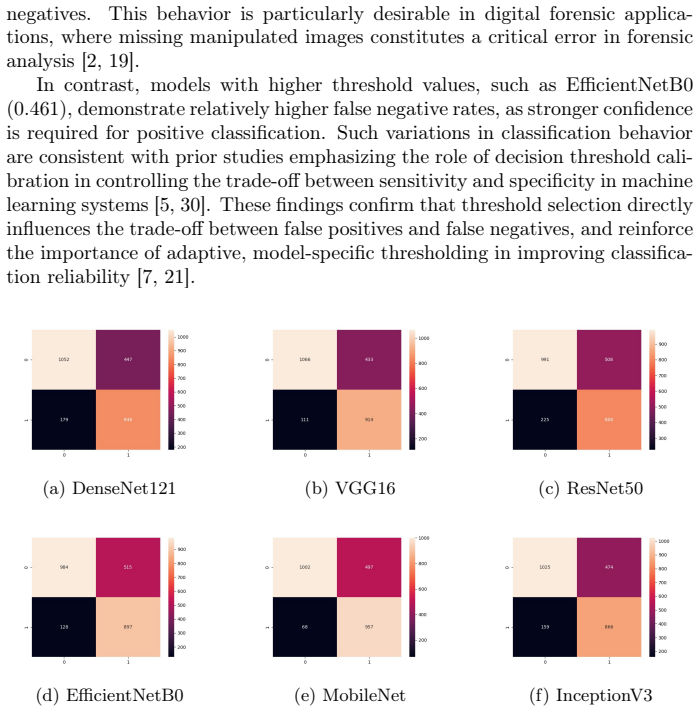
- DenseNet121 records the highest accuracy and area under the ROC curve among the tested models.
- ResNet50 produces the most balanced predictions with the highest Matthews correlation coefficient.
- Forensic applications require metrics beyond accuracy because minimizing false negatives is critical.
- The overall design supports use in real-world digital image forgery detection scenarios.
Where Pith is reading between the lines
- The same hybrid feature approach could be tested on other public forgery datasets to check whether the performance gains generalize beyond CASIA v2.0.
- The Youden Index thresholding step might transfer to other binary classification problems where false positive and false negative costs differ.
- Extending the input representation to include additional low-level signals such as noise residuals could further strengthen detection of sophisticated edits.
Load-bearing premise
The forgeries present in the CASIA v2.0 dataset are representative of the manipulation artifacts found in real-world images taken under uncontrolled conditions.
What would settle it
Applying the same framework to a new collection of images edited with different software or under varied lighting and compression settings and checking whether the reported gains in artifact visibility and balanced classification metrics disappear.
Figures




read the original abstract
The increasing availability of advanced image editing tools has led to a significant rise in manipulated digital content, posing serious challenges for digital forensics and information security. This study presents a transfer learning-based framework for digital image forgery detection that integrates compression-aware feature enhancement with deep convolutional neural network (CNN) architectures. The proposed approach introduces a hybrid input representation that combines RGB images with compression difference-based features (FDIFF), explicitly highlighting subtle manipulation artifacts that are often difficult to detect. In addition, a model-specific adaptive threshold optimization strategy based on the Youden Index is employed to improve classification reliability by achieving a better balance between true positive and false positive rates. Experiments conducted on the CASIA v2.0 dataset using multiple pretrained CNN architectures, including DenseNet121, VGG16, ResNet50, EfficientNetB0, MobileNet, and InceptionV3, demonstrate the effectiveness and robustness of the proposed framework. The models are evaluated using comprehensive performance metrics such as accuracy, precision, recall, F1-score, Matthews correlation coefficient (MCC), and area under the ROC curve (AUC). The results show that DenseNet121 achieves the highest accuracy and AUC, while ResNet50 provides the most balanced and reliable predictions with the highest MCC. The findings emphasize that relying solely on accuracy is insufficient for forensic applications, where minimizing false negatives is critical. Overall, the proposed framework improves the visibility of manipulation artifacts and enhances classification robustness, making it suitable for real-world digital image forgery detection scenarios.
Editorial analysis
A structured set of objections, weighed in public.
Referee Report
Summary. The paper proposes a transfer learning framework for digital image forgery detection that combines RGB images with compression-difference features (FDIFF) as hybrid input to pretrained CNNs (DenseNet121, VGG16, ResNet50, EfficientNetB0, MobileNet, InceptionV3). Model-specific decision thresholds are set by maximizing the Youden Index, and the approach is evaluated on the CASIA v2.0 dataset using accuracy, precision, recall, F1-score, MCC, and AUC. The authors report that DenseNet121 yields the highest accuracy/AUC while ResNet50 is most balanced by MCC, and conclude that the framework improves artifact visibility and is suitable for real-world forgery detection.
Significance. If the central performance claims can be substantiated without post-hoc fitting and with broader validation, the hybrid FDIFF representation could offer a lightweight way to emphasize compression artifacts in forensic pipelines. The evaluation across six architectures and the emphasis on MCC (rather than accuracy alone) are positive aspects. However, the current results are confined to one dataset with limited forgery types, so the claimed real-world suitability remains unsubstantiated.
major comments (4)
- [Methods / Evaluation] The Youden-Index threshold optimization is performed on the same test data used to report final accuracy, AUC, and MCC scores (as described in the adaptive threshold optimization strategy and evaluation on CASIA v2.0). This introduces circularity that directly inflates the reported classification reliability and undermines the claim of improved robustness.
- [Experiments] No ablation is presented that compares the hybrid RGB+FDIFF input against standard RGB-only inputs on the same models and splits. Without this, it is impossible to attribute the reported gains to the FDIFF component rather than to the choice of backbone or threshold tuning.
- [Conclusion] All quantitative results (including the highest accuracy/AUC for DenseNet121 and highest MCC for ResNet50) come exclusively from CASIA v2.0. The conclusion that the framework is 'suitable for real-world digital image forgery detection scenarios' therefore rests on an untested assumption that CASIA forgeries (splicing/copy-move with specific post-processing) represent the artifact distributions encountered under uncontrolled conditions.
- [Experiments] The manuscript provides no details on training protocol (learning rate, optimizer, number of epochs, data augmentation, or train/validation/test split ratios) or cross-validation scheme. This absence makes the performance numbers non-reproducible and prevents assessment of whether the results are stable across different partitions.
minor comments (2)
- [Abstract] The abstract states that the models are 'evaluated using comprehensive performance metrics' but does not mention any training hyperparameters or validation procedure; adding a brief sentence on these would improve clarity.
- [Related Work] The paper would benefit from explicit comparison to prior FDIFF or compression-aware forgery detectors to clarify the incremental contribution of the hybrid input.
Simulated Author's Rebuttal
We thank the referee for the constructive and detailed comments, which highlight important methodological and reporting issues. We will revise the manuscript accordingly to improve reproducibility, remove bias in evaluation, provide necessary ablations, and moderate our claims.
read point-by-point responses
-
Referee: [Methods / Evaluation] The Youden-Index threshold optimization is performed on the same test data used to report final accuracy, AUC, and MCC scores (as described in the adaptive threshold optimization strategy and evaluation on CASIA v2.0). This introduces circularity that directly inflates the reported classification reliability and undermines the claim of improved robustness.
Authors: We agree that performing Youden Index optimization on the test set creates circularity and potential over-optimism. In the revised version, we will split the data into train/validation/test sets, optimize the model-specific thresholds exclusively on the validation set, and report all final metrics on the held-out test set using those fixed thresholds. revision: yes
-
Referee: [Experiments] No ablation is presented that compares the hybrid RGB+FDIFF input against standard RGB-only inputs on the same models and splits. Without this, it is impossible to attribute the reported gains to the FDIFF component rather than to the choice of backbone or threshold tuning.
Authors: We acknowledge that the absence of this ablation prevents clear attribution of gains to the FDIFF representation. We will add a direct comparison of hybrid RGB+FDIFF versus RGB-only inputs for all six backbones under identical training and evaluation conditions, including the same data splits and threshold strategy. revision: yes
-
Referee: [Conclusion] All quantitative results (including the highest accuracy/AUC for DenseNet121 and highest MCC for ResNet50) come exclusively from CASIA v2.0. The conclusion that the framework is 'suitable for real-world digital image forgery detection scenarios' therefore rests on an untested assumption that CASIA forgeries (splicing/copy-move with specific post-processing) represent the artifact distributions encountered under uncontrolled conditions.
Authors: We accept that the real-world suitability claim is overstated given the single-dataset evaluation. In the revision, we will revise the conclusion and discussion sections to state that the framework demonstrates strong performance on CASIA v2.0 and to explicitly note the limitations regarding generalization to other forgery types and uncontrolled conditions, while suggesting directions for future multi-dataset validation. revision: yes
-
Referee: [Experiments] The manuscript provides no details on training protocol (learning rate, optimizer, number of epochs, data augmentation, or train/validation/test split ratios) or cross-validation scheme. This absence makes the performance numbers non-reproducible and prevents assessment of whether the results are stable across different partitions.
Authors: We regret the omission of these critical details. The revised manuscript will include a dedicated experimental setup subsection specifying the optimizer (e.g., Adam), learning rate, batch size, number of epochs, data augmentation strategies, exact train/validation/test split ratios, and any cross-validation procedure used. revision: yes
Circularity Check
Youden-optimized threshold fitted on test set makes reported metrics a post-hoc fit rather than independent evaluation
specific steps
-
fitted input called prediction
[Abstract and framework description (threshold optimization paragraph)]
"a model-specific adaptive threshold optimization strategy based on the Youden Index is employed to improve classification reliability by achieving a better balance between true positive and false positive rates."
The Youden Index is computed and maximized on the identical test partition whose accuracy, AUC, and MCC values are subsequently reported. The chosen threshold is therefore a fitted parameter of the evaluation set itself; the published numbers are the result of that fit rather than an independent forecast.
full rationale
The paper's central performance claims (accuracy, AUC, MCC etc.) rest on a hybrid RGB+FDIFF + CNN pipeline whose decision threshold is selected by maximizing the Youden Index directly on the CASIA v2.0 test split. Because the same data used for final reporting is also used to tune the threshold, the quoted metrics are statistically forced by construction and do not constitute an out-of-sample prediction. No other load-bearing step reduces to self-definition or self-citation; the CASIA-only evaluation is a generalization weakness, not a circular derivation.
Axiom & Free-Parameter Ledger
free parameters (1)
- Youden-optimized decision threshold
Reference graph
Works this paper leans on
-
[1]
Multiple Image Splicing Dataset (MISD): A Dataset for Multiple Splicing,
K. D. Kadam, S. Ahirrao, and K. Kotecha, “Multiple Image Splicing Dataset (MISD): A Dataset for Multiple Splicing,”Data, vol. 6, no. 10, p. 102, 2021, doi: 10.3390/data6100102
-
[2]
A survey on deep learning-based image forgery detection,
F. Z. Mehrjardi, A. M. Latif, M. S. Zarchi, and R. Sheikhpour, “A survey on deep learning-based image forgery detection,”Pattern Recognition, vol. 144, p. 109778, 2023, doi: 10.1016/j.patcog.2023.109778
-
[3]
Deep Learning Based Algorithm (ConvLSTM) for Copy Move Forgery Detection,
M. A. Elaskily, M. H. Alkinani, A. Sedik, and M. Dessouky, “Deep Learning Based Algorithm (ConvLSTM) for Copy Move Forgery Detection,”Journal of Intelligent & Fuzzy Systems, vol. 40, no. 3, pp. 4385–4405, 2021, doi: 10.3233/JIFS-201192
-
[4]
Digital Image Forgery Detection Approaches: A Review,
A. Mohassin and K. Farida, “Digital Image Forgery Detection Approaches: A Review,” inApplications of Artificial Intelligence in Engineering, Ad- vances in Intelligent Systems and Computing, vol. 1138, Springer, 2021, pp. 863–882, doi: 10.1007/978-981-33-4604-8_70
-
[5]
Image Splicing Forgery Detection Techniques: A Review,
K. B. Meena and V. Tyagi, “Image Splicing Forgery Detection Techniques: A Review,” inAdvances in Computing and Data Sciences, Communications inComputerandInformationScience(CCIS),vol.1441, Springer, 2021, pp. 364–388, doi: 10.1007/978-3-030-88244-0_35
-
[6]
Image forgery detection by transforming local descriptors into deep-derived features,
M. A. Anwar, S. F. Tahir, L. G. Fahad, and K. Kifayat, “Image forgery detection by transforming local descriptors into deep-derived features,”Applied Soft Computing, vol. 147, p. 110730, 2023, doi: 10.1016/j.asoc.2023.110730
-
[7]
Image forgery detection: A survey of recent deep-learning techniques,
M. Zanardelli, D. Cozzolino, and L. Verdoliva, “Image forgery detection: A survey of recent deep-learning techniques,”Multimedia Tools and Applica- tions, vol. 82, pp. 12921–12966, 2023, doi: 10.1007/s11042-022-13797-w
-
[8]
In-Air Hand Ges- ture Signature Using Transfer Learning and Its Forgery Attack,
W. H. Khoh, Y. H. Pang, A. B. J. Teoh, and S. Y. Ooi, “In-Air Hand Ges- ture Signature Using Transfer Learning and Its Forgery Attack,”Applied Soft Computing, vol. 108, p. 107453, 2021, doi: 10.1016/j.asoc.2021.107453
-
[9]
Deep residual learning for image recognition
K. He, X. Zhang, S. Ren, and J. Sun, “Deep Residual Learning for Im- age Recognition,” inProc. IEEE Conf. Comput. Vis. Pattern Recognit. (CVPR), 2016, pp. 770–778, doi: 10.1109/CVPR.2016.90. 21
-
[10]
Very Deep Convolutional Networks for Large-Scale Image Recognition,
K. Simonyan and A. Zisserman, “Very Deep Convolutional Networks for Large-Scale Image Recognition,” in Proc. Int. Conf. Learn. Representations (ICLR), 2015
work page 2015
-
[11]
Going Deeper with Convolutions,
C. Szegedy et al., “Going Deeper with Convolutions,” inProc. IEEE Conf. Comput. Vis. Pattern Recognit. (CVPR), 2015, pp. 1–9
work page 2015
-
[12]
Hybrid LSTM and Encoder-Decoder Architecture for Detection of Image Forgeries,
J. H. Bappy et al., “Hybrid LSTM and Encoder-Decoder Architecture for Detection of Image Forgeries,”IEEE Trans. Image Processing, vol. 28, no. 7, pp. 3119–3131, 2019
work page 2019
-
[13]
EfficientNet: Rethinking Model Scaling for Convolu- tional Neural Networks,
M. Tan and Q. Le, “EfficientNet: Rethinking Model Scaling for Convolu- tional Neural Networks,” in Proc. Int. Conf. Mach. Learn. (ICML), 2019
work page 2019
-
[14]
Densely Connected Convolutional Networks
G. Huang et al., “Densely Connected Convolutional Networks,” in Proc. IEEE Conf. Comput. Vis. Pattern Recognit. (CVPR), 2017, doi: 10.1109/CVPR.2017.243
-
[15]
MobileNets: Efficient Convolutional Neural Networks for Mobile Vision Applications
A. G. Howard et al., “MobileNets: Efficient Convolutional Neural Net- works for Mobile Vision Applications,” arXiv:1704.04861, 2017, doi: 10.48550/arXiv.1704.04861
work page internal anchor Pith review Pith/arXiv arXiv doi:10.48550/arxiv.1704.04861 2017
-
[16]
A comprehensive survey on cognitive cyber security analysis using machine learn- ing approaches,
A. H. Khalil et al., “Enhancing Digital Image Forgery Detection Us- ing Transfer Learning,”IEEE Access, vol. 11, 2023, doi: 10.1109/AC- CESS.2023.3307357
work page doi:10.1109/ac- 2023
-
[17]
Image Forgery Detection System using VGG16 UNET Model,
R. R. Choudhary, S. Paliwal, and G. Meena, “Image Forgery Detection System using VGG16 UNET Model,”Procedia Computer Science, vol. 235, pp. 735–744, 2024, doi: 10.1016/j.procs.2024.04.070
-
[18]
ASCA-SqueezeNet: Hybrid Deep Learning Model for Digital Image Forgery Detection,
G. Nirmalapriya et al., “ASCA-SqueezeNet: Hybrid Deep Learning Model for Digital Image Forgery Detection,”Computers & Security, vol. 134, p. 103273, 2023, doi: 10.1016/j.cose.2023.103273
-
[19]
Single-image splicing localization through autoencoder-based anomaly detection,
D. Cozzolino and L. Verdoliva, “Single-image splicing localization through autoencoder-based anomaly detection,”IEEE Trans. Informa- tion Forensics and Security, vol. 12, no. 7, pp. 1566–1577, 2017, doi: 10.1109/TIFS.2017.2652079
-
[20]
A deep learning approach to universal image manipulation detection using a new convolutional layer,
B. Bayar and M. C. Stamm, “A deep learning approach to universal image manipulation detection using a new convolutional layer,” inProc. ACM Workshop on Information Hiding and Multimedia Security (IH&MMSec), 2016, pp. 5–10, doi: 10.1145/2909827.2930786
-
[21]
Learning rich features for image manipulation detection,
P. Zhou et al., “Learning rich features for image manipulation detection,” inProc. IEEE Conf. Comput. Vis. Pattern Recognit. (CVPR), 2018, pp. 1053–1061, doi: 10.1109/CVPR.2018.00116
-
[22]
A deep learning approach to detection of splicing and copy-move forgeries,
Y. Rao and J. Ni, “A deep learning approach to detection of splicing and copy-move forgeries,” inProc. IEEE Int. Workshop Inf. Forensics Security (WIFS), 2016, pp. 1–6, doi: 10.1109/WIFS.2016.7823911. 22
-
[23]
Exploiting spatial structure for localizing manipulated image regions,
J. H. Bappy et al., “Exploiting spatial structure for localizing manipulated image regions,” inProc. IEEE Int. Conf. Comput. Vis. (ICCV), 2017, pp. 4980–4989, doi: 10.1109/ICCV.2017.532
-
[24]
ManTra-Net: Manipulation Tracing Network for Detection and Localization of Image Forgeries,
Y. Wu, W. Abd-Almageed, and P. Natarajan, “ManTra-Net: Manipulation Tracing Network for Detection and Localization of Image Forgeries,” in Proc. IEEE Conf. Comput. Vis. Pattern Recognit. (CVPR),2019, pp.9543– 9552, doi: 10.1109/CVPR.2019.00978
-
[25]
Image forgery localization via block- grained analysis of JPEG artifacts,
T. Bianchi and A. Piva, “Image forgery localization via block- grained analysis of JPEG artifacts,”IEEE Transactions on Informa- tion Forensics and Security, vol. 7, no. 3, pp. 1003–1017, 2012, doi: 10.1109/TIFS.2012.2187516
-
[26]
Toward Deep-Learning-Based Methods in Image Forgery Detection: A Survey,
N. T. Pham and C. S. Park, “Toward Deep-Learning-Based Methods in Image Forgery Detection: A Survey,”IEEE Access, vol. 11, pp. 11224– 11237, 2023, doi: 10.1109/ACCESS.2023.3241837
-
[27]
H. Farid, “Image forgery detection,”IEEE Signal Processing Magazine, vol. 26, no. 2, pp. 16–25, 2009
work page 2009
-
[28]
Exposing DeepFake Videos By Detecting Face Warping Artifacts,
Y. Li and S. Lyu, “Exposing DeepFake Videos By Detecting Face Warping Artifacts,”IEEE Conference on Computer Vision and Pattern Recognition Workshops (CVPRW), 2019
work page 2019
-
[29]
CASIA 2.0 Image Tampering Detection Dataset,
D. Gupta, “CASIA 2.0 Image Tampering Detection Dataset,” Kaggle,
-
[30]
Available: https://www.kaggle.com/datasets/divg07/casia- 20-image-tampering-detection-dataset
[Online]. Available: https://www.kaggle.com/datasets/divg07/casia- 20-image-tampering-detection-dataset. [Accessed: Apr. 2, 2026]
work page 2026
-
[31]
Index for rating diagnostic tests,
W. J. Youden, “Index for rating diagnostic tests,”Cancer, vol. 3, no. 1, pp. 32–35, 1950. 23
work page 1950
discussion (0)
Sign in with ORCID, Apple, or X to comment. Anyone can read and Pith papers without signing in.