Recognition: 2 theorem links
· Lean TheoremThe Case for Space-Based Particle Colliders: Orbital Infrastructure as a Path to Grand Unification Energy Scales
Pith reviewed 2026-05-12 01:16 UTC · model grok-4.3
The pith
Space-based proton colliders with radii of 10^3 to 10^5 km can reach the PeV-EeV energies needed to test grand unification theories.
A machine-rendered reading of the paper's core claim, the machinery that carries it, and where it could break.
Core claim
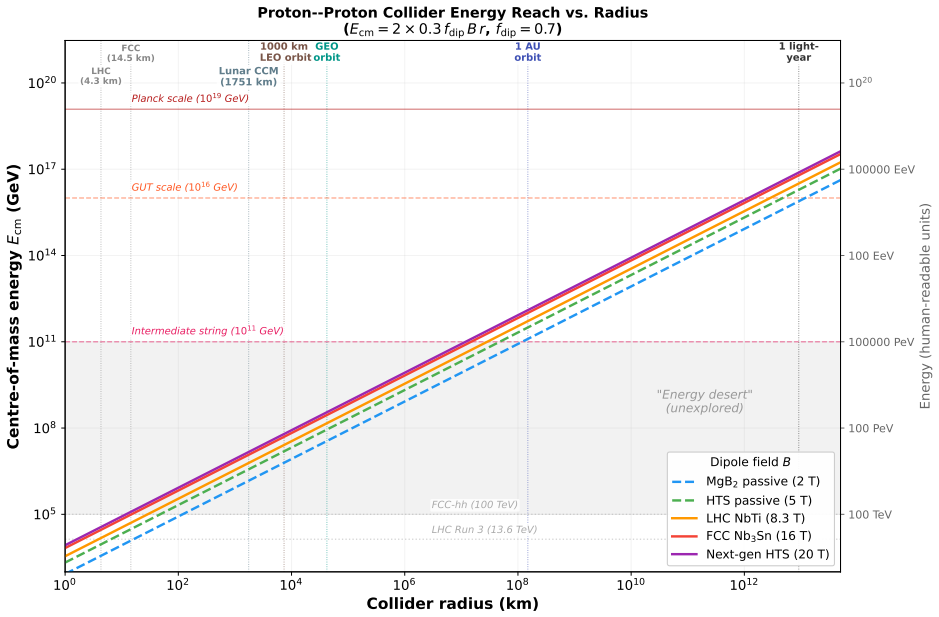
By examining the fundamental scaling law for circular proton colliders, we establish that colliders of radius 10^3-10^5 km are required to enter the PeV-EeV regime. In addition, Space-based colliders benefit from virtually free ultra-high vacuum (< 10^10 particles/m^3 above 1000 km altitude), passive cryogenic cooling, reduction of geological and political constraints, and perhaps most importantly the substantial reduction of the thermodynamic penalty that dominates terrestrial cryogenic power budgets.
What carries the argument
The fundamental scaling law relating the radius of a circular proton collider to its achievable center-of-mass energy.
If this is right
- Reaching PeV-EeV energies requires orbital radii of 10^3-10^5 km.
- Space provides virtually free ultra-high vacuum and passive cryogenic cooling.
- Geological and political constraints on collider size are removed.
- Thermodynamic penalties for cryogenics drop sharply compared to ground-based systems.
- Gigawatt-scale orbital power architectures under development align with collider needs.
Where Pith is reading between the lines
- A working space collider could directly test whether forces unify at the predicted energies.
- Shared orbital infrastructure for power generation could reduce the cost of both colliders and other space projects.
- Small-scale test rings in low Earth orbit could check beam stability before committing to full-scale designs.
- Formation-flying precision developed for data centers might transfer to maintaining collider beam paths.
Load-bearing premise
The standard terrestrial scaling law for collider energy versus radius applies directly in the space environment without dominant new effects from orbital dynamics, radiation, or formation control.
What would settle it
A prototype orbital ring collider that fails to achieve the proton energies predicted by the terrestrial scaling law due to beam instability from orbital effects or radiation would show the assumption does not hold.
Figures
read the original abstract
The Standard Model of particle Physics has been validated to extraordinarily high precision by the Large Hadron Collider (LHC). Yet it leaves some of the most fundamental questions in Physics unresolved: the nature of dark matter, the hierarchy problem, and the unification of forces. Multiple next-generation terrestrial colliders have been proposed such as the Future Circular Collider (FCC) which will reach centre-of-mass energies of $\approx$100 TeV, yet the energy scales at which hints of Grand Unified Theories (GUTs) and string theory are expected to be observed ($10^{11}-10^{13}$ TeV) remain orders of magnitude beyond the reach of any terrestrial facility. We argue that the path to these energy frontiers inevitably leads to Space. By examining the fundamental scaling law for circular proton colliders, we establish that colliders of radius $10^3-10^5$ km are required to enter the PeV-EeV regime. In addition, Space-based colliders benefit from virtually free ultra-high vacuum ($< 10^{10}$ particles/m$^3$ above 1000 km altitude), passive cryogenic cooling, reduction of geological and political constraints, and perhaps most importantly -- the substantial reduction of the thermodynamic penalty that dominates terrestrial cryogenic power budgets. We survey existing proposals for beyond-Earth colliders, derive order-of-magnitude requirements for an orbital collider constellation, and assess feasibility against current and near-term spacecraft capabilities in formation flying, power generation, and precision attitude control. We conclude that recent developments in orbital infrastructure -- particularly gigawatt-scale orbital power architectures being developed for Space-based data centers -- are converging with the needs of a Space-based mega collider, making serious feasibility studies warranted and promising a more certain path towards the core questions of modern Physics.
Editorial analysis
A structured set of objections, weighed in public.
Referee Report
Summary. The paper argues that the energy scales required to probe Grand Unified Theories (10^{11}-10^{13} TeV) necessitate space-based circular proton colliders with radii between 10^3 and 10^5 km, derived from the standard scaling law for accelerator bending radius. It emphasizes the advantages of the orbital environment, including ultra-high vacuum, passive cooling, and lower power requirements for cryogenics, and evaluates the feasibility based on current trends in space infrastructure such as gigawatt-scale orbital power systems.
Significance. Should the scaling arguments and space-environment assumptions prove valid, this manuscript identifies a potentially viable route to energy regimes far beyond terrestrial capabilities, linking particle physics goals with developments in space technology. It could encourage further interdisciplinary studies on orbital particle accelerators. The conceptual nature of the analysis is suitable for initiating discussion but would benefit from more rigorous engineering validation to strengthen its impact.
major comments (2)
- Abstract: The central claim that colliders of radius 10^3-10^5 km are required to enter the PeV-EeV regime relies on direct application of the terrestrial scaling law p = 0.3 B R without quantitative assessment of whether orbital dynamics, radiation belts, or formation control introduce dominant new effects that could alter the required radius or beam stability at fixed B.
- Feasibility assessment: The order-of-magnitude requirements for an orbital collider constellation and assessment against spacecraft capabilities are presented qualitatively but lack error analysis, simulations, or bounds on the impact of space-specific constraints, which is load-bearing for the conclusion that recent orbital infrastructure developments make serious studies warranted.
minor comments (2)
- Abstract: The stated vacuum density (< 10^{10} particles/m^3 above 1000 km altitude) lacks a supporting reference or derivation.
- The manuscript would benefit from explicit comparison (e.g., a table) of the proposed space-based radii and power budgets against the FCC or other terrestrial proposals to clarify the claimed advantages.
Simulated Author's Rebuttal
We thank the referee for their detailed and constructive comments, which help clarify the scope and limitations of our conceptual analysis. We address each major comment below, indicating where revisions will be made to strengthen the manuscript without altering its core arguments.
read point-by-point responses
-
Referee: Abstract: The central claim that colliders of radius 10^3-10^5 km are required to enter the PeV-EeV regime relies on direct application of the terrestrial scaling law p = 0.3 B R without quantitative assessment of whether orbital dynamics, radiation belts, or formation control introduce dominant new effects that could alter the required radius or beam stability at fixed B.
Authors: The relation p = 0.3 B R is a direct consequence of the Lorentz force balance for relativistic particles and holds irrespective of the accelerator environment; it therefore provides the baseline radius needed for a target momentum at a given bending field. Orbital dynamics, radiation belts, and formation control primarily influence operational stability, magnet shielding, and control precision rather than the fundamental scaling itself. The manuscript discusses space-environment benefits but does not quantify these perturbations. We will revise the abstract to state the scaling assumptions explicitly and add a concise paragraph in the feasibility section explaining why these effects are not expected to modify the order-of-magnitude radius range, supported by references to existing work on space-based beam dynamics and plasma interactions. revision: partial
-
Referee: Feasibility assessment: The order-of-magnitude requirements for an orbital collider constellation and assessment against spacecraft capabilities are presented qualitatively but lack error analysis, simulations, or bounds on the impact of space-specific constraints, which is load-bearing for the conclusion that recent orbital infrastructure developments make serious studies warranted.
Authors: We agree that the feasibility discussion is qualitative and order-of-magnitude, as is appropriate for a conceptual paper linking particle-physics goals with space-technology trends. Full error analysis, Monte-Carlo simulations, or detailed bounds on every space-specific constraint would require engineering-level modeling beyond the present scope. We will strengthen the section by adding conservative numerical bounds drawn from published performance data on formation-flying missions and proposed orbital power systems, and we will explicitly qualify the conclusion to emphasize that the assessment is indicative and intended to motivate dedicated follow-on studies rather than to claim readiness. revision: partial
Circularity Check
No significant circularity; scaling law is external kinematic input
full rationale
The paper's core claim—that radii of 10^3-10^5 km are required for PeV-EeV energies—follows directly from the standard Lorentz-force bending relation p = 0.3 B R (p in GeV/c, B in T, R in m), which is invoked as a fundamental external law rather than derived or fitted inside the manuscript. This kinematic constraint holds independently of orbital environment and is not reduced to any self-defined quantity, fitted parameter, or prior self-citation. Feasibility discussions (vacuum, cooling, formation flying) address engineering realization but do not alter or circularly depend on the radius-energy scaling. No self-definitional steps, renamed predictions, or load-bearing self-citations appear in the derivation chain.
Axiom & Free-Parameter Ledger
free parameters (1)
- Collider radius for PeV-EeV regime
axioms (1)
- domain assumption Standard scaling law relating collider radius, magnetic field strength, and achievable center-of-mass energy for proton rings
Lean theorems connected to this paper
-
IndisputableMonolith/Cost/FunctionalEquation.leanwashburn_uniqueness_aczel unclearE_beam ≈ 0.3 f_dip B r … for an ultrarelativistic proton … the beam energy is determined by the magnetic rigidity relation
-
IndisputableMonolith/Foundation/Constants.leanreality_from_one_distinction unclearU0 = q² γ⁴ / (3 ε0 ρ) … PSR = 2 U0 I_beam / e
Reference graph
Works this paper leans on
-
[1]
ATLAS Collaboration, “Observation of a new particle in the search for the Standard Model Higgs boson with the ATLAS detector at the LHC,”Phys. Lett. B716, 1–29 (2012)
work page 2012
-
[2]
Observation of a new boson at a mass of 125 GeV with the CMS experiment at the LHC,
CMS Collaboration, “Observation of a new boson at a mass of 125 GeV with the CMS experiment at the LHC,”Phys. Lett. B716, 30–61 (2012)
work page 2012
- [3]
-
[4]
CMS Collaboration, “First measurement of the top quark pair production cross section in proton-proton collisions at√s= 13.6TeV,” CMS-PAS-TOP-22-012 (2022)
work page 2022
-
[5]
The ATLAS Collaboration, ”Search for high-mass dilepton resonances using 139f b−1 of pp collision data collected at√s= 13TeV with the ATLAS detector”, Phys. Lett. B 796, 68–87 (2019)
work page 2019
-
[6]
S. Raby,et al., “Grand Unified Theories,” inReview of Particle Physics, Particle Data Group,Phys. Rev. D110, 030001 (2024), Ch. 93
work page 2024
-
[7]
M. Strassler, “The Hierarchy Problem,” Of Particular Significance (web), 2024. See also G. F. Giudice, “Naturally Speaking: The Naturalness Criterion and Physics at the LHC,” arXiv:0801.2562
-
[8]
Proton stability in grand unified theories, in strings and in branes,
P. Nath and P. Fileviez Pérez, “Proton stability in grand unified theories, in strings and in branes,”Phys. Rept.441, 191–317 (2007)
work page 2007
-
[9]
Langacker,The Standard Model and Beyond, 2nd ed
P. Langacker,The Standard Model and Beyond, 2nd ed. (CRC Press, 2017)
work page 2017
-
[10]
M. B. Green, J. H. Schwarz, and E. Witten,Superstring Theory, Vols. 1–2 (Cambridge Univ. Press, 1987). 16
work page 1987
-
[11]
Sparticle spectra and LHC signatures for large volume string compactifications,
J. P. Conlon, C. H. Kom, K. Suruliz, B. C. Allanach, and F. Quevedo, “Sparticle spectra and LHC signatures for large volume string compactifications,”JHEP2007(08), 061 (2007). arXiv:0704.3403
-
[12]
Strings at the intermediate scale, or is the Fermi scale dual to the Planck scale?
C. P. Burgess, L. E. Ibáñez, and F. Quevedo, “Strings at the intermediate scale, or is the Fermi scale dual to the Planck scale?”Phys. Lett. B447, 257 (1999). hep-ph/9810535
-
[13]
The hierarchy problem and new di- mensions at a millimeter,
N. Arkani-Hamed, S. Dimopoulos, and G. Dvali, “The hierarchy problem and new di- mensions at a millimeter,”Phys. Lett. B429, 263 (1998)
work page 1998
-
[14]
A large mass hierarchy from a small extra dimension,
L. Randall and R. Sundrum, “A large mass hierarchy from a small extra dimension,” Phys. Rev. Lett.83, 3370 (1999)
work page 1999
-
[15]
Search for proton decay viap→e +π0 andp→ µ+π0,
Super-Kamiokande Collaboration, “Search for proton decay viap→e +π0 andp→ µ+π0,”Phys. Rev. D95, 012004 (2017)
work page 2017
-
[16]
Hyper-Kamiokande Collaboration, “Hyper-Kamiokande Design Report,” arXiv:1805.04163 (2018); DUNE Collaboration, arXiv:1512.06148
-
[17]
A very high energy hadron collider on the Moon,
J. Beacham and F. Zimmermann, “A very high energy hadron collider on the Moon,” New J. Phys.24, 023029 (2022)
work page 2022
-
[18]
Wiedemann,Particle Accelerator Physics, 4th ed
H. Wiedemann,Particle Accelerator Physics, 4th ed. (Springer, 2015)
work page 2015
-
[19]
Beam optics and lattice design for particle accelerators,
B. J. Holzer, “Beam optics and lattice design for particle accelerators,” arXiv:1303.6514 (2013). CERN Accelerator School lectures
-
[20]
Brüninget al.(eds.),LHC Design Report, Vol
O. Brüninget al.(eds.),LHC Design Report, Vol. 1: The LHC Main Ring, CERN-2004- 003-V-1 (2004)
work page 2004
-
[21]
Future Circular Collider: Integrated Programme and Feasibility Study,
M. Benedikt and F. Zimmermann, “Future Circular Collider: Integrated Programme and Feasibility Study,”Front. Phys.10, 888078 (2022)
work page 2022
- [22]
-
[23]
CERN releases detailed plans for supercollider — but no hints about funding,
D. Castelvecchi, "CERN releases detailed plans for supercollider — but no hints about funding," Nature (online news), 1 April 2025
work page 2025
-
[24]
The Superconducting Super Collider,
M. Tigner, “The Superconducting Super Collider,”Nuovo Cimento37, 1228 (1965). See also SSC Design Report, 1986
work page 1965
-
[25]
Ask Ethan: Could we build a collider bigger than Earth?
E. Siegel, “Ask Ethan: Could we build a collider bigger than Earth?”Big Think / Starts With a Bang, August 2024
work page 2024
-
[26]
CEPC Conceptual Design Report,
CEPC Study Group, “CEPC Conceptual Design Report,” arXiv:1809.00285 (2018)
-
[27]
On the feasibility of future colliders: report of the Snowmass’21 Imple- mentation Task Force,
T. Roseret al., “On the feasibility of future colliders: report of the Snowmass’21 Imple- mentation Task Force,”JINST18, P05018 (2023). 17
work page 2023
-
[28]
P. McIntyreet al., “Collider in the Sea,” Accelerator Research Laboratory, Texas A&M University (2016). See also Gizmodo interview, October 2024
work page 2016
-
[29]
Soft SUSY breaking, dilaton domination and intermediate scale string models,
S. F. King and J. P. Roberts, “Soft SUSY breaking, dilaton domination and intermediate scale string models,” hep-ph/0005260 (2000)
-
[30]
Current LHC constraints on minimal universal extra dimen- sions,
N. Deutschmannet al., “Current LHC constraints on minimal universal extra dimen- sions,”Phys. Lett. B771, 515 (2017)
work page 2017
-
[31]
C. Bachas, “Scales of string theory,” hep-th/0001093 (2000)
-
[32]
String phenomenology: past, present and future perspectives,
A. E. Faraggi, “String phenomenology: past, present and future perspectives,”Galaxies 2(2), 223 (2014)
work page 2014
-
[33]
Overview of the LHC vacuum system,
O. Gröbner, “Overview of the LHC vacuum system,”Vacuum60, 25 (2001)
work page 2001
-
[34]
LHC: The world’s largest vacuum systems being operated at CERN,
G. Bregliozziet al., “LHC: The world’s largest vacuum systems being operated at CERN,”Vacuum84, 285 (2009)
work page 2009
-
[35]
A vacuum as empty as interstellar space,
CERN, “A vacuum as empty as interstellar space,” CERN Engineering page, home.cern/science/engineering/vacuum-empty-interstellar-space
-
[36]
NRLMSISE-00 empirical model of the atmosphere,
J. M. Piconeet al., “NRLMSISE-00 empirical model of the atmosphere,”J. Geophys. Res.107(A12), 1468 (2002)
work page 2002
-
[37]
NOAA/NASA/USAF,U.S. Standard Atmosphere, 1976(U.S. Government Printing Of- fice, 1976)
work page 1976
-
[38]
L. Evans, “The Large Hadron Collider,” SLAC-PUB-L003, presented at ICHEP 2006
work page 2006
-
[39]
V. Shiltsev and F. Zimmermann, “Modern and future colliders,”Rev. Mod. Phys.93, 015006 (2021)
work page 2021
- [40]
-
[41]
Powering the Large Hadron Collider,
W. Sweet, “Powering the Large Hadron Collider,”IEEE Spectrum, September 2008
work page 2008
-
[42]
2019 CERN Electrical Power Consumption,
CERN EN-EL, “2019 CERN Electrical Power Consumption,” EDMS (2020)
work page 2019
-
[43]
CERN Courier, “Accelerating power for LHC,”CERN Courier, July 2001
work page 2001
-
[44]
James Webb Space Telescope: Overview,
M. Clampinet al., “James Webb Space Telescope: Overview,”Space Sci. Rev.123, 1 (2006). JWST achieved∼40 K passive cooling at L2
work page 2006
-
[45]
Atomic oxygen effects on spacecraft materials,
B. A. Bankset al., “Atomic oxygen effects on spacecraft materials,” inEncyclopedia of Aerospace Engineering(Wiley, 2010). 18
work page 2010
-
[46]
Total hadronic cross-sections,
Particle Data Group, “Total hadronic cross-sections,” inReview of Particle Physics, Phys. Rev. D110, 030001 (2024). Nuclear cross-sections scale approximately asσ∝ A2/3
work page 2024
-
[47]
Proba-3 achieves precise formation flying,
ESA, “Proba-3 achieves precise formation flying,” ESA Press Release, 8 May 2025. See also D. Galanoet al., “PROBA-3 mission and formation flying technologies,” Proc. 4S Symposium, ESA (2022)
work page 2025
-
[48]
PROBA-3: Precise formation flying demonstration mission,
J.S. Llorente, A. Agenjo, C. Carrascosa, C. de Negueruela, A. Mestreau-Garreau, A. Cropp, A. Santovincenzo, “PROBA-3: Precise formation flying demonstration mission,” Acta Astronautica82, 38–46 (2013)
work page 2013
-
[49]
Combined-function optics for circular high-energy hadron colliders,
M. Giovannozzi and E. Todesco, “Combined-function optics for circular high-energy hadron colliders,”Eur. Phys. J. Plus137, 337 (2022)
work page 2022
-
[50]
Autonomous formation flying: the PRISMA mission,
S. D’Amicoet al., “Autonomous formation flying: the PRISMA mission,”J. Spacecr. Rockets49(3), 486 (2012)
work page 2012
-
[51]
Intersatellite laser ranging instrument for the GRACE Follow-On mission,
B. Sheardet al., “Intersatellite laser ranging instrument for the GRACE Follow-On mission,”J. Geod.86, 1083 (2012)
work page 2012
-
[52]
Why we should train AI in space,
Lumen Orbit / Starcloud, “Why we should train AI in space,” White Paper, September 2024
work page 2024
-
[53]
How Starcloud is bringing data centers to outer space,
NVIDIA Blog, “How Starcloud is bringing data centers to outer space,” December 2025
work page 2025
-
[54]
Google, “Project Suncatcher,” announced November 2025. SeeScientific American, “Space-based data centers could power AI with solar energy—at a cost,” December 2025
work page 2025
-
[55]
ASCEND: Advanced Space Cloud for European Net zero emission and Data sovereignty,
Thales Alenia Space / European Commission, “ASCEND: Advanced Space Cloud for European Net zero emission and Data sovereignty,” Feasibility Study (2023–2026)
work page 2023
-
[56]
Can orbital data centers solve AI’s power crisis?
G. Zorpette, “Can orbital data centers solve AI’s power crisis?”IEEE Spectrum, March 2026
work page 2026
-
[57]
A phenomenological cost model for high energy particle accelerators,
V. Shiltsev, “A phenomenological cost model for high energy particle accelerators,” JINST9, T07002 (2014)
work page 2014
-
[58]
Challenges of future accelerators for particle Physics research,
S. Gourlay, T. Raubenheimer, and V. Shiltsev, “Challenges of future accelerators for particle Physics research,”Front. Phys.10, 920520 (2022)
work page 2022
-
[59]
Status of MgB2 wire and cable applications in Europe,
A. Ballarino and R. Flükiger, “Status of MgB2 wire and cable applications in Europe,” J. Phys.: Conf. Ser.871, 012098 (2017). See also G. Grassoet al., “MgB2 conductor for accelerator applications,”IEEE Trans. Appl. Supercond.31, 6200206 (2021). 19
work page 2017
-
[60]
Record current density of 344 A/mm2 at 4.2 K and 20 T in CORC cables,
D. C. van der Laanet al., “Record current density of 344 A/mm2 at 4.2 K and 20 T in CORC cables,”Supercond. Sci. Technol.22, 065013 (2009). See also S. Hahnet al., “45.5- tesla direct-current magnetic field generated with a high-temperature superconducting magnet,”Nature570, 496 (2019). 20
work page 2009
discussion (0)
Sign in with ORCID, Apple, or X to comment. Anyone can read and Pith papers without signing in.