Recognition: 2 theorem links
· Lean TheoremGrowth of small localized perturbations in Surface Quasi-Geostrophic turbulence
Pith reviewed 2026-05-12 00:53 UTC · model grok-4.3
The pith
In Surface Quasi-Geostrophic turbulence, small localized perturbations decrease in energy for a variable time before growing.
A machine-rendered reading of the paper's core claim, the machinery that carries it, and where it could break.
Core claim
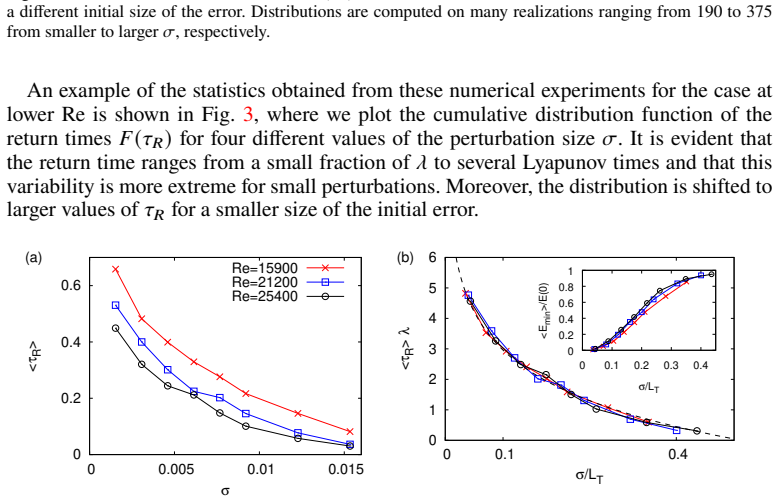
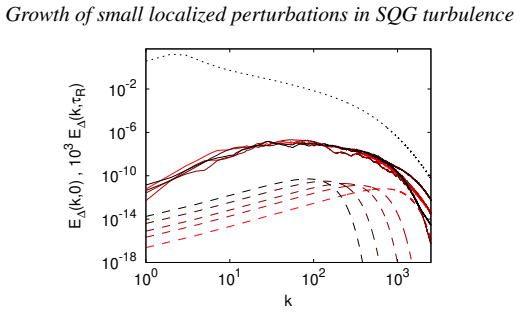
The evolution of a spatially localized infinitesimal perturbation in SQG turbulence exhibits strong variability, with an initial transient regime in which the perturbation energy decreases. The duration of this transient is broad and can persist for several small-scale characteristic times, depending on the initial location of the perturbation.
What carries the argument
Numerical integration of the Surface Quasi-Geostrophic equations applied to spatially localized infinitesimal perturbations.
If this is right
- Error growth rates in mesoscale geophysical turbulence depend on the spatial location where the error is introduced.
- Ensemble forecasts must incorporate the possibility of an initial decay phase whose length varies across the domain.
- The overall predictability time scale is set by the longest transients rather than by the fastest local growth rates.
Where Pith is reading between the lines
- The same location-dependent transient may appear in other stratified rotating flows whose equations share the same leading-order balance.
- Observations that track the spread of small-scale tracers or model errors in real ocean or atmosphere data could reveal whether such transients occur outside idealised simulations.
Load-bearing premise
The numerical solutions of the SQG equations capture the true physical evolution without being dominated by resolution limits or details of the forcing.
What would settle it
A high-resolution SQG simulation in which the energy of a localized perturbation is tracked from many different starting positions; the claim is falsified if the energy grows immediately from every position.
Figures


read the original abstract
The ``butterfly effect'', i.e. the growth of a localized infinitesimal perturbation, is the fundamental property of chaotic systems. While the butterfly effect is today an obvious property of low-dimensional chaotic systems, its significance is more nuanced in extended systems with many spatial and temporal scales, such as geophysical flows. In this Letter we explore the butterfly effect, i.e., the fate of infinitesimal localized perturbations, in the Surface-Quasi-Geostrophic turbulence, a minimal model for mesoscale geophysical turbulence in the regime of strong stratification and rotation. We find that the evolution of a spatially localized perturbation exhibits strong variability, with an initial transient regime in which the perturbation energy decreases. The duration of this transient is broad and can persist for several small-scale characteristic times, depending on the initial location of the perturbation.
Editorial analysis
A structured set of objections, weighed in public.
Referee Report
Summary. The manuscript explores the butterfly effect in Surface Quasi-Geostrophic (SQG) turbulence by tracking the evolution of infinitesimal, spatially localized perturbations. It reports strong variability in this evolution, including an initial transient regime in which perturbation energy decreases; the duration of the transient is broad, can span several small-scale eddy turnover times, and depends on the initial location of the perturbation within the turbulent flow.
Significance. If the reported transients are physical rather than numerical, the result refines understanding of predictability in multi-scale geophysical turbulence: even in a chaotic system the growth of small errors is not immediate but can be delayed by location-dependent filtering of the perturbation spectrum. This has potential implications for ensemble forecasting and error-growth diagnostics in stratified, rotating flows. The work is a direct numerical exploration of a minimal model, which is a strength when accompanied by appropriate convergence checks.
major comments (1)
- The central claim that the initial energy decrease and its location-dependent duration are intrinsic features of SQG dynamics requires that numerical dissipation does not dominate the early evolution. Because a localized perturbation projects onto a broad wavenumber spectrum, hyperviscosity or dealiasing filters can preferentially damp high-k components at early times, producing an apparent energy drop before nonlinear transfer takes over. The manuscript should therefore document resolution-doubling tests, hyperviscosity coefficient sweeps, and explicit checks that the transient duration remains statistically unchanged when the effective Reynolds number is increased.
Simulated Author's Rebuttal
We thank the referee for the positive assessment of our work and for the constructive comment on numerical robustness. We address the major comment in detail below.
read point-by-point responses
-
Referee: The central claim that the initial energy decrease and its location-dependent duration are intrinsic features of SQG dynamics requires that numerical dissipation does not dominate the early evolution. Because a localized perturbation projects onto a broad wavenumber spectrum, hyperviscosity or dealiasing filters can preferentially damp high-k components at early times, producing an apparent energy drop before nonlinear transfer takes over. The manuscript should therefore document resolution-doubling tests, hyperviscosity coefficient sweeps, and explicit checks that the transient duration remains statistically unchanged when the effective Reynolds number is increased.
Authors: We agree that it is essential to demonstrate that the reported initial energy decrease is not an artifact of numerical dissipation. In the original simulations the hyperviscosity coefficient was chosen so that dissipation acts only at the smallest resolved scales, and the transient occurs on timescales shorter than the dissipative time for the wavenumbers carrying most of the perturbation energy. Nevertheless, to meet the referee’s request explicitly we will revise the manuscript to include (i) resolution-doubling tests between 1024² and 2048² grids, (ii) a sweep of the hyperviscosity coefficient over a factor of four, and (iii) quantitative statistics showing that the duration of the location-dependent transient remains unchanged within sampling uncertainty. These additional diagnostics will be presented in a new figure and accompanying text, together with a brief discussion of the dealiasing filter’s effect on the early spectrum. The revised results continue to support that the transient is a physical feature of SQG dynamics. revision: yes
Circularity Check
No circularity: direct numerical results on perturbation evolution
full rationale
The paper reports outcomes from direct numerical simulations of the SQG equations, focusing on the time evolution of spatially localized infinitesimal perturbations. The reported initial transient energy decrease and its location-dependent duration are presented as direct simulation outputs rather than as predictions derived from a closed analytical chain. No equations, parameters, or uniqueness claims are introduced that reduce by construction to fitted inputs, self-definitions, or self-citations; the work contains no load-bearing self-citation steps or ansatz smuggling. The derivation chain is therefore self-contained as a computational exploration of chaotic dynamics, with findings grounded in the simulated trajectories themselves.
Axiom & Free-Parameter Ledger
axioms (1)
- domain assumption The SQG model is a valid minimal model for mesoscale geophysical turbulence
Lean theorems connected to this paper
-
IndisputableMonolith/Foundation/RealityFromDistinction.leanreality_from_one_distinction unclearThe evolution of a spatially localized perturbation exhibits strong variability, with an initial transient regime in which the perturbation energy decreases... depending on the initial location of the perturbation.
-
IndisputableMonolith/Cost/FunctionalEquation.leanwashburn_uniqueness_aczel uncleardE_Δ/dt = −ν⟨(∇δθ)²⟩_x − μ⟨(∇⁻¹δθ)²⟩_x − ⟨δθ δu·∇θ⟩_x
Reference graph
Works this paper leans on
-
[1]
Surface quasi-geostrophy , author=. Fluids , volume=. 2017 , publisher=
work page 2017
-
[2]
The butterfly effect: can a butterfly in Brazil really cause a tornado in Texas? , author=. Weatherwise , volume=. 2024 , publisher=
work page 2024
-
[3]
From the butterfly effect to spontaneous stochasticity in singular shear flows , author=. Commun. Phys. , volume=. 2020 , publisher=
work page 2020
-
[4]
Spontaneous stochasticity amplifies even thermal noise to the largest scales of turbulence in a few eddy turnover times , author=. Phys. Rev. Lett. , volume=. 2024 , publisher=
work page 2024
-
[5]
Generalized Lyapunov exponents in high-dimensional chaotic dynamics and products of large random matrices , author=. J. Stat. Phys. , volume=. 1988 , publisher=
work page 1988
-
[7]
On the growth of localised perturbations in isotropic turbulence , author=. J. Phys. Conf. Ser. , volume=. 2024 , organization=
work page 2024
-
[8]
Chaos: From Simple Models to Complex Systems , author=. 2009 , publisher=
work page 2009
-
[9]
Spectrum correction in Ekman-Navier-Stokes turbulence , author=. J. Turbul. , volume=. 2025 , publisher=
work page 2025
- [10]
- [11]
- [12]
-
[13]
Held, I.M. and Pierrehumbert, R.T. and Garner, S.T. and Swanson, K.L. , journal=
-
[14]
Predictability of turbulent flows , author=. J. Atmos. Sci. , volume=
- [15]
-
[16]
Scaling and predictability in surface quasi-geostrophic turbulence , author=. J. Fluid Mech. , volume=
-
[17]
Predictability in two-dimensional decaying turbulence , author=. Phys. Fluids , volume=. 1997 , publisher=
work page 1997
-
[18]
Chaos and predictability of homogeneous-isotropic turbulence , author=. Phys. Rev. Lett. , volume=. 2017 , publisher=
work page 2017
-
[19]
The production of uncertainty in three-dimensional Navier-Stokes turbulence , author=. J. Fluid Mech. , volume=
-
[20]
Spectra of local and nonlocal two-dimensional turbulence , author=. Chaos Solit. Fractals , volume=. 1994 , publisher=
work page 1994
-
[21]
Dynamics of the upper oceanic layers in terms of surface quasigeostrophy theory , author=. J. Phys. Ocean. , volume=. 2006 , publisher=
work page 2006
-
[22]
Nonequilibrium fluctuations of the direct cascade in surface quasi-geostrophic turbulence , author=. Phys. Rev. Fluids , volume=. 2024 , publisher=
work page 2024
-
[23]
Surface quasi-geostrophic turbulence: the refined study of an active scalar , author=. J. Fluid Mech. , volume=
-
[24]
Anomalous dissipation and spontaneous stochasticity in deterministic surface quasi-geostrophic flow , author=. Ann. Henri Poincar
-
[25]
Frisch, U. (1995). Turbulence: the legacy of A.N. Kolmogorov . Cambridge University Press
work page 1995
-
[26]
Lorenz, E.N. (1969). The predictability of a flow which possesses many scales of motion . Tellus. 21 289
work page 1969
-
[27]
Leith, C.E., Kraichnan, R.H. (1972). Predictability of turbulent flows. J. Atmos. Sci.. 29 1041
work page 1972
-
[28]
Boffetta, G., Celani, A., Crisanti, A., Vulpiani, A. (1997). Predictability in two-dimensional decaying turbulence. Phys. Fluids. 9 (3) 724--734
work page 1997
-
[29]
Rotunno, R., Snyder, C. (2008). A Generalization of Lorenz's Model for the Predictability of Flows with Many Scales of Motion . J. Atmos. Sci.. 65 1063
work page 2008
-
[30]
Boffetta, G., Musacchio, S. (2017). Chaos and predictability of homogeneous-isotropic turbulence. Phys. Rev. Lett.. 119 (5) 054102
work page 2017
-
[31]
Ge, J., Rolland, J., Vassilicos, J.C. (2023). The production of uncertainty in three-dimensional Navier-Stokes turbulence. J. Fluid Mech.. 977 A17
work page 2023
-
[32]
Pielke, R.A., Shen, B., Zeng, X. (2024). The butterfly effect: can a butterfly in Brazil really cause a tornado in Texas?. Weatherwise. 77 (3) 14--18
work page 2024
-
[33]
Encinar, M.P. (2024). On the growth of localised perturbations in isotropic turbulence. J. Phys. Conf. Ser.. 2753 012015. IOP Publishing
work page 2024
- [34]
-
[35]
Held, I.M., Pierrehumbert, R.T., Garner, S.T., Swanson, K.L. (1995). Surface quasi-geostrophic dynamics . J. Fluid Mech.. 282 1
work page 1995
-
[36]
Lapeyre, G. (2017). Surface quasi-geostrophy. Fluids. 2 (1) 7
work page 2017
-
[37]
Valade, N., Thalabard, S., Bec, J. (2024). Anomalous dissipation and spontaneous stochasticity in deterministic surface quasi-geostrophic flow. Ann. Henri Poincar \'e . 25 1261--1283
work page 2024
-
[38]
Palmer, T.N., D\"oring, A., Seregin, G. (2014). The real butterfly effect . Nonlinearity. 27 R123
work page 2014
-
[39]
Durran, D.R., Gingrich, M. (2014). Atmospheric Predictability: Why Butterflies Are Not of Practical Importance . J. Atmos. Sci.. 71 2476
work page 2014
-
[40]
Pierrehumbert, R.T., Held, I.M., Swanson, K.L. (1994). Spectra of local and nonlocal two-dimensional turbulence. Chaos Solit. Fractals. 4 (6) 1111--1116
work page 1994
-
[41]
Lapeyre, G., Klein, P. (2006). Dynamics of the upper oceanic layers in terms of surface quasigeostrophy theory. J. Phys. Ocean.. 36 (2) 165--176
work page 2006
-
[42]
Valad \ a o, V.J., Ceccotti, T., Boffetta, G., Musacchio, S. (2024). Nonequilibrium fluctuations of the direct cascade in surface quasi-geostrophic turbulence. Phys. Rev. Fluids. 9 (9) 094601
work page 2024
-
[43]
Valade, N., Bec, J., Thalabard, S. (2025). Surface quasi-geostrophic turbulence: the refined study of an active scalar. J. Fluid Mech.. 1021 A17
work page 2025
-
[44]
Valad \ a o, V.J., Boffetta, G., De Lillo, F., Musacchio, S., Crialesi-Esposito, M. (2025). Spectrum correction in Ekman-Navier-Stokes turbulence. J. Turbul.. 26 (5) 143--152
work page 2025
-
[45]
Cencini, M., Cecconi, F., Vulpiani, A. (2009). Chaos: From Simple Models to Complex Systems. 17 World Scientific
work page 2009
-
[46]
Valad \ a o, V.J., De Lillo, F., Musacchio, S., Boffetta, G. (2025). Scaling and predictability in surface quasi-geostrophic turbulence. J. Fluid Mech.. 1017 A38
work page 2025
-
[47]
Crisanti, A., Paladin, G., Vulpiani, A (1988). Generalized Lyapunov exponents in high-dimensional chaotic dynamics and products of large random matrices. J. Stat. Phys.. 53 (3) 583--601
work page 1988
-
[48]
Thalabard, S., Bec, J., Mailybaev, A.A. (2020). From the butterfly effect to spontaneous stochasticity in singular shear flows. Commun. Phys.. 3 (1) 122
work page 2020
-
[49]
Bandak, D., Mailybaev, A.A., Eyink, G., Goldenfeld, N. (2024). Spontaneous stochasticity amplifies even thermal noise to the largest scales of turbulence in a few eddy turnover times. Phys. Rev. Lett.. 132 (10) 104002
work page 2024
discussion (0)
Sign in with ORCID, Apple, or X to comment. Anyone can read and Pith papers without signing in.