Recognition: no theorem link
Revisiting predictions for cosmic-ray antinucleon fluxes from Galactic Dark Matter
Pith reviewed 2026-05-12 01:13 UTC · model grok-4.3
The pith
GAPS low-energy antiproton data could tighten dark matter annihilation limits by up to a factor of ten for candidates below 50 GeV.
A machine-rendered reading of the paper's core claim, the machinery that carries it, and where it could break.
Core claim
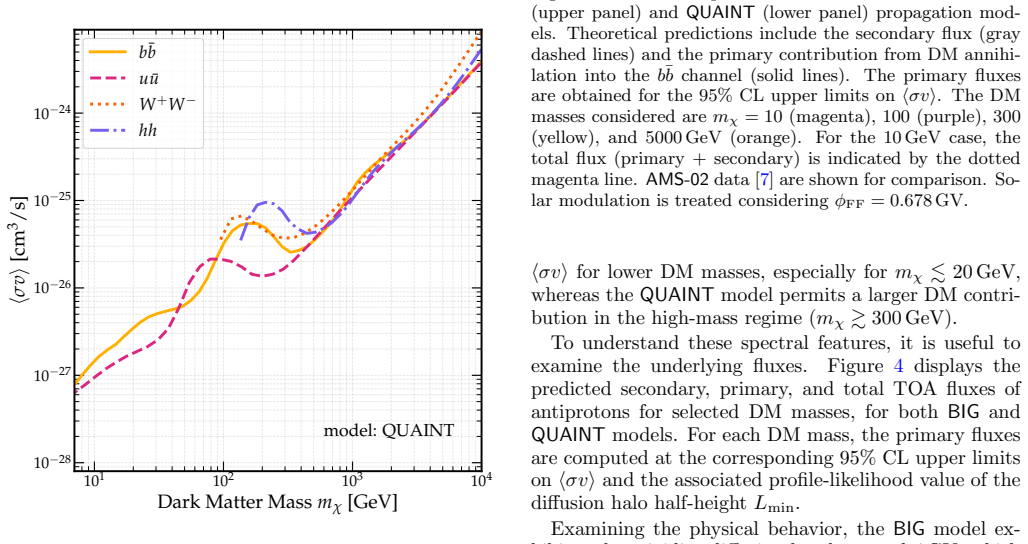
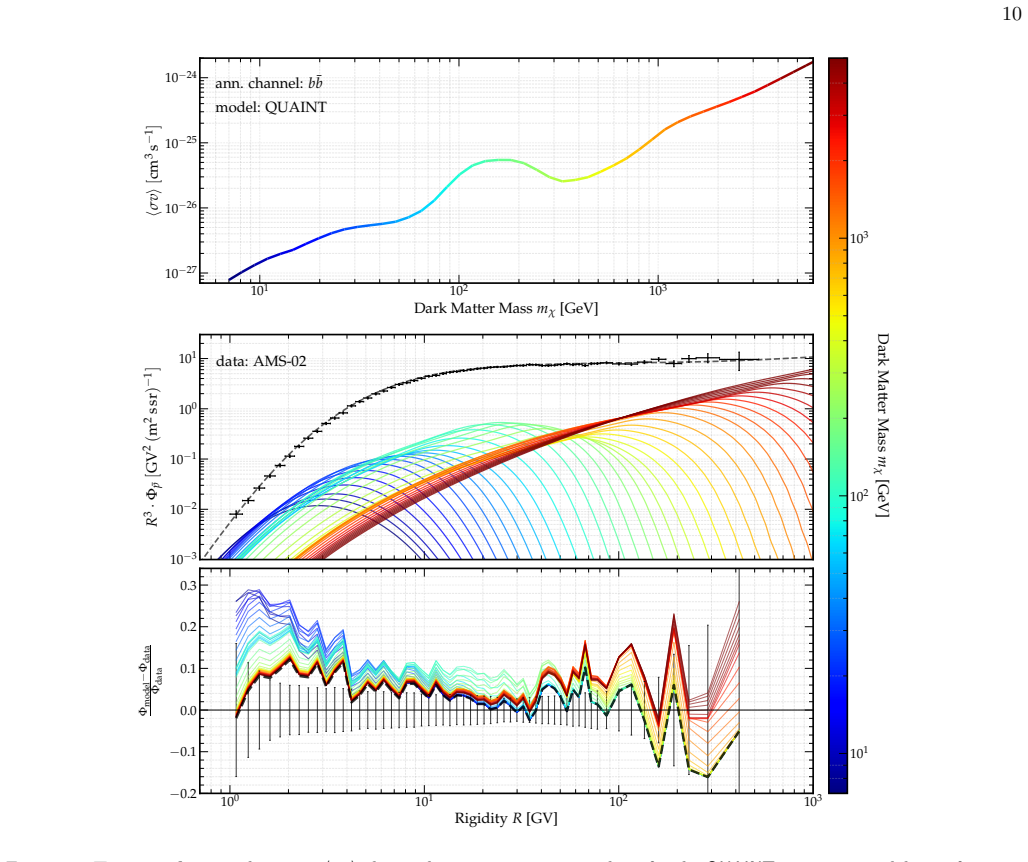
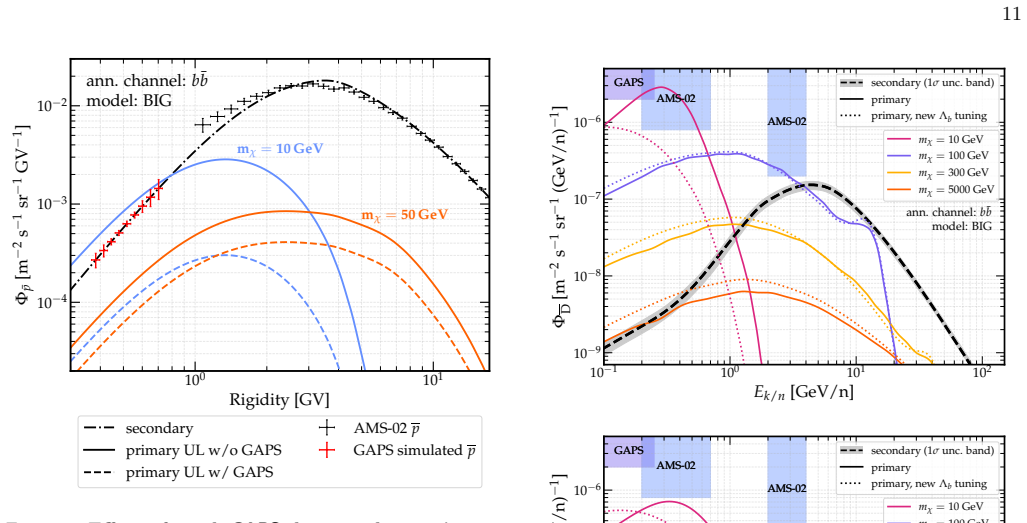
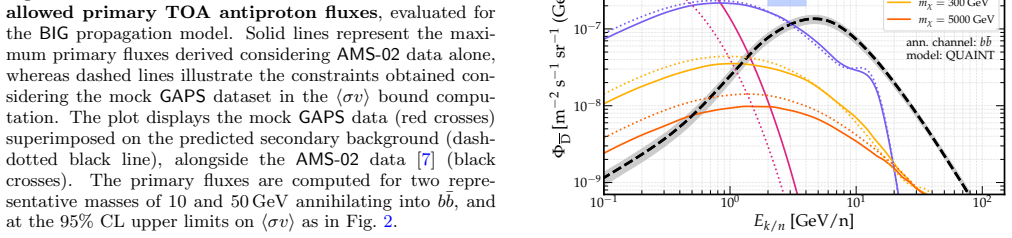
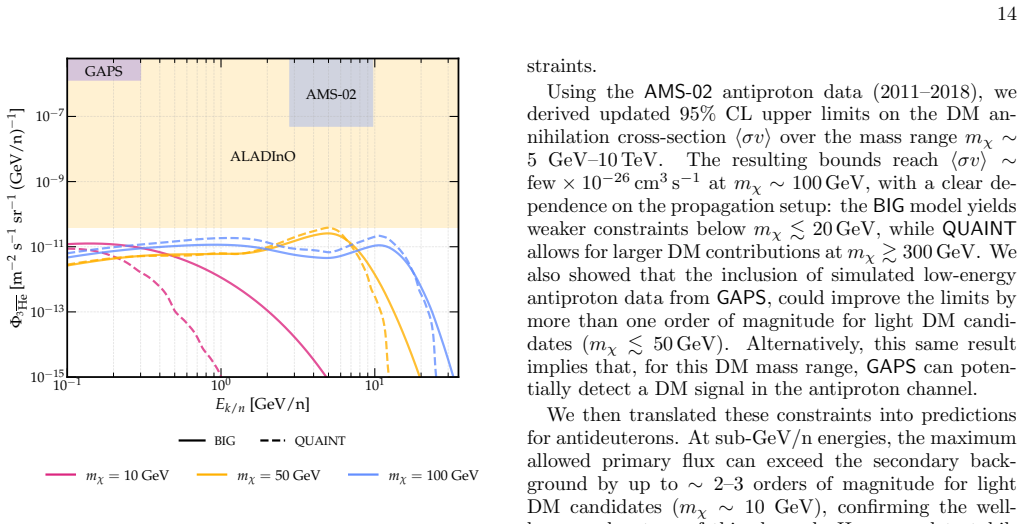
Using state-of-the-art production cross sections, nuclear coalescence, and two Galactic propagation models (BIG and QUAINT), the paper derives upper limits on the dark matter velocity-averaged annihilation cross section from existing AMS-02 antiproton data and forecasts that GAPS sensitivity to sub-GeV antiprotons can improve those limits by up to an order of magnitude for dark matter masses below 50 GeV, while the detectability of antideuterons and antihelium with current and planned instruments varies strongly with propagation assumptions and hadronization tuning.
What carries the argument
Two fixed Galactic propagation models (BIG and QUAINT) that map dark matter annihilation spectra and secondary spallation production into Earth fluxes, with nuclear coalescence supplying the antinuclei yields.
If this is right
- AMS-02 antiproton data already constrain the dark matter annihilation cross section, with the strength of the bound depending on the choice of BIG or QUAINT propagation parameters.
- GAPS sub-GeV sensitivity can improve those constraints by up to a factor of ten for dark matter masses below 50 GeV.
- Prospects for detecting antihelium and antideuterons depend on the experiment, the propagation model, and the hadronization tuning chosen.
- Antinuclei channels offer complementary information to antiprotons for indirect dark matter searches.
Where Pith is reading between the lines
- Joint analysis of low- and high-energy antinuclei data could reduce the uncertainty arising from propagation model choice.
- If GAPS data align with secondary predictions, any residual high-energy antiproton excess would be harder to attribute to light dark matter.
- The same low-energy window sensitivity may apply to other light dark matter candidates that produce antinuclei through decay rather than annihilation.
Load-bearing premise
The propagation parameters calibrated to other cosmic-ray species remain unchanged when low-energy antinuclei data are added.
What would settle it
A GAPS measurement of the sub-GeV antiproton flux that lies significantly above the pure-secondary prediction while remaining consistent with the dark-matter signal shape for a given mass and cross section would falsify the secondary-only interpretation.
Figures




read the original abstract
The data on cosmic antiprotons have reached an outstanding precision on energies spanning from GeV to hundreds of TeV, thanks to the space-based AMS-02 experiment. The balloon-borne GAPS experiment, which just completed its first Antarctic flight, will address antiproton and antideuteron fluxes well below GeV energies. Antinuclei in cosmic rays, as well as being produced by spallation reactions between cosmic-ray nuclei and the atoms of the interstellar medium, may hide contributions from exotic sources, such as particle dark matter annihilation in the Galaxy. In this paper, we present predictions for cosmic antiproton, antideuteron and antihelium fluxes both from secondary and dark matter origin. We use state-of-the-art production spectra, nuclear coalescence for antinuclei, and Galactic propagation models to derive upper limits on the dark matter annihilation cross-section from AMS-02 antiproton data in different propagation scenarios (BIG and QUAINT). We quantify the impact of future GAPS data, showing that its sensitivity to sub-GV antiprotons could improve the $\langle\sigma v\rangle$ constraints by up to an order of magnitude for light DM ($m_{\chi} \lesssim 50$ GeV). For heavier antinuclei, the detection perspective with existing and upcoming experiments are derived for those scenarios consistent with AMS-02 antiproton flux. The detectability of such signals strongly depends on the experiment, the propagation model, and the hadronization tuning. Our analysis underscores the complementarity of antinuclei channels for indirect DM searches and the critical role of low-energy windows in constraining light DM candidates.
Editorial analysis
A structured set of objections, weighed in public.
Referee Report
Summary. The manuscript revisits predictions for cosmic-ray antinucleon fluxes (antiprotons, antideuterons, antihelium) from secondary spallation and dark matter annihilation. It employs state-of-the-art production spectra and nuclear coalescence, computes fluxes in the BIG and QUAINT Galactic propagation models, derives upper limits on the DM annihilation cross-section ⟨σv⟩ from AMS-02 antiproton data, and projects that future GAPS sub-GeV antiproton sensitivity could tighten those limits by up to an order of magnitude for light DM (mχ ≲ 50 GeV). Detection prospects for heavier antinuclei in scenarios consistent with AMS-02 are also presented.
Significance. If the results hold, the work usefully illustrates the complementarity of antinuclei channels and the leverage of low-energy data for light DM. The explicit comparison of two propagation setups and the use of updated coalescence and production modeling are positive features that help quantify model dependence.
major comments (1)
- The central projection that GAPS sub-GV antiproton data could improve ⟨σv⟩ constraints by up to an order of magnitude for mχ ≲ 50 GeV (Abstract and associated results section) assumes the BIG and QUAINT propagation parameters remain fixed at their current best-fit values. These parameters are calibrated to existing cosmic-ray data; because the DM signal for light candidates peaks in the sub-GeV regime where diffusion, convection, and solar modulation are most uncertain, any re-calibration required once GAPS data are included would rescale the allowed DM contribution and therefore the quoted improvement factor. The manuscript does not provide a test of parameter stability under the addition of the very low-energy channel used to claim the gain.
Simulated Author's Rebuttal
We thank the referee for the constructive report and positive assessment of the manuscript's significance. We address the single major comment below, agreeing that the GAPS projection requires clarification regarding propagation parameter stability. We have revised the text to incorporate an explicit caveat on this point.
read point-by-point responses
-
Referee: The central projection that GAPS sub-GV antiproton data could improve ⟨σv⟩ constraints by up to an order of magnitude for mχ ≲ 50 GeV (Abstract and associated results section) assumes the BIG and QUAINT propagation parameters remain fixed at their current best-fit values. These parameters are calibrated to existing cosmic-ray data; because the DM signal for light candidates peaks in the sub-GeV regime where diffusion, convection, and solar modulation are most uncertain, any re-calibration required once GAPS data are included would rescale the allowed DM contribution and therefore the quoted improvement factor. The manuscript does not provide a test of parameter stability under the addition of the very low-energy channel used to claim the gain.
Authors: We agree with the referee that the quoted improvement in ⟨σv⟩ limits from future GAPS sub-GV antiproton data is computed under the assumption that the BIG and QUAINT propagation parameters remain fixed at the values obtained from fits to existing cosmic-ray data. The sub-GeV energy range is indeed subject to larger uncertainties in diffusion, convection, and solar modulation, and a re-calibration once low-energy data are available could rescale the allowed DM contribution. The original manuscript did not include an explicit test of how the propagation parameters would shift under the addition of hypothetical GAPS measurements. In the revised version we have added a paragraph in the results section (and a corresponding note in the abstract) that explicitly states this assumption, describes the GAPS projection as an indicative benchmark under fixed parameters, and notes that a complete re-fit of the propagation model would be required once real data arrive. This addition does not change the numerical results but provides the necessary qualification on their interpretation. revision: yes
Circularity Check
No significant circularity: propagation models used as fixed external inputs
full rationale
The paper takes the BIG and QUAINT propagation parameter sets as calibrated inputs from prior cosmic-ray studies and uses them to compute secondary backgrounds and to extract upper limits on ⟨σv⟩ from AMS-02 antiproton data. No equation or step in the derivation reduces by construction to a fit performed inside the paper itself, nor does any central claim rest on a self-citation chain that is itself unverified. The GAPS sensitivity projection is a forward calculation within the same fixed models rather than a statistically forced prediction. The analysis is therefore self-contained against external benchmarks and receives the default non-circularity finding.
Axiom & Free-Parameter Ledger
free parameters (2)
- BIG and QUAINT propagation parameters
- Coalescence momentum for antideuterons and antihelium
axioms (2)
- domain assumption Dark matter annihilation produces antinuclei via standard hadronization and coalescence
- domain assumption Secondary production spectra from spallation are accurately modeled by state-of-the-art Monte Carlo generators
Reference graph
Works this paper leans on
- [1]
-
[2]
O. Adrianiet al., Phys. Rev. Lett.102, 051101 (2009), arXiv:0810.4994 [astro-ph]
-
[3]
Adrianiet al.(PAMELA), Nature458, 607 (2009), arXiv:0810.4995 [astro-ph]
O. Adrianiet al.(PAMELA), Nature458, 607 (2009), arXiv:0810.4995 [astro-ph]
-
[4]
O. Adrianiet al.(PAMELA), Riv. Nuovo Cim.40, 473 (2017), arXiv:1801.10310 [astro-ph.HE]
-
[5]
M. Aguilar, L. Ali Cavasonza, B. Alpat, G. Ambrosi, et al.(AMS Collaboration), Phys. Rev. Lett.117, 091103 (2016)
work page 2016
- [6]
- [7]
-
[8]
K. Abeet al., Phys. Rev. Lett.108, 131301 (2012), arXiv:1201.2967 [astro-ph.CO]
- [9]
-
[10]
von Doetinchemet al., JCAP08, 035 (2020), arXiv:2002.04163 [astro-ph.HE]
P. von Doetinchemet al., JCAP08, 035 (2020), arXiv:2002.04163 [astro-ph.HE]
-
[11]
Sakaiet al.(BESS Collaboration), Phys
K. Sakaiet al.(BESS Collaboration), Phys. Rev. Lett. 132, 131001 (2024)
work page 2024
-
[12]
V. Choutko and F. Giovacchini, inInternational Cosmic Ray Conference, International Cosmic Ray Conference, Vol. 4 (2008) pp. 765–768
work page 2008
-
[13]
Latest results of the Alpha Magnetic Spec- trometer on the International Space Station,
A. Oliva, “Latest results of the Alpha Magnetic Spec- trometer on the International Space Station,” (2024), invited talk at the JENAA Workshop @ CERN, 20 Aug 2024
work page 2024
-
[14]
T. Aramaki, C. J. Hailey, S. E. Boggs, P. von Doet- inchem, H. Fuke, S. I. Mognet, R. A. Ong, K. Perez, and J. Zweerink (GAPS), Astropart. Phys.74, 6 (2016), arXiv:1506.02513 [astro-ph.HE]
-
[15]
von Doetinchemet al., PoSICRC2015, 1218 (2016), arXiv:1507.02712 [hep-ph]
P. von Doetinchemet al., PoSICRC2015, 1218 (2016), arXiv:1507.02712 [hep-ph]
-
[16]
C. Hailey (GAPS), Invited talk at the Workshop https://indico.cern.ch/event/1480110/overview, CERN 22 Jan 2026 (2026)
- [17]
-
[18]
M. Boudaud, Y. G´ enolini, L. Derome, J. Lavalle, D. Maurin, P. Salati, and P. D. Serpico, Phys. Rev. Res.2, 023022 (2020), arXiv:1906.07119 [astro-ph.HE]
-
[19]
M. Di Mauro, M. Korsmeier, and A. Cuoco, Phys. Rev. D109, 123003 (2024), arXiv:2311.17150 [astro-ph.HE]
- [20]
- [21]
-
[22]
M. Cirelli, N. Fornengo, M. Taoso, and A. Vittino, Journal of High Energy Physics2014, 009 (2014), arXiv:1401.4017 [hep-ph]
-
[23]
E. Carlson, A. Coogan, T. Linden, S. Profumo, A. Ibarra, and S. Wild, Phys. Rev. D89, 076005 (2014), arXiv:1401.2461 [hep-ph]
-
[24]
P. Chardonnet, J. Orloff, and P. Salati, Phys. Lett. B409, 313 (1997), arXiv:astro-ph/9705110 [astro-ph]
-
[25]
N. Fornengo, L. Maccione, and A. Vittino, JCAP09, 031 (2013), arXiv:1306.4171 [hep-ph]
-
[26]
M. Korsmeier, F. Donato, and N. Fornengo, Phys. Rev. D97, 103011 (2018), arXiv:1711.08465 [astro-ph.HE]
-
[27]
M. Kachelrieß, S. Ostapchenko, and J. Tjemsland, JCAP08, 048 (2020), arXiv:2002.10481 [hep-ph]
-
[28]
L. ˇSerkˇ snyt˙ eet al., Phys. Rev. D105, 083021 (2022), arXiv:2201.00925 [astro-ph.HE]
-
[29]
P. De La Torre Luque, M. W. Winkler, and T. Linden, JCAP10, 017 (2024), arXiv:2404.13114 [astro-ph.HE]
-
[31]
M. Di Mauro, N. Fornengo, A. Jueid, R. R. de Austri, and F. Bellini, Phys. Rev. Lett.135, 131002 (2025), arXiv:2411.04815 [astro-ph.HE]
-
[32]
M. Di Mauro, J. Koechler, L. Stefanuto, F. Bellini, F. Donato, and N. Fornengo, subm. to Phys. Rev. D (2026), arXiv:2603.19352 [hep-ph]
-
[33]
S. Acharyaet al.(ALICE), Eur. Phys. J. C80, 889 (2020), arXiv:2003.03184 [nucl-ex]
-
[34]
ALICE Collaboration, Phys. Lett. B860, 139191 (2025)
work page 2025
- [35]
-
[36]
A. Ibarra and S. Wild, JCAP02, 021 (2013), arXiv:1209.5539 [hep-ph]
-
[37]
Pohlet al.(CREMA), Science353, 669 (2016)
R. Pohlet al.(CREMA), Science353, 669 (2016)
work page 2016
-
[38]
M. Di Mauro, A. Jueid, J. Koechler, and R. R. de Aus- tri, Phys. Rev. D112, 083017 (2025), arXiv:2504.07172 [hep-ph]
-
[39]
R. Scheibl and U. W. Heinz, Phys. Rev.C59, 1585 (1999), arXiv:nucl-th/9809092 [nucl-th]. 16
-
[40]
F. Bellini and A. P. Kalweit, Phys. Rev. C99, 054905 (2019), arXiv:1807.05894 [hep-ph]
- [41]
-
[42]
F. Bellini, K. Blum, A. P. Kalweit, and M. Puccio, Phys. Rev. C103, 014907 (2021), arXiv:2007.01750 [nucl-th]
-
[43]
M. Kachelrieß, S. Ostapchenko, and J. Tjemsland, Eur. Phys. J. A56, 4 (2020), arXiv:1905.01192 [hep-ph]
- [45]
- [46]
-
[47]
V. De Romeri, F. Donato, D. Maurin, L. Stefanuto, and A. Tolino, Phys. Rev. D112, 023003 (2025), arXiv:2505.04692 [hep-ph]
-
[48]
J. F. Navarro, C. S. Frenk, and S. D. M. White, Astro- phys. J.462, 563 (1996), arXiv:astro-ph/9508025
work page Pith review arXiv 1996
-
[49]
P. J. McMillan, Monthly Notices of the Royal Astro- nomical Society465, 76–94 (2016)
work page 2016
- [50]
-
[51]
Gravity Collaboration, R. Abuter,et al., Astron. Astro- phys.625, L10 (2019), arXiv:1904.05721 [astro-ph.GA]
-
[52]
A comprehensive guide to the physics and usage of PYTHIA 8.3
C. Bierlichet al., SciPost Phys. Codeb.2022, 8 (2022), arXiv:2203.11601 [hep-ph]
work page internal anchor Pith review arXiv 2022
- [53]
- [54]
-
[55]
S. Schaelet al.(ALEPH), Phys. Lett. B639, 192 (2006), arXiv:hep-ex/0604023
- [56]
- [57]
-
[58]
S. Amoroso, S. Caron, A. Jueid, R. Ruiz de Austri, and P. Skands, JCAP05, 007 (2019), arXiv:1812.07424 [hep- ph]
- [59]
- [60]
-
[61]
Acharyaet al.(ALICE Collaboration), Phys
S. Acharyaet al.(ALICE Collaboration), Phys. Rev. C 97, 024615 (2018), arXiv:1709.08522 [nucl-ex]
- [62]
-
[63]
M. Korsmeier, F. Donato, and M. Di Mauro, Phys. Rev. D97, 103019 (2018), arXiv:1802.03030 [astro-ph.HE]
-
[64]
Differential cross- sections for secondary antiproton and antideuteron pro- duction,
M. Di Mauro, J. Koechler, L. Stefanuto, F. Bellini, F. Donato, and N. Fornengo, “Differential cross- sections for secondary antiproton and antideuteron pro- duction,” (2026)
work page 2026
-
[65]
V. S. Berezinskii, S. V. Bulanov, V. A. Dogiel, and V. S. Ptuskin,Amsterdam: North-Holland, 1990, edited by Ginzburg, V.L.(Elsevier Science and Technology, 1990)
work page 1990
-
[66]
R. Schlickeiser,Cosmic ray astrophysics / Rein- hard Schlickeiser, Astronomy and Astrophysics Li- brary; Physics and Astronomy Online Library. Berlin: Springer. ISBN 3-540-66465-3, 2002, XV + 519 pp. (Springer, 2002)
work page 2002
- [67]
-
[68]
D. Maurin, Comput. Phys. Commun.247, 106942 (2020), arXiv:1807.02968 [astro-ph.IM]
-
[69]
E. S. Seo and V. S. Ptuskin, Astrophys. J.431, 705 (1994)
work page 1994
- [70]
- [71]
-
[72]
Y. G´ enolini, M. Boudaud, P. I. Batista, S. Caroff, L. Derome, J. Lavalle, A. Marcowith, D. Maurin, V. Poireau, V. Poulin, S. Rosier, P. Salati, P. D. Ser- pico, and M. Vecchi, Phy. Rev. D99, 123028 (2019), arXiv:1904.08917 [astro-ph.HE]
-
[73]
N. Weinrich, Y. G´ enolini, M. Boudaud, L. Derome, and D. Maurin, Astron. Astrophys.639, A131 (2020), arXiv:2002.11406 [astro-ph.HE]
-
[74]
N. Weinrich, M. Boudaud, L. Derome, Y. Genolini, J. Lavalle, D. Maurin, P. Salati, P. Serpico, and G. Weymann-Despres, Astron. Astrophys.639, A74 (2020), arXiv:2004.00441 [astro-ph.HE]
- [75]
-
[76]
Y. G´ enolini, M. Boudaud, M. Cirelli, L. Derome, J. Lavalle, D. Maurin, P. Salati, and N. Weinrich, Phys. Rev. D104, 083005 (2021), arXiv:2103.04108 [astro- ph.HE]
-
[77]
Acharyaet al.(ALICE), Nature Phys.19, 61 (2023), arXiv:2202.01549 [nucl-ex]
S. Acharyaet al.(ALICE), Nature Phys.19, 61 (2023), arXiv:2202.01549 [nucl-ex]
-
[78]
Aguilaret al.(AMS Collaboration), Phys
M. Aguilaret al.(AMS Collaboration), Phys. Rev. Lett. 134, 051002 (2025)
work page 2025
-
[79]
L. J. Gleeson and W. I. Axford, Astrophys. J.154, 1011 (1968)
work page 1968
-
[80]
L. A. Fisk, J. Geophys. Res.76, 221 (1971)
work page 1971
- [81]
- [82]
discussion (0)
Sign in with ORCID, Apple, or X to comment. Anyone can read and Pith papers without signing in.