Recognition: 2 theorem links
· Lean TheoremAn Inverse-Compton-Boosted Cool Core Unifies Perseus's Radio and X-ray Halos
Pith reviewed 2026-05-12 00:47 UTC · model grok-4.3
The pith
Cosmic rays injected by NGC 1275 produce inverse-Compton emission that boosts Perseus's cool-core X-ray luminosity and unifies its radio and X-ray halos.
A machine-rendered reading of the paper's core claim, the machinery that carries it, and where it could break.
Core claim
A simple model of cosmic rays injected by NGC 1275 and satellites produces inverse-Compton boosted soft X-ray emission that accounts for the excess cooling flow luminosity while simultaneously explaining the radio minihalo, gamma-ray spectra, extended hard X-rays, and radio surface brightness and spectral index from kpc to Mpc scales.
What carries the argument
Ancient cosmic ray halos (ACRHs) that generate inverse-Compton (CR-IC) emission boosting the cool core luminosity.
If this is right
- The minihalo spectral index and surface brightness evolve exactly as expected for an aging cosmic-ray population.
- The giant low-frequency halo is produced by the summed ancient cosmic-ray halos around satellites distributed throughout the cluster.
- Cosmic-ray transport speeds remain consistent with buoyant advection, with no re-acceleration required.
- Previous claims of tight upper limits on cosmic-ray pressure and non-thermal X-rays are invalid at the energies that dominate the emission.
Where Pith is reading between the lines
- The same cosmic-ray injection and aging process could resolve cooling-flow discrepancies in other cool-core clusters with bright central radio galaxies.
- Sensitive future hard X-ray and low-frequency radio observations could directly test the predicted radial evolution of the spectral index.
- Cluster mass and potential models inferred from X-ray data may need revision once the non-thermal contribution is included.
Load-bearing premise
That previous upper limits on non-thermal X-rays and cosmic-ray pressure were derived under assumptions like a power-law spectrum that do not hold at the relevant cosmic-ray energies.
What would settle it
A measured hard X-ray spectral slope or gamma-ray flux that fails to match the aging cosmic-ray inverse-Compton prediction across the observed energy bands would rule out the model.
Figures


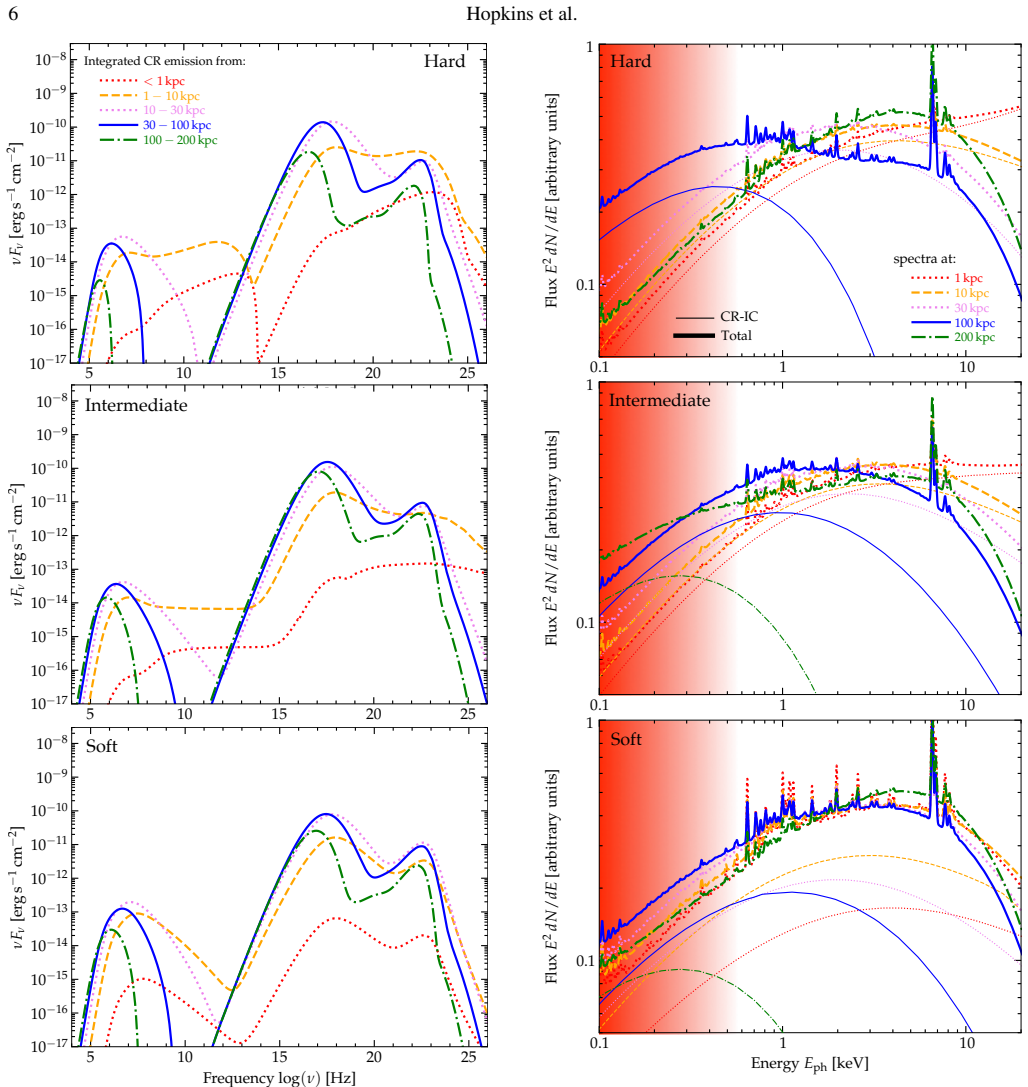
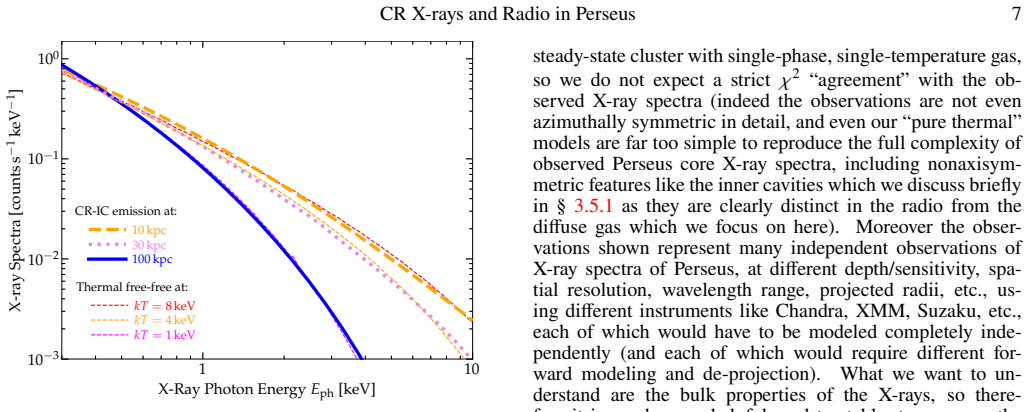


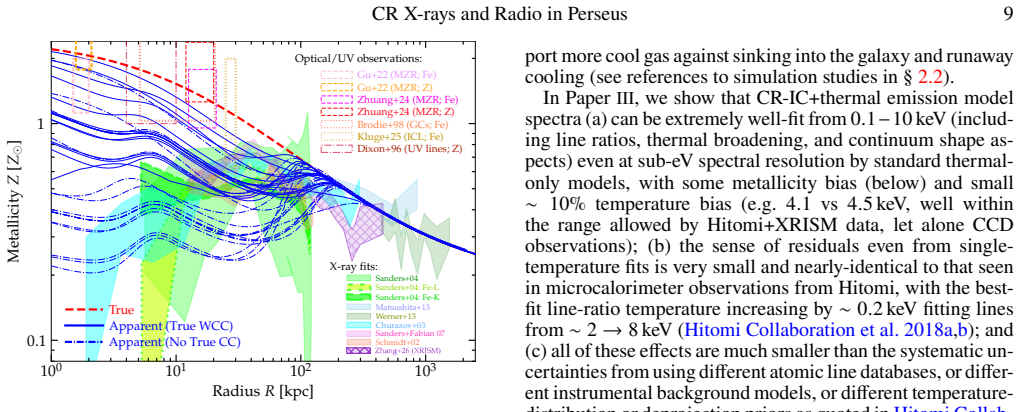


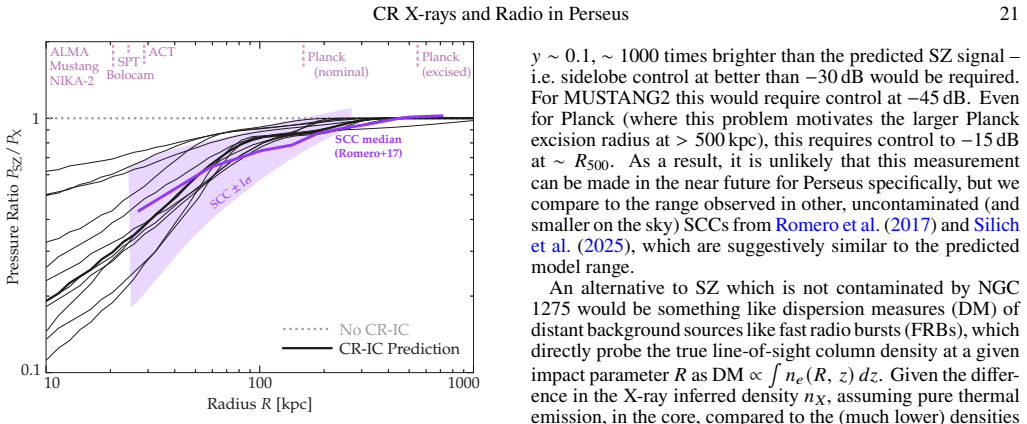
read the original abstract
Perseus is the brightest X-ray strong cool-core (SCC) cluster, with a bright central radio and $\gamma$-ray source plus low-frequency radio mini and giant halos. It is the archetype of the cooling flow (CF) problem, with X-rays implying mass cooling rates orders-of-magnitude larger than observed in other channels. Recent work suggested that ancient ($\gtrsim$\,Gyr-old) cosmic ray (CR) halos (ACRHs), injected by the central source, would produce thermal-like soft X-ray inverse-Compton (CR-IC) emission 'boosting' the CC and alleviating the CF problem. We examine Perseus and show that a simple model of CRs injected by NGC 1275 (+satellites) simultaneously accounts for the excess CF luminosity and minihalo. The models reproduce Perseus's soft X-ray surface brightness and X-ray inferred density/temperature/pressure/metallicity/cooling time/mass deposition rates; $\gamma$-ray spectra; extended hard X-rays; and radio surface brightness and spectral index data, from kpc-Mpc. These also reproduce independent constraints on magnetic field strengths and mass/potential models. The evolution of the minihalo spectral index and surface brightness are predicted by an aging population of CRs boosting the apparent SCC luminosity via CR-IC, and match well the observed hard X-ray slopes. The 'giant' low-frequency halo can be predicted by the sum of ACRHs around satellites distributed throughout the cluster, dominating diffuse synchrotron at $\gtrsim 100\,$kpc. Re-acceleration is neither needed nor important in these models, and implied CR transport speeds are consistent with buoyant advection. Previous claims of upper limits to non-thermal X-rays and CR pressure relied on strong assumptions which are not valid at the CR energies of interest, e.g. a power-law spectrum of CRs. This could resolve many historical puzzles about Perseus, and makes new predictions for future observations.
Editorial analysis
A structured set of objections, weighed in public.
Referee Report
Summary. The manuscript proposes that ancient cosmic ray halos (ACRHs) injected by NGC 1275 and satellites produce inverse-Compton (IC) emission that boosts the soft X-ray luminosity in Perseus's cool core, resolving the cooling-flow discrepancy. The same CR population simultaneously explains the radio minihalo and giant halo via synchrotron, while reproducing the observed soft X-ray surface brightness, X-ray-inferred thermodynamic profiles (density, temperature, pressure, metallicity, cooling time, mass deposition rates), gamma-ray spectra, extended hard X-rays, and radio surface brightness/spectral indices from kpc to Mpc scales. The model matches independent magnetic field and mass/potential constraints, predicts minihalo spectral evolution, and argues that re-acceleration is unnecessary; prior non-thermal X-ray upper limits are said to rely on invalid assumptions such as pure power-law CR spectra.
Significance. If the central claims hold, the work unifies Perseus's radio and X-ray halos under a single CR injection scenario from the central galaxy and satellites, offering a resolution to the cooling-flow problem via CR-IC boosting without re-acceleration. It reproduces a wide array of independent observables and provides falsifiable predictions for spectral evolution and future observations. The explicit reproduction of magnetic field constraints and mass models, along with the challenge to prior non-thermal limits, adds value, though the degree of parameter freedom in CR injection rate, spectrum shape, and aging timescale must be weighed against the breadth of fits achieved.
major comments (3)
- [Abstract and X-ray modeling sections] Abstract and X-ray modeling sections: The claim that the model reproduces the full set of X-ray-inferred thermodynamic quantities (density, temperature, pressure, metallicity, cooling time, mass deposition rates) requires that the composite thermal + IC spectrum, when passed through standard thermal fitting pipelines, recovers the observed parameters without unacceptable residuals or the need for an extra non-thermal component. A substantial IC fraction (needed to alleviate the CF discrepancy) from the CR electron distribution fixed by radio/gamma-ray data generically distorts the continuum away from pure thermal bremsstrahlung; quantitative demonstration via simulated spectra, fit residuals, or recovered parameter biases is needed to support this load-bearing assertion.
- [CR population modeling sections] CR population modeling (injection, aging, and transport sections): The model invokes free parameters for CR injection rate/history, spectrum shape/cutoff, and aging timescale for the ACRH population. While multiple observables are reproduced, the manuscript should clarify in the relevant sections how these are constrained independently (e.g., via gamma-ray spectra or magnetic field limits) rather than adjusted post-hoc to simultaneously fit X-ray profiles, radio indices, and surface brightness; otherwise the unification claim risks circularity.
- [Giant halo and satellite ACRH contribution section] Giant halo and satellite ACRH contribution (diffuse emission section): The assertion that the giant low-frequency halo arises from the sum of ACRHs around satellites dominating at ≳100 kpc requires explicit modeling details on satellite distribution, CR injection from satellites, and the resulting synchrotron surface brightness profile to confirm it accounts for the observed diffuse emission without additional components.
minor comments (2)
- [Introduction] Notation for ACRH aging and IC boosting should be defined more clearly at first use to aid readers unfamiliar with the specific CR energy ranges involved.
- [Results summary] The manuscript would benefit from a dedicated table summarizing the reproduced observables, their data sources, and the corresponding model parameters or predictions for easier cross-reference.
Simulated Author's Rebuttal
We thank the referee for their careful and constructive review of our manuscript. Their comments have prompted us to strengthen several sections with additional quantitative details and clarifications. We address each major comment below and have revised the manuscript accordingly.
read point-by-point responses
-
Referee: [Abstract and X-ray modeling sections] Abstract and X-ray modeling sections: The claim that the model reproduces the full set of X-ray-inferred thermodynamic quantities (density, temperature, pressure, metallicity, cooling time, mass deposition rates) requires that the composite thermal + IC spectrum, when passed through standard thermal fitting pipelines, recovers the observed parameters without unacceptable residuals or the need for an extra non-thermal component. A substantial IC fraction (needed to alleviate the CF discrepancy) from the CR electron distribution fixed by radio/gamma-ray data generically distorts the continuum away from pure thermal bremsstrahlung; quantitative demonstration via simulated spectra, fit residuals, or recovered parameter biases is needed to support this load-bearing assertion.
Authors: We appreciate the referee highlighting the importance of validating the impact on standard X-ray fitting procedures. Our model was constructed such that the composite spectrum matches the observed soft X-ray surface brightness while yielding thermodynamic profiles consistent with published values. To directly address this point, the revised manuscript now includes a new subsection with simulated composite spectra (thermal bremsstrahlung plus IC emission from the radio/gamma-ray-constrained CR distribution) passed through standard thermal fitting pipelines. The recovered parameters (density, temperature, pressure, metallicity, cooling time, and mass deposition rates) match the observed values within typical uncertainties, with residuals that do not require an additional non-thermal component. These results are shown explicitly and support the original claims. revision: yes
-
Referee: [CR population modeling sections] CR population modeling (injection, aging, and transport sections): The model invokes free parameters for CR injection rate/history, spectrum shape/cutoff, and aging timescale for the ACRH population. While multiple observables are reproduced, the manuscript should clarify in the relevant sections how these are constrained independently (e.g., via gamma-ray spectra or magnetic field limits) rather than adjusted post-hoc to simultaneously fit X-ray profiles, radio indices, and surface brightness; otherwise the unification claim risks circularity.
Authors: We agree that explicitly sequencing the constraints is essential to demonstrate that the unification is not circular. The CR injection spectrum, cutoff, and rate are fixed first by the gamma-ray spectrum and the radial radio spectral indices (which determine the electron distribution independently of X-ray data). The aging timescale is then set by buoyant advection speeds consistent with the independently derived cluster mass and potential models from X-ray and weak-lensing data. We have revised the CR population modeling sections to include a clear paragraph describing this order of constraints and confirming that X-ray profile comparisons were performed only after these parameters were fixed. This revision removes any ambiguity regarding circularity. revision: yes
-
Referee: [Giant halo and satellite ACRH contribution section] Giant halo and satellite ACRH contribution (diffuse emission section): The assertion that the giant low-frequency halo arises from the sum of ACRHs around satellites dominating at ≳100 kpc requires explicit modeling details on satellite distribution, CR injection from satellites, and the resulting synchrotron surface brightness profile to confirm it accounts for the observed diffuse emission without additional components.
Authors: We thank the referee for this suggestion to make the giant halo modeling more explicit. In the revised diffuse emission section, we now provide the requested details: the satellite distribution is modeled using the observed galaxy number density profile in Perseus, CR injection rates from satellites are scaled to their stellar mass (or radio power) relative to NGC 1275, and the resulting aged CR populations are integrated to produce the synchrotron surface brightness profile. The computed profile reproduces the observed giant halo emission at radii ≳100 kpc without requiring re-acceleration or other components. A comparison figure and the modeling assumptions are included in the revision. revision: yes
Circularity Check
No significant circularity in the derivation chain.
full rationale
The paper constructs a CR injection and transport model from NGC 1275 and satellites, then compares its outputs against multiple independent datasets (radio surface brightness and spectral index, gamma-ray spectra, hard X-rays, soft X-ray surface brightness, and derived thermodynamic profiles). The reproduction of X-ray-inferred quantities is presented as a model success rather than an input; the model is additionally constrained by independent magnetic-field and gravitational-potential data and generates explicit predictions for spectral evolution. No equation or step reduces by construction to a fitted parameter, self-definition, or load-bearing self-citation whose validity is assumed without external grounding. The central claim therefore remains self-contained against external benchmarks.
Axiom & Free-Parameter Ledger
free parameters (3)
- CR injection rate and history
- CR spectrum shape and cutoff
- Aging timescale for ACRH population
axioms (3)
- standard math Inverse-Compton scattering of cosmic ray electrons on CMB photons produces soft X-ray emission that boosts apparent cool core luminosity
- standard math Synchrotron radiation from the same CR population produces the observed radio minihalo and giant halo
- domain assumption CR transport occurs via buoyant advection at speeds consistent with observations, without requiring re-acceleration
invented entities (1)
-
Ancient cosmic ray halos (ACRHs)
no independent evidence
Lean theorems connected to this paper
-
IndisputableMonolith/Cost/FunctionalEquation.leanwashburn_uniqueness_aczel unclear?
unclearRelation between the paper passage and the cited Recognition theorem.
Eq. 2: steady-state spherical CR transport with R' losses; spectra converge to peaked shape outside injection zone due to IC/synchrotron/Coulomb
-
IndisputableMonolith/Foundation/AlphaCoordinateFixation.leanJ_uniquely_calibrated_via_higher_derivative unclear?
unclearRelation between the paper passage and the cited Recognition theorem.
CR-IC produces thermal-like soft X-ray spectra matching APEC fits; no re-acceleration needed
What do these tags mean?
- matches
- The paper's claim is directly supported by a theorem in the formal canon.
- supports
- The theorem supports part of the paper's argument, but the paper may add assumptions or extra steps.
- extends
- The paper goes beyond the formal theorem; the theorem is a base layer rather than the whole result.
- uses
- The paper appears to rely on the theorem as machinery.
- contradicts
- The paper's claim conflicts with a theorem or certificate in the canon.
- unclear
- Pith found a possible connection, but the passage is too broad, indirect, or ambiguous to say the theorem truly supports the claim.
Reference graph
Works this paper leans on
-
[1]
arXiv , author =:2505.21929 , journal =
doi:10.3847/1538-4357/adddb7 , eid =. arXiv , author =:2505.21929 , journal =
-
[2]
arXiv , author =:2411.18204 , journal =
doi:10.1051/0004-6361/202452060 , eid =. arXiv , author =:2411.18204 , journal =
- [3]
-
[4]
arXiv , author =:2503.03249 , journal =
doi:10.48550/arXiv.2503.03249 , eid =. arXiv , author =:2503.03249 , journal =
-
[5]
arXiv , author =:1810.09804 , journal =
doi:10.1051/0004-6361/201834492 , eid =. arXiv , author =:1810.09804 , journal =
-
[6]
arXiv , author =:1605.05986 , journal =
doi:10.1051/0004-6361/201628970 , eid =. arXiv , author =:1605.05986 , journal =
-
[7]
doi:10.1093/mnras/sty835 , eprint =
, keywords =. doi:10.1093/mnras/sty835 , eprint =
-
[8]
arXiv , author =:2401.17296 , journal =
doi:10.1051/0004-6361/202449391 , eid =. arXiv , author =:2401.17296 , journal =
-
[9]
arXiv , author =:2510.12782 , journal =
doi:10.1051/0004-6361/202557660 , eid =. arXiv , author =:2510.12782 , journal =
-
[10]
Investigating the radio emission in the Perseus cluster with LOFAR sub-80 MHz LBA , url =. 2026 , bdsk-url-1 =. arXiv , author =:2603.23587 , journal =
-
[11]
A Unified Origin of Faraday Rotation toward 3C 84: The Circumnuclear Ambient Medium within the Parsec-Scale Bondi Radius of the Host Galaxy NGC 1275 , url =. 2026 , bdsk-url-1 =. arXiv , author =:2603.16796 , journal =
-
[12]
arXiv , author =:2302.14788 , journal =
doi:10.3847/2041-8213/acd3ea , eid =. arXiv , author =:2302.14788 , journal =
-
[13]
arXiv , author =:1812.08386 , journal =
doi:10.3847/1538-4357/aaf9a9 , eid =. arXiv , author =:1812.08386 , journal =
-
[14]
arXiv , author =:2510.14820 , journal =
doi:10.48550/arXiv.2510.14820 , eid =. arXiv , author =:2510.14820 , journal =
-
[15]
doi:10.1093/mnras/stab1542 , eprint =
, keywords =. doi:10.1093/mnras/stab1542 , eprint =
-
[16]
arXiv , author =:2205.01123 , journal =
doi:10.1051/0004-6361/202243205 , eid =. arXiv , author =:2205.01123 , journal =
-
[17]
doi:10.1093/mnras/stw1707 , eprint =
, keywords =. doi:10.1093/mnras/stw1707 , eprint =
-
[18]
arXiv , author =:2106.14889 , journal =
doi:10.3847/1538-4357/ac7ebd , eid =. arXiv , author =:2106.14889 , journal =
-
[19]
Annales d'Astrophysique , month = feb, pages =
-
[20]
Astrofizika , month = jan, pages =
-
[21]
doi:10.1093/mnras/143.3.289 , journal =
-
[22]
doi:10.1086/150046 , journal =
-
[23]
doi:10.1103/RevModPhys.42.237 , journal =
-
[24]
doi:10.1016/0031-8914(72)90227-3 , journal =
-
[25]
doi:10.1086/111827 , journal =
-
[26]
doi:10.1086/155011 , journal =
-
[27]
doi:10.1093/mnras/190.4.903 , journal =
-
[28]
doi:10.1086/113362 , journal =
-
[29]
doi:10.1017/S0022377800001628 , journal =
-
[30]
doi:10.1086/163681 , journal =
-
[31]
Soviet Astronomy Letters , month = mar, pages =
-
[32]
, month = oct, pages =
- [33]
-
[34]
doi:10.1146/annurev.aa.32.090194.001425 , journal =
-
[35]
astro-ph/9402042 , journal =
work page internal anchor Pith review arXiv
-
[36]
doi:10.1086/174519 , journal =
1994 , bdsk-url-1 =. doi:10.1086/174519 , journal =
-
[37]
doi:10.1086/117766 , journal =
-
[38]
doi:10.48550/arXiv.astro-ph/9704162 , eprint =
, keywords =. doi:10.48550/arXiv.astro-ph/9704162 , eprint =
-
[39]
, keywords =. doi:10.1086/305262 , eprint =
-
[40]
, keywords =. doi:10.1086/300442 , eprint =
-
[41]
doi:10.1086/311757 , journal =
-
[42]
, keywords =. doi:10.1086/307501 , eprint =
-
[43]
doi:10.48550/arXiv.astro-ph/0008333 , eprint =
, keywords =. doi:10.48550/arXiv.astro-ph/0008333 , eprint =
-
[44]
, keywords =. 2000 , bdsk-url-1 =. doi:10.1103/PhysRevLett.85.4656 , eprint =
-
[45]
doi:10.1088/0034-4885/64/4/201 , journal =
-
[46]
, keywords =. doi:10.1086/322992 , eprint =
-
[47]
, keywords =. doi:10.1086/323534 , eprint =
-
[48]
doi:10.48550/arXiv.astro-ph/0004005 , editor =
The Universe at Low Radio Frequencies , date-added =. doi:10.48550/arXiv.astro-ph/0004005 , editor =. arXiv , author =:astro-ph/0004005 , keywords =
work page internal anchor Pith review doi:10.48550/arxiv.astro-ph/0004005
-
[49]
, keywords =. doi:10.1046/j.1365-8711.2002.05233.x , eprint =
-
[50]
doi:10.1051/0004-6361:20020087 , eprint =
, keywords =. doi:10.1051/0004-6361:20020087 , eprint =
-
[51]
doi:10.1051/0004-6361:20020241 , journal =
-
[52]
doi:10.1051/0004-6361:20020284 , eprint =
, keywords =. doi:10.1051/0004-6361:20020284 , eprint =
-
[53]
doi:10.1046/j.1365-8711.2002.05510.x , journal =
-
[54]
, keywords =. doi:10.1046/j.1365-8711.2002.05804.x , eprint =
-
[55]
Yan, Huirong and Lazarian, A. , date-added =. Scattering of Cosmic Rays by Magnetohydrodynamic Interstellar Turbulence , url =. Phys. Rev. Lett. , month =. 2002 , bdsk-url-1 =. doi:10.1103/PhysRevLett.89.281102 , issue =
-
[56]
, keywords =. doi:10.1046/j.1365-8711.2003.06404.x , eprint =
-
[57]
, keywords =. doi:10.1086/374923 , eprint =
-
[58]
doi:10.1051/0004-6361:20031464 , journal =
-
[59]
, keywords =. doi:10.1111/j.1365-2966.2004.07576.x , eprint =
-
[60]
doi:10.1051/0004-6361:20041269 , eprint =
, keywords =. doi:10.1051/0004-6361:20041269 , eprint =
-
[61]
, keywords =. doi:10.1111/j.1365-2966.2004.08167.x , eprint =
-
[62]
, keywords =. 2004 , bdsk-url-1 =. doi:10.1086/423733 , eprint =
-
[63]
, keywords =. doi:10.1086/429559 , eprint =
-
[64]
, keywords =. doi:10.1086/431142 , eprint =
-
[65]
, month = mar, pages =. doi:10.1111/j.1365-2966.2005.09981.x , eprint =
-
[66]
Ram Pressure Stripping of Disc Galaxies: The Role of the Inclination Angle , shorttitle =
, keywords =. doi:10.1111/j.1365-2966.2006.10244.x , eprint =
-
[67]
Ram Pressure Stripping of Disc Galaxies: The Role of the Inclination Angle , shorttitle =
, keywords =. doi:10.1111/j.1365-2966.2006.10501.x , eprint =
-
[68]
, month = jan, pages =. doi:10.1086/509629 , eprint =
-
[69]
, keywords =. doi:10.1086/510515 , eprint =
-
[70]
doi:10.1111/j.1365-2966.2007.11492.x , journal =
-
[71]
, month = jul, pages =. doi:10.1111/j.1365-2966.2007.11934.x , eprint =
-
[72]
, month = aug, pages =. doi:10.1086/521357 , eprint =
-
[73]
doi:10.1146/annurev.astro.45.051806.110625 , eprint =
, keywords =. doi:10.1146/annurev.astro.45.051806.110625 , eprint =
-
[74]
doi:10.1051/0004-6361:20065294 , eprint =
, keywords =. doi:10.1051/0004-6361:20065294 , eprint =
-
[75]
, keywords =. doi:10.1086/519022 , eprint =
-
[76]
, month = nov, pages =. doi:10.1111/j.1365-2966.2007.12347.x , eprint =
-
[77]
, keywords =. doi:10.1111/j.1365-2966.2007.12460.x , eprint =
-
[78]
doi:10.1051/0004-6361:20079103 , eprint =
, keywords =. doi:10.1051/0004-6361:20079103 , eprint =
-
[79]
, keywords =. doi:10.1111/j.1745-3933.2008.00463.x , eprint =
-
[80]
, keywords =. doi:10.1111/j.1365-2966.2008.13507.x , eprint =
discussion (0)
Sign in with ORCID, Apple, or X to comment. Anyone can read and Pith papers without signing in.