Recognition: no theorem link
Theory for TERS of 2D materials including out-of-plane Raman response
Pith reviewed 2026-05-12 00:48 UTC · model grok-4.3
The pith
Out-of-plane Raman response makes the sample-to-tip scattering path matter in TERS of 2D materials.
A machine-rendered reading of the paper's core claim, the machinery that carries it, and where it could break.
Core claim
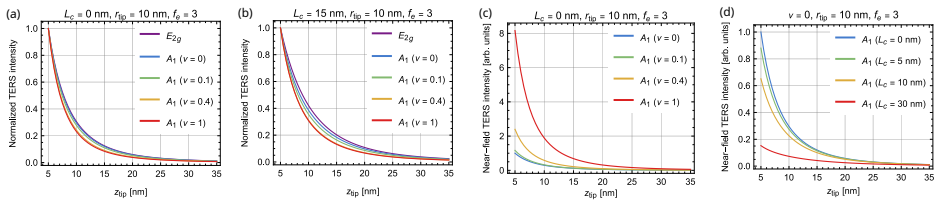
By including the full Raman tensor with out-of-plane elements, an exact analytical expression for tip-sample field propagation is obtained within the dipole and local-response approximations. This expression shows that the sample-tip (TS) scattering pathway contributes appreciably only when the out-of-plane Raman response is non-negligible. Calculations establish that TERS enhancement depends sensitively on the out-of-plane component, normalized tip-approach curves depend primarily on coherence length, and the medium refractive index produces an effective enhancement factor f_e. Existing graphene TERS measurements are consistent with a vanishing out-of-plane response and a non-zero coherence
What carries the argument
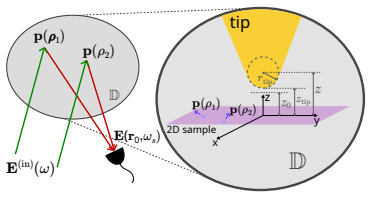
The exact analytical expression for electromagnetic field propagation between tip and sample under the dipole approximation, which separates ST and TS scattering paths and couples them to in-plane versus out-of-plane Raman tensor components.
If this is right
- TERS enhancement varies strongly with the magnitude of the out-of-plane Raman response of the phonon mode.
- Normalized tip-approach curves are primarily sensitive to the TERS coherence length.
- The refractive index of the surrounding medium produces an effective tip enhancement factor f_e.
- Strong overall TERS enhancement is required to distinguish Raman modes that differ in their out-of-plane activity.
- Graphene TERS data are consistent with negligible out-of-plane response and finite coherence length.
Where Pith is reading between the lines
- The same propagation formula may simplify modeling of near-field spectra in other layered materials where out-of-plane modes are active.
- Varying tip radius or wavelength could be used experimentally to modulate the relative weight of the TS pathway.
- If approach curves are dominated by coherence length, they might serve as an independent probe of scattering length even when absolute enhancement is uncertain.
Load-bearing premise
The electromagnetic interaction between tip and sample admits an exact analytical propagation expression under the dipole and local-response approximations.
What would settle it
A TERS measurement that shows a large TS contribution for a purely in-plane Raman mode, or a negligible TS contribution for a mode with strong out-of-plane response, would contradict the central claim.
Figures


read the original abstract
Tip-Enhanced Raman Spectroscopy (TERS) can be used to make nanoscale spatial measurements of 2D materials, such as graphene and transition metal dichalcogenides (TMDs). The TERS theory introduced in [Phys. Rev. X 4, 031054 (2014)], however, was tailored for graphene, whose out-of-plane Raman response is neglected. In the present work, we include the out-of-plane response in the TERS theory. In doing so, we provide an exact analytical expression for the field propagation between the tip and the sample, and show that the contribution to the TERS signal that scatters first at the sample, then at the tip (sample-tip, or TS) is important only when the out-of-plane response is significant. We extensively study the variation of TERS experimental measurements when varying physical parameters of the system, like the tip radius, the out-of-plane response, the TERS coherence length, and others. It becomes evident that the TERS enhancement is very sensitive to the out-of-plane Raman response of the phonon mode, while normalized tip-approach measurements are more sensitive to the coherence length, and we show that the medium refractive index leads to an effective tip enhancement factor $f_e$. Our results lead to the conclusion that, in general, a strong TERS enhancement is a necessary condition for investigating the physics discussed here, which here means surveying the difference in TERS signals between different Raman modes. We use our model to analyze some graphene TERS experiments, showing that they are consistent with a negligible out-of-plane Raman response and a non-zero TERS coherence length in the fitting.
Editorial analysis
A structured set of objections, weighed in public.
Referee Report
Summary. The manuscript extends prior TERS theory (tailored to graphene) to 2D materials by incorporating out-of-plane Raman response. It derives a closed-form analytical expression for tip-sample electromagnetic field propagation under the dipole approximation for the tip and local-response approximation for the sample. The central result is that the sample-tip (TS) scattering pathway contributes appreciably to the TERS signal only when the out-of-plane Raman tensor component is significant; otherwise it is negligible. Systematic parameter sweeps are performed over tip radius, out-of-plane strength, coherence length, and refractive index, revealing differential sensitivities (TERS enhancement to out-of-plane response; normalized tip-approach curves to coherence length). The model is then fitted to existing graphene TERS data, yielding consistency with negligible out-of-plane response and finite coherence length.
Significance. If the results hold, the work supplies a more complete analytical framework for interpreting nanoscale TERS on 2D materials that may possess active out-of-plane modes (e.g., TMDs). Credit is due for the closed-form propagation kernel and the extensive, reproducible parameter sweeps that cleanly separate sensitivities. These features allow quantitative statements about when out-of-plane effects must be retained. The graphene application provides a concrete test case, though its evidential weight is limited by the fitting procedure itself.
major comments (2)
- [Theory section, propagation kernel] Theory section, propagation kernel (exact analytical expression): the derivation assumes a position-independent (local-response) dielectric tensor for the atomically thin 2D layer. For out-of-plane polarization the near-field varies on the lattice-constant scale, so the local-response premise is questionable and may alter the TS kernel differently from the in-plane channels. This directly affects the load-bearing claim that TS vanishes for in-plane-only modes.
- [Graphene application section] Graphene application section: the statements that the data imply 'negligible out-of-plane Raman response' and 'non-zero TERS coherence length' are obtained by fitting precisely those two free parameters inside the model to the same datasets. No independent cross-check (ab initio Raman tensors, separate coherence-length measurement, or out-of-plane-only sample) is shown, weakening the evidential support for the central conclusion.
minor comments (2)
- [Figures] Figure captions for the parameter-sweep panels should explicitly state the normalization used for the TERS intensity (e.g., relative to far-field or to a reference in-plane mode) so that quantitative trends can be read without returning to the text.
- [Notation] Notation: the out-of-plane Raman tensor component is introduced without a dedicated symbol distinct from the in-plane components; adding a subscript (e.g., α_zz) would improve readability when comparing modes.
Simulated Author's Rebuttal
We thank the referee for their careful reading of the manuscript and for the constructive comments, which have helped us improve the clarity and rigor of the presentation. We address each major comment below and indicate the revisions made.
read point-by-point responses
-
Referee: Theory section, propagation kernel (exact analytical expression): the derivation assumes a position-independent (local-response) dielectric tensor for the atomically thin 2D layer. For out-of-plane polarization the near-field varies on the lattice-constant scale, so the local-response premise is questionable and may alter the TS kernel differently from the in-plane channels. This directly affects the load-bearing claim that TS vanishes for in-plane-only modes.
Authors: We agree that the local-response approximation for the dielectric tensor is a simplification whose validity is more limited for out-of-plane polarization, where the near-field varies on the scale of the lattice constant. Our derivation follows the standard local-response treatment used throughout the TERS literature for atomically thin layers. In the revised manuscript we have added an explicit discussion of this approximation in the Theory section, noting that non-local dielectric response could quantitatively modify the TS kernel. Nevertheless, the central qualitative result—that the TS pathway is suppressed for modes with vanishing out-of-plane Raman tensor components—remains intact under the dipole approximation, because the in-plane Raman tensor symmetry and the structure of the propagation kernel still cause the TS term to vanish identically when the out-of-plane polarizability is zero. revision: partial
-
Referee: Graphene application section: the statements that the data imply 'negligible out-of-plane Raman response' and 'non-zero TERS coherence length' are obtained by fitting precisely those two free parameters inside the model to the same datasets. No independent cross-check (ab initio Raman tensors, separate coherence-length measurement, or out-of-plane-only sample) is shown, weakening the evidential support for the central conclusion.
Authors: The referee is correct that the graphene analysis consists of a two-parameter fit to the same experimental data sets. In the revised manuscript we have rephrased the relevant paragraphs to state that the fit is consistent with a negligible out-of-plane Raman response and a finite coherence length, rather than claiming that the data independently establish these values. We have also added an explicit caveat acknowledging the lack of cross-validation against ab initio Raman tensors or independent coherence-length measurements, and we note that such checks would strengthen future applications of the model. revision: partial
Circularity Check
No significant circularity; derivation and fitting are independent of inputs
full rationale
The paper derives an analytical propagation kernel under explicit dipole and local-response approximations, then computes that the TS term vanishes for purely in-plane Raman tensors. This is a direct mathematical consequence of the kernel, not a redefinition or fit. The graphene analysis fits out-of-plane amplitude and coherence length to data and reports consistency; this is ordinary parameter extraction, not a prediction that reduces to the fit by construction. The cited 2014 base theory is extended rather than used to justify the new claims. No step equates to its own input.
Axiom & Free-Parameter Ledger
free parameters (2)
- TERS coherence length
- out-of-plane Raman response strength
axioms (2)
- domain assumption Electromagnetic field propagation between tip and sample admits an exact analytical expression
- domain assumption Raman polarizability can be decomposed into independent in-plane and out-of-plane components
Reference graph
Works this paper leans on
-
[1]
Cardona, ed.,Light scattering in solids I(Springer-Verlag, Berlin, 1983)
M. Cardona, ed.,Light scattering in solids I(Springer-Verlag, Berlin, 1983)
work page 1983
-
[2]
Bloembergen,Nonlinear optics, 4th ed
N. Bloembergen,Nonlinear optics, 4th ed. (World Scientific, New York, 1996)
work page 1996
-
[3]
L. Novotny and B. Hecht,Principles of nano-optics, 2nd ed. (Cambridge University Press, Cambridge, 2012)
work page 2012
-
[4]
S. Kawata and V. M. Shalaev, eds.,Tip enhancement(Elsevier, Amsterdam, 2007)
work page 2007
- [5]
-
[6]
Y.-F. Bao, M.-Y. Zhu, X.-J. Zhao, H.-X. Chen, X. W. Wang, and B. Ren, Nanoscale chemical characterization of materials and interfaces by tip-enhanced Raman spectroscopy, Chem. Soc. Rev. 10.1039/D4CS00588K (2024). 39
- [7]
- [8]
-
[9]
R. S. Alencar, C. Rabelo, H. L. S. Miranda, T. L. Vasconcelos, B. S. Oliveira, A. Ribeiro, B. C. P´ ublio, J. Ribeiro-Soares, A. G. S. Filho, L. G. Can¸ cado, and A. Jorio, Probing spatial phonon correlation length in post-transition metal monochalcogenide GaS using tip-enhanced Raman spectroscopy, Nano Lett.19, 7357 (2019)
work page 2019
-
[10]
L. G. Can¸ cado, R. Beams, A. Jorio, and L. Novotny, Theory of spatial coherence in near-field Raman scattering, Phys. Rev. X4, 031054 (2014)
work page 2014
-
[11]
B. C. Publio, B. S. Oliveira, C. Rabelo, H. Miranda, T. L. Vasconcelos, A. Jorio, and L. G. Can¸ cado, Inclusion of the sample-tip interaction term in the theory of tip-enhanced Raman spectroscopy, Phys. Rev. B105, 235414 (2022)
work page 2022
-
[12]
M. Jin, W. Zheng, Y. Ding, Y. Zhu, W. Wang, and F. Huang, Raman tensor of van der Waals MoSe2, J. Phys. Chem. Lett.11, 4311 (2020)
work page 2020
-
[13]
F. R. Pratama, M. S. Ukhtary, and R. Saito, Non-vertical optical transition in near-field enhanced spectroscopy of graphene, J. Phys.: Condens. Matter31, 265701 (2019)
work page 2019
-
[14]
We do not use repeated index summation convention because it may get ambiguous later
-
[15]
Tan, ed.,Raman spectroscopy of Two-dimensional materials(Springer Nature, Singa- pore, 2019)
P.-H. Tan, ed.,Raman spectroscopy of Two-dimensional materials(Springer Nature, Singa- pore, 2019)
work page 2019
-
[16]
K.-D. Park, O. Khatib, V. Kravtsov, G. Clark, X. Xu, and M. B. Raschke, Hybrid tip-enhanced nanospectroscopy and nanoimaging of monolayer WSe2 with local strain control, Nano Lett. 16, 2621 (2016)
work page 2016
- [17]
-
[18]
Y. Zhao, X. Luo, H. Li, J. Zhang, P. T. Araujo, C. K. Gan, J. Wu, H. Zhang, S. Y. Quek, M. S. Dresselhaus, and Q. Xiong, Interlayer breathing and shear modes in few-trilayer MoS2 and WSe2, Nano Lett.13, 1007 (2013)
work page 2013
-
[19]
Piessens, The Hankel transform, inThe Transforms and Applications Handbook, edited by A
R. Piessens, The Hankel transform, inThe Transforms and Applications Handbook, edited by A. D. Poularikas (CRC Press LLC, Boca Raton, 2000) 2nd ed. 40
work page 2000
-
[20]
H. Miranda, V. Monken, J. a. L. E. Campos, T. L. Vasconcelos, C. Rabelo, B. S. Archanjo, C. M. Almeida, S. Grieger, C. Backes, A. Jorio, and L. Gustavo Can¸ cado, Establishing the excitation field in tip-enhanced Raman spectroscopy to study nanostructures within two- dimensional systems, 2D Mater.10, 015002 (2022)
work page 2022
-
[21]
A. Cuyt, V. B. Petersen, B. Verdonk, H. Waadeland, and W. B. Jones,Handbook of Continued Fractions for Special Functions(Springer, 2008)
work page 2008
-
[22]
Davies,Integral transforms and their applications, 3rd ed
B. Davies,Integral transforms and their applications, 3rd ed. (Springer-Verlag, New York, 2002)
work page 2002
-
[23]
F. E. Relton,Applied Bessel functions(Dover Publications, New York, 1965)
work page 1965
-
[24]
L. G. Can¸ cado, A. Jorio, A. Ismach, E. Joselevich, A. Hartschuh, and L. Novotny, Mechanism of near-field Raman enhancement in one-dimensional systems, Phys. Rev. Lett.103, 186101 (2009)
work page 2009
-
[25]
J. E. Guimar˜ aes, R. Nadas, R. Alves, W. Zhang, T. Endo, K. Watanabe, T. Taniguchi, R. Saito, Y. Miyata, B. R. A. Neves, and A. Jorio, Nano-Raman spectroscopy figure of merit and chemical analysis of contaminations in single-layer MoSe 2, ACS Nano19, 35438 (2025)
work page 2025
-
[26]
J. D. Jackson,Classical Electrodynamics, 3rd ed. (John Wiley & Sons, New York, 1999)
work page 1999
-
[27]
R. B. Nadas, A. C. Gadelha, T. C. Barbosa, C. Rabelo, T. de Louren¸ co e Vasconcelos, V. Monken, A. V. R. Portes, K. Watanabe, T. Taniguchi, J. C. Ramirez, L. C. Campos, R. Saito, L. G. Can¸ cado, and A. Jorio, Spatially coherent tip-enhanced raman spectroscopy measurements of electron–phonon interaction in a graphene device, Nano Lett.23, 8827 (2023)
work page 2023
-
[28]
A. R. Neto, C. Rabelo, L. G. Can¸ cado, M. Engel, M. Steiner, and A. Jorio, Protocol and reference material for measuring the nanoantenna enhancement factor in tip-enhanced Raman spectroscopy, in2019 4th International Symposium on Instrumentation Systems, Circuits and Transducers (INSCIT)(2019) pp. 1–6. 41
work page 2019
discussion (0)
Sign in with ORCID, Apple, or X to comment. Anyone can read and Pith papers without signing in.