Recognition: 2 theorem links
· Lean TheoremGeneralized Global Self-Optimizing Control for Chemical Processes: Part II Objective-Guided Controlled Variable Learning Approach
Pith reviewed 2026-05-12 01:20 UTC · model grok-4.3
The pith
The OGCVL algorithm designs scalable nonlinear controlled variables for global self-optimizing control of chemical processes.
A machine-rendered reading of the paper's core claim, the machinery that carries it, and where it could break.
Core claim
The OGCVL method guides the learning of controlled variables directly by the process objective, allowing seamless symbolic-numerical integration to produce high-quality nonlinear CVs. This overcomes the infeasibility of pure optimization-based g2SOC for large-scale problems while retaining its advantages over regression-based alternatives, as demonstrated by good results and maintained efficiency in two numerical examples.
What carries the argument
The OGCVL algorithm, an objective-guided procedure that learns general nonlinear controlled variables by blending symbolic manipulation with numerical optimization to achieve scalable self-optimizing design.
Load-bearing premise
The assumption that perfect self-optimizing controlled variables exist in theory and that their practical approximation via seamless symbolic-numerical integration will produce high-quality, scalable results in real nonlinear chemical systems without hidden accuracy or computational trade-offs.
What would settle it
A large-scale nonlinear process example in which OGCVL either produces controlled variables with significantly higher economic loss than the optimization-based method or requires computation time comparable to or exceeding that method.
Figures


read the original abstract
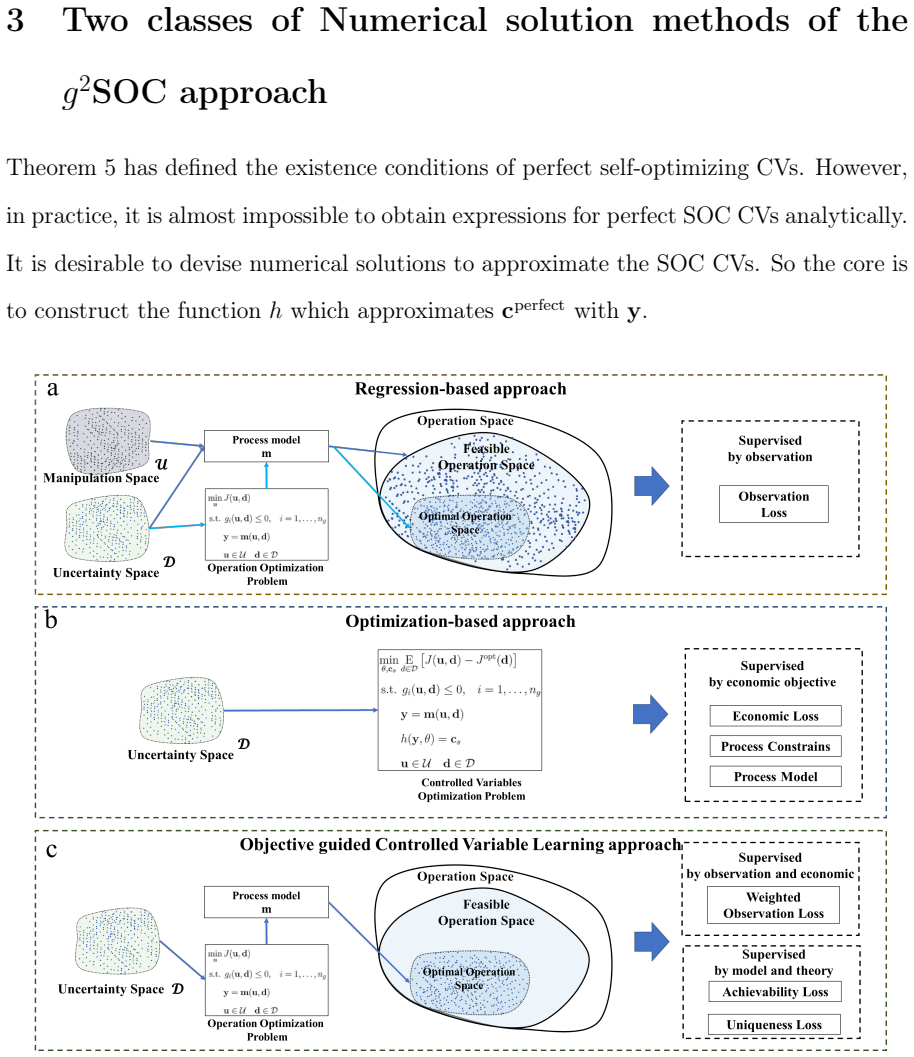
Self-optimizing control (SOC) aims to maintain near-optimal process operation by judiciously selecting controlled variables (CVs). In this series of work, the generalized global SOC (g2SOC) approach is proposed, which extends the concept of SOC to the whole operation space and uses general nonlinear functions to design CVs instead of linear combinations. In the first part of this series work, two numerical approaches for g2SOC are proposed: the optimization-based approach and the regression-based approach, based on a theoretical analysis of the existence of perfect self-optimizing CVs. The CVs designed by the former perform better, but are usually infeasible for large-scale problems. In this paper, we propose an algorithm called objective-guided controlled variable learning (OGCVL) that combines the advantages of both and has a better scalability. OGCVL is proposed for efficient CV design that seamlessly integrates symbolic and numerical computation techniques. Finally, the effectiveness of the OGCVL method is verified in two numerical examples. Both examples illustrate show that the OGCVL method is able to achieve good results while maintaining computational efficiency and is also feasible in large-scale problems.
Editorial analysis
A structured set of objections, weighed in public.
Referee Report
Summary. The paper proposes the objective-guided controlled variable learning (OGCVL) algorithm for generalized global self-optimizing control (g2SOC) of chemical processes. Building on the existence result for perfect self-optimizing controlled variables from Part I, OGCVL integrates symbolic and numerical computation techniques to design nonlinear CVs. It is positioned as combining the performance advantages of the optimization-based approach with the scalability of the regression-based approach. Effectiveness is verified on two numerical examples, which are stated to demonstrate good results, maintained computational efficiency, and feasibility for large-scale problems.
Significance. If the OGCVL method reliably delivers near-optimal performance with improved scalability and no hidden accuracy or computational trade-offs in high-dimensional nonlinear systems, it would advance practical self-optimizing control by enabling its use in large-scale chemical processes where purely optimization-based methods become intractable. The seamless symbolic-numerical integration, if shown to be robust, represents a useful algorithmic contribution for bridging performance and efficiency in SOC design.
major comments (1)
- [§5] §5 (Numerical Examples): the claim that OGCVL 'is also feasible in large-scale problems' rests on verification in two numerical examples, but no problem dimensions, timing or memory scaling data, or head-to-head comparisons against the Part I optimization-based method on larger instances are reported. This makes the large-scale feasibility assertion an extrapolation rather than a demonstrated result.
minor comments (2)
- [Abstract] Abstract: the phrase 'Both examples illustrate show that' contains a duplicated word.
- [Abstract] The abstract refers to 'this series of work' and 'this paper' without an explicit citation to Part I in the opening paragraph; adding a clear forward reference would improve readability.
Simulated Author's Rebuttal
We thank the referee for the constructive comments on our manuscript. We address the major comment point by point below and agree that additional quantitative details will strengthen the presentation of the numerical results.
read point-by-point responses
-
Referee: [§5] §5 (Numerical Examples): the claim that OGCVL 'is also feasible in large-scale problems' rests on verification in two numerical examples, but no problem dimensions, timing or memory scaling data, or head-to-head comparisons against the Part I optimization-based method on larger instances are reported. This makes the large-scale feasibility assertion an extrapolation rather than a demonstrated result.
Authors: We agree that the manuscript would be improved by providing explicit problem dimensions, timing data, and memory usage for the two examples. In the revised manuscript we will add a table in §5 that reports the number of decision variables, equality/inequality constraints, and measured CPU times and peak memory for OGCVL on both examples. We will also include a brief comparison of OGCVL versus the optimization-based method of Part I on the smaller example where the latter remains tractable. Direct head-to-head timing comparisons on instances larger than those solvable by the Part I method are not possible, because that method becomes computationally intractable precisely in the regime where OGCVL is intended to be used; we will state this limitation explicitly rather than implying a full scaling study has been performed. revision: yes
Circularity Check
Minor self-citation to Part I existence result; OGCVL algorithm is a distinct new method with no reduction to prior fits
specific steps
-
self citation load bearing
[Abstract]
"In the first part of this series work, two numerical approaches for g2SOC are proposed: the optimization-based approach and the regression-based approach, based on a theoretical analysis of the existence of perfect self-optimizing CVs. [...] we propose an algorithm called objective-guided controlled variable learning (OGCVL) that combines the advantages of both and has a better scalability. OGCVL is proposed for efficient CV design that seamlessly integrates symbolic and numerical computation techniques."
The new OGCVL method is explicitly positioned as building on the existence result from the authors' own prior Part I paper. While this reference is minor and the algorithm itself is presented as distinct, it qualifies as a self-citation that underpins the claimed theoretical grounding without independent verification in the current work.
full rationale
The paper's core contribution is the proposal of the OGCVL algorithm, which integrates symbolic and numerical techniques to design CVs and is verified through two numerical examples. This is independent of the Part I approaches. The only self-reference is to the theoretical existence of perfect self-optimizing CVs from Part I, which serves as background justification rather than a load-bearing reduction of the new algorithm or its performance claims to prior fitted quantities. No self-definitional loops, fitted inputs renamed as predictions, or ansatz smuggling appear in the described derivation. The scalability assertion is an empirical extrapolation from examples and does not constitute circularity in the mathematical sense.
Axiom & Free-Parameter Ledger
axioms (1)
- domain assumption Existence of perfect self-optimizing controlled variables for the generalized global SOC problem
Lean theorems connected to this paper
-
IndisputableMonolith/Foundation/AlphaCoordinateFixation.leancostAlphaLog_fourth_deriv_at_zero / J_uniquely_calibrated_via_higher_derivative echoesmin_θ E[Lo + λLa + μLu] ... Lw = ||Luu^{1/2} (h(yopt,θ))|| ... La = ||∂h/∂y Gu − I|| ... Lu = Σ ||ck,uu|| (Hessian of CVs)
Reference graph
Works this paper leans on
-
[1]
Optimization of Chemical Processes , author =. 2001 , month = jan, edition =
work page 2001
-
[2]
Adaptation Strategies for Real-Time Optimization , author =. 2009 , journal =
work page 2009
-
[3]
110th Anniversary: A Feature-Based Analysis of Static Real-Time Optimization Schemes , author =. 2019 , journal =
work page 2019
-
[4]
Process Decomposition and the Classification of the Control Tasks
Studies in the Synthesis of Control Structures for Chemical Processes: Part I: Formulation of the Problem. Process Decomposition and the Classification of the Control Tasks. Analysis of the Optimizing Control Structures , author =. 1980 , journal =
work page 1980
-
[5]
Real-Time Optimization as a Feedback Control Problem -- A Review , author =. 2022 , month = may, journal =. doi:10.1016/J.COMPCHEMENG.2022.107723 , urldate =
-
[6]
Real Time Optimization by Extremum Seeking Control , author =. 2003 , publisher =
work page 2003
-
[7]
Use of Measurements for Enforcing the Necessary Conditions of Optimality in the Presence of Constraints and Uncertainty , author =. 2005 , journal =
work page 2005
-
[8]
Plantwide Control: The Search for the Self-Optimizing Control Structure , author =. 2000 , journal =
work page 2000
-
[9]
Global Self-Optimizing Control of Batch Processes , author =. 2024 , month = mar, journal =. doi:10.1016/j.jprocont.2024.103163 , urldate =
-
[10]
Dynamic Controlled Variables Based Dynamic Self-Optimizing Control , author =. 2024 , month = jun, journal =. doi:10.1016/j.jprocont.2024.103228 , urldate =
-
[11]
Skogestad, Sigurd , year =. Self-Optimizing Control: The Missing Link between Steady-State Optimization and Control , shorttitle =. Computers & Chemical Engineering , volume =. doi:10.1016/S0098-1354(00)00405-1 , urldate =
-
[12]
Lagrange-Based Global Self-Optimizing Control for Constraint Activeness Varying Processes , author =. 2023 , journal =
work page 2023
-
[13]
The Existence of Perfect Controlled Variables and Numerical Design Methods , author =
Generalized Global Self-Optimizing Control for Chemical Processes Part I. The Existence of Perfect Controlled Variables and Numerical Design Methods , author =. 2023 , month = sep, journal =. doi:10.1021/acs.iecr.3c01685 , urldate =
-
[14]
Industrial & Engineering Chemistry Research , shortjournal =
Real-Time Optimization of Gold Cyanidation Leaching Process in a Two-Layer Control Architecture Integrating Self-Optimizing Control and Modifier Adaptation , author =. Industrial & Engineering Chemistry Research , shortjournal =. 2017 , date =. doi:10.1021/acs.iecr.6b04801 , url =
-
[15]
Using Stochastic Programming to Train Neural Network Approximation of Nonlinear MPC Laws , author =. 2022 , month = dec, journal =. doi:10.1016/j.automatica.2022.110665 , urldate =
-
[16]
Performance Guaranteed MPC Policy Approximation via Cost Guided Learning , author =. 2024 , journal =. doi:10.1109/LCSYS.2024.3379115 , urldate =
-
[17]
2016 , month = nov, publisher =
Deep Learning , author =. 2016 , month = nov, publisher =
work page 2016
-
[19]
Physics-Informed Deep Learning , author =. Computer vision , langid =
-
[20]
Optimal Control of PDEs Using Physics-Informed Neural Networks , author =. 2023 , month = jan, journal =. doi:10.1016/j.jcp.2022.111731 , urldate =
-
[21]
Physics-Informed Neural Networks: A Deep Learning Framework for Solving Forward and Inverse Problems Involving Nonlinear Partial Differential Equations , author =. 2019 , month = feb, journal =. doi:10.1016/J.JCP.2018.10.045 , urldate =
-
[22]
Andersson, Joel A. E. and Gillis, Joris and Horn, Greg and Rawlings, James B. and Diehl, Moritz , year =. CasADi: A Software Framework for Nonlinear Optimization and Optimal Control , shorttitle =. Mathematical Programming Computation , volume =. doi:10.1007/s12532-018-0139-4 , urldate =
-
[23]
Dontchev, Asen L. and Rockafellar, R. Tyrrell , year =. Implicit Functions and Solution Mappings: A View from Variational Analysis , shorttitle =. doi:10.1007/978-1-4939-1037-3 , urldate =
-
[24]
Chemical Engineering Research and Design , year =
Alabi, SI and Morris, AJ and Martin, EB , title =. Chemical Engineering Research and Design , year =
- [25]
-
[26]
Null Space Method for Selecting Optimal Measurement Combinations as Controlled Variables , author =. 2007 , month = jan, journal =. doi:10.1021/ie060285+ , urldate =
-
[27]
V. Alstad and S. Skogestad and E. S. Hori , title =. J. Process Control , year =
- [28]
-
[29]
Araujo, A. C. B. D. and Hori, E. S. and Skogestad, S. , title =. Ind. Eng. Chem. Res. , year =
-
[30]
Real-time optimization by extremum-seeking control , publisher =. 2003 , author =
work page 2003
-
[31]
Baldea, Michael and Araujo, Antonio and Skogestad, Sigurd and Daoutidis, Prodromos , title =. AIChE journal , year =
-
[32]
Industrial & engineering chemistry research , year =
Basak, Kaushik and Abhilash, KS and Ganguly, Saibal and Saraf, DN , title =. Industrial & engineering chemistry research , year =
-
[33]
Nonlinear programming: theory and algorithms , publisher =. 2013 , author =
work page 2013
-
[34]
Biegler, L. T. , title =. Chemical Engineering and Processing: Process Intensification , year =
-
[35]
Large-Scale Nonlinear Programming Using IPOPT: An Integrating Framework for Enterprise-Wide Dynamic Optimization , author =. 2009 , month = mar, journal =. doi:10.1016/J.COMPCHEMENG.2008.08.006 , urldate =
-
[36]
Neural networks for pattern recognition , publisher =. 1995 , author =
work page 1995
-
[37]
Blondel, V. and Tsitsiklis, J. N. , title =. SIAM Journal on Control and Optimization , year =
-
[38]
IEEE Control Systems Magazine , year =
Bonvin, Dominique and Srinivasan, Bala and Hunkeler, David , title =. IEEE Control Systems Magazine , year =
-
[39]
Iterative algorithms for multilayer optimizing control , publisher =. 2005 , author =
work page 2005
-
[40]
Applied optimal control: optimization, estimation and control , publisher =. 1975 , author =
work page 1975
- [41]
- [42]
- [43]
-
[44]
Cao, Y. and Rossiter, D. and Owens, D. H. , title =. Proc. IFAC symposium on. 1998 , pages =
work page 1998
- [45]
- [46]
-
[47]
Journal of Process Control , year =
Cao, Zhixing and Lu, Jingyi and Zhang, Ridong and Gao, Furong , title =. Journal of Process Control , year =
-
[48]
Chachuat, B. and Marchetti, A. and Bonvin, D. , title =. J. Proc. Control , year =
-
[49]
Chachuat, B. and Srinivasan, B. and Bonvin, D. , title =. Comput. Chem. Eng. , year =
-
[50]
Industrial & engineering chemistry research , year =
Chen, Chun Y and Joseph, Babu , title =. Industrial & engineering chemistry research , year =
-
[51]
Q. Chen and U. Kruger and M. Meronk and A. Y. T. Leung , title =. Control Engineering Practice , year =
-
[52]
T. Chen and J. Morris and E. Martin , title =. Journal of the Royal Statistical Society C (Applied Statistics) , year =
- [53]
- [54]
-
[55]
Cheng and Chiu, Min-Sen , title =
C. Cheng and Chiu, Min-Sen , title =. Chem. Eng. Sci. , year =
-
[56]
Fault Detection and Diagnosis in Industrial Systems. , publisher =. 2001 , author =
work page 2001
-
[57]
S. W. Choi and E. B. Martin and A. J. Morris , title =. Industrial and Engineering Chemistry Research , year =
-
[58]
S. W. Choi and J. H. Park and I.-B. Lee , title =. Computers and Chemical Engineering , year =
- [59]
-
[60]
A directional modifier-adaptation algorithm for real-time optimization , journal =
Costello, Sean and Fran. A directional modifier-adaptation algorithm for real-time optimization , journal =. 2016 , volume =
work page 2016
-
[61]
Mathematics of control, signals and systems , year =
Cybenko, George , title =. Mathematics of control, signals and systems , year =
-
[62]
Dahl-Olsen, H. and Narasimhan, S. and Skogestad, S. , title =. Proc. of American Control Conference , year =
-
[63]
Deshpande, Saurabh Anand , title =
-
[64]
SIAM Journal on Control and Optimization , year =
Deshpande, Saurabh A and Bonvin, Dominique and Chachuat, Benoit , title =. SIAM Journal on Control and Optimization , year =
-
[65]
IFAC Proceedings Volumes , year =
Deshpande, Saurabh and Srinivasan, Bala and Bonvin, Dominique , title =. IFAC Proceedings Volumes , year =
-
[66]
Diwekar, Urmila M and Kalagnanam, Jayant R , title =. AIChE Journal , year =
-
[67]
Downs, J. J. and Skogestad, S. , title =. Ann. Rev. Control , year =
-
[68]
J. J. Downs and E. F. Vogel , title =. Comput. Chem. Eng. , year =
- [69]
-
[70]
Engell, Sebastian , title =. J. Process Control , year =
-
[71]
Proceedings of the 19th IFAC World Congress , year =
Faulwasser, Timm and Bonvin, Dominique , title =. Proceedings of the 19th IFAC World Congress , year =
- [72]
- [73]
-
[74]
Nonlinear and Mixed-Integer Optimization , publisher =. 1995 , author =
work page 1995
- [75]
-
[76]
G. Francois and B. Srinivasan and D. Bonvin , title =. Ind. Eng. Chem. Res. , year =
-
[77]
G. Francois and B. Srinivasan and D. Bonvin , title =. J. Eur. Syst. Autom. , year =. doi:10.3166/JESA.46.291-305 , keywords =
-
[78]
Francois, G. and Srinivasan, B. and Bonvin, D. , title =. J. Process Control , year =
-
[79]
Use of convex model approximations for real-time optimization via modifier adaptation , journal =
Fran. Use of convex model approximations for real-time optimization via modifier adaptation , journal =. 2013 , volume =
work page 2013
-
[80]
Comparison of six implicit real-time optimization schemes , journal =
Fran. Comparison of six implicit real-time optimization schemes , journal =. 2012 , volume =
work page 2012
-
[81]
Fujiwara, K. and Kano, M. and Hasebe, S. and Takinami, A. , title =. AIChE J. , year =
discussion (0)
Sign in with ORCID, Apple, or X to comment. Anyone can read and Pith papers without signing in.