Recognition: no theorem link
Equisingularity in families of double point curves
Pith reviewed 2026-05-12 01:15 UTC · model grok-4.3
The pith
Equisingularity of a map unfolding does not imply equisingularity of its associated double point curve families.
A machine-rendered reading of the paper's core claim, the machinery that carries it, and where it could break.
Core claim
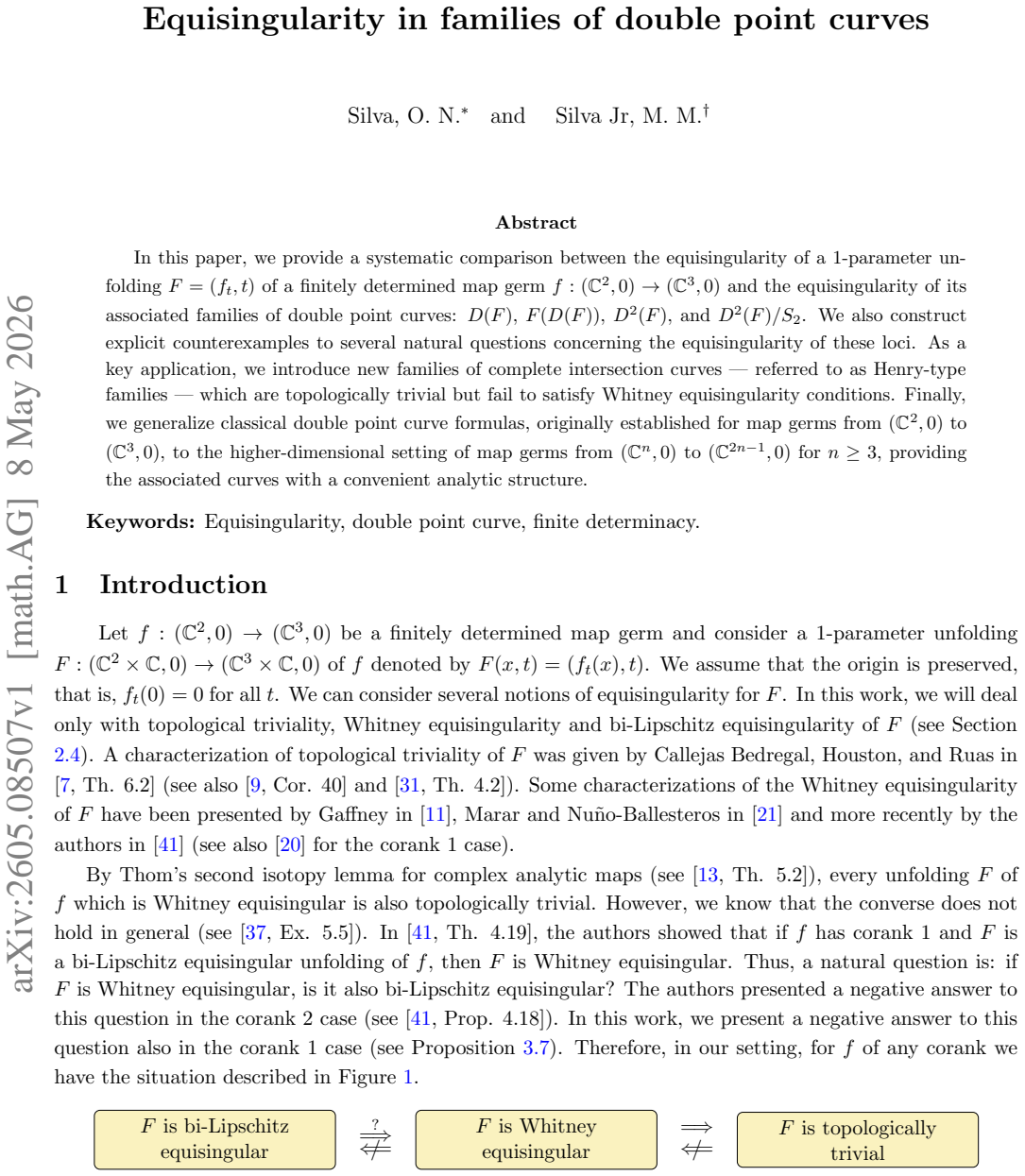
For a 1-parameter unfolding F = (f_t, t) of a finitely determined map germ f from (C^2, 0) to (C^3, 0), the equisingularity of F is compared to that of the families D(F), F(D(F)), D^2(F), and D^2(F)/S_2. The comparison reveals that equisingularity does not transfer between these objects in either direction, with counterexamples constructed. New families of complete intersection curves called Henry-type families are topologically trivial but not Whitney equisingular. Classical formulas for double point curves are generalized to map germs from (C^n, 0) to (C^{2n-1}, 0) for n at least 3, equipped with convenient analytic structures.
What carries the argument
The four families of double point curves D(F), F(D(F)), D^2(F), and D^2(F)/S_2 associated to the unfolding, together with the definitions of equisingularity and Whitney equisingularity applied to them.
If this is right
- The equisingularity of the unfolding F does not determine or follow from the equisingularity of its double point curve families in general.
- Topologically trivial families of complete intersection curves need not satisfy Whitney equisingularity conditions.
- Classical double point curve formulas extend to the setting of map germs in dimensions n to 2n-1 for n greater than or equal to 3.
Where Pith is reading between the lines
- This indicates that equisingularity must be verified independently for the map and for its double point loci when studying deformations in singularity theory.
- The Henry-type families offer concrete test cases for distinguishing different notions of equisingularity in curve families.
- Generalizing the formulas may enable similar comparisons for higher-dimensional mappings and their multiple point loci.
Load-bearing premise
The map germs must be finitely determined and the unfoldings must be one-parameter with the curves carrying convenient analytic structures for the comparisons and counterexamples to apply.
What would settle it
An explicit computation showing that every 1-parameter unfolding of a finitely determined map germ from the plane to space is equisingular precisely when its double point curve families are equisingular, or showing that no topologically trivial complete intersection curve families fail Whitney equisingularity.
Figures

read the original abstract
In this paper, we provide a systematic comparison between the equisingularity of a 1-parameter unfolding F = (f_t, t) of a finitely determined map germ f: (\mathbb{C}^2, 0) \to (\mathbb{C}^3, 0) and the equisingularity of its associated families of double point curves: D(F), F(D(F)), D^2(F), and D^2(F)/S_2. We also construct explicit counterexamples to several natural questions concerning the equisingularity of these loci. As a key application, we introduce new families of complete intersection curves - referred to as Henry-type families - which are topologically trivial but fail to satisfy Whitney equisingularity conditions. Finally, we generalize classical double point curve formulas, originally established for map germs from (\mathbb{C}^2, 0) to (\mathbb{C}^3, 0), to the higher-dimensional setting of map germs from (\mathbb{C}^n, 0) to (\mathbb{C}^{2n-1}, 0) for n \geq 3, providing the associated curves with a convenient analytic structure.
Editorial analysis
A structured set of objections, weighed in public.
Referee Report
Summary. The manuscript provides a systematic comparison between the equisingularity of a 1-parameter unfolding F = (f_t, t) of a finitely determined map germ f: (C^2, 0) → (C^3, 0) and the equisingularity of its associated families of double point curves D(F), F(D(F)), D^2(F), and D^2(F)/S_2. It constructs explicit counterexamples to several natural questions concerning these equisingularities, introduces new families of complete intersection curves called Henry-type families that are topologically trivial but fail Whitney equisingularity, and generalizes classical double point curve formulas to map germs from (C^n, 0) to (C^{2n-1}, 0) for n ≥ 3, endowing the associated curves with a convenient analytic structure.
Significance. If the comparisons, counterexamples, and generalizations hold, the work advances singularity theory by clarifying relationships among equisingularity notions for double-point loci in unfoldings, supplying concrete examples that separate topological triviality from Whitney equisingularity, and extending classical formulas to higher-dimensional map germs. The Henry-type families and the higher-dimensional analytic structures are particularly useful for future studies of equisingularity in families of curves.
minor comments (3)
- In the section introducing Henry-type families, state explicitly which Whitney equisingularity conditions fail and provide the local equations or defining ideals of at least one example to facilitate independent verification.
- In the generalization to n ≥ 3, clarify the precise meaning of 'convenient analytic structure' on the double-point curves and indicate how it is constructed from the map germ (e.g., via Fitting ideals or Fitting ideals of the appropriate module).
- Ensure that the counterexamples in the comparison section include the explicit 1-parameter unfoldings and the computed invariants (e.g., Milnor numbers or multiplicities) that demonstrate the failure of equisingularity equivalence.
Simulated Author's Rebuttal
We thank the referee for the positive evaluation of our manuscript, the accurate summary of its contributions, and the recommendation for minor revision. We are pleased that the comparisons between equisingularity notions, the counterexamples, the introduction of Henry-type families, and the higher-dimensional generalizations are viewed as advancing the field.
Circularity Check
No significant circularity
full rationale
The paper's core contributions consist of explicit comparisons between equisingularity notions for unfoldings and their double-point loci, construction of counterexamples to naive equivalences, introduction of Henry-type families as concrete distinctions, and a generalization of existing double-point formulas to higher dimensions. These rest on standard hypotheses (finite determinacy of map germs and convenient analytic structures on loci) and are carried out via direct constructions rather than any derivation that reduces by definition or self-citation to its own inputs. No equations or fitted parameters are presented as predictions; the work is self-contained through algebraic-geometric constructions and does not invoke load-bearing self-citations or uniqueness theorems from the authors' prior work.
Axiom & Free-Parameter Ledger
Reference graph
Works this paper leans on
-
[1]
R.; Pe˜ nafort-Sanchis, G.; Or´ efice-Okamoto, B.; Tomazella, J
Borges Zampiva, J. R.; Pe˜ nafort-Sanchis, G.; Or´ efice-Okamoto, B.; Tomazella, J. N.:Double points and image of reflection maps. Proc. Roy. Soc. Edinburgh Sect. A., (2025), 1–45
work page 2025
-
[2]
Brasselet, J.-P.; Ruas, M. A. S.; Thuy, N. T. B.:Local bi-Lipschitz classification of semialgebraic surfaces. Dalat Univ. J. Sci.,15(3) (2025), 76–97
work page 2025
-
[3]
Brian¸ con, J.; Galligo, A.; Granger, M.:Deformations ´ equisinguli` eres des germes de courbes gauches r´ eduites. M´ em. Soc. Math. Fr. (N.S.),2(1980), 1–69
work page 1980
-
[4]
Brian¸ con, J.; Speder, J.-P.:Les conditions de Whitney impliquentµconstant. Ann. Inst. Fourier (Grenoble),26(2) (1976), 153—163
work page 1976
-
[5]
Manuscripta Math.,70(1991), 93–114
Br¨ ucker, C.; Greuel, G.-M.:Deformationen isolierter Kurvensingularit¨ aten mit eigebetteten Komponenten. Manuscripta Math.,70(1991), 93–114
work page 1991
-
[6]
O.; Greuel, G.-M.:The Milnor Number and Deformations of Complex Curve Singularities
Buchweitz, R. O.; Greuel, G.-M.:The Milnor Number and Deformations of Complex Curve Singularities. Invent. Math.,58(1980), 241–281
work page 1980
- [7]
-
[8]
Nonlinearity,5(2) (1992), 373–412
Damon, J.:Topological triviality and versality for subgroups ofAandK.II.Sufficient conditions and applications. Nonlinearity,5(2) (1992), 373–412
work page 1992
-
[9]
Fern´ andez de Bobadilla, J.; Pe Pereira, M.:Equisingularity at the Normalisation. J. Topol.,1(4) (2008), 879–909. 22
work page 2008
-
[10]
E.:Topological invariants and Milnor fibre for A-finite germsC 2 →C 3
Fern´ andez de Bobadilla, J.; Pe˜ nafort-Sanchis, G.; Sampaio, J. E.:Topological invariants and Milnor fibre for A-finite germsC 2 →C 3. Dalat Univ. J. Sci.,12(2) (2022), 19–25
work page 2022
-
[11]
Gaffney, T.Polar multiplicities and equisingularity of map germs. Topology,32(1993), 185–223
work page 1993
-
[12]
da:On reflection maps from then-space to then+ 1-space
Gama, M.B.; Silva, O.N. da:On reflection maps from then-space to then+ 1-space. Rev. Mat. Iberoam.,42(2), 441–476, (2026)
work page 2026
-
[13]
G.; Wirthm¨ uller, K.; du Plessis, A
Gibson, C. G.; Wirthm¨ uller, K.; du Plessis, A. A.; Looijenga, E. J. N.:Topological stability of smooth mappings. Springer LNM.,552(1976), 71–88
work page 1976
-
[14]
N.; Snoussi, J.:On tangency in equisingular families of curves and surfaces
Giles-Flores, A.; Silva, O. N.; Snoussi, J.:On tangency in equisingular families of curves and surfaces. Quart. J. Math.,71(2020), 485–505
work page 2020
-
[15]
N.; Snoussi, J.:On the fifth Whitney cone of a complex analytic curve
Giles-Flores, A.; Silva, O. N.; Snoussi, J.:On the fifth Whitney cone of a complex analytic curve. J. Singul.,24 (2022), 96–118
work page 2022
-
[16]
Greuel, G.-M.; Lossen, C.; Shustin, E.:Introduction to singularities and deformations, Springer Monographs in Mathematics. Springer, Berlin, (2007)
work page 2007
-
[17]
Hironaka, H.:On the Arithmetic Genera and the Effective Genera of Algebraic Curves, Mere. Coll. Sci., Univ. of Kyoto 30, 177-195 (1957). [18]Institute IMAGINARY. SURFER– Software for visualization of algebraic surfaces. [Computer Software]. Avail- able at: https://imaginary.org/program/surfer. (Accessed: December 2025)
work page 1957
-
[18]
Jorge-P´ erez, V. H.; Nu˜ no-Ballesteros, J. J.:Finite determinacy and Whitney equisingularity of map germs from Cn toC 2n−1. Manuscripta Math.,128(3) (2009), 389–410
work page 2009
-
[19]
Marar, W. L.; Nu˜ no-Ballesteros, J. J.:Slicing corank 1 map germs fromC 2 toC 3. Quart. J. Math.,65(2014), 1375–1395
work page 2014
-
[20]
Marar, W. L.; Nu˜ no-Ballesteros, J. J.; Pe˜ nafort-Sanchis, G.:Double point curves for corank 2 map germs from C2 toC 3.Topology Appl.,159(2012), 526–536
work page 2012
-
[21]
Marar, W. L.; Mond, D. :Multiple point schemes for corank 1 maps. J. London Math. Soc.,39(1989), 553–567
work page 1989
-
[22]
Mather, J. N.:Stability ofC ∞ mappings. VI: The nice dimensions. Proceedings of Liverpool Singularities- Symposium, I, (1969/70). Lecture Notes in Math., Springer, Berlin,192(1971), 207–253
work page 1969
-
[23]
D.; Weber, C.:Sur le comportement des polaires associ´ ees aux germes de courbes planes
Michel, F.; Tr` ang, L. D.; Weber, C.:Sur le comportement des polaires associ´ ees aux germes de courbes planes. Compositio Math.,72(1989), 87–113
work page 1989
-
[24]
Mond, D.:Some remarks on the geometry and classification of germs of maps from surfaces to 3-space.Topology, 26(1987), 361–383
work page 1987
-
[25]
Mond, D.:On the classification of germs of maps fromR 2 toR 3.Proc. London Math. Soc.,50(3) (1985), 333–369
work page 1985
-
[26]
Mond, D.:The number of vanishing cycles for a quasihomogeneous mapping fromC 2 toC 3. Quart. J. Math.,42 (1991), 335–345
work page 1991
-
[27]
Mond, D.; Nu˜ no-Ballesteros, J. J.:Singularities of Mappings. volume 357 of Grundlehren der mathematischen Wissenschaften. Springer-Verlag, New York, first edition, (2020)
work page 2020
-
[28]
In: Algebraic Geometry and Complex Analysis
Mond, D.; Pellikaan, R.:Fitting ideals and multiple points of analytic mappings. In: Algebraic Geometry and Complex Analysis. Lecture Notes in Math., Springer-Verlag,1414(1987), 107–161
work page 1987
-
[29]
D.; Pichon, A.:Lipschitz geometry of complex curves
Neumann, W. D.; Pichon, A.:Lipschitz geometry of complex curves. J. Singul.,10(2014), 225–234
work page 2014
-
[30]
Nu˜ no-Ballesteros, J. J.; Tomazella, J. N.:Equisingularity of families of map germs between curves, Math. Z.,272 (2012), 349–360. 23
work page 2012
-
[31]
Parusi´ nski, A.; P˘ aunescu, L.:Lipschitz stratification of complex hypersurfaces in codimension 2. J. Eur. Math. Soc.,25(5) (2023), 1743–1781
work page 2023
-
[32]
Pe˜ nafort Sanchis, G.:Reflection maps.Math. Ann.,378(2020), 559–598
work page 2020
-
[33]
PhD Thesis, Universitat de Val` encia, (2016)
Pe˜ nafort-Sanchis, G.:Multiple point spaces of finite holomorphic maps. PhD Thesis, Universitat de Val` encia, (2016)
work page 2016
-
[34]
Pham, F.; Teissier, B.:Fractions lipschitziennes d’une alg` ebre analytique complexe et saturation de Zariski. Centre Math. l’ ´Ecole Polytech., Paris (1969)
work page 1969
-
[35]
Pham, F.; Teissier, B.:Saturation des alg` ebres analytiques locales de dimension un. Appendice in: Briancon, J.; Galligo, A.; Granger, M.: D´ eformations ´ equisingulieres des germes de courbes gauches r´ eduites. M´ em. Soc. Math. France, deuxi` eme s´ erie, tome 1,1(1980) , 1–69
work page 1980
-
[36]
Ruas, M. A. S.; Silva, O. N.:Whitney equisingularity of families of surfaces inC 3. Math. Proc. Cambridge Philos. Soc.,166(2) (2019), 353–369
work page 2019
-
[37]
E.:Bi-Lipschitz homeomorphic subanalytic sets have bi-Lipschitz homeomorphic tangent cones
Sampaio, J. E.:Bi-Lipschitz homeomorphic subanalytic sets have bi-Lipschitz homeomorphic tangent cones. Se- lecta Math. (N.S.),22(2016), 553–559
work page 2016
-
[38]
N.:Surfaces with non-isolated singularities
Silva, O. N.:Surfaces with non-isolated singularities. PhD thesis, S˜ ao Carlos, Universidade de S˜ ao Paulo, (2017), Available at: http://www.teses.usp.br/teses/disponiveis/55/55135/tde-10052017-085440/pt-br.php. (Ac- cessed: December 2025)
work page 2017
-
[39]
N.:On the topology of the transversal slice of a quasi-homogeneous map germ
Silva, O. N.:On the topology of the transversal slice of a quasi-homogeneous map germ. Math. Proc. Cambridge Philos. Soc.,176(2) (2024), 339–359
work page 2024
-
[40]
Silva, O. N.; Silva Jr, M. M.:Transverse slices, Ruas’ conjecture, and Zariski’s multiplicity conjecture for quasi- homogeneous surfaces. Preprint: arXiv:2509.01634 (2025)
-
[41]
Silva, O.N.:On Invariants of Generic Slices of Weighted Homogeneous Corank 1 Map Germs from the Plane to 3-Space. Bull. Braz. Math. Soc.,52, 663–677, (2021)
work page 2021
-
[42]
Wall, C. T. C.:Finite determinacy of smooth map germs. Bull. London Math. Soc.,13(1981), 481–539
work page 1981
-
[43]
Whitney, H.:Local properties of analytic varieties. Differ. and Combinat. Topology, Sympos. Marston Morse, Princeton (1965), 205–244
work page 1965
-
[44]
A computer algebra system for polyno- mial computations
Wolfram, D.; Greuel, G.-M.; Pfister, G.; Sch¨ onemann, H.:Singular 4-0-2. A computer algebra system for polyno- mial computations. 2015:https://www.singular.uni-kl.de. 24
work page 2015
discussion (0)
Sign in with ORCID, Apple, or X to comment. Anyone can read and Pith papers without signing in.