Recognition: 2 theorem links
· Lean TheoremNonparametric Empirical Bayes Confidence Intervals
Pith reviewed 2026-05-12 00:49 UTC · model grok-4.3
The pith
Nonparametric empirical Bayes intervals achieve asymptotic exact coverage for individual effects in a normal means model.
A machine-rendered reading of the paper's core claim, the machinery that carries it, and where it could break.
Core claim
The NP-EBCIs, formed by replacing oracle posterior quantiles under a point-identified nonparametric prior with feasible nonparametric estimates, are asymptotically exact: conditional coverage given the individual effect and marginal coverage both converge to the nominal level as the number of units grows, with coverage errors vanishing at the logarithmic rate that is minimax optimal for the underlying deconvolution problem.
What carries the argument
Nonparametric estimation of posterior quantiles under a point-identified prior in the normal means model.
If this is right
- Both conditional and marginal coverage probabilities converge to the nominal level at the logarithmic rate inherited from deconvolution.
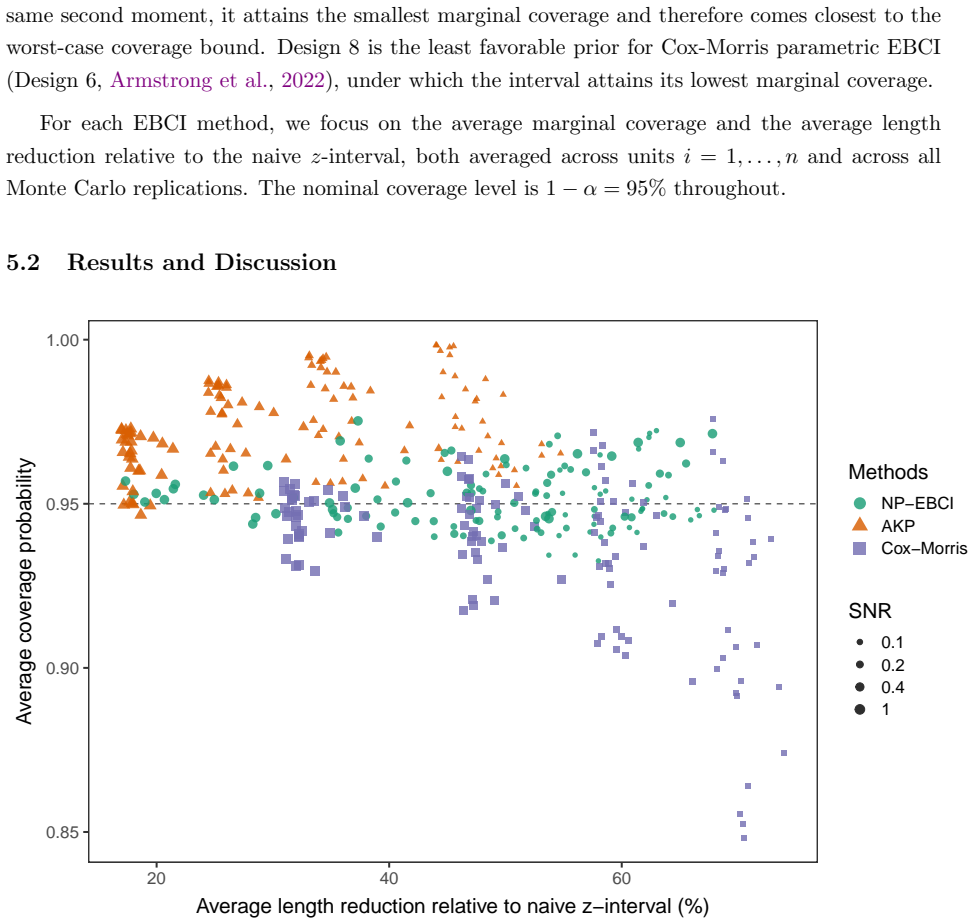
- The intervals deliver substantial length reductions relative to intervals constructed for each unit in isolation.
- The intervals remain close to nominal coverage in finite samples even when the underlying prior is non-Gaussian.
- Errors in the marginal coverage probability also vanish at the same logarithmic rate as the conditional coverage errors.
Where Pith is reading between the lines
- The logarithmic rate implies that reliable performance in practice will require either large numbers of units or additional smoothness assumptions on the prior.
- The construction may extend to other deconvolution settings where posterior quantiles rather than means are the target and point identification holds.
- Practitioners facing many parallel estimation problems could adopt the method when borrowing strength is valuable and asymptotic guarantees suffice.
Load-bearing premise
The observations follow a normal means model whose nonparametric prior is point-identified so that posterior quantiles can be consistently estimated from the data.
What would settle it
A sequence of simulations or real datasets in which the empirical coverage of the NP-EBCIs fails to approach the nominal level as the number of units increases while the prior remains non-Gaussian.
Figures
read the original abstract
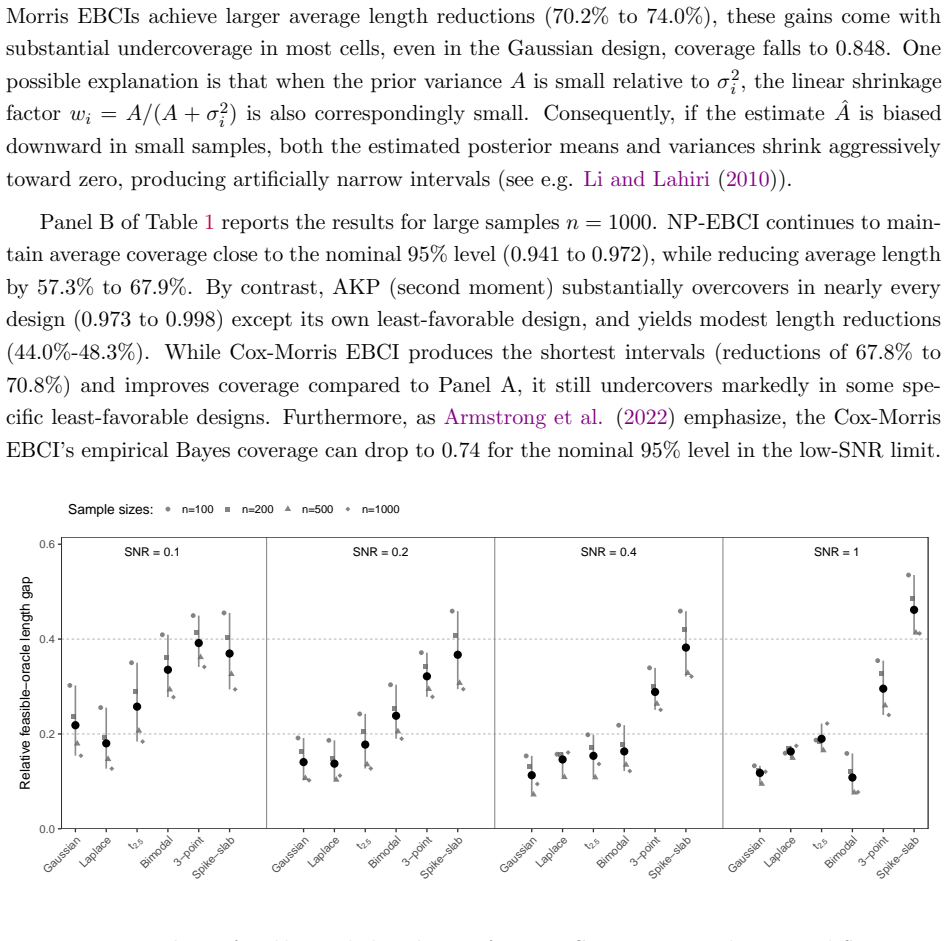
Empirical Bayes methods can improve inference on unobservable individual effects by borrowing strength across units. This paper proposes nonparametric empirical Bayes confidence intervals (NP-EBCIs) for unobservable individual effects in a normal means model. The oracle intervals are constructed from posterior quantiles under a point-identified, fully nonparametric prior; feasible intervals replace these quantiles with nonparametric estimates. The NP-EBCIs are asymptotically exact in the sense that both their conditional and marginal coverage probabilities converge to the nominal level. The flexibility of this nonparametric construction has an unavoidable statistical cost. We demonstrate that posterior quantiles, unlike posterior means, inherit the severe ill-posedness of nonparametric deconvolution: the minimax optimal estimation rate is logarithmic. This logarithmic rate is minimax optimal for errors in the conditional coverage probability, and the resulting errors in the marginal coverage probability also vanish at the same logarithmic rate. Despite these slow asymptotic rates, simulations show that the NP-EBCIs remain close to nominal coverage when the prior is non-Gaussian, and deliver substantial length reductions relative to intervals that treat each unit in isolation.
Editorial analysis
A structured set of objections, weighed in public.
Referee Report
Summary. The paper proposes nonparametric empirical Bayes confidence intervals (NP-EBCIs) for unobservable individual effects in a normal means model. Oracle intervals are constructed from posterior quantiles under a point-identified, fully nonparametric prior; feasible intervals replace these quantiles with nonparametric estimates. The NP-EBCIs are asymptotically exact in the sense that both their conditional and marginal coverage probabilities converge to the nominal level. The flexibility of this nonparametric construction has an unavoidable statistical cost: posterior quantiles inherit the severe ill-posedness of nonparametric deconvolution, with a logarithmic minimax optimal estimation rate. This rate is shown to be minimax optimal for errors in the conditional coverage probability, with marginal coverage errors vanishing at the same rate. Simulations demonstrate that the NP-EBCIs remain close to nominal coverage when the prior is non-Gaussian and deliver substantial length reductions relative to intervals that treat each unit in isolation.
Significance. If the asymptotic coverage results hold under the stated conditions, the paper makes a valuable contribution by extending empirical Bayes methods to a fully nonparametric setting while rigorously establishing asymptotic exactness for both conditional and marginal coverage. The precise characterization of the logarithmic rate as the unavoidable cost of nonparametric flexibility, and its sufficiency for vanishing coverage errors, is a clear theoretical strength. The simulation evidence provides useful practical validation. The application of standard deconvolution theory to the normal means model is cleanly executed and yields falsifiable predictions about coverage behavior.
minor comments (4)
- The introduction and Section 2 could more explicitly state the precise technical conditions (e.g., smoothness assumptions on the prior density and the form of the deconvolution kernel) under which the logarithmic rate is derived, to aid readers in assessing applicability.
- In the simulation section, the choice of tuning parameters for the nonparametric estimator (bandwidth or regularization) is not fully detailed; adding a brief sensitivity analysis or default selection rule would improve reproducibility.
- Notation for the oracle versus feasible posterior quantiles is occasionally overloaded; a dedicated table or display equation summarizing the two constructions would enhance clarity.
- The paper cites the relevant deconvolution literature but could add a short paragraph contrasting the NP-EBCI rate with existing parametric EB confidence interval results to better situate the contribution.
Simulated Author's Rebuttal
We thank the referee for their supportive review and recommendation of minor revision. The referee's summary accurately captures the paper's focus on constructing NP-EBCIs from nonparametric posterior quantiles, establishing asymptotic exact coverage (both conditional and marginal) at logarithmic rates due to deconvolution ill-posedness, and demonstrating length reductions in simulations relative to isolated intervals.
Circularity Check
No significant circularity detected
full rationale
The paper's central claims rest on applying known minimax rates from nonparametric deconvolution to posterior quantiles in the normal means model. Asymptotic exactness of both conditional and marginal coverage follows from showing that quantile estimation errors vanish (at the logarithmic rate), which is a standard result independent of the coverage statements themselves. No derivation step reduces by construction to a fitted parameter renamed as a prediction, a self-referential definition, or a load-bearing self-citation chain. The feasible estimator is constructed to inherit oracle properties asymptotically without circularity.
Axiom & Free-Parameter Ledger
axioms (2)
- domain assumption Observations follow a normal means model: each observation equals an unobservable individual effect plus independent normal noise.
- domain assumption The prior distribution on individual effects is point-identified and fully nonparametric.
Reference graph
Works this paper leans on
-
[1]
Amiti, M. and D. E. Weinstein(2018): “How much do idiosyncratic bank shocks affect in- vestment? Evidence from matched bank-firm loan data,”Journal of Political Economy, 126, 525–587. Angelopoulos, A. N. and S. Bates(2023): “Conformal Prediction: A Gentle Introduction,” Foundations and Trends in Machine Learning, 16, 494–591. Armstrong, T. B., M. Koles´ar...
work page 2018
-
[2]
On the foundations of statistical inference,
Berger, J. O.(1985):Statistical Decision Theory and Bayesian Analysis, Springer Series in Statistics, New York: Springer, 2nd ed. Birnbaum, A.(1962): “On the foundations of statistical inference,”Journal of the American Statistical Association, 57, 269–306. Bonhomme, S. and A. Denis(2024): “Estimating heterogeneous effects: applications to labor economics...
work page 1985
-
[3]
Empirical Bayes when estimation precision predicts parameters,
Chen, J.(2026): “Empirical Bayes when estimation precision predicts parameters,”Econometrica, 94, 305–340. Chen, X., O. Linton, and I. Van Keilegom(2003): “Estimation of semiparametric models when the criterion function is not smooth,”Econometrica, 71, 1591–1608. Chen, X. and D. Pouzo(2015): “Sieve Wald and QLR inferences on semi/nonparametric con- dition...
work page 2026
-
[4]
The impacts of neighborhoods on intergenerational mo- bility I: Childhood exposure effects,
Chetty, R. and N. Hendren(2018): “The impacts of neighborhoods on intergenerational mo- bility I: Childhood exposure effects,”The quarterly journal of economics, 133, 1107–1162. Cox, D. R.(1958): “Some problems connected with statistical inference,”The Annals of Mathe- matical Statistics, 29, 357–372. ——— (1975): “Prediction intervals and empirical Bayes ...
work page 2018
-
[5]
Empirical Bayes deconvolution estimates,
——— (2016): “Empirical Bayes deconvolution estimates,”Biometrika, 103, 1–20. ——— (2019): “Bayes, oracle Bayes and empirical Bayes,”Statistical science, 34, 177–201. Escanciano, J. C.(2023): “Irregular identification of structural models with nonparametric unobserved heterogeneity,”Journal of Econometrics, 234, 106–127. Fan, J.(1991): “On the optimal rates...
work page 2016
-
[6]
Sources of geographic variation in health care: Evidence from patient migration,
Finkelstein, A., M. Gentzkow, and H. Williams(2016): “Sources of geographic variation in health care: Evidence from patient migration,”The quarterly journal of economics, 131, 1681–1726. Folland, G. B.(1999):Real analysis: modern techniques and their applications, John Wiley & Sons. Gaillac, C.(2024): “Predicting Unobserved Individual-level Causal Effects...
-
[7]
Ill-posed inverse problems in economics,
——— (2009):Semiparametric and nonparametric methods in econometrics, vol. 12, Springer. ——— (2014): “Ill-posed inverse problems in economics,”Annu. Rev. Econ., 6, 21–51. Horowitz, J. L. and S. Lee(2005): “Nonparametric estimation of an additive quantile regression model,”Journal of the American Statistical Association, 100, 1238–1249. Horowitz, J. L. and ...
work page 2009
-
[8]
General maximum likelihood empirical Bayes estimation of normal means,
Jiang, W. and C.-H. Zhang(2009): “General maximum likelihood empirical Bayes estimation of normal means,”The Annals of Statistics, 37, 1647–1684. Kiefer, J.(1967): “On Bahadur’s representation of sample quantiles,”The Annals of Mathemat- ical Statistics, 38, 1323–1342. Kiefer, J. and J. Wolfowitz(1956): “Consistency of the maximum likelihood estimator in ...
-
[9]
Asymptotics for least absolute deviation regression estimators,
——— (1991): “Asymptotics for least absolute deviation regression estimators,”Econometric The- ory, 7, 186–199. Polyanskiy, Y. and Y. Wu(2020): “Self-regularizing property of nonparametric maximum likelihood estimator in mixture models,”arXiv preprint arXiv:2008.08244. Robbins, H.(1956): “An Empirical Bayes Approach to Statistics,” inProceedings of the Thi...
-
[10]
An introductory guide to Fano’s inequality with appli- cations in statistical estimation,
Scarlett, J. and V. Cevher(2019): “An introductory guide to Fano’s inequality with appli- cations in statistical estimation,”arXiv preprint arXiv:1901.00555. Schennach, S. M.(2020): “Mismeasured and unobserved variables,” inHandbook of econometrics, Elsevier, vol. 7, 487–565. Soloff, J. A., A. Guntuboyina, and B. Sen(2025): “Multivariate, heteroscedastic ...
-
[11]
On differentiable functionals,
Tsybakov, A. B.(2008):Introduction to Nonparametric Estimation, Springer Publishing Com- pany, Incorporated, 1st ed. Ullah, A. and A. Pagan(1999):Nonparametric econometrics, Cambridge university press Cam- bridge. van der Vaart, A.(1991): “On differentiable functionals,”The Annals of Statistics, 178–204. van der Vaart, A. W. and J. A. Wellner(1996):Weak C...
work page 2008
-
[12]
In this subsection, we characterize the decay behavior of the Fourier coefficients of the weighting functionψ(q 0, θ;y) = (τ−1{θ≤q 0})ϕ y−θ σ : ψ⋆(q0, t;y) := Z exp(−itθ) (τ−1{θ≤q 0})ϕ y−θ σ dθ(A.1) Its decay behavior plays a crucial role in our analysis of convergence rates of the posterior quantile. Proposition A.1.The Fourier coefficients of the weight...
work page 1973
-
[13]
The baseline densityg 0 is Cauchy with Fourier transformationg ⋆ 0(t) = exp(−λ|t|)
andg 1(θ) =g 0(θ) +H T (θ) (A.3) 35 whereg 0(θ) is a fixed baseline density andH T (θ) is a local perturbation that will be specified later. The baseline densityg 0 is Cauchy with Fourier transformationg ⋆ 0(t) = exp(−λ|t|). Moreover Z |g⋆ 0(t)|2(1 +t 2)sdt= Z exp(−2λ|t|)(1 +t 2)sdt→0 asλ→ ∞. Therefore, we may chooseλlarge enough so that R |g⋆ 0(t)|2(1 +t...
work page 1999
-
[14]
Then its Fourier transform is H ⋆ T (t) =νT −s−1/2(−isgn(t)) exp(itq0)k⋆(|t|/T).(A.5) 21HereC ∞(E) means the smooth functions onE: all partial derivatives of every finite order exist and are contin- uous, see Folland (1999, p.235). 36 Step
work page 1999
-
[15]
Hence (fY )0(y)≥ c 1+y2 for ally∈R
≥ cη 1+y2 . Hence (fY )0(y)≥ c 1+y2 for ally∈R. Therefore χ2 ((fY )1,(f Y )0) = Z R uT (y)2 (fY )0(y)dy≤C Z R (1 +y 2)uT (y)2dy. Then it suffices to show thatS T := R R(1 +y 2)uT (y)2dy=O(n −1). 39 By Parseval’s identity, we have that Z uT (y)2dy= 1 2π Z |H ⋆ T (t)|2 exp −σ2t2 dt≤Cν 2T −2s exp(−σ2T 2).(A.8) Also, since the Fourier transformation ofyu T (y...
work page 2011
-
[16]
= (2π) −1R ψ⋆(q0, t;y)g ⋆(t)dt= R (τ−1{θ≤q 0})ϕ y−θ σ g(θ)dθ≡ 0, which corresponds to the moment condition. In this sense, Ψ n(q0) can be viewed as a sample moment function, andbqn as the associatedZ-estimator. 41 (b) =r −1 n Z δ 0 Z 1{θ−q 0 ≤r −1 n z} −1{θ−q 0 ≤0} ϕ y−θ σ ˆg(θ)dθ dz =r −1 n Z δ 0 Z q0+r−1 n z q0 ϕ y−θ σ ˆg(θ)dθdz (c) =r −1 n Z q0+r−1 n δ...
work page 2011
-
[17]
First, we bound the Kullback-Leibler divergence between the laws ofY −i under different alternatives
The alternatives are statistically close We now show that the alternatives constructed in Step 1 are statistically close. First, we bound the Kullback-Leibler divergence between the laws ofY −i under different alternatives. Second, because the target of the lower bound is the conditional coverage probability at a fixedy, we show that the corresponding pos...
work page 2008
-
[18]
First, we construct a finite local packing of alternatives
Reduction to multiple testing This step completes the proof by using a local Fano argument. First, we construct a finite local packing of alternatives. Choose a subsetM T ⊂ {1, ..., M}such that|m−m ′|>2r+ 1 for all 52 distinctm, m ′ ∈ M T . Becauseris fixed andM≍T, such a subset can be chosen with|M T | ≍T. For eachm∈ M T , we define the errors in conditi...
work page 2019
-
[19]
We next considerA n2. Assumption 3.8 implies that |An2| ≤π −1 E [π(q(Yi)|Y i)|Ψn2(Yi)|].(A.37) Now, the same argument used to analyze Ψn2(q0) in Appendix A.3 applies uniformly overy∈ Y because Proposition A.1 gives thet −1 bound on the Fourier coefficient of the weighting function uniformly overy∈ Y. Therefore sup y∈Y |Ψn2(y)|=O h s+1/2 n .(A.38) Combinin...
work page 2014
-
[20]
1 n nX i=1 K y−Y i hn −f Y (y) ! +σ 3 1 nh2n K′ y−Y i hn −f ′ Y (y) . The convergence rate analysis follows directly from standard results on kernel density estimation (see e.g. Ullah and Pagan (1999); Li and Racine (2007); Horowitz (2009, Appendix) for textbook treatments). We note that the optimal rates of convergence of Ψ n(m0)−Ψ(m
work page 1999
-
[21]
This smoothnessrin our setting is characterized in Proposition C.3
coincides with that for estimating the derivative of a density, namelyn −(r−1)/(2r+1), whereris the smoothness of fY (y) (Stone, 1980). This smoothnessrin our setting is characterized in Proposition C.3. Proposition C.3.Under the normal location model (2.1) and the smoothness assumption for g∈ G(s, L)(3.2), we have thatf Y (y)is super-smooth in the sense ...
work page 1980
-
[22]
To let the kernel estimator match this parametric rate, one should use an infinite-order kernel
– and thus the posterior mean – isO p(n−1/2). To let the kernel estimator match this parametric rate, one should use an infinite-order kernel. For instance, the sinc kernelK(z) = sin(z)/πzhas infinite order,23 see e.g. Meister (2009, Page
work page 2009
-
[23]
for more details. Remark C.1.The point of parametric rate of the posterior mean in the normal location model has been previously made in the empirical Bayes literature. Zhang (1997, Theorem
work page 1997
-
[24]
showed that the kernel estimator for thek-th derivative of marginal density ˆf (k)(·) converges at parametric rate (up to a logarithm factor) inL 2 andL ∞ norm. By Tweedie’s formula, one can obtain that the posterior mean shall also convergence at parametric rate. Zhang (2009, Theorem
work page 2009
-
[25]
showed that the generalized maximum likelihood estimator (GMLE) for the marginal densityf Y (y) converges at parametric rate (up to a logarithm factor) in Hellinger distance given that the mixing distribution has compact support or has a heavier-than-normal exponential tail. C.3 Extension to precision dependence The baseline model in Section 4.1 treats th...
work page 2026
-
[26]
Therefore the dominated convergence theorem yields that sup θ∈R |Sn2(θ)|=o(1)
By Assumption 3.1,g ⋆ ∈L 1(R). Therefore the dominated convergence theorem yields that sup θ∈R |Sn2(θ)|=o(1). For the first termS n1(θ), sinceK ⋆ is supported on [−1,1], we have that sup θ∈R |Sn1(θ)|= sup θ∈R (2π)−1 Z exp(−itθ) f ⋆ε (t) bf ⋆ Y (t)−f ⋆ Y (t) K⋆(hnt)dt ≤sup |t|≤h−1 n bf ⋆ Y (t)−f ⋆ Y (t) ×(2π) −1 Z h−1 n −h−1 n |K⋆(hnt)| |f ⋆ε (t)| dt(D.1) ...
work page 1983
discussion (0)
Sign in with ORCID, Apple, or X to comment. Anyone can read and Pith papers without signing in.