Recognition: 2 theorem links
· Lean TheoremYoung tableau descriptions for the polyhedral realizations of crystal bases in type A_n
Pith reviewed 2026-05-12 00:59 UTC · model grok-4.3
The pith
Reverse semi-standard Young tableaux correspond explicitly to the polyhedral realizations of crystal bases in type A_n.
A machine-rendered reading of the paper's core claim, the machinery that carries it, and where it could break.
Core claim
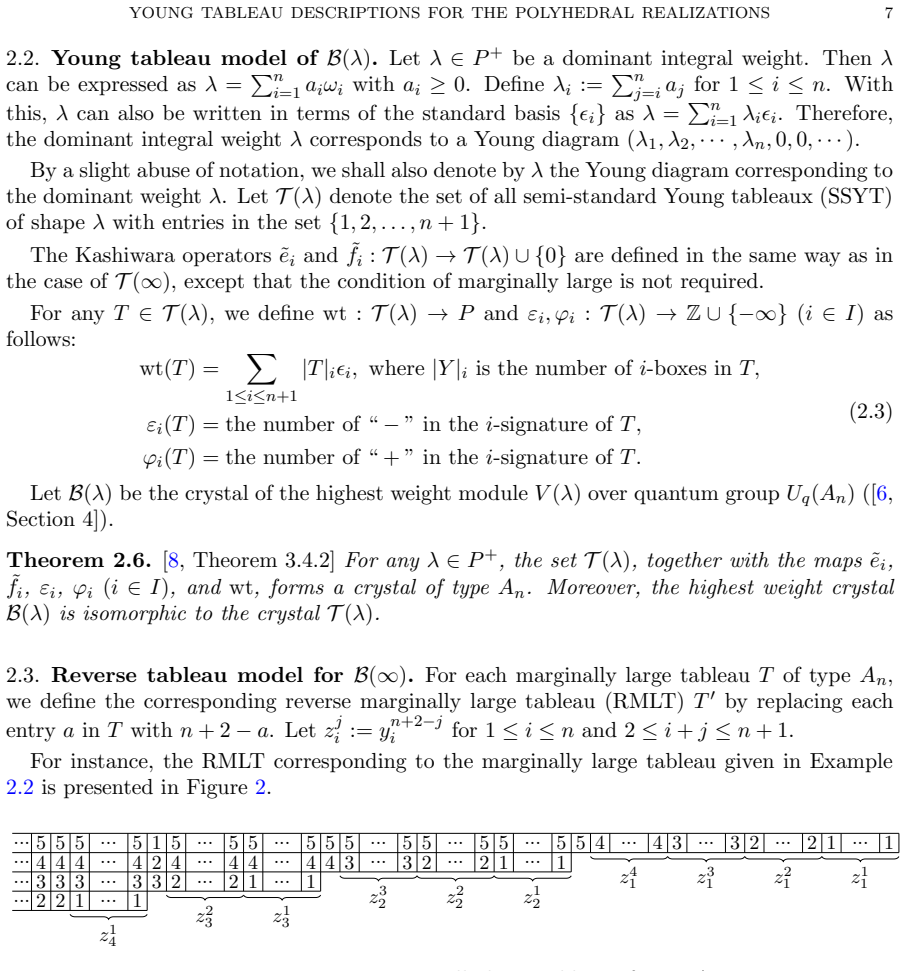
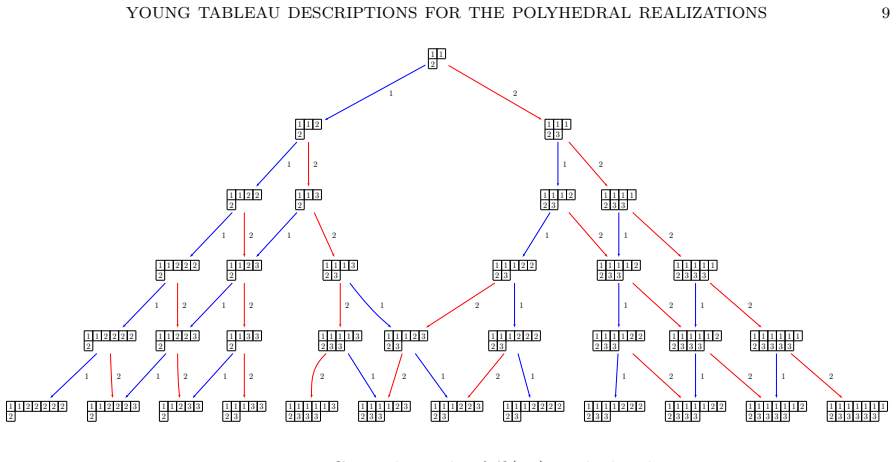
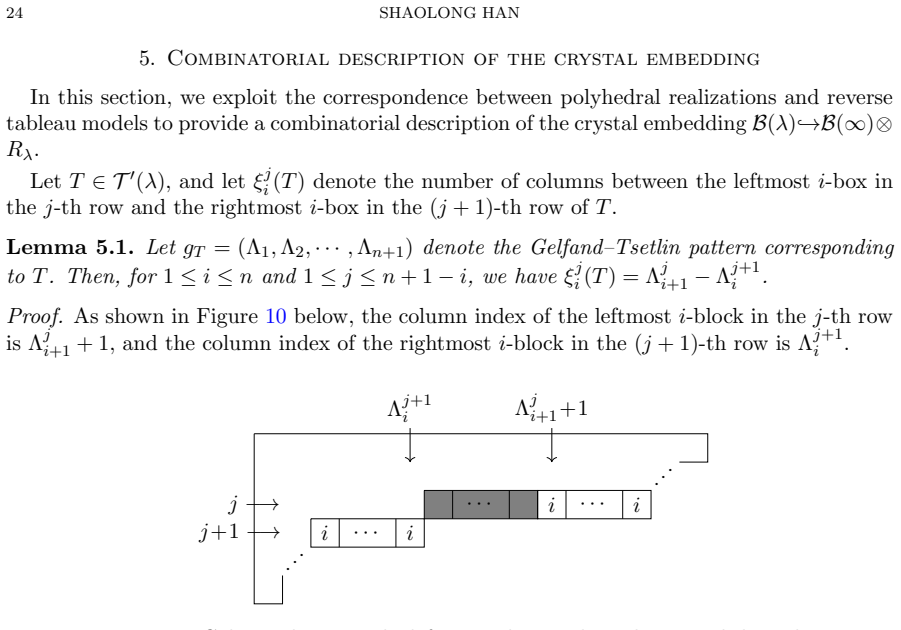
The polyhedral realization of the crystal basis B(λ) for a dominant integral weight λ is in one-to-one correspondence with the set of reverse semi-standard Young tableaux of shape λ, and the polyhedral realization of B(∞) corresponds to the set of reverse marginally large tableaux. Under this correspondence the Kashiwara crystal operators on the polyhedral side are realized by the standard bumping or sliding rules on the reverse tableaux. The same correspondence yields a crystal structure on Gelfand-Tsetlin patterns and gives explicit combinatorial realizations of the embedding B(λ) ⊂ B(∞) together with the Lusztig data.
What carries the argument
The explicit bijection between polyhedral realizations of B(λ) (resp. B(∞)) and reverse semi-standard Young tableaux (resp. reverse marginally large tableaux), which preserves the action of the crystal operators.
If this is right
- The crystal embedding of B(λ) into B(∞) acquires a direct description in terms of inclusion of reverse tableaux.
- The set of Lusztig data receives a combinatorial parametrization via these tableaux.
- Gelfand-Tsetlin patterns become equipped with a crystal basis structure through the transported operators.
- Computations involving the polyhedral realizations can be performed using the well-studied algorithms for Young tableaux.
Where Pith is reading between the lines
- Similar tableau correspondences might be sought for crystal bases in other Lie types where polyhedral realizations are known.
- The approach could connect polyhedral geometry of crystals to classical tableau identities such as the Littlewood-Richardson rule.
- Explicit generating functions for the polyhedral realizations may now be derived from known tableau enumerations.
Load-bearing premise
The combinatorial properties of reverse semi-standard Young tableaux and reverse marginally large tableaux fully reproduce the structure of the polyhedral realizations, including all crystal operators, without missing cases or needing type-specific adjustments.
What would settle it
Finding a weight vector or a specific tableau for which the Kashiwara operator computed from the polyhedral inequalities produces a result different from the one given by the reverse tableau rule would disprove the claimed correspondence.
Figures




read the original abstract
By utilizing the combinatorial properties of various tableau models, we establish an explicit correspondence between the polyhedral realizations of the crystal bases $\mathcal B(\lambda)$ (resp. $\mathcal B(\infty)$) of type $A_n$ and the reverse semi-standard Young tableaux (resp. reverse marginally large tableaux), thereby providing a combinatorial description of the corresponding polyhedral realizations. Furthermore, a crystal structure on the set of Gelfand-Tsetlin patterns is obtained via the correspondence between the polyhedral realization of $\mathcal{B}(\lambda)$ and the reverse tableaux. As applications of our framework, we present concrete combinatorial realizations of the crystal embedding of $\mathcal B(\lambda)$ into $\mathcal B(\infty)$ and the set of Lusztig data.
Editorial analysis
A structured set of objections, weighed in public.
Referee Report
Summary. The manuscript claims to establish an explicit correspondence between the polyhedral realizations of the crystal bases B(λ) (resp. B(∞)) of type A_n and reverse semi-standard Young tableaux (resp. reverse marginally large tableaux) by utilizing combinatorial properties of these tableau models. This yields a combinatorial description of the polyhedral realizations, a crystal structure on Gelfand-Tsetlin patterns via the B(λ) correspondence, and applications to explicit combinatorial realizations of the crystal embedding B(λ) ↪ B(∞) and the set of Lusztig data.
Significance. If the bijections and the verification that tableau rules reproduce the piecewise-linear polyhedral crystal operators hold, the work supplies a concrete combinatorial bridge between polyhedral models and standard tableau combinatorics in type A. This strengthens explicit access to crystal embeddings and Lusztig data by composition with known maps, and the Gelfand-Tsetlin corollary follows directly from the B(λ) case.
minor comments (2)
- The abstract asserts the correspondence via combinatorial properties but does not outline the verification steps (e.g., how the tableau operators are shown to match the polyhedral piecewise-linear functions); a one-sentence sketch in the introduction would aid readers.
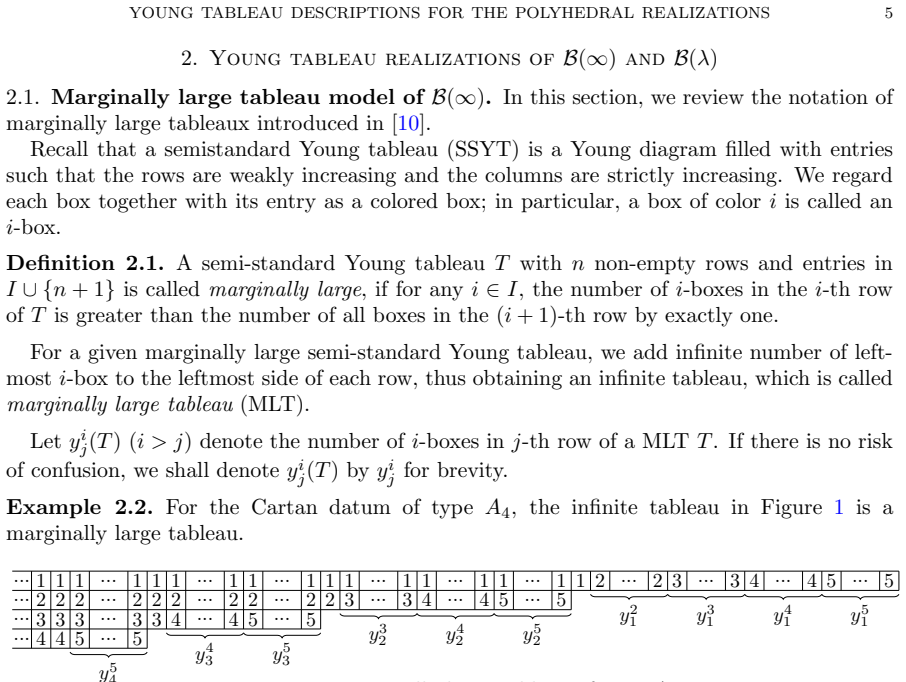
- Notation for the reverse tableaux and the precise definition of 'marginally large' should be recalled or referenced at the first use in the main text to ensure the argument is self-contained for readers outside the immediate tableau literature.
Simulated Author's Rebuttal
We thank the referee for their positive assessment of our manuscript and for recommending minor revision. The referee's summary accurately captures the main contributions of the work. As no specific major comments were provided in the report, we have no points to address point-by-point at this stage. We will carefully review the manuscript for any minor issues and prepare a revised version accordingly.
Circularity Check
No significant circularity; derivation uses external combinatorial properties
full rationale
The paper constructs an explicit bijection between lattice points of known polyhedral realizations (B(λ) and B(∞)) and reverse SSYT / reverse marginally large tableaux, then verifies that the standard tableau crystal operators reproduce the piecewise-linear functions of the polyhedral model. This verification relies on pre-existing combinatorial rules for reverse tableaux in type A, which are independent of the polyhedral realizations being described. The Gelfand-Tsetlin crystal structure, embeddings, and Lusztig data follow by composition with this bijection. No step reduces a claimed prediction or uniqueness result to a self-definition, fitted input, or self-citation chain; the central correspondence is a new explicit map whose correctness is checked against external tableau axioms.
Axiom & Free-Parameter Ledger
axioms (1)
- domain assumption Combinatorial properties of reverse semi-standard Young tableaux and reverse marginally large tableaux accurately model crystal structures
Lean theorems connected to this paper
-
IndisputableMonolith/Cost/FunctionalEquation.leanwashburn_uniqueness_aczel unclearBy computing the weight functions in the polyhedral realizations... we introduce the concept of reverse semi-standard Young tableaux (RSSYT) and reverse marginally large tableaux (RMLT)
Reference graph
Works this paper leans on
-
[1]
J. T. Hartwig, O. Kingston,Gelfand-Tsetlin Crystals, Glasg. Math. J.68(2026), 120–133
work page 2026
-
[2]
J. Hong, S.-J. Kang,Introduction to Quantum Groups and Crystal Bases, Graduate Studies in Mathematics,
-
[3]
American Mathematical Society, Providence, RI, 2002
work page 2002
-
[4]
K. Jeong, S.-J. Kang, M. Kashiwara, D.-U. Shin,Abstract crystals for quantum generalized Kac-Moody algebras, Int. Math. Res. Not.2007(2007), rnm001
work page 2007
-
[5]
Y. Kanakubo, T. Nakashima,Adapted sequence for polyhedral realization of crystal bases, Commun. Algebra 48(2020), 4732–4766
work page 2020
-
[6]
Y. Kanakubo, T. Nakashima,Adapted sequences and polyhedral realizations of crystal bases for highest weight modules, J. Algebra574(2021), 327–374
work page 2021
-
[7]
Kashiwara,Crystalizing theq-Analogue of Universal Enveloping Algebras, Commu
M. Kashiwara,Crystalizing theq-Analogue of Universal Enveloping Algebras, Commu. Math. Phys.133 (1990), 249–260
work page 1990
-
[8]
Kashiwara,On crystal bases of the q-analogue of universal enveloping algebras, Duke Math
M. Kashiwara,On crystal bases of the q-analogue of universal enveloping algebras, Duke Math. J.63(1991), 465–516
work page 1991
-
[9]
M. Kashiwara, T. Nakashima,Crystal graphs for representations of theq-analogue of classical Lie algebras, J. Algebra165(1994), 295–345
work page 1994
-
[10]
Kwon,A crystal embedding into Lusztig data of typeA, J
J.-H. Kwon,A crystal embedding into Lusztig data of typeA, J. Combin. Theory Ser. A154(2018), 422–443
work page 2018
-
[11]
Lee,Realizations of crystalB(∞)using Young tableaux and Young walls, J
H. Lee,Realizations of crystalB(∞)using Young tableaux and Young walls, J. Algebra308(2007), 780– 799
work page 2007
-
[12]
Lee,CrystalB(λ)as a subset of crystalB(∞)expressed as tableaux forA n type, J
H. Lee,CrystalB(λ)as a subset of crystalB(∞)expressed as tableaux forA n type, J. Algebra400(2014), 142–160
work page 2014
-
[13]
Nakashima,Polyhedral realizations of crystal bases for integrable highest weight modules, J
T. Nakashima,Polyhedral realizations of crystal bases for integrable highest weight modules, J. Algebra 219(1999), 571–597
work page 1999
-
[14]
T. Nakashima, A. Zelevinsky,Polyhedral realizations of crystal bases for quantized Kac-Moody algebras, Adv. Math.131(1997), 253–278
work page 1997
-
[15]
Saito,PBW basis of quantized universal enveloping algebras, Publ
Y. Saito,PBW basis of quantized universal enveloping algebras, Publ. Res. Inst. Math. Sci.30(1994), 209–232
work page 1994
-
[16]
Saito,Mirkovi´ c–Vilonen Polytopes and a Quiver Construction of Crystal Basis in TypeA, Int
Y. Saito,Mirkovi´ c–Vilonen Polytopes and a Quiver Construction of Crystal Basis in TypeA, Int. Math. Res. Not.2012(2011), 3877–3928
work page 2012
-
[17]
Shimozono,Crystals for dummies, Notes, https://www.aimath.org/WWN/kostka/crysdumb.pdf
M. Shimozono,Crystals for dummies, Notes, https://www.aimath.org/WWN/kostka/crysdumb.pdf. Beijing International Center for Mathematical Research, Peking University, No. 5 Yiheyuan Road, Beijing, 100871, China Email address:hanshaolong@bicmr.pku.edu.cn
discussion (0)
Sign in with ORCID, Apple, or X to comment. Anyone can read and Pith papers without signing in.