Recognition: no theorem link
Invariant measure for double base expansions
Pith reviewed 2026-05-12 01:26 UTC · model grok-4.3
The pith
The greedy and lazy maps on I_Q each admit a unique absolutely continuous invariant probability measure equivalent to Lebesgue measure on specified subintervals and are exact dynamical systems.
A machine-rendered reading of the paper's core claim, the machinery that carries it, and where it could break.
Core claim
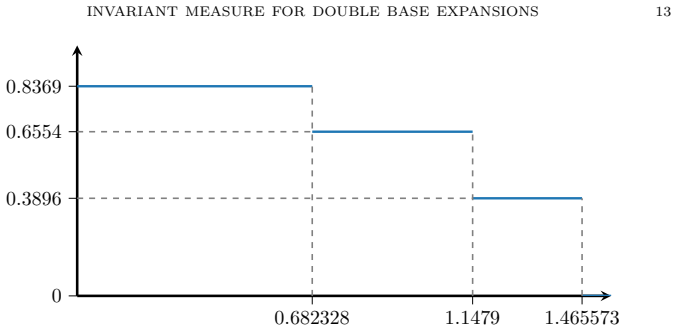
We show that the greedy and lazy maps each of which has a unique absolutely continuous invariant probability measure, equivalent to the Lebesgue measure on the intervals [0, q0/q1) and (q1/(q0(q1-1))-1, 1/(q1-1)], respectively. Furthermore, the corresponding dynamical systems are exact on I_Q. As a dynamical consequence, under the stronger condition q0 + q1 > q0 q1 the set of points having unique Q-expansions has Lebesgue measure zero, and almost every x in I_Q admits a continuum of Q-expansions.
What carries the argument
The greedy map and lazy map: the piecewise-linear maps on I_Q defined by the greedy and lazy algorithms that select the next digit in a Q-expansion.
If this is right
- The invariant measures are equivalent to Lebesgue measure precisely on the stated subintervals of I_Q.
- Exactness of each system implies strong mixing and ergodicity with respect to the invariant measure.
- Under q0 + q1 > q0 q1, the set of points with a unique Q-expansion has Lebesgue measure zero.
- Almost every x in I_Q has uncountably many distinct Q-expansions when the parameter inequality is strict.
Where Pith is reading between the lines
- The exactness property could be used to compute the entropy of these maps or the dimension of the set of points with unique expansions.
- The construction may extend to finite alphabets larger than two digits, yielding similar multiplicity results for generalized expansions.
- Numerical orbit sampling under the greedy map should reproduce the density of the invariant measure on [0, q0/q1) for concrete q0, q1 values.
Load-bearing premise
The parameter restriction q0 + q1 >= q0 q1 that ensures the greedy and lazy maps are well-defined and map I_Q into itself while keeping all Q-expansions valid.
What would settle it
An explicit point or positive-measure set in I_Q whose orbit under the greedy map stays outside [0, q0/q1) or whose density with respect to Lebesgue fails to exist would contradict the claimed invariant measure.
Figures
read the original abstract
Given a pair $Q=(q_0,q_1)\in(1,\infty)^2$ with $q_0+q_1\ge q_0q_1$, a sequence $(c_i)\in\set{0,1}^\infty$ is called a $Q$-expansion of $x$ if<br/>\begin{equation*}<br/>x=\sum_{i=1}^{\infty}\frac{c_i}{q_{c_1}\cdots q_{c_i}}.<br/>\end{equation*}<br/>We primarily study the dynamical properties of the greedy and lazy maps, which are the piecewise-linear maps on the interval $I_Q=[0,\,1/(q_1-1)]$ defined by the corresponding algorithms for $Q$-expansions. <br/>We show that the greedy and lazy maps each of which has a unique absolutely continuous invariant probability measure, equivalent to the Lebesgue measure on the intervals<br/>\begin{equation*}<br/>\left[0,\frac{q_0}{q_1}\right)\qtq{and}\left(\frac{q_1}{q_0(q_1-1)}-1,\frac{1}{q_1-1}\right],<br/>\end{equation*}<br/>respectively. <br/>Furthermore, the corresponding dynamical systems are exact on $I_Q$. <br/>As a dynamical consequence, under the stronger condition $q_0+q_1>q_0q_1$ the set of points having unique $Q$-expansions has Lebesgue measure zero, and almost every $x\in I_{Q}$ admits a continuum of $Q$-expansions.
Editorial analysis
A structured set of objections, weighed in public.
Referee Report
Summary. The manuscript studies Q-expansions of real numbers in the interval I_Q = [0, 1/(q1-1)] for parameters Q = (q0, q1) satisfying q0 + q1 ≥ q0 q1. It introduces the associated greedy and lazy maps, which are piecewise-linear and expanding, and proves that each admits a unique absolutely continuous invariant probability measure equivalent to Lebesgue measure on the respective subintervals [0, q0/q1) and (q1/(q0(q1-1)) - 1, 1/(q1-1)]. The systems are shown to be exact on I_Q. Under the stricter condition q0 + q1 > q0 q1, it follows that the set of points with unique Q-expansions has Lebesgue measure zero and that almost every x ∈ I_Q admits a continuum of Q-expansions.
Significance. If the central claims hold, the paper supplies a clean dynamical-systems proof of the existence, uniqueness, and support of ACIMs for the greedy and lazy maps in this two-base setting, together with an exactness argument that directly yields the measure-zero statement for unique expansions. This fits squarely within the literature on non-integer base representations and generalized beta-transformations; the reduction to standard results for piecewise-expanding maps with a full branch is efficient and the consequence for multiplicity of expansions is a natural and falsifiable dynamical corollary.
minor comments (3)
- [Abstract] Abstract, displayed equation after 'respectively': the symbol sequence 'qtq' is evidently a typesetting placeholder for 'and'; replace with the appropriate conjunction or punctuation in the final version.
- [Abstract / §2] The statement that the ACIM is 'equivalent to the Lebesgue measure on the intervals' should be clarified: does this mean the invariant density is constant (hence the measure is a scalar multiple of Lebesgue restricted to the interval) or merely that the density is positive Lebesgue-almost everywhere on the support? A brief sentence distinguishing these would remove ambiguity.
- [Proof of Theorem 1 / §3] When invoking 'standard results' for existence and uniqueness of ACIMs for piecewise-expanding maps, cite the precise theorem (e.g., Lasota–Yorke or its modern variants) and verify explicitly that the full-branch covering condition holds on the stated support intervals under the hypothesis q0 + q1 ≥ q0 q1.
Simulated Author's Rebuttal
We thank the referee for the careful summary of our results on the greedy and lazy maps for Q-expansions, the positive significance assessment, and the recommendation of minor revision. No specific major comments or requested changes were identified in the report.
Circularity Check
No circularity; standard application of ergodic theory to explicitly defined maps
full rationale
The derivation begins from the explicit definition of the greedy and lazy maps on I_Q under the hypothesis q0 + q1 ≥ q0 q1, which ensures the maps send I_Q into itself and are piecewise linear with slopes q0, q1 > 1 and at least one full branch. Existence and uniqueness of the ACIMs (equivalent to Lebesgue on the stated subintervals) and exactness then follow from the standard Perron-Frobenius theory for expanding maps with a covering branch; these properties are not presupposed but derived from the forward-invariance and expansion. The measure-zero statement for unique expansions is an immediate consequence of exactness plus the positive length of the ambiguous interval. No parameters are fitted, no self-citations are load-bearing, and no result is renamed or smuggled in via prior work by the same authors. The chain is therefore self-contained against external benchmarks.
Axiom & Free-Parameter Ledger
axioms (1)
- domain assumption q0 + q1 >= q0 q1 ensures the greedy and lazy maps are well-defined on I_Q and the Q-expansions are valid
Reference graph
Works this paper leans on
-
[1]
B. Adamczewski, Y. Bugeaud, Real andp-adic expansions involving symmetric patterns. International Mathematics Research Notices2006: 75968
-
[2]
´E. Charlier, C. Cisternino, K. Dajani, Dynamical behavior of alternate base expansions. Ergodic Theory Dynam. Systems43(2023), 827–860
work page 2023
- [3]
- [4]
-
[5]
M. de Vries, V. Komornik, P. Loreti, Topology of the set of univoque bases.Topology Appl. 205(2016), 117–137
work page 2016
-
[6]
M. de Vries, V. Komornik, P. Loreti, Topology of univoque sets in real base expansions. Topology Appl.312(2022), 108085
work page 2022
-
[7]
P. Erd˝ os, M. Horv´ ath, I. Jo´ o, On the uniqueness of the expansions 1 =P q−ni.Acta Math. Acad. Sci. Hungar.58(1991), 333–342
work page 1991
-
[8]
P. Erd˝ os, I. Jo´ o, On the number of expansions 1 =P q−ni.Ann. Univ. Sci. Budapest. E¨ otv¨ os Sect. Math.35(1992), 129–132
work page 1992
-
[9]
P. Erd˝ os, I. Jo´ o, V. Komornik, On the number of q-expansions.Ann. Univ. Sci. Budapest. E¨ otv¨ os Sect. Math.37(1994), 109–118
work page 1994
-
[10]
M. Hochman, P. Shmerkin, Equidistribution from fractal measures.Invent. Math.202(2015), no. 1, 427–479
work page 2015
- [11]
-
[12]
Y. Hu, R. A. Barrera, Y. Zou, Topological and dimensional properties of univoque bases in double-base expansions.Top. Appl.2025,366: 109294
work page 2025
-
[13]
Jakubowski, A complement to the Chebyshev integral inequality.Statist
A. Jakubowski, A complement to the Chebyshev integral inequality.Statist. Probab. Lett. 168(2021), Paper No. 108934, 4 pp
work page 2021
- [14]
-
[15]
V. Komornik, Y. Li, Y. Zou, Topology of univoque sets in double-base expansions.Top. Appl. 384(2026) 109773
work page 2026
-
[16]
V. Komornik, J. Lu, Y. Zou, Expansions in multiple bases over general alphabets.Acta Math. Hungar.166(2022), 481–506
work page 2022
-
[17]
V. Komornik, W. Steiner, Y. Zou, Unique double base expansions.Monatshefte f¨ ur Mathe- matik2024,204(3): 513–542
- [18]
- [19]
-
[20]
Li, Expansions in multiple bases.Acta Math
Y. Li, Expansions in multiple bases.Acta Math. Hungar.163(2021), 576–600
work page 2021
-
[21]
J. Lu, W. Steiner and Y. Zou, Hausdorff dimension of double-base expansions and binary shifts with a hole.Bulletin of the London Mathematical Society58(2026), no. 4, e70344
work page 2026
-
[22]
M. C. Mackey, M. Tyran-Kami´ nska, H. O. Walther.The Mathematical Legacy of Andrzej Lasota. Wiad. Mat.48(2012), no. 2, 143-–156
work page 2012
-
[23]
H. Masai, Topological entropy of random walks on mapping class groups.International Math- ematics Research Notices2018, 2018(3): 739–761
work page 2018
-
[24]
D. S. Mitrinovi´ c , J. E. Peˇ cari´ c , A. M. Fink,Classical and New Inequalities in Analysis. Springer, 1993
work page 1993
-
[25]
I. P. Natanson,Theory of Functions of a Real Variable. Dover Publications, 2016
work page 2016
-
[26]
Neunh¨ auserer, Non-uniform expansions of real numbers.Mediterr
J. Neunh¨ auserer, Non-uniform expansions of real numbers.Mediterr. J. Math.18(2021), Paper No. 70
work page 2021
-
[27]
Parry, On theβ-expansions of real numbers.Acta Math
W. Parry, On theβ-expansions of real numbers.Acta Math. Acad. Sci. Hungar.11(1960), 401–416
work page 1960
-
[28]
A. R´ enyi, Representations for real numbers and their ergodic properties.Acta Mathematica Academiae Scientiarum Hungaricae8(1957), 477–493
work page 1957
-
[29]
V. A. Rokhlin, Lectures on the entropy theory of measure-preserving transformations.Russian Mathematical Surveys22(5): 1–52, 1967
work page 1967
-
[30]
Sidorov, Almost every number has a continuum ofβ-expansions.Amer
N. Sidorov, Almost every number has a continuum ofβ-expansions.Amer. Math. Monthly 110(2003), no. 9, 838–842
work page 2003
-
[31]
Sidorov, Universalβ-expansions.Period
N. Sidorov, Universalβ-expansions.Period. Math. Hungar.47(2003), no. 1–2, 221–231
work page 2003
-
[32]
N. Sidorov,Arithmetic dynamics. Topics in dynamics and ergodic theory, 145–189, London Math. Soc. Lecture Note Ser.,310, Cambridge Univ. Press, Cambridge, 2003
work page 2003
-
[33]
Sidorov, Expansions in non-integer bases: lower, middle and top orders.J
N. Sidorov, Expansions in non-integer bases: lower, middle and top orders.J. Number Theory 129(2009), 741–754. (W. Huang & Y. Zou)College of Mathematics and Statistics, Shenzhen University, Shenzhen 518060, People’s Republic of China Email address:wdhuang2001@163.com, yuruzou@szu.edu.cn (V. Komornik)D ´epartement de math´ematique, Universit´e de Strasbour...
work page 2009
discussion (0)
Sign in with ORCID, Apple, or X to comment. Anyone can read and Pith papers without signing in.