Recognition: 2 theorem links
· Lean TheoremUniShield: Unified Face Attack Detection via KG-Informed Multimodal Reasoning
Pith reviewed 2026-05-12 01:04 UTC · model grok-4.3
The pith
A face attack knowledge graph enables unified detection of physical spoofs and digital forgeries through consistent multimodal reasoning.
A machine-rendered reading of the paper's core claim, the machinery that carries it, and where it could break.
Core claim
UniShield constructs a Face Attack Knowledge Graph that links attack categories to diagnostic visual cues and attack-conditioned relations. It synthesizes 52,025 FAKG-QA examples for Attack-Graph Instruction Tuning and applies Graph-Consistent Reasoning Optimization with a KG-consistency reward to encourage rationales that match graph-supported cues while penalizing incompatible claims. Experiments on the multimodal UAD benchmark show strong performance with high accuracy and low half-total error rates across binary, coarse-grained, and fine-grained protocols, indicating that structured attack knowledge improves both detection accuracy and reasoning reliability over discriminative baselines.
What carries the argument
The Face Attack Knowledge Graph (FAKG), which encodes links between attack categories, diagnostic visual cues, and relations, used to create tuning data and supply the consistency reward that aligns model rationales with supported evidence.
If this is right
- Structured knowledge from the graph supports higher accuracy and lower error rates across binary, coarse-grained, and fine-grained evaluation protocols.
- The KG-consistency reward reduces generation of rationales that contradict the encoded visual cues and relations.
- Detection moves from pure appearance correlations toward evidence-grounded reasoning that can cite specific cues.
- The method outperforms both standard discriminative approaches and general-purpose multimodal models on the shared benchmark.
Where Pith is reading between the lines
- If the graph captures generalizable cues, the same structure could be adapted to unify detection across additional attack surfaces such as video or audio streams.
- Consistent rationales tied to an explicit graph might support human review processes by making the basis for each decision traceable to specific visual features.
- Performance gains would likely disappear in an ablation that removes the graph component, confirming the knowledge structure as the main driver rather than generic tuning.
Load-bearing premise
The Face Attack Knowledge Graph accurately encodes diagnostic visual cues and relations for all attack categories, and the consistency reward produces genuine generalization rather than fitting synthetic patterns.
What would settle it
A controlled ablation that trains the same multimodal model without the knowledge graph or consistency reward and checks whether accuracy falls and error rates rise significantly on the multimodal UAD benchmark.
Figures




read the original abstract
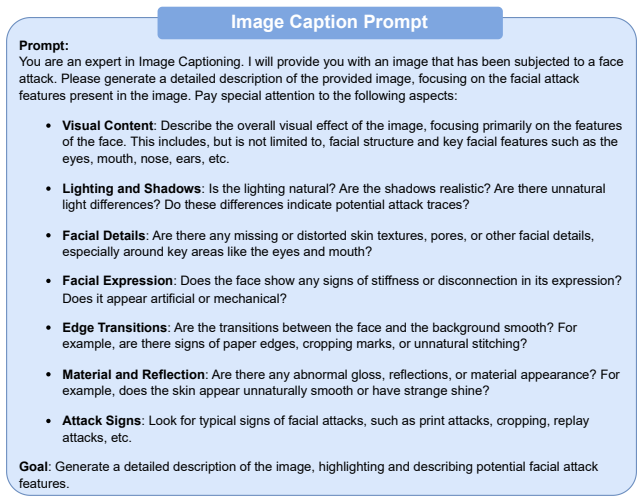
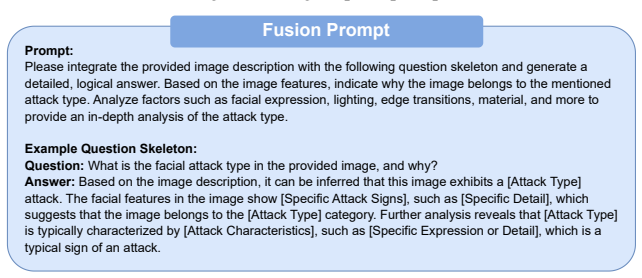
Unified face attack detection (UAD) requires recognizing physical spoofing and digital forgery within a shared decision space, yet existing discriminative or prompt-based methods largely rely on appearance correlations and provide limited evidence-grounded reasoning. We propose UniShield, a knowledge-grounded multimodal reasoning framework for unified face attack defense. UniShield constructs a Face Attack Knowledge Graph (FAKG) that links attack categories to diagnostic visual cues and attack-conditioned relations, and uses it to synthesize 52,025 FAKG-QA examples for Attack-Graph Instruction Tuning (AGIT). To improve rationale consistency, we further introduce Graph-Consistent Reasoning Optimization (GCRO), a GRPO-based objective with a KG-consistency reward that encourages generated rationales to match graph-supported cues while penalizing incompatible claims. Experiments on our multimodal UAD benchmark show that UniShield achieves strong performance across binary, coarse-grained, and fine-grained protocols, with consistently high ACC and low HTER. These results suggest that structured attack knowledge can improve both detection accuracy and reasoning reliability over discriminative baselines and general-purpose MLLMs. Our code will be released at https://anonymous.4open.science/r/Unishield-A6A3/.
Editorial analysis
A structured set of objections, weighed in public.
Referee Report
Summary. The paper proposes UniShield, a knowledge-grounded multimodal reasoning framework for unified face attack detection (UAD). It constructs a Face Attack Knowledge Graph (FAKG) linking attack categories to diagnostic visual cues, synthesizes 52,025 FAKG-QA examples for Attack-Graph Instruction Tuning (AGIT), and applies Graph-Consistent Reasoning Optimization (GCRO) with a KG-consistency reward to align rationales with the graph. Experiments on the authors' multimodal UAD benchmark report strong performance across binary, coarse-grained, and fine-grained protocols with high ACC and low HTER, suggesting improvements over discriminative baselines and general MLLMs.
Significance. If the performance gains hold under external validation, the integration of structured attack knowledge with multimodal LLMs could meaningfully advance UAD by enabling evidence-grounded reasoning rather than pure appearance correlations. The explicit code release commitment is a strength for reproducibility.
major comments (2)
- [Experiments] Experiments section: The multimodal UAD benchmark and the 52,025 training QA examples are both derived from the same FAKG. This creates a closed loop where reported high ACC/low HTER may measure fidelity to the authors' curated relations rather than generalization to real physical/digital attacks; no external benchmarks or held-out real-world attack sets are described.
- [Method] GCRO objective (method section): The KG-consistency reward penalizes incompatible claims relative to the authors' graph. While this enforces internal consistency, it does not guarantee that learned cues are diagnostic on distributions outside the synthetic FAKG data, undermining claims that GCRO improves robustness over standard GRPO or prompt-based methods.
minor comments (1)
- [Abstract] Abstract lacks any numerical results, baseline names, or statistical details, which makes the headline performance claim difficult to evaluate at first reading.
Simulated Author's Rebuttal
We thank the referee for the detailed and constructive review of our work on UniShield. We address each of the major comments point by point below, providing clarifications and indicating the revisions we will incorporate in the updated manuscript.
read point-by-point responses
-
Referee: [Experiments] Experiments section: The multimodal UAD benchmark and the 52,025 training QA examples are both derived from the same FAKG. This creates a closed loop where reported high ACC/low HTER may measure fidelity to the authors' curated relations rather than generalization to real physical/digital attacks; no external benchmarks or held-out real-world attack sets are described.
Authors: We appreciate the referee pointing out this potential limitation in our experimental design. The FAKG is indeed used to generate both the instruction-tuning data and the evaluation benchmark to ensure that the model is tested on its ability to perform knowledge-informed reasoning across binary, coarse-grained, and fine-grained detection tasks. While this setup allows for controlled evaluation of the proposed AGIT and GCRO components, we acknowledge that it does not include held-out real-world attack datasets independent of the graph. In the revised version, we will expand the Experiments section to include a discussion of the data sources, explicitly note the synthetic nature of the benchmark, and add a limitations paragraph outlining future directions for validation on external datasets. We believe this will provide a more transparent assessment of the framework's strengths and scope. revision: yes
-
Referee: [Method] GCRO objective (method section): The KG-consistency reward penalizes incompatible claims relative to the authors' graph. While this enforces internal consistency, it does not guarantee that learned cues are diagnostic on distributions outside the synthetic FAKG data, undermining claims that GCRO improves robustness over standard GRPO or prompt-based methods.
Authors: We concur that the KG-consistency reward in GCRO is specifically formulated to enforce alignment with the Face Attack Knowledge Graph, which is central to our goal of moving beyond appearance correlations toward evidence-grounded reasoning. This does prioritize internal consistency with the curated knowledge rather than broad generalization guarantees. Our experiments demonstrate relative improvements in accuracy and rationale quality over GRPO and prompt-based approaches on the benchmark, but we do not assert universal robustness. We will revise the Method section to better articulate the objectives and assumptions of GCRO, including caveats about its behavior on data distributions beyond the FAKG. This revision will help temper the claims and highlight the intended benefits of the approach. revision: partial
Circularity Check
GCRO reward defines reasoning reliability as fidelity to self-constructed FAKG
specific steps
-
self definitional
[Abstract]
"To improve rationale consistency, we further introduce Graph-Consistent Reasoning Optimization (GCRO), a GRPO-based objective with a KG-consistency reward that encourages generated rationales to match graph-supported cues while penalizing incompatible claims."
The paper claims GCRO improves rationale consistency and reasoning reliability, yet the reward is defined precisely to reward matches to the authors' input FAKG and penalize deviations; therefore the consistency is enforced by construction rather than derived from the model or data.
full rationale
The paper constructs FAKG, synthesizes training QA pairs from it, and applies GCRO whose explicit reward term forces rationales to match the same graph. This makes the claimed improvement in 'reasoning reliability' a direct consequence of the optimization definition rather than an independent discovery. However, the reported detection metrics (ACC/HTER) on the multimodal UAD benchmark remain an empirical comparison against baselines and are not reduced to the inputs by construction, so the overall derivation retains independent content and does not reach higher circularity.
Axiom & Free-Parameter Ledger
axioms (1)
- domain assumption Multimodal large language models can be tuned via instruction data and consistency rewards to produce reliable visual reasoning.
invented entities (3)
-
Face Attack Knowledge Graph (FAKG)
no independent evidence
-
Attack-Graph Instruction Tuning (AGIT)
no independent evidence
-
Graph-Consistent Reasoning Optimization (GCRO)
no independent evidence
Lean theorems connected to this paper
-
IndisputableMonolith/Foundation/Cost/FunctionalEquation.leanwashburn_uniqueness_aczel unclear?
unclearRelation between the paper passage and the cited Recognition theorem.
UniShield constructs a Face Attack Knowledge Graph (FAKG) that links attack categories to diagnostic visual cues... Graph-Consistent Reasoning Optimization (GCRO), a GRPO-based objective with a KG-consistency reward
-
IndisputableMonolith/Foundation/AlexanderDuality.leanalexander_duality_circle_linking unclear?
unclearRelation between the paper passage and the cited Recognition theorem.
Experiments on our multimodal UAD benchmark... high ACC and low HTER
What do these tags mean?
- matches
- The paper's claim is directly supported by a theorem in the formal canon.
- supports
- The theorem supports part of the paper's argument, but the paper may add assumptions or extra steps.
- extends
- The paper goes beyond the formal theorem; the theorem is a base layer rather than the whole result.
- uses
- The paper appears to rely on the theorem as machinery.
- contradicts
- The paper's claim conflicts with a theorem or certificate in the canon.
- unclear
- Pith found a possible connection, but the passage is too broad, indirect, or ambiguous to say the theorem truly supports the claim.
Reference graph
Works this paper leans on
-
[1]
Face anti-spoofing using patch and depth-based cnns
Yousef Atoum, Yaojie Liu, Amin Jourabloo, and Xiaoming Liu. Face anti-spoofing using patch and depth-based cnns. In2017 IEEE international joint conference on biometrics (IJCB), pages 319–328. IEEE, 2017
work page 2017
-
[2]
Qwen-VL: A Versatile Vision-Language Model for Understanding, Localization, Text Reading, and Beyond
Jinze Bai, Shuai Bai, Shusheng Yang, Shijie Wang, Sinan Tan, Peng Wang, Junyang Lin, Chang Zhou, and Jingren Zhou. Qwen-vl: A versatile vision-language model for understanding, localization, text reading, and beyond, 2023. URLhttps://arxiv.org/abs/2308.12966
work page internal anchor Pith review Pith/arXiv arXiv 2023
-
[3]
Xueying Chen, Tianqiang Huang, Wenyu Liu, Zhenghong Wang, Wentong Li, Wei Huang, Riqing Chen, and Haifeng Luo. Deepfakeclip: Semantic-opposite prompt learning for general- izable deepfake detection.Knowledge-Based Systems, page 114681, 2025
work page 2025
-
[4]
Zihong Chen, Wanli Jiang, Jinzhe Li, Zhonghang Yuan, Huanjun Kong, Wanli Ouyang, and Nanqing Dong. Graphgen: Enhancing supervised fine-tuning for llms with knowledge-driven synthetic data generation, 2025. URLhttps://arxiv.org/abs/2505.20416
-
[5]
Unified physical-digital face attack detection, 2024
Hao Fang, Ajian Liu, Haocheng Yuan, Junze Zheng, Dingheng Zeng, Yanhong Liu, Jiankang Deng, Sergio Escalera, Xiaoming Liu, Jun Wan, and Zhen Lei. Unified physical-digital face attack detection, 2024. URLhttps://arxiv.org/abs/2401.17699
-
[6]
Google. Gemini models: Gemini 3 pro. https://ai.google.dev/gemini-api/docs/ models, 2025. Accessed: 2026-02-12
work page 2025
-
[7]
Deepfake detection by analyzing convolutional traces
Luca Guarnera, Oliver Giudice, and Sebastiano Battiato. Deepfake detection by analyzing convolutional traces. InProceedings of the IEEE/CVF conference on computer vision and pattern recognition workshops, pages 666–667, 2020
work page 2020
-
[8]
Daya Guo, Dejian Yang, Haowei Zhang, Junxiao Song, Peiyi Wang, Qihao Zhu, Runxin Xu, Ruoyu Zhang, Shirong Ma, Xiao Bi, Xiaokang Zhang, Xingkai Yu, Yu Wu, Z. F. Wu, Zhibin Gou, Zhihong Shao, Zhuoshu Li, Ziyi Gao, Aixin Liu, Bing Xue, Bingxuan Wang, Bochao Wu, Bei Feng, Chengda Lu, Chenggang Zhao, Chengqi Deng, Chong Ruan, Damai Dai, Deli Chen, Dongjie Ji, ...
-
[9]
Xinan He, Yue Zhou, Bing Fan, Bin Li, Guopu Zhu, and Feng Ding. Vlforgery face triad: Detection, localization and attribution via multimodal large language models, 2025. URL https://arxiv.org/abs/2503.06142. 10
-
[10]
Fine-grained prompt learning for face anti-spoofing
Xueli Hu, Huan Liu, Haocheng Yuan, Zhiyang Fu, Yizhi Luo, Ning Zhang, Hang Zou, Jianwen Gan, and Yuan Zhang. Fine-grained prompt learning for face anti-spoofing. InProceedings of the 32nd ACM International Conference on Multimedia, pages 7619–7628, 2024
work page 2024
-
[11]
Junnan Li, Dongxu Li, Silvio Savarese, and Steven Hoi. Blip-2: Bootstrapping language- image pre-training with frozen image encoders and large language models, 2023. URL https: //arxiv.org/abs/2301.12597
work page internal anchor Pith review Pith/arXiv arXiv 2023
-
[12]
Face x-ray for more general face forgery detection, 2020
Lingzhi Li, Jianmin Bao, Ting Zhang, Hao Yang, Dong Chen, Fang Wen, and Baining Guo. Face x-ray for more general face forgery detection, 2020. URL https://arxiv.org/abs/ 1912.13458
-
[13]
Casia-surf cefa: A benchmark for multi-modal cross-ethnicity face anti-spoofing
Ajian Liu, Zichang Tan, Jun Wan, Sergio Escalera, Guodong Guo, and Stan Z Li. Casia-surf cefa: A benchmark for multi-modal cross-ethnicity face anti-spoofing. InProceedings of the IEEE/CVF winter conference on applications of computer vision, pages 1179–1187, 2021
work page 2021
-
[14]
Cfpl-fas: Class free prompt learning for generalizable face anti-spoofing, 2024
Ajian Liu, Shuai Xue, Jianwen Gan, Jun Wan, Yanyan Liang, Jiankang Deng, Sergio Escalera, and Zhen Lei. Cfpl-fas: Class free prompt learning for generalizable face anti-spoofing, 2024. URLhttps://arxiv.org/abs/2403.14333
-
[15]
Benchmarking unified face attack detection via hierarchical prompt tuning, 2025
Ajian Liu, Haocheng Yuan, Xiao Guo, Hui Ma, Wanyi Zhuang, Changtao Miao, Yan Hong, Chuanbiao Song, Jun Lan, Qi Chu, Tao Gong, Yanyan Liang, Weiqiang Wang, Jun Wan, Xiaoming Liu, and Zhen Lei. Benchmarking unified face attack detection via hierarchical prompt tuning, 2025. URLhttps://arxiv.org/abs/2505.13327
-
[16]
Y . Liu, A. Jourabloo, and X. Liu. Learning deep models for face anti-spoofing: Binary or auxiliary supervision. InCVPR, 2018
work page 2018
-
[17]
Nguyen, Junichi Yamagishi, and Isao Echizen
Huy H. Nguyen, Junichi Yamagishi, and Isao Echizen. Capsule-forensics: Using capsule networks to detect forged images and videos, 2018. URL https://arxiv.org/abs/1810. 11215
work page 2018
-
[18]
Learning Transferable Visual Models From Natural Language Supervision
Alec Radford, Jong Wook Kim, Chris Hallacy, Aditya Ramesh, Gabriel Goh, Sandhini Agar- wal, Girish Sastry, Amanda Askell, Pamela Mishkin, Jack Clark, Gretchen Krueger, and Ilya Sutskever. Learning transferable visual models from natural language supervision, 2021. URL https://arxiv.org/abs/2103.00020
work page internal anchor Pith review Pith/arXiv arXiv 2021
-
[19]
Faceforensics++: Learning to detect manipulated facial images
Andreas Rossler, Davide Cozzolino, Luisa Verdoliva, Christian Riess, Justus Thies, and Matthias Nießner. Faceforensics++: Learning to detect manipulated facial images. InProceedings of the IEEE/CVF international conference on computer vision, pages 1–11, 2019
work page 2019
-
[20]
Yichen Shi, Yuhao Gao, Yingxin Lai, Hongyang Wang, Jun Feng, Lei He, Jun Wan, Changsheng Chen, Zitong Yu, and Xiaochun Cao. Shield : An evaluation benchmark for face spoofing and forgery detection with multimodal large language models, 2025. URL https://arxiv.org/ abs/2402.04178
-
[21]
Aaditya Singh, Adam Fry, Adam Perelman, Adam Tart, Adi Ganesh, Ahmed El-Kishky, Aidan McLaughlin, Aiden Low, AJ Ostrow, Akhila Ananthram, Akshay Nathan, Alan Luo, Alec Helyar, Aleksander Madry, Aleksandr Efremov, Aleksandra Spyra, Alex Baker-Whitcomb, Alex Beutel, Alex Karpenko, Alex Makelov, Alex Neitz, Alex Wei, Alexandra Barr, Alexandre Kirchmeyer, Ale...
work page internal anchor Pith review Pith/arXiv arXiv 2025
-
[22]
C2p-clip: Injecting category common prompt in clip to enhance generalization in deepfake detection
Chuangchuang Tan, Renshuai Tao, Huan Liu, Guanghua Gu, Baoyuan Wu, Yao Zhao, and Yunchao Wei. C2p-clip: Injecting category common prompt in clip to enhance generalization in deepfake detection. InProceedings of the AAAI Conference on Artificial Intelligence, volume 39, pages 7184–7192, 2025
work page 2025
-
[23]
V Team, Wenyi Hong, Wenmeng Yu, Xiaotao Gu, Guo Wang, Guobing Gan, Haomiao Tang, Jiale Cheng, Ji Qi, Junhui Ji, Lihang Pan, Shuaiqi Duan, Weihan Wang, Yan Wang, Yean Cheng, Zehai He, Zhe Su, Zhen Yang, Ziyang Pan, Aohan Zeng, Baoxu Wang, Bin Chen, Boyan Shi, Changyu Pang, Chenhui Zhang, Da Yin, Fan Yang, Guoqing Chen, Jiazheng Xu, Jiale Zhu, Jiali Chen, J...
work page internal anchor Pith review Pith/arXiv arXiv 2025
-
[24]
Knowledge-guided prompt learning for deepfake facial image detection, 2025
Hao Wang, Cheng Deng, and Zhidong Zhao. Knowledge-guided prompt learning for deepfake facial image detection, 2025. URLhttps://arxiv.org/abs/2501.00700
-
[25]
Faceshield: Explainable face anti-spoofing with multimodal large language models, 2025
Hongyang Wang, Yichen Shi, Zhuofu Tao, Yuhao Gao, Liepiao Zhang, Xun Lin, Jun Feng, Xiaochen Yuan, Zitong Yu, and Xiaochun Cao. Faceshield: Explainable face anti-spoofing with multimodal large language models, 2025. URLhttps://arxiv.org/abs/2505.09415
- [26]
-
[27]
Peipeng Yu, Jianwei Fei, Hui Gao, Xuan Feng, Zhihua Xia, and Chip Hong Chang. Unlocking the capabilities of large vision-language models for generalizable and explainable deepfake detection, 2025. URLhttps://arxiv.org/abs/2503.14853
-
[28]
Searching central difference convolutional networks for face anti-spoofing,
Zitong Yu, Chenxu Zhao, Zezheng Wang, Yunxiao Qin, Zhuo Su, Xiaobai Li, Feng Zhou, and Guoying Zhao. Searching central difference convolutional networks for face anti-spoofing,
- [29]
- [30]
-
[31]
Honglu Zhang, Zhiqin Fang, Ningning Zhao, Saihui Hou, Long Ma, Renwang Pei, and Zhaofeng He. Harnessing chain-of-thought reasoning in multimodal large language models for face anti- spoofing, 2026. URLhttps://arxiv.org/abs/2506.01783
-
[32]
Kaiyang Zhou, Jingkang Yang, Chen Change Loy, and Ziwei Liu. Learning to prompt for vision-language models.International journal of computer vision, 130(9):2337–2348, 2022
work page 2022
-
[33]
MiniGPT-4: Enhancing Vision-Language Understanding with Advanced Large Language Models
Deyao Zhu, Jun Chen, Xiaoqian Shen, Xiang Li, and Mohamed Elhoseiny. Minigpt-4: En- hancing vision-language understanding with advanced large language models, 2023. URL https://arxiv.org/abs/2304.10592
work page internal anchor Pith review Pith/arXiv arXiv 2023
-
[34]
La-softmoe clip for unified physical-digital face attack detection, 2024
Hang Zou, Chenxi Du, Hui Zhang, Yuan Zhang, Ajian Liu, Jun Wan, and Zhen Lei. La-softmoe clip for unified physical-digital face attack detection, 2024. URL https://arxiv.org/abs/ 2408.12793. 13 A FAKG-QA Construction and Detailed Prompting A.1 FAKG Knowledge Graph Construction To construct the Face Attack Knowledge Graph (FAKG), we leverage the UniAttackD...
-
[35]
Unnatural lighting --Relations--
-
[36]
2D-Print: Print is a type of 2D attack
-
[37]
Print-Paper edge: Print attacks are often accompanied by paper edges
-
[38]
Print-Unnatural lighting: Print attacks often cause lighting inconsistencies Question: What type of face attack is present in the given image, and why? Answer: It is a Print attack, which belongs to the 2D attack category. This is because the lighting is inconsistent and lacks natural shadows. In addition, paper edges can be observed around the image, whi...
-
[39]
Image Caption: {caption}
-
[40]
Proposed QA Rationale: {rationale} Task: Determine whether the reasoning is logically consistent with the visual evidence described in the caption. Output one of the following labels: - Consistent - Fact-Conflict A conflict occurs if the reasoning assumes artifacts or evidence that contradict the visual description. Figure 10: Prompt for Logical Flow Veri...
-
[41]
Logical Complexity: Does the reasoning involve multi-step analysis or merely a simple statement?
-
[42]
Samples with low complexity or low information gain should be discarded
Information Gain: Does the dialogue contain meaningful forensic cues that help distinguish different attack types? Output a score from 1-5 for each dimension. Samples with low complexity or low information gain should be discarded. Heuristic Pruning Prompt Figure 11: Prompt for Heuristic Pruning 17
discussion (0)
Sign in with ORCID, Apple, or X to comment. Anyone can read and Pith papers without signing in.