Recognition: 2 theorem links
· Lean TheoremMagnetoplasmonic Nanopore Lensing for Enhanced Optical Readout and Controlled Translocation
Pith reviewed 2026-05-12 01:07 UTC · model grok-4.3
The pith
A bull's-eye magnetoplasmonic nanopore concentrates plasmon fields for stronger optical signals while magnetic layers control the speed of tagged molecules.
A machine-rendered reading of the paper's core claim, the machinery that carries it, and where it could break.
Core claim
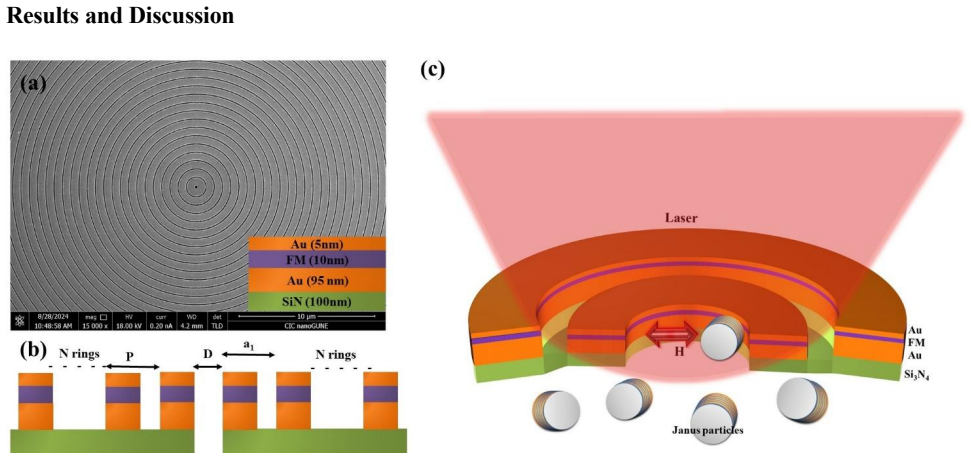
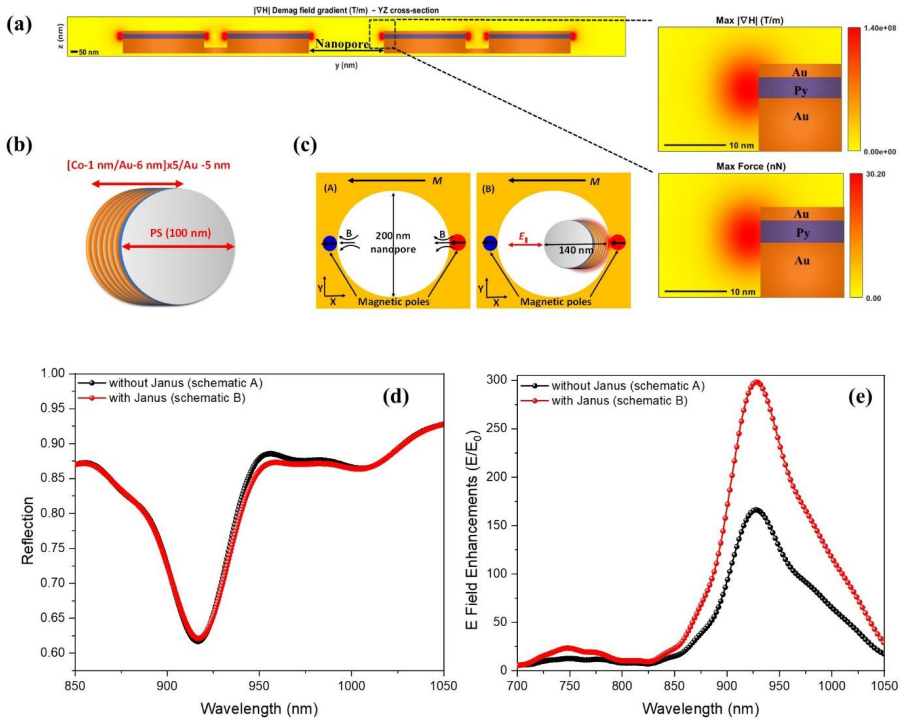
The authors report an experimentally developed hybrid magnetoplasmonic nanopore platform based on bull's-eye geometry that concentrates surface plasmon polaritons into the pore, resulting in significant electric-field enhancement and improved signal readout. The addition of a ferromagnetic layer allows for magnetic tweezing of magneto-plasmonic nanoparticle-tagged molecules, providing active control over their translocation dynamics. Simulations reveal a further boost in enhancement arising from mirror-on-mirror plasmonic coupling between the nanopore and wall-aligned tagged nanoparticles.
What carries the argument
Bull's-eye geometry that concentrates surface plasmon polaritons into the nanopore, paired with a ferromagnetic layer for magnetic tweezing of tagged molecules and mirror-on-mirror coupling for added field boost.
Load-bearing premise
The bull's-eye plasmonic structure and ferromagnetic layer can be fabricated together to deliver the claimed field enhancement and translocation control without stability or noise problems.
What would settle it
Fabrication of the bull's-eye magnetoplasmonic nanopore followed by direct measurement of local electric field strength at the pore and comparison of molecular translocation speeds with and without applied magnetic fields.
Figures

read the original abstract
Plasmonic nanopores hold a significant promise for molecular sequencing, but their sensitivity and temporal resolution are constrained by limited signal strength and rapid translocation of molecules through the pore. Here we report an experimentally developed hybrid magnetoplasmonic nanopore platform based on bull's-eye geometry that concentrates surface plasmon polaritons into the pore, resulting in significant electric-field enhancement and improved signal readout. The addition of a ferromagnetic layer allows for magnetic tweezing of magneto-plasmonic nanoparticle-tagged molecules, providing active control over their translocation dynamics. Simulations reveal a further boost in enhancement arising from mirror-on-mirror plasmonic coupling between the nanopore and wall-aligned tagged nanoparticles. Together, experimental realization and simulation-guided insights establish a magnetically configurable, plasmonically enhanced nanopore platform that combines signal amplification with controlled translocation for advanced single-molecule sensing and sequencing. KEYWORDS: Nanopores, plasmonics, single-molecule sequencing, magneto-plasmonics, active control, magnetic tweezing.
Editorial analysis
A structured set of objections, weighed in public.
Referee Report
Summary. The manuscript claims to have experimentally developed a hybrid magnetoplasmonic nanopore platform using bull's-eye geometry to concentrate surface plasmon polaritons, achieving significant electric-field enhancement for improved optical readout. The integration of a ferromagnetic layer enables magnetic tweezing of nanoparticle-tagged molecules for active control of translocation dynamics. Simulations show additional enhancement from mirror-on-mirror plasmonic coupling, positioning the platform for advanced single-molecule sensing and sequencing.
Significance. If the experimental realization is confirmed, this work could have high significance in the field of single-molecule biophysics and sequencing technologies. It combines plasmonic enhancement with magnetic manipulation in a novel way, potentially overcoming key limitations in nanopore sensitivity and speed. The simulation insights into the coupling mechanism add value to the design principles for future plasmonic devices.
major comments (1)
- [Abstract] The abstract asserts that the platform was 'experimentally developed' and that 'experimental realization' is established, but the manuscript contains no experimental methods, data, figures, error analysis, or results to support this. There are no reports of fabricated structures, measured spectra, or translocation experiments, which is load-bearing for the central claim of an experimentally realized platform.
Simulated Author's Rebuttal
We thank the referee for their careful reading of the manuscript and for highlighting the need for precise language regarding experimental claims. We address the major comment point by point below and confirm that revisions will be made to ensure accuracy.
read point-by-point responses
-
Referee: [Abstract] The abstract asserts that the platform was 'experimentally developed' and that 'experimental realization' is established, but the manuscript contains no experimental methods, data, figures, error analysis, or results to support this. There are no reports of fabricated structures, measured spectra, or translocation experiments, which is load-bearing for the central claim of an experimentally realized platform.
Authors: We agree with the referee that the current wording in the abstract and related sections overstates the experimental content. The manuscript presents a simulation-based study of the bull's-eye magnetoplasmonic nanopore design, including electromagnetic modeling of field enhancement and magnetic control mechanisms, but does not include fabricated devices, measured optical spectra, or translocation data. To correct this, we will revise the abstract to replace 'experimentally developed' with 'theoretically proposed and numerically simulated' and remove references to 'experimental realization' as an established result. Corresponding changes will be made in the introduction and conclusions to frame the work as a design and simulation study that provides a foundation for future experimental implementation. These revisions will accurately reflect the manuscript's scope without altering the reported simulation results or their implications. revision: yes
Circularity Check
No significant circularity detected; claims rest on experimental realization and external simulations.
full rationale
The paper presents an experimentally developed hybrid magnetoplasmonic nanopore platform using bull's-eye geometry, with simulations for field enhancement and mirror-on-mirror coupling. No mathematical derivation chain, fitted parameters renamed as predictions, self-definitional loops, or load-bearing self-citations appear in the abstract or described structure. Central claims of field enhancement and translocation control are framed as outcomes of fabrication and simulation-guided insights rather than reductions to prior inputs by construction. This aligns with a self-contained experimental report having no evident circularity patterns.
Axiom & Free-Parameter Ledger
Lean theorems connected to this paper
-
IndisputableMonolith/Cost/FunctionalEquation.leanwashburn_uniqueness_aczel unclear?
unclearRelation between the paper passage and the cited Recognition theorem.
Simulations reveal a further boost in enhancement arising from mirror-on-mirror plasmonic coupling between the nanopore and wall-aligned tagged nanoparticles... FDTD simulations... MuMax3 micromagnetic simulations
-
IndisputableMonolith/Foundation/AlexanderDuality.leanalexander_duality_circle_linking unclear?
unclearRelation between the paper passage and the cited Recognition theorem.
bull's-eye geometry that concentrates surface plasmon polaritons into the pore
What do these tags mean?
- matches
- The paper's claim is directly supported by a theorem in the formal canon.
- supports
- The theorem supports part of the paper's argument, but the paper may add assumptions or extra steps.
- extends
- The paper goes beyond the formal theorem; the theorem is a base layer rather than the whole result.
- uses
- The paper appears to rely on the theorem as machinery.
- contradicts
- The paper's claim conflicts with a theorem or certificate in the canon.
- unclear
- Pith found a possible connection, but the passage is too broad, indirect, or ambiguous to say the theorem truly supports the claim.
Reference graph
Works this paper leans on
- [1]
-
[2]
Nano Letters 2019, 19 (11), 7553-7562
Garoli, D.; Yamazaki, H.; Maccaferri, N.; and Wanunu, M. Nano Letters 2019, 19 (11), 7553-7562
work page 2019
-
[3]
Verschueren, Daniel V.; Pud, Sergii.; Shi, Xin.; Angelis, Lorenzo De.; Kuipers, L.; and Dekker, C. ACS Nano 2019, 13 (1), 61-70
work page 2019
-
[4]
Khozeymeh Sarbishe, F.; Khabarov, K.; Blanco Formoso, M.; et al . Adv. Mater. 2025, 37, 2504436 (2025)
work page 2025
-
[5]
Huang, J A.; Mousavi, M.Z.; Zhao, Y. et al. Nat Commun 2019, 10, 5321
work page 2019
-
[6]
Nano Letters 2013, 13 (3), 1029-1033
Jonsson, Magnus P.; and Dekker, C. Nano Letters 2013, 13 (3), 1029-1033
work page 2013
-
[7]
Nano Letters 2015, 15 (1), 553-559
Crick, Colin R.; Albella, Pablo.; Ng, Binghao.; Ivanov, Aleksandar P.; Roschuk, Tyler.; Cecchini, Michael P., Bresme, Fernando, Maier, Stefan A., and Edel, Joshua B. Nano Letters 2015, 15 (1), 553-559
work page 2015
-
[8]
Zhang, Y.; Min, C.; Dou, X.; Xianyou, W.; Hendrik Paul, U; Somekh, M G.; Xiaocong, Y. Light Sci Appl 2021, 10, 59
work page 2021
-
[9]
ACS Nano 2021 15 (4), 6105- 6128
Ren,Y.; Chen, Q.; He, M.; Zhang, Xi.; Qi,H.; and Yan, Y. ACS Nano 2021 15 (4), 6105- 6128
work page 2021
-
[10]
ACS Photonics 11 (2), 321-333 (2024) 23
Kenneth B C. ACS Photonics 11 (2), 321-333 (2024) 23
work page 2024
-
[11]
Koya, A N. Adv. Photonics Res 2022., 3: 2100325
work page 2022
-
[12]
Sapunova, Stuber, A.; Nanni, G.; Nakatsuka, N.; Tsutsui, M.; Yokota, K.; Krahne, R.; Garoli,D
Douaki, A.; Weng, S.; Lanzavecchia, G.; A. Sapunova, Stuber, A.; Nanni, G.; Nakatsuka, N.; Tsutsui, M.; Yokota, K.; Krahne, R.; Garoli,D. Adv. Optical Mater 2025, 13, 2402189
work page 2025
-
[13]
Baffou, G.; Cichos, F.; Quidant, R. Nat. Mater. 2020 19, 946–958
work page 2020
-
[14]
Maccaferri, N.; Vavassori, P.; Garoli, D. Appl. Phys. Lett. 2021 118 (19)
work page 2021
-
[15]
Koya, A N.; Sapunova, A.; Sanamreddy, N R.; Zou, Y.; Ma, Q.; Kotsifaki, D G.; Jin, H.; Jin, S.; Liu, Q H.; Vavassori, P.; Garoli, D. J. Appl. Phys. 2025 137 (21): 210901
work page 2025
-
[16]
Carretero-Palacios, S.; Mahboub, O.; Garcia -Vidal, F J.; Martin -Moreno, L.; Rodrigo, Sergio G.; Genet,C.; and Ebbesen,T W. Opt. Express 2011 19, 10429-10442
work page 2011
-
[17]
Mahboub,O.; Carretero Palacios, S.; Genet, C.; Garcia-Vidal, F J.; Rodrigo, S G., Martin- Moreno,L.; and Ebbesen,T W. Opt. Express 2010 18, 11292-11299
work page 2010
-
[18]
Sun, M.; Liu, Y.; Shi, Y.; Zhang, Y.; Song, J.; Li, M.; Shi, S.; Zhang, S.; Wang, X.; Yang, F. Crystals 2022 12, 1210
work page 2022
-
[19]
Dolde,F.; Schröder, T.; Karaveli, S.; Markham, M L.; Twitchen,D J.; and Englund, D
Li, L.; Chen,E H.; Zheng, J.; Mouradian, S L. ; Dolde,F.; Schröder, T.; Karaveli, S.; Markham, M L.; Twitchen,D J.; and Englund, D. Nano Letters 2015 15 (3), 1493-1497
work page 2015
-
[20]
Lanzavecchia,G.; Kuttruff,J.; Doricchi, A. ; Douaki,A.; Ramankutty,K K.; García, I.; Lin, L.; Rodríguez,A V.; Wågberg, T.; Krahne, R.; Maccaferri,N.; Garoli,D. Adv. Optical Mater 2023 11, 2300786
work page 2023
-
[21]
Lanzavecchia.G.; Sapunova. A.; Douaki. A; Weng. S.; Momotenko.D.; Paulo. G.; Giacomello.A.; Krahne. R.; Garoli.D. Nano Letters 2024 24 (33), 10098-10105
work page 2024
-
[22]
ACS Nano 2016 10 (12), 11228-11236
Chen,Y.; Bi, K.; Wang, Q.; Zheng, M.; Liu, Q.; Han,Y.; Yang, J.; Chang.S.; Guanhua.Z. ACS Nano 2016 10 (12), 11228-11236
work page 2016
-
[23]
Nano Letters 2023, 23 (11), 4830-4836
Zhao, Y.; Hubarevich,A.; Fazio, A F.; Iarossi, M.; Huang, J A.; Angelis, F D. Nano Letters 2023, 23 (11), 4830-4836
work page 2023
-
[24]
Lovera, P.; Jones, D.; Corbett, B; and O’Riordan, A. Opt. Express 2012, 20, 25325-25332
work page 2012
-
[25]
Journal of Nanomaterials 2015, 9 468069
Wang, H.; Zhou, W.; Li, E. Journal of Nanomaterials 2015, 9 468069
work page 2015
-
[26]
Li,Z.; Lopez-Ortega, A.; Aranda-Ramos. A.; Tajada. J L.; Sort J.; Nogues, C.; Vavassori, P.; Nogues. J.; Sepulveda, B. Small 2018, 14, 1800868 24
work page 2018
-
[27]
Applied Materials Today 2018 , Volume 12, ISSN 2352-9407
Li.Z.; Aranda-Ramos, A.; Güell-Grau, P; Tajada, J L; Pou-Macayo, L.; Piedrafita, S L.; Pi, F.; Roca, A G.; Baró, M D.; Sort, J.; Nogués, C.; Nogués, J.; Sepúlveda, B. Applied Materials Today 2018 , Volume 12, ISSN 2352-9407
work page 2018
-
[28]
Campuzano, S.; Gamella, M.; Serafín, V.; Pedrero, M.; Yáñez -Sedeño, P.; Pingarrón, J M. Magnetochemistry 2019 5(3):47
work page 2019
- [29]
-
[30]
Merkel, M.; Dingel, K.; Holzinger, D; Sick, B.; Vogel, M.; Ehresmann,A
Huhnstock, R.; Reginka, M.; Tomita, A. Merkel, M.; Dingel, K.; Holzinger, D; Sick, B.; Vogel, M.; Ehresmann,A. Sci Rep 2021 11, 21794
work page 2021
-
[31]
Reviews in Physics 2020, 5, 100041, ISSN 2405-4283
Achanta, V G. Reviews in Physics 2020, 5, 100041, ISSN 2405-4283
work page 2020
-
[32]
Krishnan, A.; Thio, T.; Lezec, H J.; Ebbesen, T W.; Wolff, P A.; Pendry, J.; Martin- Moreno, L.; Garcia-Vidal,F J, Optics Communications 2001, 200 ISSN 0030-4018
work page 2001
-
[33]
IEEE Transactions on Magnetics 1997 vol
McMichael, M D.; and Donahue, M J. IEEE Transactions on Magnetics 1997 vol. 33, no. 5, pp. 4167-4169
work page 1997
-
[34]
Vavassori, P.; Bovolenta, R.; Metlushko, V.; Ilic, B. J. Appl. Phys 2006 99 (5): 053902
work page 2006
-
[35]
https://epub.uni-regensburg.de/10440/1/diss-main.pdf
Ingo Neudecker, PhD thesis 2006. https://epub.uni-regensburg.de/10440/1/diss-main.pdf
work page 2006
-
[36]
IEEE Transactions on Magnetics 2010, vol
Jain, S.; Adeyeye, A O. IEEE Transactions on Magnetics 2010, vol. 46, no. 6, pp. 1595- 1598
work page 2010
-
[37]
Adeyeye, A O.; Goolaup, S.; Singh, N.; Wang, C C.; Gao, X S.; Ross, C A.; Jung, W.; Castaño. F J. Appl. Phys. 2007, 40 6479
work page 2007
-
[38]
Montoncello, F.; Giovannini, L.; Nizzoli, F.; Tanigawa, H.; Ono, T; Gubbiotti, G.; and Madami, M.; Tacchi, S.; and Carlotti, G. Phys. Rev. B 2008, 78
work page 2008
-
[39]
den Broeder, F J A; Kuiper, D; van de Mosselaer, A P; Hoving, W; Phys. Rev. Lett. 1988, 60, 2769
work page 1988
discussion (0)
Sign in with ORCID, Apple, or X to comment. Anyone can read and Pith papers without signing in.