Recognition: 2 theorem links
· Lean TheoremA Reconfigurable Multiplier Architecture for Error-Resilient Applications in RISC-V Core
Pith reviewed 2026-05-12 01:20 UTC · model grok-4.3
The pith
A reconfigurable multiplier in a RISC-V core uses a dedicated control register to switch between exact and multiple approximate modes for energy savings in error-tolerant workloads.
A machine-rendered reading of the paper's core claim, the machinery that carries it, and where it could break.
Core claim
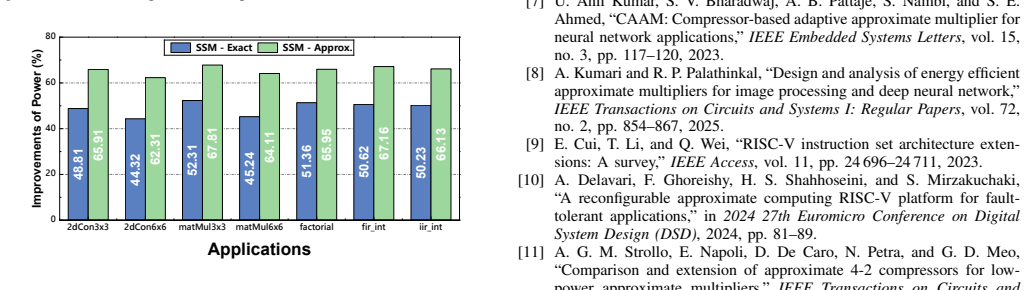
The central claim is that the reconfigurable multiplier architecture, controlled through a dedicated mulscr register, supports both exact and approximate computation with multiple accuracy levels inside a standard RISC-V pipeline, yielding 44-52 percent power reduction in exact mode and 62-68 percent in approximate mode while preserving computational throughput and delivering up to 63 percent lower energy consumption on workloads including matrix multiplication at 1.21 pJ per instruction.
What carries the argument
The reconfigurable multiplier controlled by a dedicated mulscr register, which selects among exact and approximate accuracy levels to enable fine-grained energy-accuracy trade-offs without disrupting the processor pipeline.
Load-bearing premise
Neural network workloads must remain sufficiently accurate under the chosen approximation levels, and the added reconfiguration logic must introduce only negligible overhead in area, delay, and power inside the RISC-V pipeline.
What would settle it
Measure the classification or detection accuracy of a neural network model executed on the modified core in approximate modes against the exact-mode baseline, or measure post-synthesis area and power to confirm whether the mulscr logic adds measurable overhead.
Figures






read the original abstract
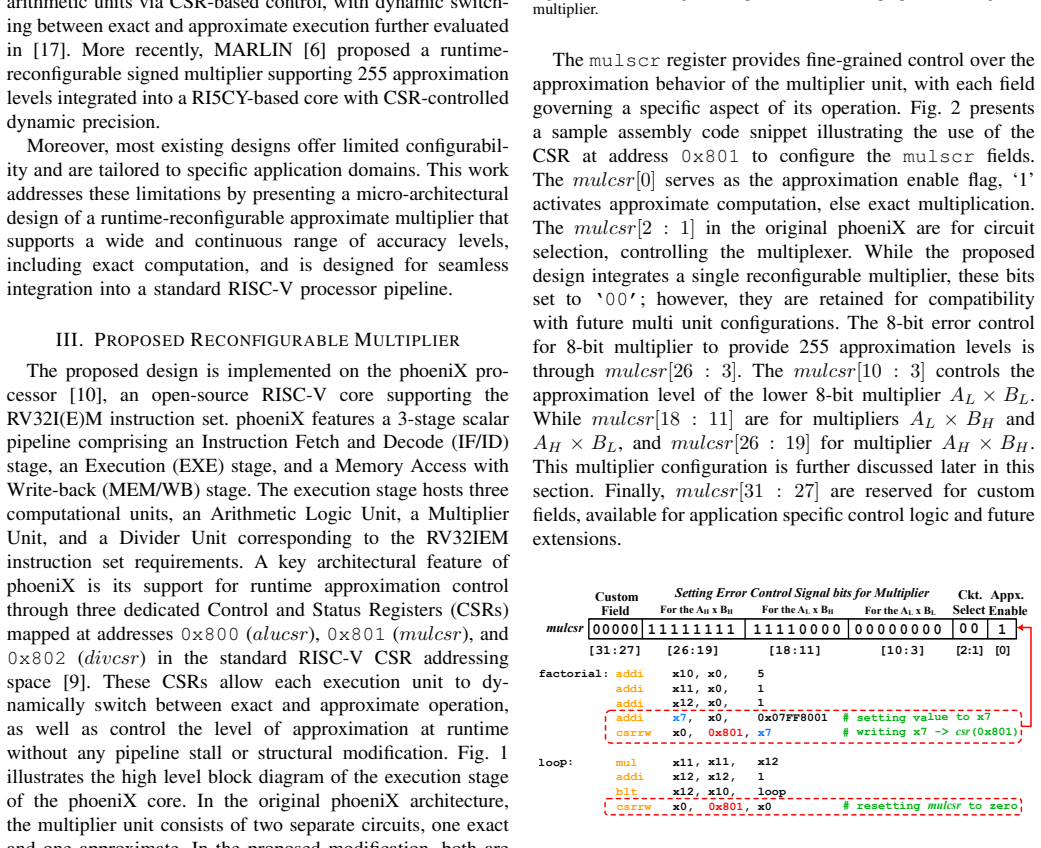
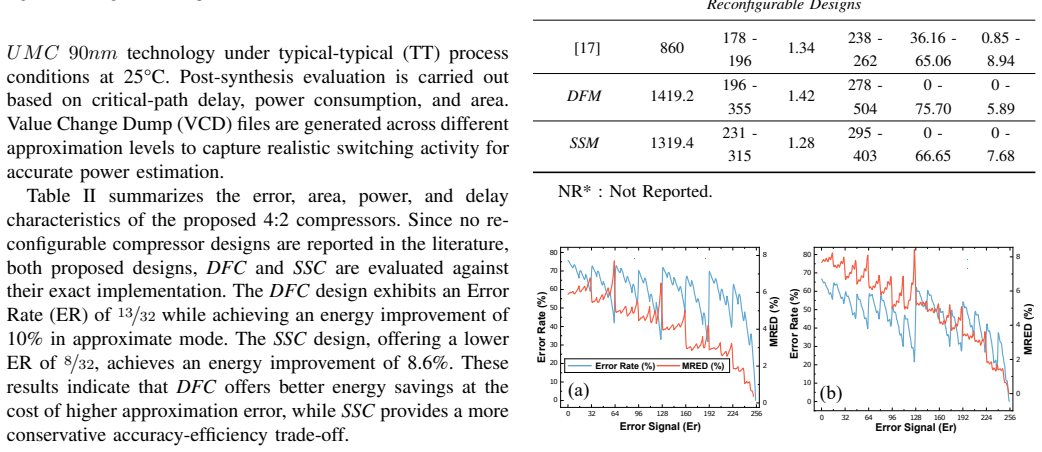
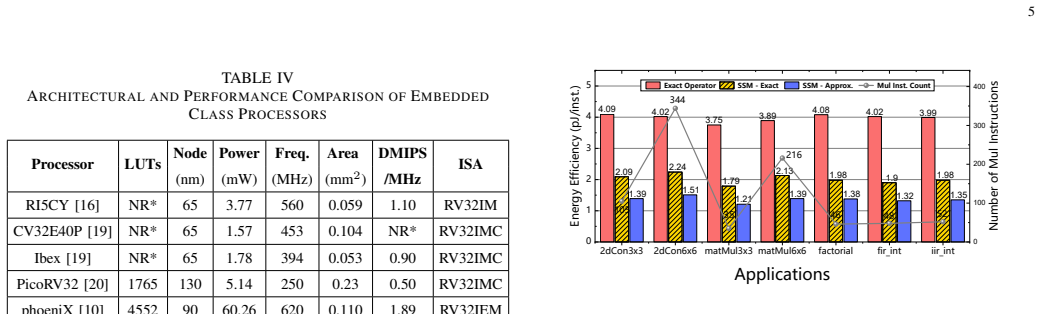
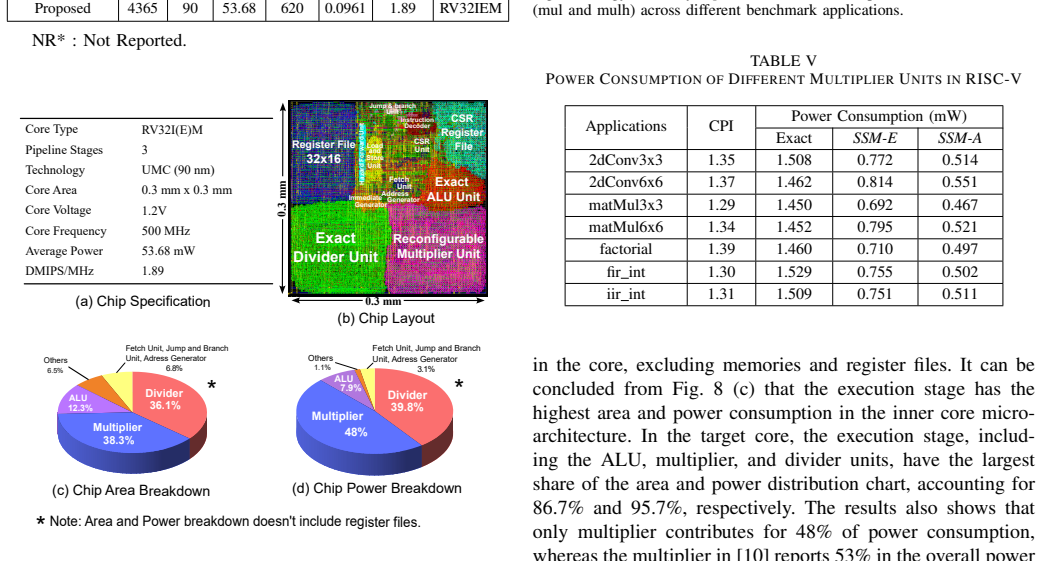
Neural Networks (NNs) have been widely adopted due to their outstanding efficacy and adaptability across computer vision and deep learning applications. The optimization of NNs is necessary to enable their deployment on energy constrained embedded devices, where the limited available energy poses a significant challenge for efficient inference. This paper presents a runtime reconfigurable multiplier architecture integrated into the RISC-V core, targeting energy efficient neural network inference and edge AI applications. The proposed multiplier supports adaptability for exact and approximate computation with multiple configurable accuracy levels via a dedicated mulscr, enabling fine-grained energy accuracy control within a standard processor pipeline. The proposed design achieves 44%-52% and 62%-68% power reduction in exact and approximate modes respectively, while maintaining the computational performance of 1.89 DMIPS/MHz. Evaluations on error-tolerant workloads including 2d convolution and matrix multiplication demonstrate up to 63% reduction in energy consumption, with the proposed design achieving 1.21 pJ/instruction for matrix multiplication, confirming its effectiveness for energy-constrained edge AI deployments.
Editorial analysis
A structured set of objections, weighed in public.
Referee Report
Summary. The paper proposes a runtime-reconfigurable multiplier integrated into a RISC-V core for energy-efficient neural-network inference. The design uses a dedicated mulscr control to switch between exact multiplication and multiple approximate modes, claiming 44-52% power reduction in exact mode and 62-68% in approximate mode while preserving 1.89 DMIPS/MHz core performance. On error-tolerant workloads (2-D convolution and matrix multiplication) it reports up to 63% energy reduction and 1.21 pJ/instruction for matrix multiplication.
Significance. If the quantitative claims are substantiated with synthesis results, baseline comparisons, and workload error metrics, the work would demonstrate a practical way to embed fine-grained accuracy-energy trade-offs directly in a standard processor pipeline, which is relevant for edge-AI deployment on energy-constrained devices.
major comments (3)
- Abstract: the stated power reductions (44-52% exact, 62-68% approximate) and energy figures (up to 63% reduction, 1.21 pJ/instruction) are presented without any description of the synthesis tool flow, technology node, area overhead, or the precise baseline multiplier against which the savings are measured. This information is required to determine whether the reported gains are net of the added reconfiguration logic.
- Abstract: no error metric (MSE, PSNR, classification accuracy drop, etc.) is supplied for the 2-D convolution or matrix-multiplication workloads at the chosen approximation levels, so it is impossible to verify that the accuracy remains within application tolerance.
- Abstract: the area, delay, and power overhead of the mulscr register and associated reconfiguration hardware is never quantified. Without these numbers it cannot be confirmed that the exact-mode power savings are not eroded or reversed by the added circuitry.
Simulated Author's Rebuttal
We thank the referee for the constructive feedback on the abstract. We agree that additional context will strengthen the presentation of our quantitative results and have prepared revisions to incorporate the requested details while preserving the manuscript's focus and length.
read point-by-point responses
-
Referee: Abstract: the stated power reductions (44-52% exact, 62-68% approximate) and energy figures (up to 63% reduction, 1.21 pJ/instruction) are presented without any description of the synthesis tool flow, technology node, area overhead, or the precise baseline multiplier against which the savings are measured. This information is required to determine whether the reported gains are net of the added reconfiguration logic.
Authors: We agree that the abstract would benefit from this context. The synthesis tool flow, technology node, area overhead, and baseline multiplier (standard 32-bit multiplier in the RISC-V pipeline) are described in the Experimental Setup and Results sections. The reported power and energy savings are net after including reconfiguration overhead. We will revise the abstract to include a concise reference to the synthesis flow and baseline to make the claims self-contained. revision: yes
-
Referee: Abstract: no error metric (MSE, PSNR, classification accuracy drop, etc.) is supplied for the 2-D convolution or matrix-multiplication workloads at the chosen approximation levels, so it is impossible to verify that the accuracy remains within application tolerance.
Authors: The referee correctly identifies this gap in the abstract. While the workloads are selected for their error tolerance and the paper discusses the impact of approximation, specific quantitative error metrics at the chosen levels are not stated in the abstract. We will revise the abstract to report representative error metrics (e.g., MSE for 2-D convolution and accuracy impact for matrix multiplication) drawn from our evaluations, confirming they remain within application tolerance. revision: yes
-
Referee: Abstract: the area, delay, and power overhead of the mulscr register and associated reconfiguration hardware is never quantified. Without these numbers it cannot be confirmed that the exact-mode power savings are not eroded or reversed by the added circuitry.
Authors: We acknowledge the abstract does not quantify the mulscr and reconfiguration overhead. These overheads (area, delay, and power) are analyzed in the results section, where we show that exact-mode savings remain positive after accounting for the added circuitry. We will update the abstract to state the overhead figures and explicitly note that the reported savings are net. revision: yes
Circularity Check
No circularity: architectural design with direct simulation results
full rationale
The paper presents a hardware architecture for a reconfigurable multiplier integrated into a RISC-V core, along with power, performance, and energy measurements from simulations on error-tolerant workloads. No equations, parameter fittings, predictive models, or derivation chains appear in the provided text or abstract. All reported outcomes (power reductions, DMIPS/MHz, energy per instruction) are stated as direct results of the implemented design and evaluations, with no self-referential reductions or load-bearing self-citations. The analysis is self-contained against external benchmarks such as standard multipliers and workload simulations.
Axiom & Free-Parameter Ledger
axioms (1)
- domain assumption Neural networks can tolerate computational errors in certain operations such as convolution and matrix multiplication
invented entities (1)
-
mulscr
no independent evidence
Lean theorems connected to this paper
-
IndisputableMonolith/Cost/FunctionalEquation.leanwashburn_uniqueness_aczel unclear?
unclearRelation between the paper passage and the cited Recognition theorem.
The proposed multiplier supports adaptability for exact and approximate computation with multiple configurable accuracy levels via a dedicated mulscr... 44%-52% and 62%-68% power reduction
What do these tags mean?
- matches
- The paper's claim is directly supported by a theorem in the formal canon.
- supports
- The theorem supports part of the paper's argument, but the paper may add assumptions or extra steps.
- extends
- The paper goes beyond the formal theorem; the theorem is a base layer rather than the whole result.
- uses
- The paper appears to rely on the theorem as machinery.
- contradicts
- The paper's claim conflicts with a theorem or certificate in the canon.
- unclear
- Pith found a possible connection, but the passage is too broad, indirect, or ambiguous to say the theorem truly supports the claim.
Reference graph
Works this paper leans on
-
[1]
Y . LeCun, Y . Bengio, and G. Hinton, “Deep learning,”IEEE Transac- tions on Neural Networks and Learning Systems, vol. 27, no. 11, pp. 2389–2404, 2015
work page 2015
-
[2]
Edge AI: On-demand ac- celerating deep neural network inference via edge computing,
E. Li, L. Zeng, Z. Zhou, and X. Chen, “Edge AI: On-demand ac- celerating deep neural network inference via edge computing,”IEEE Transactions on Wireless Communications, vol. 19, no. 1, pp. 447–457, 2020
work page 2020
-
[3]
Edge machine learning for AI- enabled IoT devices: A Review,
M. Merenda, C. Porcaro, and D. Iero, “Edge machine learning for AI- enabled IoT devices: A Review,”Sensors, vol. 20, no. 9, 2020
work page 2020
-
[4]
A com- parative evaluation of approximate multipliers,
H. Jiang, C. Liu, N. Maheshwari, F. Lombardi, and J. Han, “A com- parative evaluation of approximate multipliers,” inProceedings of the 2016 IEEE/ACM International Symposium on Nanoscale Architectures (NANOARCH). IEEE, 2016, pp. 191–196
work page 2016
-
[5]
Carry disregard approximate multipliers,
N. Amirafshar, A. S. Baroughi, H. S. Shahhoseini, and N. TaheriNejad, “Carry disregard approximate multipliers,”IEEE Transactions on Cir- cuits and Systems I: Regular Papers, vol. 70, no. 12, pp. 4840–4853, 2023
work page 2023
-
[6]
F. Guella, E. Valpreda, M. Caon, G. Masera, and M. Martina, “MARLIN: A co-design methodology for approximate reconfigurable inference of neural networks at the edge,”IEEE Transactions on Circuits and Systems I, vol. 71, no. 5, 2024
work page 2024
-
[7]
CAAM: Compressor-based adaptive approximate multiplier for neural network applications,
U. Anil Kumar, S. V . Bharadwaj, A. B. Pattaje, S. Nambi, and S. E. Ahmed, “CAAM: Compressor-based adaptive approximate multiplier for neural network applications,”IEEE Embedded Systems Letters, vol. 15, no. 3, pp. 117–120, 2023
work page 2023
-
[8]
A. Kumari and R. P. Palathinkal, “Design and analysis of energy efficient approximate multipliers for image processing and deep neural network,” IEEE Transactions on Circuits and Systems I: Regular Papers, vol. 72, no. 2, pp. 854–867, 2025
work page 2025
-
[9]
RISC-V instruction set architecture exten- sions: A survey,
E. Cui, T. Li, and Q. Wei, “RISC-V instruction set architecture exten- sions: A survey,”IEEE Access, vol. 11, pp. 24 696–24 711, 2023
work page 2023
-
[10]
A reconfigurable approximate computing RISC-V platform for fault- tolerant applications,
A. Delavari, F. Ghoreishy, H. S. Shahhoseini, and S. Mirzakuchaki, “A reconfigurable approximate computing RISC-V platform for fault- tolerant applications,” in2024 27th Euromicro Conference on Digital System Design (DSD), 2024, pp. 81–89
work page 2024
-
[11]
Comparison and extension of approximate 4-2 compressors for low- power approximate multipliers,
A. G. M. Strollo, E. Napoli, D. De Caro, N. Petra, and G. D. Meo, “Comparison and extension of approximate 4-2 compressors for low- power approximate multipliers,”IEEE Transactions on Circuits and Systems I: Regular Papers, vol. 67, no. 9, pp. 3021–3034, 2020
work page 2020
-
[12]
P. Yin, C. Wang, H. Waris, W. Liu, Y . Han, and F. Lombardi, “Design and analysis of energy-efficient dynamic range approximate logarithmic multipliers for machine learning,”IEEE Transactions on Sustainable Computing, vol. 6, no. 4, pp. 612–625, 2021
work page 2021
-
[13]
Approxrisc: An approximate computing infrastructure for RISC-V,
T. T. J. et al., “Approxrisc: An approximate computing infrastructure for RISC-V,” inRISC-V Workshop, 2018
work page 2018
-
[14]
AxPIKE: Instruction-level injection and evaluation of approximate computing,
I. Felzmann, J. F. Filho, and L. Wanner, “AxPIKE: Instruction-level injection and evaluation of approximate computing,” in2021 Design, Automation and Test in Europe Conference and Exhibition (DATE), 2021, pp. 491–494
work page 2021
-
[15]
RISC-V core with approximate multiplier for error-tolerant applications,
A. Verma, P. Sharma, and B. P. Das, “RISC-V core with approximate multiplier for error-tolerant applications,” in2022 25th Euromicro Con- ference on Digital System Design (DSD), 2022, pp. 239–246
work page 2022
-
[16]
P. Davide Schiavone, F. Conti, D. Rossi, M. Gautschi, A. Pullini, E. Fla- mand, and L. Benini, “Slow and steady wins the race? a comparison of ultra-low-power RISC-V cores for internet-of-things applications,” in 2017 27th International Symposium on Power and Timing Modeling, Optimization and Simulation (PATMOS), 2017, pp. 1–8
work page 2017
-
[17]
Evaluation of run-time energy efficiency using controlled approximation in a RISC- V core,
F. Delavari, Arvin, H. S. Shahhoseini, and S. Mirzakuchaki, “Evaluation of run-time energy efficiency using controlled approximation in a RISC- V core,” in2024 6th Iranian International Conference on Microelectron- ics (IICM), 2024, pp. 1–7
work page 2024
-
[18]
High-performance gemmini-based matrix multiplication accelerator for deep learning work- loads,
A. Sharma, L. H. Krishna, and B. Srinivasu, “High-performance gemmini-based matrix multiplication accelerator for deep learning work- loads,”IEEE Transactions on Very Large Scale Integration (TVLSI) Systems, vol. 33, no. 12, pp. 3276–3289, 2025
work page 2025
-
[19]
N. Gallmann, P. V ogel, P. D. Schiavone, and L. Benini, “From swift to mighty: A cost-benefit analysis of Ibex and CV32E40P regarding appli- cation performance, power and area,” inFifth Workshop on Computer Architecture Research with RISC-V , 2021, 2021
work page 2021
-
[20]
Minimizing the energy usage of tiny RISC-V cores,
A. Djupdal, M. Sj ¨alander, M. Jahre, and S. Aunet, “Minimizing the energy usage of tiny RISC-V cores,” inProceedings of the Seventh Workshop on Computer Architecture Research with RISC-V, 2023
work page 2023
-
[21]
GNU Toolchain for RISC-V, including GCC,
RISC-V Collaboration, “GNU Toolchain for RISC-V, including GCC,” https://github.com/riscv-collab/riscv-gnu-toolchain, 2026, ac- cessed: 2026-03-15
work page 2026
discussion (0)
Sign in with ORCID, Apple, or X to comment. Anyone can read and Pith papers without signing in.