Recognition: no theorem link
Reconfigurable Magnetic Nanopore Platform for Selective Trapping
Pith reviewed 2026-05-12 00:51 UTC · model grok-4.3
The pith
Magnetic nanopores can be switched on and off with short pulses to trap and release tagged biomolecules on demand.
A machine-rendered reading of the paper's core claim, the machinery that carries it, and where it could break.
Core claim
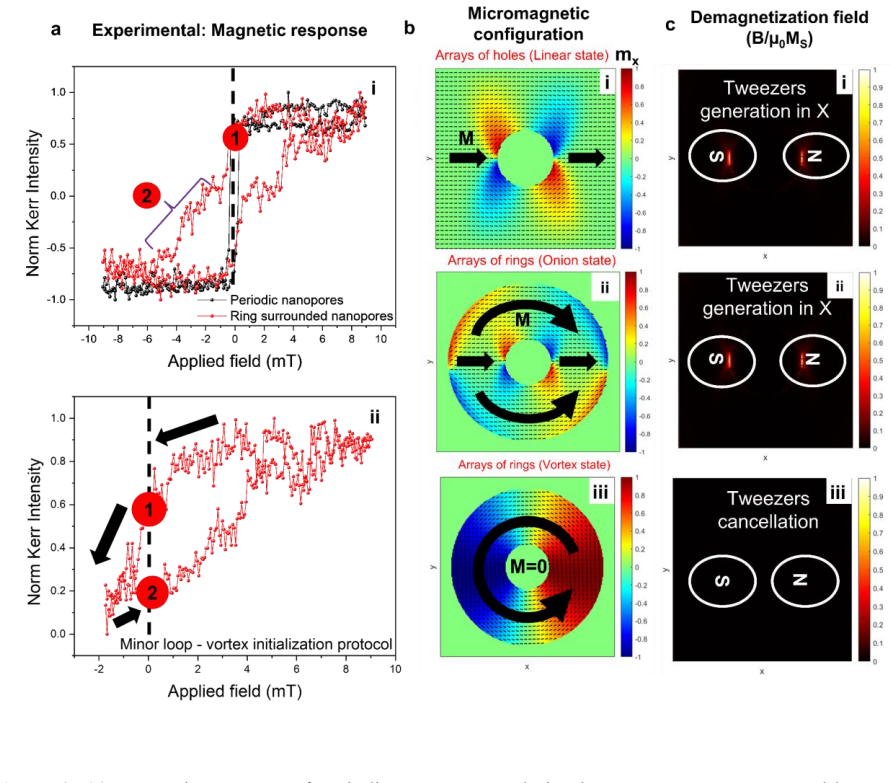
The central claim is that a ferromagnetic layer integrated into a solid-state nanopore acts as a magnetic discontinuity that produces localized stray fields for magnetic tweezing; the chosen geometry permits reversible transitions between a nearly uniform magnetization state and a magnetic flux-closure state via short applied field pulses, thereby turning the tweezing force on or off at will for controlled capture and release of tagged magnetic nanoparticles.
What carries the argument
The reconfigurable nanopore geometry that switches between nearly uniform magnetization and flux-closure states to control the presence of localized stray magnetic fields.
If this is right
- Magnetic tweezing can be activated or deactivated on demand for selective trapping and release of tagged biomolecules.
- The platform enables controlled particle positioning inside the pore, overcoming the passive limitation of conventional nanopores.
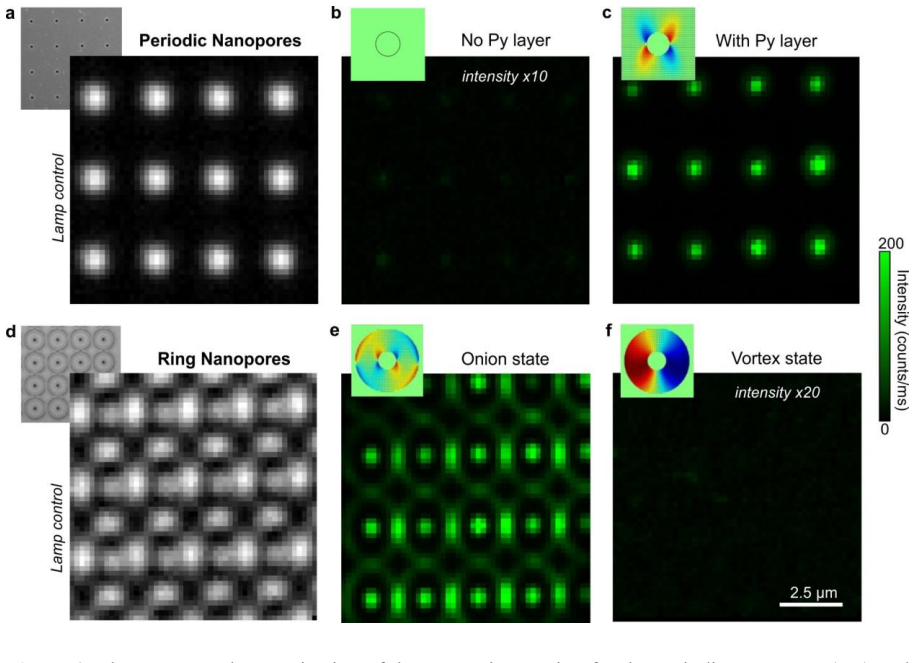
- Selective trapping of fluorescent magnetic particles is shown as proof of concept.
- Reconfigurable on-chip systems become feasible for high-throughput single-particle detection.
Where Pith is reading between the lines
- The same pulse-controlled switching could be paired with simultaneous electrical or optical readout to study trapped molecules under defined magnetic forces.
- Pulse sequences might allow differential sorting of particles carrying different magnetic tags within a single device.
- The architecture suggests a route to multiplexed analysis where magnetic control is used to hold and then interrogate multiple analytes in sequence.
Load-bearing premise
Adding the ferromagnetic layer and applying magnetic pulses will leave the nanopore structurally intact, preserve its sensing resolution and biocompatibility, and still produce stray fields strong enough for reliable trapping.
What would settle it
Direct observation that fluorescent magnetic particles are captured only in the flux-closure state and released upon a pulse that restores uniform magnetization, without measurable pore damage or loss of optical signal, would support the claim; absence of reversible switching or degradation in pore performance would falsify it.
Figures
read the original abstract
Solid-state nanopores offer a powerful platform for nanoscale analysis of individual analytes, including biomolecules and functionalized nanoparticles, by confining them within a precisely defined sensing region. However, their inherently passive operation restricts practical applications, as they cannot precisely control particle position or dynamics inside the pore. Here, we introduce magnetic nanopore architectures that integrate a ferromagnetic layer into the nanopore system. Acting as a magnetic discontinuity within an otherwise uniformly magnetized film, the nanopore generates localized stray magnetic fields that enable magnetic tweezing of magnetic nanoparticles, which can be functionalized with fluorescent biomolecules. Importantly, the nanopore geometry is designed to reversibly switch between a nearly uniform magnetization state and a magnetic flux-closure state through the application of short magnetic field pulses of controlled amplitude. This capability allows the magnetic tweezing effect to be selectively activated or deactivated, enabling controlled capture and release of tagged biomolecules on demand. As a proof of concept, we demonstrate the selective magnetic trapping of fluorescent magnetic particles. These findings pave the way for reconfigurable, on-chip magnetic nanopore platforms capable of selective trapping and high-throughput single-particle detection. KEYWORDS: Nanopores, magnetic tweezers, fluorescence microscopy, vortex state, active control, magnetic nanoparticles
Editorial analysis
A structured set of objections, weighed in public.
Referee Report
Summary. The manuscript introduces magnetic nanopore architectures that integrate a ferromagnetic layer to generate localized stray magnetic fields for tweezing functionalized magnetic nanoparticles. The nanopore geometry is designed to reversibly switch between a nearly uniform magnetization state and a flux-closure state via short magnetic field pulses of controlled amplitude, enabling on-demand activation and deactivation of trapping for selective capture and release of tagged biomolecules. A qualitative proof-of-concept demonstration of selective trapping of fluorescent magnetic particles is presented.
Significance. If validated, the reconfigurable control could enable active manipulation in solid-state nanopore platforms, advancing applications in single-particle detection and biomolecular analysis by combining magnetic tweezing with sensing. The approach builds on standard electromagnetic principles but the current work remains conceptual with only qualitative evidence, so its significance is prospective rather than established.
major comments (2)
- Abstract: The central claim that the specific nanopore geometry (ferromagnetic layer with hole) supports reversible switching between nearly uniform magnetization and flux-closure states under short field pulses is asserted as a design feature but lacks any supporting data such as hysteresis loops, MFM/MOKE images, or pulse-response measurements to confirm the states are reached, the switching is reversible, or the stray-field localization changes as required for capture/release.
- Proof-of-concept demonstration: The selective trapping of fluorescent magnetic particles is shown qualitatively, but no quantitative metrics (e.g., trapping efficiency, required field amplitudes, error bars, or controls without the magnetic layer) are provided, preventing rigorous evaluation of the tweezing effect or the reconfigurability's practical utility.
minor comments (2)
- Abstract: The keywords list 'vortex state' while the text refers to 'flux-closure state'; clarify whether these are synonymous in this context and ensure consistent terminology.
- The manuscript would benefit from explicit fabrication parameters, nanopore dimensions, and material specifications to support reproducibility, even in a conceptual design paper.
Simulated Author's Rebuttal
We thank the referee for their insightful comments, which have helped us improve the clarity and presentation of our work. Below we provide point-by-point responses to the major comments.
read point-by-point responses
-
Referee: [—] Abstract: The central claim that the specific nanopore geometry (ferromagnetic layer with hole) supports reversible switching between nearly uniform magnetization and flux-closure states under short field pulses is asserted as a design feature but lacks any supporting data such as hysteresis loops, MFM/MOKE images, or pulse-response measurements to confirm the states are reached, the switching is reversible, or the stray-field localization changes as required for capture/release.
Authors: The switching mechanism is supported by micromagnetic simulations detailed in the main text and supplementary information, which show the magnetization states, the effect of short field pulses, and the resulting stray field localization. We have revised the abstract to explicitly mention these simulation results and added a reference to the relevant figure. We agree that experimental validation using MFM or MOKE would further strengthen the claims; however, such measurements were outside the scope of this proof-of-concept study focused on particle trapping. We have added a note in the discussion section about planned future experimental characterization of the magnetic states. revision: partial
-
Referee: [—] Proof-of-concept demonstration: The selective trapping of fluorescent magnetic particles is shown qualitatively, but no quantitative metrics (e.g., trapping efficiency, required field amplitudes, error bars, or controls without the magnetic layer) are provided, preventing rigorous evaluation of the tweezing effect or the reconfigurability's practical utility.
Authors: We accept that the demonstration is qualitative. To address this, we have included the specific amplitudes of the magnetic field pulses used for switching and trapping in the revised methods and results sections. We have also added a discussion of control experiments conceptually (without the ferromagnetic layer, no localized fields are generated) and noted the limitations of the current qualitative data. However, we did not perform statistical analysis for trapping efficiency or include error bars, as the experiments were limited to demonstrating the on-demand capture and release. We believe this is appropriate for a proof-of-concept manuscript but have expanded the text to better contextualize the results. revision: partial
Circularity Check
No significant circularity; experimental design with no derivations
full rationale
The paper describes an experimental magnetic nanopore architecture relying on standard electromagnetic principles and a proof-of-concept demonstration of particle trapping. No equations, derivations, parameter fittings, or load-bearing self-citations appear in the provided text. The reconfigurability claim is presented as a geometric design feature rather than a result derived from or equivalent to its own inputs. This matches the reader's assessment of minimal circularity and qualifies as a self-contained experimental report without any of the enumerated circular patterns.
Axiom & Free-Parameter Ledger
axioms (1)
- standard math Localized stray magnetic fields arise at geometric discontinuities in a ferromagnetic film under applied fields.
Reference graph
Works this paper leans on
-
[1]
L. Xue, H. Yamazaki, R. Ren, M. Wanunu, A. P. Ivanov, J. B. Edel, Nat. Rev. Mater. 2020, 5, 931
work page 2020
- [2]
-
[3]
W. Li, J. Zhou, N. Maccaferri, R. Krahne, K. Wang, D. Garoli, Anal. Chem. 2022, 94, 503
work page 2022
- [4]
-
[5]
A. Ivankin, R. Y. Henley, J. Larkin, S. Carson, M. L. Toscano, M. Wanunu, ACS Nano 2014, 8, 10774
work page 2014
-
[6]
Y.-L. Ying, Z. -L. Hu, S. Zhang, Y. Qing, A. Fragasso, G. Maglia, A. Meller, H. Bayley, C. Dekker, Y.-T. Long, Nat. Nanotechnol. 2022, 17, 1136
work page 2022
-
[7]
G. T. Solymosi, G. Jágerszki, L. Illés, P. Fürjes, R. E. Gyurcsányi, Adv. Funct. Mater. 2025, 202519292
work page 2025
-
[8]
Y. He, M. Tsutsui, Y. Zhou, X. S. Miao, NPG Asia Mater. 2021, 13, 48
work page 2021
-
[9]
P. Xia, D. Satyabola, N. K. Bamrah, M. A. R. Laskar, A. Al Mamun, X. Zhou, G. B. M. Wisna, Y. Zhang, A. Ikbal, A. Kemeklis, A. E. Krylova, R. F. Hariadi, H. Yan, C. Wang, Adv. Funct. Mater. 2025, 202523998
work page 2025
-
[10]
K. Song, R. Gao, X. Pan, S. Yang, Z. Xue, C. Zhu, J. Wang, X.-H. Xia, Anal. Chem. 2026, 98, 1213
work page 2026
- [11]
-
[12]
H. Liu, Q. Zhou, W. Wang, F. Fang, J. Zhang, Small 2023, 19, 2205680
work page 2023
- [13]
-
[14]
J. Gao, Y. Wu, S. Yu, X. Zhou, Y. Li, W. Xie, S. Fang, R. Tian, Y. Yin, T. Weng, D. Zhou, Small 2025, 21, 2507736
work page 2025
-
[15]
R. Hu, X. Tong, Q. Zhao, Adv. Healthcare Mater. 2020, 9, 2000933
work page 2020
- [16]
-
[17]
M. Tsutsui, W.-L. Hsu, D. Garoli, A. Douaki, Y. Komoto, H. Daiguji, T. Kawai, Nat. Commun. 2026, 17, 1496
work page 2026
-
[18]
A. J. Storm, J. H. Chen, X. S. Ling, H. W. Zandbergen, C. Dekker, Nat. Mater. 2003, 2, 537
work page 2003
-
[19]
H. Qian, R. F. Egerton, Appl. Phys. Lett. 2017, 111, 193106
work page 2017
-
[20]
J. P. Fried, J. L. Swett, B. P. Nadappuram, J. A. Mol, J. B. Edel, A. P. Ivanov, J. R. Yates, Chem. Soc. Rev. 2021, 50, 4974
work page 2021
- [21]
-
[22]
J. Joby, Y. Marom, G. Lin, A. Baron-Wiechec, A. Meller, Adv. Funct. Mater. 2025, 202518770
work page 2025
-
[23]
G. Pérez -Mitta, M. E. Toimil -Molares, C. Trautmann, W. A. Marmisollé, O. Azzaroni, Adv. Mater. 2019, 31, 1901483
work page 2019
-
[24]
K. Wang, K. B. Crozier, ChemPhysChem 2012, 13, 2639
work page 2012
-
[25]
K. B. Crozier, ACS Photonics 2024, 11, 321
work page 2024
-
[26]
K.-Y. Chen, A.-T. Lee, C.-C. Hung, J.-S. Huang, Y.-T. Yang, Nano Lett. 2013, 13, 4118
work page 2013
-
[27]
K. Wang, E. Schonbrun, P. Steinvurzel, K. B. Crozier, Nat. Commun. 2011, 2, 469
work page 2011
- [28]
-
[29]
D. V. Verschueren, S. Pud, X. Shi, L. De Angelis, L. Kuipers, C. Dekker, ACS Nano 2019, 13, 61
work page 2019
-
[30]
F. K. Sarbisheh, K. Khabarov, M. Blanco Formoso, et al., Adv. Mater. 2025, 37, 2504436
work page 2025
-
[31]
J. A. Huang, M. Z. Mousavi, Y. Zhao, et al., Nat. Commun. 2019, 10, 5321
work page 2019
-
[32]
M. P. Jonsson, C. Dekker, Nano Lett. 2013, 13, 1029
work page 2013
-
[33]
C. R. Crick, P. Albella, B. Ng, A. P. Ivanov, T. Roschuk, M. P. Cecchini, F. Bresme, S. A. Maier, J. B. Edel, Nano Lett. 2015, 15, 553
work page 2015
-
[34]
N. Maccaferri, P. Vavassori, D. Garoli, Appl. Phys. Lett. 2021, 118, 193102
work page 2021
-
[35]
T. Tan, Z. Wang, C. Zhao, W. Duan, H. Bai, N. Zhang, J. Feng, Nano Lett. 2025, 25, 12637
work page 2025
-
[36]
F. Montoncello, L. Giovannini, G. Nizzoli, et al., Phys. Rev. B 2008, 78, 104421
work page 2008
-
[37]
Vidamour et al., Nanotechnology 2022, 33, 485203
T. Vidamour et al., Nanotechnology 2022, 33, 485203
work page 2022
-
[38]
P. Vavassori, R. Bovolenta, V. Metlushko, B. Ilic, J. Appl. Phys. 2006, 99, 053902
work page 2006
-
[39]
R. D. McMichael, M. J. Donahue, IEEE Trans. Magn. 1997, 33, 4167
work page 1997
-
[40]
S. Jain, A. O. Adeyeye, IEEE Trans. Magn. 2010, 46, 1595
work page 2010
-
[41]
I. Neudecker, Magnetization Dynamics of Confined Ferromagnetic Systems, Universität Regensburg, Regensburg 2006
work page 2006
-
[42]
A. O. Adeyeye et al., J. Phys. D: Appl. Phys. 2007, 40, 6479
work page 2007
-
[43]
G. Lanzavecchia, J. Kuttruff, A. Doricchi, A. Douaki, K. K. R. Ramankutty, I. García, L. Lin, A. Viejo Rodríguez, T. Wågberg, R. Krahne, N. Maccaferri, D. Garoli, Adv. Funct. Mater. 2023, 33, 230
work page 2023
-
[44]
H.-J. Shin, I.-S. Park, Y. J. Jang, S. J. Wi, G. S. Lee, J. Ahn, Sens. Actuators A 2019, 295, 111538
work page 2019
-
[45]
Madou, Fundamentals of Microfabrication, CRC Press (1997)
M. Madou, Fundamentals of Microfabrication, CRC Press (1997)
work page 1997
-
[46]
Y. Zou, H. Jin, Q. Ma, Z. Zheng, S. Weng, K. Kolataj, G. Acuna, I. Bald, D. Garoli, Nanoscale 2025, 17, 3656
work page 2025
-
[47]
A. Vansteenkiste, J. Leliaert, M. Dvornik, F. Garcia-Sanchez, B. Van Waeyenberge, AIP Adv. 2014, 4, 107133
work page 2014
discussion (0)
Sign in with ORCID, Apple, or X to comment. Anyone can read and Pith papers without signing in.