Recognition: no theorem link
Signature Kernel and Schwinger-Dyson Kernel Equations as Two-Parameter Rough Differential Equations
Pith reviewed 2026-05-12 01:10 UTC · model grok-4.3
The pith
Signature kernel and Schwinger-Dyson equations arise as well-posed two-parameter rough differential equations.
A machine-rendered reading of the paper's core claim, the machinery that carries it, and where it could break.
Core claim
Within spaces of jointly controlled rough paths, the signature kernel equation is a two-parameter rough differential equation for which existence, uniqueness, and stability are proved; the Schwinger-Dyson kernel equation, previously limited to bounded-variation drivers, extends to rough signals with unique solutions in the same controlled rough path spaces. A new rough integration operator over two-dimensional simplices at low regularity supplies the necessary calculus. In the smooth case the resulting equations are shown to be equivalent to PDE and integro-differential problems, and a numerical scheme for the rough Schwinger-Dyson equation is derived together with runtime and memory bounds.
What carries the argument
jointly controlled rough paths together with rough integration over two-dimensional simplices, which together define two-parameter rough differential equations at low regularity.
If this is right
- The signature kernel equation admits unique stable solutions in the two-parameter rough path setting.
- The Schwinger-Dyson kernel equation possesses unique solutions when driven by rough signals.
- In the smooth regime the kernel equations reduce to standard PDE and integro-differential equations.
- A convergent numerical scheme for the rough Schwinger-Dyson equation exists with explicit runtime and memory complexity.
Where Pith is reading between the lines
- The same two-parameter framework could be applied to other kernel-type equations that arise from multi-parameter stochastic processes.
- Numerical experiments on fractional Brownian paths of varying Hurst index would directly test the stability claims.
- The simplicial integration operator may extend to higher-dimensional parameter spaces for rough path theory in several variables.
Load-bearing premise
A consistent rough integration operator over two-dimensional simplices can be built for jointly controlled rough paths even when the paths have low regularity.
What would settle it
An explicit pair of paths with Hölder exponents below the threshold for which the two-parameter rough integral over a simplex is well-defined, producing non-existence or non-uniqueness of solutions to either kernel equation.
Figures

read the original abstract
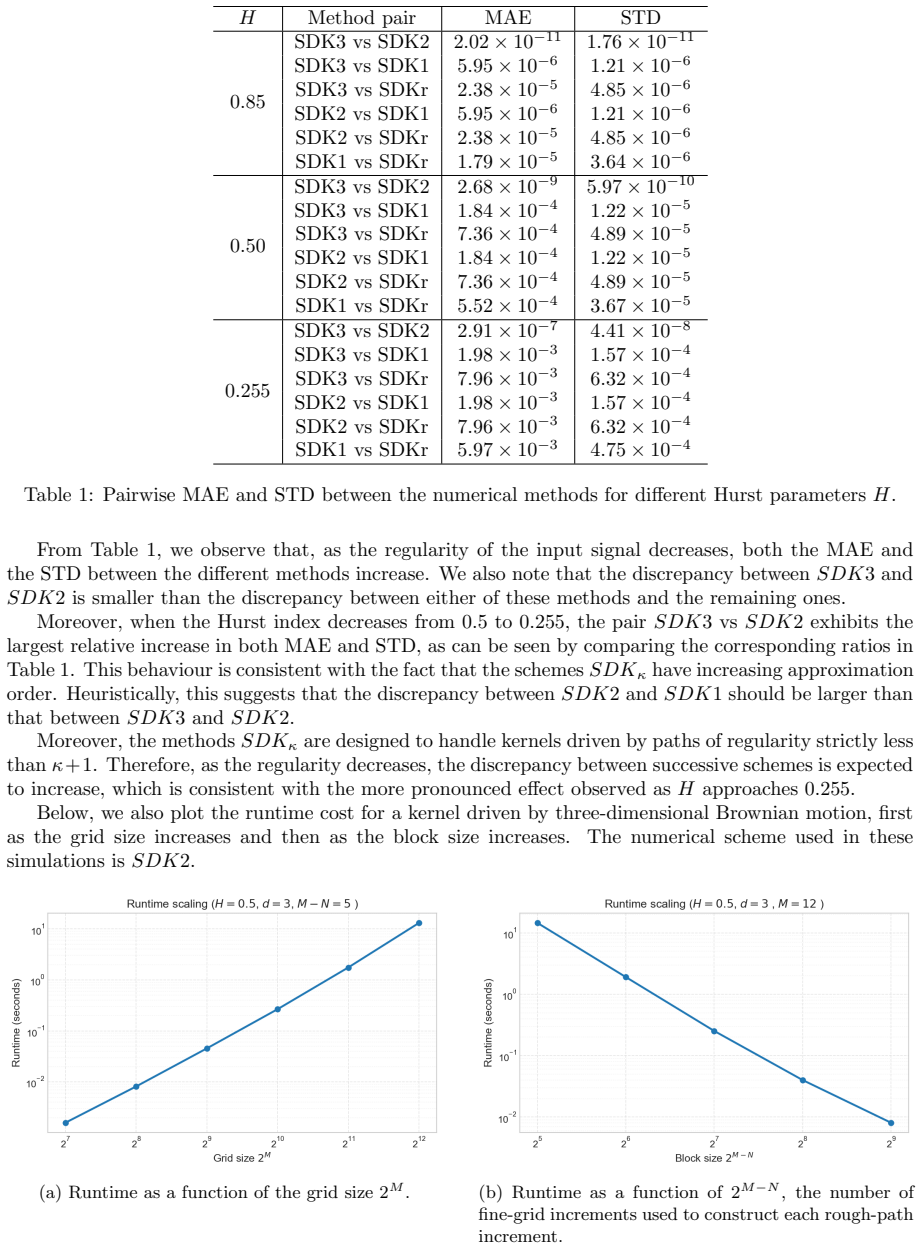
We develop a rough-path framework for two-parameter rough differential equations on rectangular and simplicial domains, motivated by the signature kernel and Schwinger--Dyson kernel equations. The theory is formulated in spaces of jointly controlled rough paths and is based on a robust two-parameter rough integration framework. In particular, we introduce a notion of rough integration over two-dimensional simplices at low regularity extending previous results in the literature. Within this setting, we show that the signature kernel equation arises naturally as a two-parameter rough differential equation and establish well-posedness and stability. We also extend the Schwinger--Dyson kernel equation, previously formulated for bounded-variation paths, to rough driving signals, proving existence and uniqueness in appropriate controlled rough path spaces. In the smooth rough path regime, we relate the resulting equations to PDE and integro-differential formulations. Finally, we derive and analyse a numerical scheme for the rough Schwinger--Dyson equation, including runtime and memory complexity estimates, and illustrate its performance with numerical experiments.
Editorial analysis
A structured set of objections, weighed in public.
Referee Report
Summary. The manuscript develops a two-parameter rough path theory for rough differential equations on rectangular and simplicial domains. It introduces a robust framework for two-parameter rough integration, including a new notion of rough integration over two-dimensional simplices at low regularity. The signature kernel equation is shown to arise as a two-parameter RDE with well-posedness and stability established. The Schwinger-Dyson kernel equation is extended to rough signals with existence and uniqueness in controlled rough path spaces. In the smooth regime, relations to PDE and integro-differential equations are derived, and a numerical scheme for the rough Schwinger-Dyson equation is analyzed with complexity estimates and numerical experiments.
Significance. If the central constructions hold, this work provides a significant extension of rough path theory to multi-parameter settings, enabling the analysis of kernel equations driven by rough paths. The explicit Hölder exponent dependence in the estimates and the numerical scheme with runtime/memory analysis represent practical strengths. This could impact areas like stochastic analysis and machine learning where signature kernels appear.
minor comments (2)
- [Abstract] The abstract refers to 'appropriate controlled rough path spaces' without indicating the precise Hölder regularity assumptions on the driving signals; adding a brief parenthetical on the range of exponents would improve immediate readability.
- [Numerical scheme section] In the numerical experiments section, the runtime and memory complexity claims would be strengthened by an explicit statement of the dependence on the mesh size and the Hölder parameters in the big-O notation.
Simulated Author's Rebuttal
We thank the referee for their positive summary of the manuscript, recognition of its significance in extending rough path theory to the multi-parameter setting, and recommendation of minor revision. As the report contains no specific major comments or requests for changes, we have no individual points to address at this stage. We remain available to incorporate any minor editorial suggestions from the editor.
Circularity Check
No significant circularity in derivation chain
full rationale
The paper develops an original two-parameter rough-path integration theory on rectangular and simplicial domains in jointly controlled rough path spaces, including a new low-regularity integral over 2D simplices that extends prior one-parameter results. It then shows the signature kernel satisfies a two-parameter RDE in this setting and extends the Schwinger-Dyson equation to rough drivers, with well-posedness and stability obtained via standard fixed-point arguments once the integral is constructed. All estimates depend explicitly on Hölder exponents and algebraic consistency conditions. No load-bearing step reduces by construction to a fitted parameter, self-definition, or unverified self-citation chain; the central claims are independent of the target equations and rest on the newly built integration framework. The development is self-contained against external benchmarks.
Axiom & Free-Parameter Ledger
axioms (2)
- domain assumption Existence and properties of jointly controlled rough paths in two parameters
- ad hoc to paper Robust two-parameter rough integration framework extending one-parameter results
Reference graph
Works this paper leans on
- [1]
-
[2]
The Annals of Applied Probability , volume=
Free probability, path developments and signature kernels as universal scaling limits , author=. The Annals of Applied Probability , volume=. 2026 , publisher=
work page 2026
-
[3]
Gerasimovi. H. Electronic Journal of Probability , year=
-
[4]
arXiv preprint math-ph/0609050 , year=
How to generate random matrices from the classical compact groups , author=. arXiv preprint math-ph/0609050 , year=
-
[5]
SIAM Journal on Mathematics of Data Science , volume=
The signature kernel is the solution of a goursat pde , author=. SIAM Journal on Mathematics of Data Science , volume=. 2021 , publisher=
work page 2021
-
[6]
Signature Methods in Finance: An Introduction with Computational Applications , pages=
Signature Maximum Mean Discrepancy Two-Sample Statistical Tests , author=. Signature Methods in Finance: An Introduction with Computational Applications , pages=. 2025 , publisher=
work page 2025
-
[7]
International Conference on Artificial Intelligence and Statistics , pages=
Distribution regression for sequential data , author=. International Conference on Artificial Intelligence and Statistics , pages=. 2021 , organization=
work page 2021
-
[8]
International Conference on Machine Learning , pages=
Bayesian learning from sequential data using Gaussian processes with signature covariances , author=. International Conference on Machine Learning , pages=. 2020 , organization=
work page 2020
-
[9]
Differential equations driven by rough paths: Ecole d'Et
Lyons, Terry J and Caruana, Michael and L. Differential equations driven by rough paths: Ecole d'Et. 2007 , publisher=
work page 2007
-
[10]
arXiv preprint arXiv:2404.02926 , year=
Log-PDE Methods for Rough Signature Kernels , author=. arXiv preprint arXiv:2404.02926 , year=
- [11]
-
[12]
Journal of the London Mathematical Society , volume=
A combinatorial approach to geometric rough paths and their controlled paths , author=. Journal of the London Mathematical Society , volume=. 2022 , publisher=
work page 2022
- [13]
-
[14]
Vietnam Journal of Mathematics , volume=
Smooth rough paths, their geometry and algebraic renormalization , author=. Vietnam Journal of Mathematics , volume=. 2022 , publisher=
work page 2022
-
[15]
arXiv preprint arXiv:1406.7748 , year=
Rough sheets , author=. arXiv preprint arXiv:1406.7748 , year=
-
[16]
arXiv preprint arXiv:2508.05103 , year=
Quantum path signatures , author=. arXiv preprint arXiv:2508.05103 , year=
-
[17]
Journal of Differential Equations , volume=
Differential equations driven by rough paths with jumps , author=. Journal of Differential Equations , volume=. 2018 , publisher=
work page 2018
-
[18]
A generative adversarial network approach to calibration of local stochastic volatility models , author=. Risks , volume=. 2020 , publisher=
work page 2020
-
[19]
Kidger, Patrick and Foster, James and Li, Xuechen and Oberhauser, Harald and Lyons, Terry , title =. 2020 , note =
work page 2020
-
[20]
Advances in Neural Information Processing Systems , volume=
PCF-GAN: generating sequential data via the characteristic function of measures on the path space , author=. Advances in Neural Information Processing Systems , volume=
-
[21]
Characteristic functions of measures on geometric rough paths , school =
Chevyrev, Ilya and Lyons, Terry , year=. Characteristic functions of measures on geometric rough paths , school =
-
[22]
Journal of Machine Learning Research , volume=
Signature moments to characterize laws of stochastic processes , author=. Journal of Machine Learning Research , volume=
-
[23]
Advances in Neural Information Processing Systems , volume=
Non-adversarial training of neural sdes with signature kernel scores , author=. Advances in Neural Information Processing Systems , volume=
discussion (0)
Sign in with ORCID, Apple, or X to comment. Anyone can read and Pith papers without signing in.