Recognition: 2 theorem links
· Lean TheoremReconstructing resonant phase oscillator interactions from noisy time series
Pith reviewed 2026-05-12 02:27 UTC · model grok-4.3
The pith
A method recovers the resonant normal form terms that set the leading drift dynamics in weakly coupled phase oscillators from noisy time series.
A machine-rendered reading of the paper's core claim, the machinery that carries it, and where it could break.
Core claim
We present a method for reconstructing resonant interactions in weakly coupled phase oscillator systems from noisy time series. Instead of attempting to recover the full phase equations, which may be non-identifiable in the presence of bounded observational uncertainty, the method reconstructs the resonant normal form terms that determine the leading-order drift dynamics. We develop first-order and second-order reconstruction procedures based on finite libraries of resonant Fourier modes and least-squares estimation. We prove error bounds for the reconstructed coefficients under natural assumptions on the observation noise and the distribution of initial conditions. The second-order method,
What carries the argument
Finite libraries of resonant Fourier modes together with least-squares estimation that target resonant normal form terms rather than the full phase equations.
If this is right
- Reconstructed resonant coefficients remain within explicit error bounds under the stated noise and initial-condition assumptions.
- Effective resonant interactions produced by nonresonant first-order couplings become detectable at second order.
- Resonant subnetworks and emergent higher-order interactions can be identified directly from the time series.
- The approach works even when the full phase equations are not uniquely recoverable from the data.
Where Pith is reading between the lines
- The same library-based least-squares idea could be tested on experimental recordings from biological or engineered oscillator networks.
- Similar reconstruction might be adapted to other weakly nonlinear systems whose slow dynamics are captured by normal forms.
- Combining the method with sparse regression could reduce the size of the Fourier-mode library needed in high-dimensional cases.
Load-bearing premise
The oscillators remain weakly coupled and the observation noise plus initial-condition distribution satisfy the natural assumptions required for the error bounds.
What would settle it
Generate time series from a known weakly coupled phase-oscillator model with added noise, apply the reconstruction, and check whether the recovered resonant coefficients lie inside the proven error bounds.
Figures




read the original abstract
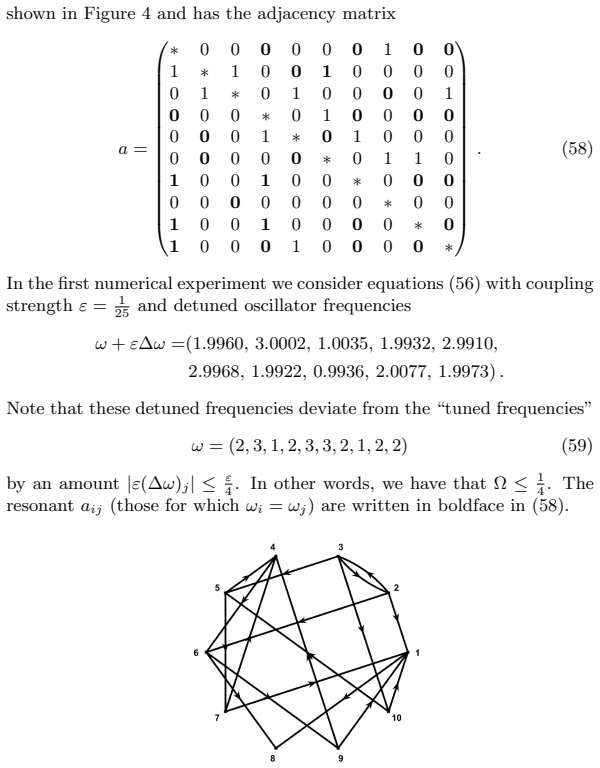
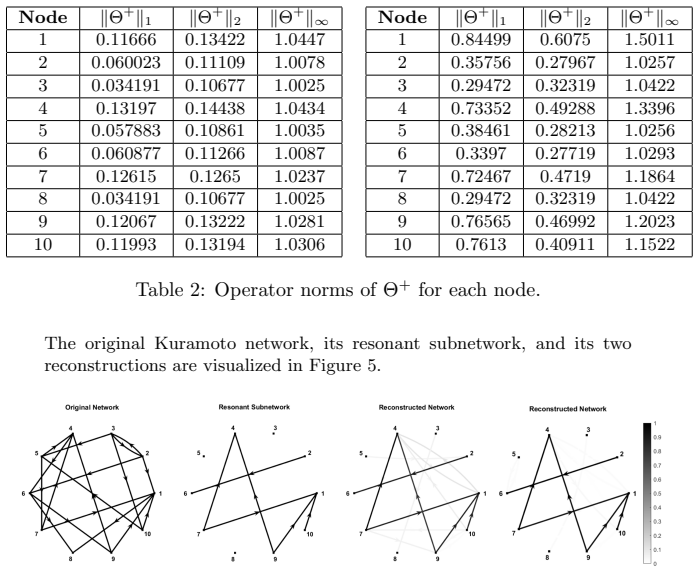
We present a method for reconstructing resonant interactions in weakly coupled phase oscillator systems from noisy time series. Instead of attempting to recover the full phase equations, which may be non-identifiable in the presence of bounded observational uncertainty, the method reconstructs the resonant normal form terms that determine the leading-order drift dynamics. We develop first-order and second-order reconstruction procedures based on finite libraries of resonant Fourier modes and least-squares estimation. We prove error bounds for the reconstructed coefficients under natural assumptions on the observation noise and the distribution of initial conditions. The second-order method detects effective resonant interactions generated by the interplay of nonresonant first-order couplings. Numerical examples illustrate the reconstruction of resonant subnetworks and emergent higher-order interactions.
Editorial analysis
A structured set of objections, weighed in public.
Referee Report
Summary. The manuscript presents a method for reconstructing resonant interactions in weakly coupled phase oscillator systems from noisy time series data. It focuses on recovering the resonant terms in the normal form using first- and second-order least-squares procedures based on finite libraries of resonant Fourier modes, rather than the full phase equations. Error bounds are proved under natural assumptions on observation noise and initial condition distributions, and the second-order method is shown to detect effective resonant interactions arising from nonresonant first-order couplings. Numerical examples are provided to illustrate the approach.
Significance. If the error bounds hold under the stated assumptions and the numerical tests are representative, this would be a useful contribution to data-driven inference in oscillator networks. The focus on resonant normal-form terms sidesteps non-identifiability issues in full phase models, and the second-order procedure for capturing emergent interactions from lower-order couplings addresses a practically relevant gap. The provision of explicit error bounds and numerical validation strengthens the work.
major comments (2)
- [§3 (Error bounds and assumptions)] The error bounds (developed for the least-squares estimators on the resonant Fourier library) rest on natural assumptions that the joint phase distribution (from dynamics plus initial conditions) produces a well-conditioned design matrix. Resonant terms can induce partial phase locking or clustering on the torus, restricting coverage of the relevant modes and potentially inflating reconstruction error beyond the proved bounds. The proofs do not appear to control for this dynamical feedback from the couplings being reconstructed.
- [§4 (Second-order method)] The second-order reconstruction procedure claims to isolate effective resonant interactions generated by nonresonant first-order couplings. It is unclear from the library construction and fitting whether the design matrix remains sufficiently independent when both orders are present simultaneously, or whether the error bounds extend directly to this case without additional conditioning requirements.
minor comments (2)
- [§5 (Numerical examples)] The numerical examples would be strengthened by including regimes near the onset of effective synchronization, where phase sampling becomes non-uniform, to directly test the robustness of the stated error bounds.
- [§2 (Method)] Notation for the resonant mode library and the precise definition of 'natural assumptions' on the initial-condition measure could be made more explicit in the main text for readers implementing the method.
Simulated Author's Rebuttal
We thank the referee for their constructive and detailed comments, which have helped clarify several aspects of our analysis. We address each major comment below, indicating planned revisions to the manuscript.
read point-by-point responses
-
Referee: [§3 (Error bounds and assumptions)] The error bounds (developed for the least-squares estimators on the resonant Fourier library) rest on natural assumptions that the joint phase distribution (from dynamics plus initial conditions) produces a well-conditioned design matrix. Resonant terms can induce partial phase locking or clustering on the torus, restricting coverage of the relevant modes and potentially inflating reconstruction error beyond the proved bounds. The proofs do not appear to control for this dynamical feedback from the couplings being reconstructed.
Authors: We appreciate the referee pointing out this subtlety in the assumptions. Our error bounds are derived under the standing hypothesis that the joint phase distribution (governed by weak coupling and the chosen initial-condition measure) produces a well-conditioned Gram matrix for the resonant Fourier library; this is stated explicitly in §3 and is consistent with the perturbative regime of the normal-form reduction. Under weak coupling the resonant terms induce only O(ε) perturbations to the phase flow, preserving sufficient ergodicity and coverage of the torus so that the design matrix remains well-conditioned with high probability. We agree, however, that the proofs do not explicitly quantify the threshold at which stronger coupling would induce partial locking and degrade conditioning. We will therefore add a clarifying remark in §3 that explicitly delimits the weak-coupling regime in which the bounds apply and note that the results are conditional on the observed distribution satisfying the stated non-degeneracy condition. A brief numerical check of the condition number will also be included in the examples. This is a partial revision: the core proofs are unchanged, but the domain of validity is stated more precisely. revision: partial
-
Referee: [§4 (Second-order method)] The second-order reconstruction procedure claims to isolate effective resonant interactions generated by nonresonant first-order couplings. It is unclear from the library construction and fitting whether the design matrix remains sufficiently independent when both orders are present simultaneously, or whether the error bounds extend directly to this case without additional conditioning requirements.
Authors: We thank the referee for this observation. In the second-order procedure the design matrix is assembled from the resonant Fourier modes at second order; nonresonant first-order couplings contribute only through their averaged effect on the slow resonant dynamics and therefore do not appear as separate columns. Because distinct Fourier modes are orthogonal on the torus, the columns remain linearly independent regardless of the simultaneous presence of first-order terms. The error analysis extends directly once the effective resonant coefficients are substituted, under the same assumptions on the phase distribution. To make this transparent we will revise §4 to (i) state the orthogonality argument explicitly, (ii) note that the conditioning requirements are identical to those of the first-order case, and (iii) include a short remark confirming that the existing error bounds carry over verbatim to the effective-coefficient setting. This constitutes a full revision of the section for added clarity. revision: yes
Circularity Check
No circularity: least-squares reconstruction with independent error bounds
full rationale
The paper defines a reconstruction procedure via least-squares fitting to a finite library of resonant Fourier modes and derives error bounds from general statistical assumptions on observation noise and initial-condition distribution. These bounds are not tautological to the fitted coefficients or the target resonant interactions; they follow from standard concentration inequalities under the stated 'natural assumptions.' The second-order detection of effective resonances is a consequence of the normal-form reduction and the fitting process, not a self-referential definition. No load-bearing self-citations, ansatzes smuggled via prior work, or fitted parameters renamed as predictions appear in the abstract or described chain. The method is self-contained against external benchmarks once the assumptions hold.
Axiom & Free-Parameter Ledger
axioms (2)
- domain assumption Observation noise is bounded and initial conditions follow a distribution that supports the error bounds
- domain assumption The system is weakly coupled phase oscillators
Lean theorems connected to this paper
-
IndisputableMonolith/Foundation/RealityFromDistinction.leanreality_from_one_distinction unclearWe present a method for reconstructing resonant interactions... first-order and second-order reconstruction procedures based on finite libraries of resonant Fourier modes and least-squares estimation... error bounds... under natural assumptions on the observation noise and the distribution of initial conditions.
-
IndisputableMonolith/Cost/FunctionalEquation.leanwashburn_uniqueness_aczel unclearϕj(T)−ϕj(0)−ωjT=εT Σ_{⟨ω,k⟩=0} A(1)j,k e^{i⟨k,ϕ(0)⟩} + O(ε) when T∼1/√ε
Reference graph
Works this paper leans on
-
[1]
Peter Ashwin, Christian Bick, and Camille Poignard. Dead zones and phase reduction of coupled oscillators.Chaos: An Interdisciplinary Journal of Nonlinear Science, 31(9):093132, September 2021
work page 2021
-
[2]
Christian Bick, Tobias B¨ ohle, and Christian Kuehn. Higher-Order Network Interactions Through Phase Reduction for Oscillators with Phase-Dependent Amplitude.Journal of Nonlinear Science, 34(4):77, June 2024. 43 j2 m=j1 j A(1)m,l A(1)j,k Figure 8: Feedforward motif in the original first order equation j2 m=j1 j A(1)j,kkmA(1)m,l⟨l,ω⟩ Figure 9: Resulting hy...
work page 2024
-
[3]
Eric Brown, Jeff Moehlis, and Philip Holmes. On the phase reduc- tion and response dynamics of neural oscillator populations.Neural Computation, 16(4):673–715, April 2004
work page 2004
-
[4]
Steven L. Brunton, Joshua L. Proctor, and J. Nathan Kutz. Dis- covering governing equations from data by sparse identification of nonlinear dynamical systems.Proceedings of the National Academy of Sciences, 113(15):3932–3937, April 2016. Publisher: Proceedings of the National Academy of Sciences
work page 2016
-
[5]
Jose Casadiego, Mor Nitzan, Sarah Hallerberg, and Marc Timme. Model-free inference of direct network interactions from nonlinear collective dynamics.Nature Communications, 8(1):2192, December
-
[6]
Publisher: Nature Publishing Group
-
[7]
Hypergraph reconstruction from dynamics.Nature Com- munications, 16(1):2691, March 2025
Robin Delabays, Giulia De Pasquale, Florian D¨ orfler, and Yuanzhao Zhang. Hypergraph reconstruction from dynamics.Nature Com- munications, 16(1):2691, March 2025. Publisher: Nature Publishing Group
work page 2025
-
[8]
Neil Fenichel and J. K. Moser. Persistence and Smoothness of Invari- ant Manifolds for Flows.Indiana University Mathematics Journal, 21(3):193–226, 1971
work page 1971
-
[9]
A parametri- sation method for high-order phase reduction in coupled oscillator networks, June 2023
S¨ oren von der Gracht, Eddie Nijholt, and Bob Rink. A parametri- sation method for high-order phase reduction in coupled oscillator networks, June 2023. arXiv:2306.03320 [math]. 44
-
[10]
Bj¨ orn Kralemann, Arkady Pikovsky, and Michael Rosenblum. Recon- structing phase dynamics of oscillator networks.Chaos: An Inter- disciplinary Journal of Nonlinear Science, 21(2):025104, June 2011
work page 2011
-
[11]
Bj¨ orn Kralemann, Arkady Pikovsky, and Michael Rosenblum. Re- constructing effective phase connectivity of oscillator networks from observations.New Journal of Physics, 16(8):085013, August 2014. Publisher: IOP Publishing
work page 2014
-
[12]
Iv´ an Le´ on, Riccardo Muolo, Shigefumi Hata, and Hiroya Nakao. The- ory of phase reduction from hypergraphs to simplicial complexes: A general route to higher-order Kuramoto models.Physica D: Nonlin- ear Phenomena, 482:134858, November 2025
work page 2025
-
[13]
Iv´ an Le´ on and Hiroya Nakao. Analytical phase reduction for weakly nonlinear oscillators.Chaos, Solitons & Fractals, 176:114117, Novem- ber 2023
work page 2023
-
[14]
Niall M. Mangan, Steven L. Brunton, Joshua L. Proctor, and J. Nathan Kutz. Inferring Biological Networks by Sparse Identifi- cation of Nonlinear Dynamics.IEEE Transactions on Molecular, Biological, and Multi-Scale Communications, 2(1):52–63, June 2016
work page 2016
-
[15]
Network infer- ence from oscillatory signals based on circle map, September 2024
Akari Matsuki, Hiroshi Kori, and Ryota Kobayashi. Network infer- ence from oscillatory signals based on circle map, September 2024. arXiv:2407.07445 [nlin]
-
[16]
Erik T. K. Mau, Michael Rosenblum, and Arkady Pikovsky. High-order phase reduction for coupled 2D oscillators.Chaos, 33(10):101101, October 2023
work page 2023
-
[17]
Hiroya Nakao. Phase reduction approach to synchronisation of non- linear oscillators.Contemporary Physics, 57(2):188–214, April 2016
work page 2016
- [18]
-
[19]
Eddie Nijholt, Jorge Luis Ocampo-Espindola, Deniz Eroglu, Istv´ an Z. Kiss, and Tiago Pereira. Emergent hypernetworks in weakly coupled oscillators.Nature Communications, 13(1):4849, August 2022. Pub- lisher: Nature Publishing Group
work page 2022
-
[20]
Marcel Novaes, Edmilson Roque dos Santos, and Tiago Pereira. Re- covering sparse networks: Basis adaptation and stability under ex- tensions.Physica D: Nonlinear Phenomena, 424:132895, October 2021
work page 2021
-
[21]
Robust reconstruction of sparse network dynamics.Nonlinearity, 38(5):055031, May 2025
Tiago Pereira, Edmilson Roque dos Santos, and Sebastian van Strien. Robust reconstruction of sparse network dynamics.Nonlinearity, 38(5):055031, May 2025. Publisher: IOP Publishing
work page 2025
-
[22]
Michael Rosenblum and Arkady Pikovsky. Numerical phase reduction beyond the first order approximation.Chaos: An Interdisciplinary Journal of Nonlinear Science, 29(1):011105, January 2019
work page 2019
-
[23]
Michael Rosenblum and Arkady Pikovsky. Inferring connectivity of an oscillatory network via the phase dynamics reconstruction.Fron- tiers in Network Physiology, 3, November 2023. Publisher: Frontiers. 45
work page 2023
-
[24]
Rosenblum, Laura Cimponeriu, Anastasios Bezerianos, Andreas Patzak, and Ralf Mrowka
Michael G. Rosenblum, Laura Cimponeriu, Anastasios Bezerianos, Andreas Patzak, and Ralf Mrowka. Identification of coupling direc- tion: Application to cardiorespiratory interaction.Physical Review E, 65(4):041909, March 2002. Publisher: American Physical Society
work page 2002
-
[25]
Coupling functions in networks of oscillators
Tomislav Stankovski, Valentina Ticcinelli, Peter V E McClintock, and Aneta Stefanovska. Coupling functions in networks of oscillators. New Journal of Physics, 17(3):035002, March 2015. Publisher: IOP Publishing. 46
work page 2015
discussion (0)
Sign in with ORCID, Apple, or X to comment. Anyone can read and Pith papers without signing in.