Recognition: no theorem link
Complexity and Multifractal Variability in Multi-Band Emission of Seyfert AGN
Pith reviewed 2026-05-12 01:55 UTC · model grok-4.3
The pith
Multifractal detrended moving average and Fisher-Shannon analyses of multi-band AGN light curves identify distinct variability patterns linked to specific physical emission processes.
A machine-rendered reading of the paper's core claim, the machinery that carries it, and where it could break.
Core claim
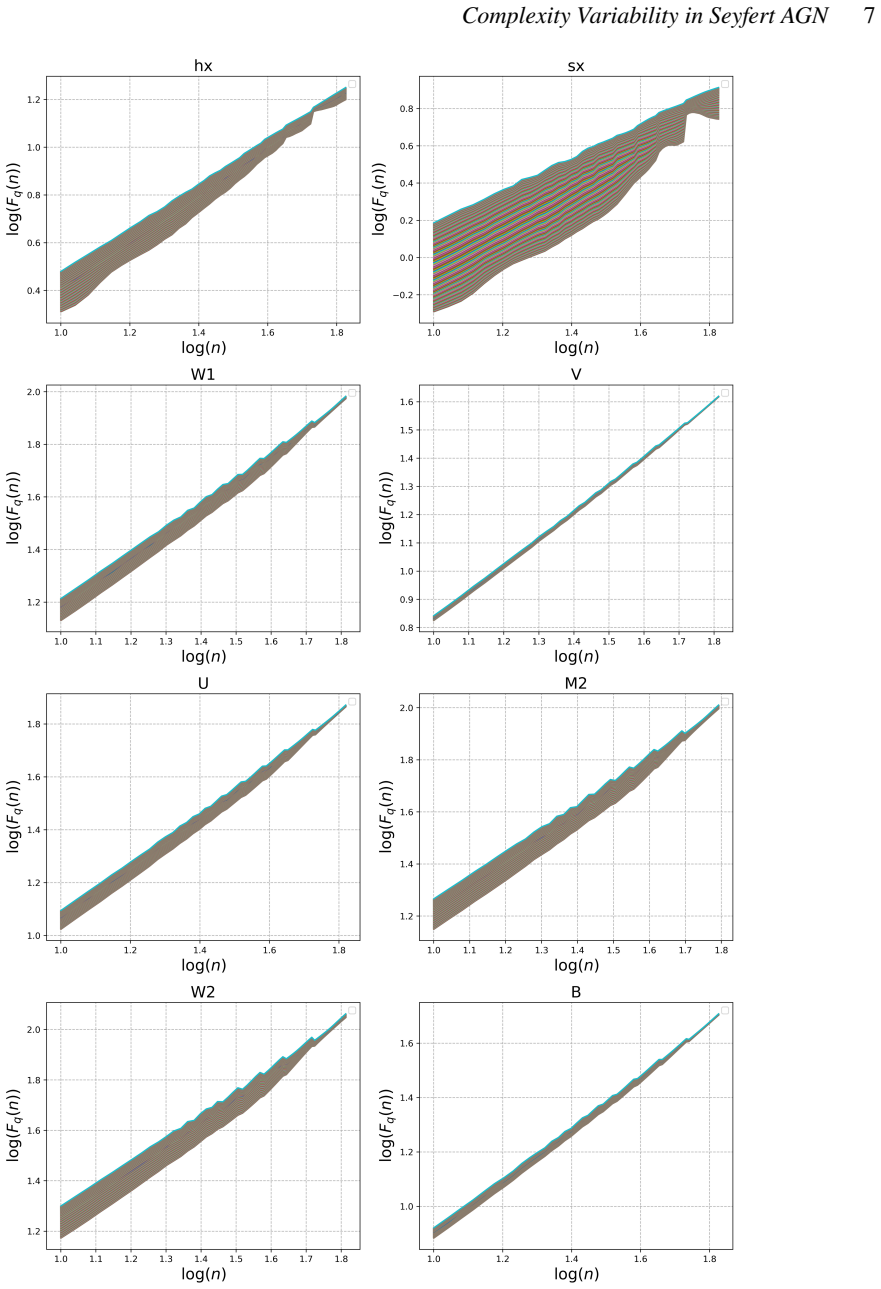
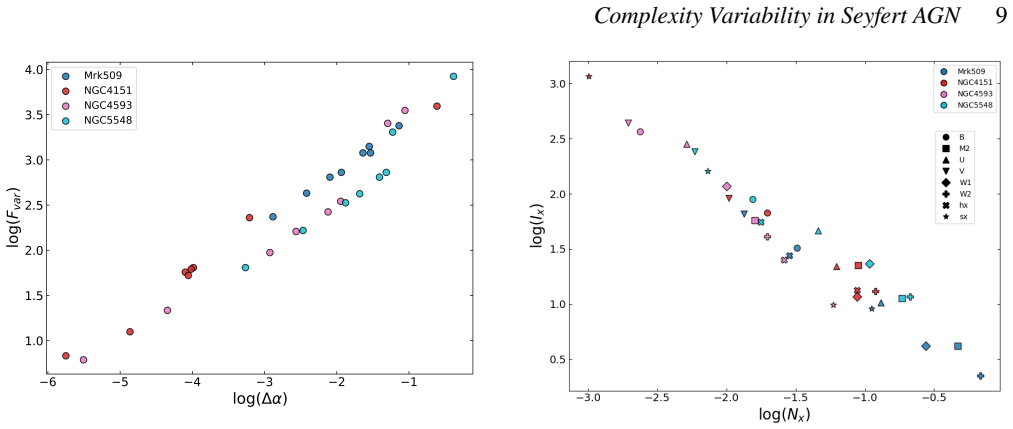
The central claim is that multifractal detrended moving average analysis and the Fisher-Shannon information plane, when applied to the X-ray, ultraviolet, and optical light curves of Mrk 509, NGC 5548, NGC 4151, and NGC 4593, quantify the scaling behavior, complexity, and stochasticity of the variability, revealing distinct patterns across energy bands that support their use as effective diagnostics of the physical mechanisms driving AGN emission.
What carries the argument
Multifractal detrended moving average (MFDMA) analysis, which extracts scaling exponents and multifractal spectra from non-stationary time series, paired with the Fisher-Shannon plane that positions signals by their information content and complexity.
If this is right
- X-ray light curves exhibit stronger multifractality than optical ones, consistent with more compact and turbulent emission regions closer to the black hole.
- The Fisher-Shannon plane separates the bands by degree of stochasticity, linking higher complexity to specific accretion or reprocessing mechanisms.
- Persistent cross-band correlations imply that variability in one band influences others through connected physical processes.
- These measures outperform basic statistical descriptors in capturing the non-linear and scale-dependent nature of AGN fluctuations.
Where Pith is reading between the lines
- The same pipeline could be tested on high-cadence data from upcoming surveys to classify AGN states in real time.
- Comparing these metrics against hydrodynamic simulations of accretion disks would test whether the observed multifractality arises from specific disk instabilities.
- Extending the analysis to radio or gamma-ray bands might reveal how variability propagates outward from the central engine.
- If the diagnostics prove robust, they could help isolate the contribution of jets versus disk emission in radio-loud AGNs.
Load-bearing premise
The observed multifractal spectra and Fisher-Shannon coordinates of the light curves map directly onto distinct physical emission processes without major distortion from sampling gaps, noise, or unrelated variability components.
What would settle it
Recomputing the MFDMA spectra and Fisher-Shannon points on phase-randomized or gap-filled versions of the same light curves and finding that the band-to-band differences disappear or match those from purely stochastic simulations with no physical structure.
Figures



read the original abstract
Active galactic nuclei (AGNs) exhibit complex variability across multiple wavelengths, reflecting diverse physical processes near their central engines. This work investigates the temporal variability of four AGNs Mrk~509, NGC~5548, NGC~4151, and NGC~4593 using multifractal detrended moving average (MFDMA) analysis and Fisher-Shannon information plane applied to their X-ray, ultraviolet, and optical light curves. These methods quantify the scaling behavior and complexity of the variability, revealing persistent correlations and distinct variability patterns across energy bands. The Fisher-Shannon analysis further characterizes the degree of stochasticity and structural complexity in the emission processes. Our findings support the interpretation that multifractal and information-theoretic measures provide effective diagnostics of the physical mechanisms driving AGN variability. This study demonstrates the utility of advanced time series techniques as effective diagnostics of AGN variability mechanisms.
Editorial analysis
A structured set of objections, weighed in public.
Referee Report
Summary. The paper applies multifractal detrended moving average (MFDMA) analysis and Fisher-Shannon information-plane methods to X-ray, UV, and optical light curves of four Seyfert AGNs (Mrk 509, NGC 5548, NGC 4151, NGC 4593). It reports band-dependent scaling exponents, multifractal widths, and complexity measures, and concludes that these quantities constitute effective diagnostics of the distinct physical processes driving multi-band AGN variability.
Significance. The application of MFDMA and Fisher-Shannon complexity to multi-wavelength AGN monitoring data is a reasonable extension of existing time-series tools. If the reported diagnostics can be shown to isolate physical emission mechanisms rather than sampling artifacts, the work would supply a quantitative framework for interpreting variability across energy bands. The manuscript is data-driven and uses named, reproducible algorithms, which are positive attributes.
major comments (1)
- [Abstract and Conclusions] Abstract and final interpretation: the central claim that MFDMA spectra and Fisher-Shannon coordinates 'provide effective diagnostics of the physical mechanisms driving AGN variability' is not accompanied by any controlled forward-modeling tests. The light curves contain irregular cadences, seasonal gaps, and heteroscedastic errors; without injecting synthetic signals (reprocessing lags, broken power-law PSDs, or disk instabilities) into realistic sampling windows and recovering the same multifractal width and information-plane coordinates, it is impossible to determine whether the reported X-ray/UV/optical differences reflect emission physics or observational artifacts. This validation step is load-bearing for the diagnostic interpretation.
minor comments (2)
- [Methods] Methods section: state explicitly the MFDMA window length, polynomial order, and segment size choices, and demonstrate that results are stable under reasonable variations of these parameters given the finite lengths and gaps in the light curves.
- [Figures] Figures: add uncertainty bands or bootstrap errors to the multifractal spectra and Fisher-Shannon plane points; label all panels with the exact energy band and object name for immediate readability.
Simulated Author's Rebuttal
We thank the referee for the constructive review and the recognition that the application of MFDMA and Fisher-Shannon methods to multi-band AGN data is a reasonable extension of existing tools. We address the single major comment below.
read point-by-point responses
-
Referee: [Abstract and Conclusions] Abstract and final interpretation: the central claim that MFDMA spectra and Fisher-Shannon coordinates 'provide effective diagnostics of the physical mechanisms driving AGN variability' is not accompanied by any controlled forward-modeling tests. The light curves contain irregular cadences, seasonal gaps, and heteroscedastic errors; without injecting synthetic signals (reprocessing lags, broken power-law PSDs, or disk instabilities) into realistic sampling windows and recovering the same multifractal width and information-plane coordinates, it is impossible to determine whether the reported X-ray/UV/optical differences reflect emission physics or observational artifacts. This validation step is load-bearing for the diagnostic interpretation.
Authors: We agree that the lack of forward-modeling tests weakens the strength of the diagnostic claim. Our analysis reports statistically significant band-dependent differences in scaling exponents, multifractal widths, and Fisher-Shannon coordinates on the observed light curves, and these differences are consistent with the expected hierarchy of variability mechanisms (X-ray corona, reprocessing in the disk, and outer-disk contributions). Nevertheless, without synthetic injections we cannot fully exclude sampling artifacts. In the revised manuscript we will add a dedicated validation section that generates synthetic light curves with prescribed PSD shapes, reprocessing lags, and instability-driven variability, resamples them onto the actual cadences and error distributions of each band, and demonstrates that the MFDMA and Fisher-Shannon diagnostics recover the input distinctions. This addition will directly address the referee's concern and support the interpretation. revision: yes
Circularity Check
No significant circularity; standard methods applied to independent external data
full rationale
The paper applies MFDMA and Fisher-Shannon information-plane analysis directly to published X-ray/UV/optical light curves of four AGNs. These are off-the-shelf techniques whose outputs (multifractal spectra, complexity coordinates) are computed from the input time series without any parameter fitted to a subset and then re-used as a 'prediction' of the same data. No equations reduce the reported diagnostics to quantities defined from the target result itself, and no self-citation chain is invoked to establish uniqueness or to smuggle an ansatz. The central claim therefore remains an independent mapping from external observations to complexity measures.
Axiom & Free-Parameter Ledger
Reference graph
Works this paper leans on
- [1]
-
[2]
The AGN Black Hole Mass Database. , keywords =. doi:10.1086/679601 , archivePrefix =. 1411.2596 , primaryClass =
-
[3]
Examining the Power Law Relationship Between Absorption and Frequency Using Spectral Riometer Data. Radio Science , keywords =. doi:10.1029/2024RS007951 , adsurl =
-
[4]
Publications of the Astronomical Society of the Pacific , volume=
The spectra of some spiral nebulae and globular star clusters , author=. Publications of the Astronomical Society of the Pacific , volume=. 1909 , publisher=
work page 1909
-
[5]
Discriminating Between Different Streamflow Regimes by Using the Fisher-Shan Method: An Application to the Colombia Rivers , author =. Acta Geophysica , volume =. 2015 , doi =
work page 2015
-
[6]
Revisiting the Spectral and Timing Properties of NGC 4151. , keywords =. doi:10.3847/1538-4357/ab3e31 , archivePrefix =. 1908.09862 , primaryClass =
-
[7]
, year = 1943, month = jan, volume =
Nuclear Emission in Spiral Nebulae. , year = 1943, month = jan, volume =. doi:10.1086/144488 , adsurl =
-
[8]
Outflow of gas in the Seyfert 1 galaxy Markarian 509. , keywords =. doi:10.1086/161470 , adsurl =
-
[9]
Assessing Urban Resilience from the Perspective of Scaling Law: Evidence from Chinese Cities , author =. Land , volume =. 2022 , doi =
work page 2022
-
[10]
Superlinear and sublinear urban scaling in geographical networks modeling cities , author =. Physical Review E , volume =. 2014 , doi =
work page 2014
-
[11]
Multifractal detrended moving average analysis of Kepler stars with surface differential rotation traces. , keywords =. doi:10.1093/mnras/stz1791 , archivePrefix =. 1906.11911 , primaryClass =
-
[12]
Multiscale behaviour of stellar activity and rotation of the planet host Kepler-30. , keywords =. doi:10.1051/0004-6361/202140287 , archivePrefix =. 2103.15921 , primaryClass =
-
[13]
Reverberation mapping of active galactic nuclei: from X-ray corona to dusty torus. iScience , keywords =. doi:10.1016/j.isci.2021.102557 , archivePrefix =. 2105.06926 , primaryClass =
-
[14]
The Astrophysical Journal , volume =
Accretion Disk Reverberation with Hubble Space Telescope Observations of NGC 4593: Evidence for Diffuse Continuum Lags , author =. The Astrophysical Journal , volume =. 2018 , publisher =
work page 2018
-
[15]
Xudong Li and Luciano Telesca and Michele Lovallo and Xuan Xu and Jun Zhang and Weiguo Song , keywords =. Spectral and informational analysis of pedestrian contact force in simulated overcrowding conditions , journal =. 2020 , issn =. doi:https://doi.org/10.1016/j.physa.2020.124614 , url =
-
[16]
Quantifying Soil Complexity Using Fisher Shannon Method on 3D X-ray Computed Tomography Scans , author =. Entropy , volume =. 2023 , doi =
work page 2023
-
[17]
Lowell Observatory Bulletin, vol
The spectrum and velocity of the nebula NGC 1068 (M 77) , author=. Lowell Observatory Bulletin, vol. 3, pp. 59-62 , volume=
-
[18]
Multifractality signatures in lensed quasars. , keywords =. doi:10.1093/mnras/stae2490 , archivePrefix =. 2411.02076 , primaryClass =
-
[19]
Transfer entropy in physical systems and the arrow of time , author=. Physical Review E , volume=. 2016 , publisher=
work page 2016
-
[20]
Kaastra, J. S. et al. , title =. Astronomy & Astrophysics , year =
-
[21]
Mehdipour, M. et al. , title =. Astronomy & Astrophysics , year =
-
[22]
Landt, H. et al. , title =. The Astrophysical Journal , year =
-
[23]
Shapovalova, A. I. et al. , title =. Astronomy & Astrophysics , year =
- [24]
-
[25]
Ward, M. J. et al. , title =. Monthly Notices of the Royal Astronomical Society , year =
-
[26]
X-ray/UV/optical variability of NGC 4593 with Swift: reprocessing of X-rays by an extended reprocessor. , keywords =. doi:10.1093/mnras/sty1983 , archivePrefix =. 1712.04852 , primaryClass =
-
[27]
The discovery of non-linear X-ray variability in NGC 4051. , keywords =. doi:10.1046/j.1365-8711.1999.02370.x , adsurl =
- [28]
-
[29]
Luminosity Variations of 3C 345: Is There Any Evidence of Low-dimensional Chaos?. , keywords =. doi:10.1086/174267 , adsurl =
-
[30]
Time Series Analysis in Astronomy: an Application to Quasar Variability Studies. , keywords =. doi:10.1086/171367 , adsurl =
-
[31]
Astrophysics and Space Science , keywords =
Nonlinear Wave-Wave Interactions in Astrophysical and Space Plasmas. Astrophysics and Space Science , keywords =. doi:10.1007/BF00645115 , adsurl =
-
[32]
Directed information measures in neuroscience , pages=
Transfer entropy in neuroscience , author=. Directed information measures in neuroscience , pages=. 2014 , publisher=
work page 2014
-
[33]
On thermodynamic interpretation of transfer entropy , author=. Entropy , volume=. 2013 , publisher=
work page 2013
-
[34]
A Novel Approach to Study the Variability of NGC 5548. , keywords =. doi:10.3847/1538-4357/ab2457 , archivePrefix =. 1905.10128 , primaryClass =
-
[35]
On characterizing the variability properties of X-ray light curves from active galaxies. , keywords =. doi:10.1046/j.1365-2966.2003.07042.x , archivePrefix =. astro-ph/0307420 , primaryClass =
-
[36]
The relentless variability of Mrk 421 from the TeV to the radio. , keywords =. doi:10.1051/0004-6361/201935557 , archivePrefix =. 2101.10651 , primaryClass =
-
[37]
Feder, Jens , title =. 1988 , edition =. doi:10.1007/978-1-4899-2124-6 , note =
-
[38]
The Astrophysical Journal , volume=
An X-ray, infrared, and submillimeter flare of Sagittarius A , author=. The Astrophysical Journal , volume=. 2008 , publisher=
work page 2008
-
[39]
The accretion of a solar mass per day by a 17-billion solar mass black hole , author=. Nature Astronomy , volume=. 2024 , publisher=
work page 2024
-
[40]
The fastest-growing black hole in the Universe , author=
-
[41]
Astronomy & Astrophysics , volume=
Millimeter to X-ray flares from Sagittarius A , author=. Astronomy & Astrophysics , volume=. 2012 , publisher=
work page 2012
-
[42]
The Astrophysical Journal , volume=
Chandra X-ray spectroscopic imaging of Sagittarius A* and the central parsec of the galaxy , author=. The Astrophysical Journal , volume=. 2003 , publisher=
work page 2003
-
[43]
Monthly Notices of the Royal Astronomical Society , volume=
A gravitationally lensed quasar discovered in OGLE , author=. Monthly Notices of the Royal Astronomical Society , volume=. 2018 , publisher=
work page 2018
-
[44]
Biomedical optics express , volume=
Multifractal nature of ocular aberration dynamics of the human eye , author=. Biomedical optics express , volume=. 2011 , publisher=
work page 2011
-
[45]
The Astrophysical Journal , volume=
The quasar accretion disk size--black hole mass relation , author=. The Astrophysical Journal , volume=. 2010 , publisher=
work page 2010
-
[46]
Journal of Statistical Mechanics: Theory and Experiment , volume=
Multifractal analysis of sunspot time series: the effects of the 11-year cycle and Fourier truncation , author=. Journal of Statistical Mechanics: Theory and Experiment , volume=. 2009 , publisher=
work page 2009
-
[47]
Journal of Statistical Mechanics: Theory and Experiment , keywords =
Multifractal detrended fluctuation analysis of sunspot time series. Journal of Statistical Mechanics: Theory and Experiment , keywords =. doi:10.1088/1742-5468/2006/02/P02003 , archivePrefix =. physics/0508149 , primaryClass =
-
[48]
The blazar sequence and its physical understanding , author=. Galaxies , volume=. 2022 , publisher=
work page 2022
- [49]
- [50]
-
[51]
Astronomy and Astrophysics (ISSN 0004-6361), vol
A new formulation of gravitational lens theory, time-delay, and Fermat's principle , author=. Astronomy and Astrophysics (ISSN 0004-6361), vol. 143, no. 2, Feb. 1985, p. 413-420. , volume=
work page 1985
-
[52]
Cosmological effects of primordial black holes , author=. Nature , volume=. 1975 , publisher=
work page 1975
-
[53]
Digital discrimination of neutron and ray using an organic scintillation detector based on wavelet transform modulus maximum , author=. Chinese Physics C , volume=. 2014 , publisher=
work page 2014
-
[54]
International Journal of Economics and Finance Studies , volume=
Multifractal Behaviour in Natural Gas Prices by using Mf-DFA and WTMM Methods , author=. International Journal of Economics and Finance Studies , volume=. 2013 , publisher=
work page 2013
-
[55]
2013 IEEE 9th International Colloquium on Signal Processing and its Applications , pages=
High performance visualization of human tumor detection using WTMM on Parallel Computing System , author=. 2013 IEEE 9th International Colloquium on Signal Processing and its Applications , pages=. 2013 , organization=
work page 2013
-
[56]
International Journal of Economics and Finance Studies , volume=
Multifractal behaviour in oil prices by using MF-DFA and WTMM methods , author=. International Journal of Economics and Finance Studies , volume=. 2013 , publisher=
work page 2013
-
[57]
Frontiers in computational neuroscience , volume=
Transfer entropy as a measure of brain connectivity: A critical analysis with the help of neural mass models , author=. Frontiers in computational neuroscience , volume=. 2020 , publisher=
work page 2020
-
[58]
Physical review letters , volume=
Measuring information transfer , author=. Physical review letters , volume=. 2000 , publisher=
work page 2000
-
[59]
Finance Research Letters , volume=
Predict or to be predicted? A transfer entropy view between adaptive green markets, structural shocks and sentiment index , author=. Finance Research Letters , volume=. 2023 , publisher=
work page 2023
-
[60]
Atmospheric Research , volume=
Forecasting rainfall using transfer entropy coupled directed--weighted complex networks , author=. Atmospheric Research , volume=. 2021 , publisher=
work page 2021
-
[61]
Journal of Environmental Management , volume=
Exploring the effect of climate risk on agricultural and food stock prices: Fresh evidence from EMD-Based variable-lag transfer entropy analysis , author=. Journal of Environmental Management , volume=. 2023 , publisher=
work page 2023
-
[62]
Studies in Nonlinear Dynamics and Econometrics , volume=
Using transfer entropy to measure information flows between financial markets , author=. Studies in Nonlinear Dynamics and Econometrics , volume=. 2013 , publisher=
work page 2013
-
[63]
The Bell system technical journal , volume=
A mathematical theory of communication , author=. The Bell system technical journal , volume=. 1948 , publisher=
work page 1948
-
[64]
Physica D: Nonlinear Phenomena , volume=
Information transfer in continuous processes , author=. Physica D: Nonlinear Phenomena , volume=. 2002 , publisher=
work page 2002
-
[65]
Astronomy and Astrophysics, vol
Primeval black holes and galaxy formation , author=. Astronomy and Astrophysics, vol. 38, no. 1, Jan. 1975, p. 5-13. , volume=
work page 1975
-
[66]
Monthly Notices of the Royal Astronomical Society , volume=
New evidence for a cosmological distribution of stellar mass primordial black holes , author=. Monthly Notices of the Royal Astronomical Society , volume=. 2022 , publisher=
work page 2022
-
[67]
Astronomy & Astrophysics , volume=
SDSS J1004+ 4112: the case for a galaxy cluster dominated by primordial black holes , author=. Astronomy & Astrophysics , volume=. 2020 , publisher=
work page 2020
-
[68]
The Astrophysical Journal , volume=
A new probe of dark matter and high-energy universe using microlensing , author=. The Astrophysical Journal , volume=. 2009 , publisher=
work page 2009
-
[69]
Black holes in binary systems. Observational appearance. , author=. Astronomy and Astrophysics, Vol. 24, p. 337-355 , volume=
-
[70]
Astronomy & Astrophysics , volume=
The signature of primordial black holes in the dark matter halos of galaxies , author=. Astronomy & Astrophysics , volume=. 2020 , publisher=
work page 2020
-
[71]
The Astrophysical Journal , volume=
The use of high-magnification microlensing events in discovering extrasolar planets , author=. The Astrophysical Journal , volume=. 1998 , publisher=
work page 1998
-
[72]
Astronomy and Astrophysics Supplement Series , volume=
30 years of multi-wavelength observations of 3C 273 , author=. Astronomy and Astrophysics Supplement Series , volume=. 1999 , publisher=
work page 1999
-
[73]
The Astrophysical Journal Supplement Series , volume=
The Next Generation Atlas of Quasar Spectral Energy Distributions from Radio to X-Rays , author=. The Astrophysical Journal Supplement Series , volume=. 2011 , publisher=
work page 2011
-
[74]
The Astrophysical Journal , volume=
HST STIS observations of PG 0946+ 301: The highest quality UV spectrum of a BALQSO , author=. The Astrophysical Journal , volume=. 2001 , publisher=
work page 2001
-
[75]
The Astronomical Journal , volume=
Composite quasar spectra from the sloan digital sky survey , author=. The Astronomical Journal , volume=. 2001 , publisher=
work page 2001
-
[76]
Peterson, B. M. and McHardy, I. M. and Wilkes, B. J. and Berlind, P. and Bertram, R. and Calkins, M. and Collier, S. J. and Huchra, J. P. and Mathur, S. and Papadakis, I. and Peters, J. and Pogge, R. W. and Romano, P. and Tokarz, S. and Uttley, P. and Vestergaard, M. and Wagner, R. M. , title =. The Astrophysical Journal , abstract =. 2000 , month =. doi:...
-
[77]
Monthly Notices of the Royal Astronomical Society , volume=
Low-luminosity active galactic nuclei: are they UV faint and radio loud? , author=. Monthly Notices of the Royal Astronomical Society , volume=. 2007 , publisher=
work page 2007
-
[78]
3C273: a star-like object with large red-shift , author=. Nature , volume=
- [79]
-
[80]
Assessing the achievability and precision of time-delay measurements , author=
COSMOGRAIL: the COSmological MOnitoring of GRAvItational Lenses-XV. Assessing the achievability and precision of time-delay measurements , author=. Astronomy & Astrophysics , volume=. 2016 , publisher=
work page 2016
discussion (0)
Sign in with ORCID, Apple, or X to comment. Anyone can read and Pith papers without signing in.