Recognition: 2 theorem links
· Lean TheoremPhase Transitions in Affective Meaning Divergence: The Hidden Drift Before the Break
Pith reviewed 2026-05-13 06:43 UTC · model grok-4.3
The pith
When the product of affective meaning divergence and response sensitivity exceeds 4, conversations undergo an abrupt hysteretic collapse in repair coordination.
A machine-rendered reading of the paper's core claim, the machinery that carries it, and where it could break.
Core claim
We formalize affective meaning divergence (AMD) as the total-variation distance between interlocutors' anchor-conditioned affect distributions. Building on speech-act theory, common-ground accumulation, and entropy-regularized game theory, we derive a logit best-response map whose dynamics undergo a saddle-node bifurcation: when β α > 4, a monotone increase in AMD-driven load produces an abrupt, hysteretic collapse of repair coordination. On Conversations Gone Awry (CGA-Wiki; N = 652), derailing conversations exhibit critical-slowing-down signatures across lexical divergence variance, AMD variance, and dialog-act repair variance, all significant after correction and stronger than toxicity or
What carries the argument
The logit best-response map from entropy-regularized game theory, whose fixed-point dynamics undergo a saddle-node bifurcation when the product of AMD load and sensitivity parameter exceeds 4.
Load-bearing premise
The logit best-response map derived from entropy-regularized game theory accurately captures human conversational repair dynamics and the chosen datasets operationalize AMD and repair coordination without major measurement error.
What would settle it
Finding no increase in variance of AMD or repair acts near the predicted transition point in a new set of conversations where the product of divergence and sensitivity exceeds 4 would falsify the bifurcation claim.
Figures
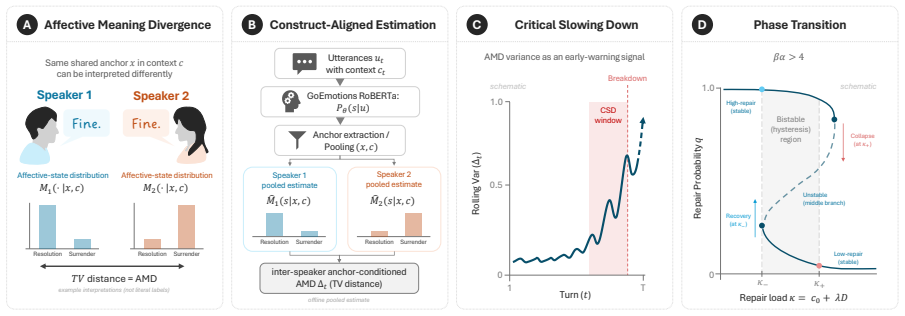
read the original abstract
One partner says "Fine" meaning "resolution"; the other hears "surrender." The word is shared; the affective uptake is not. We formalize this as affective meaning divergence (AMD), the total-variation distance between interlocutors' anchor-conditioned affect distributions. Building on speech-act theory, common-ground accumulation, and entropy-regularized game theory, we derive a logit best-response map whose dynamics undergo a saddle-node bifurcation: when $\beta\alpha > 4$, a monotone increase in AMD-driven load produces an abrupt, hysteretic collapse of repair coordination. On Conversations Gone Awry (CGA-Wiki; $N = 652$), derailing conversations exhibit critical-slowing-down (CSD) signatures across multiple levels: lexical divergence variance ($p < 0.001$, $d = 0.36$), AMD variance ($p = 0.001$, $d = 0.26$), and dialog-act repair variance ($p = 0.016$, $d = 0.20$), all significant after correction and stronger than toxicity and sentiment baselines. AMD provides a distinct temporal signature, with retrospectively measured variance peaking at the bifurcation point while toxicity variance peaks earlier, and is the only indicator grounded in the theoretical framework. Boundary-condition analysis on CGA-CMV ($N = 1,169$) yields mixed but directionally consistent evidence.
Editorial analysis
A structured set of objections, weighed in public.
Referee Report
Summary. The paper formalizes affective meaning divergence (AMD) as the total-variation distance between interlocutors' anchor-conditioned affect distributions. Building on speech-act theory, common-ground accumulation, and entropy-regularized game theory, it derives a logit best-response map whose dynamics exhibit a saddle-node bifurcation: when βα > 4, monotone increase in AMD-driven load produces abrupt, hysteretic collapse of repair coordination. On the Conversations Gone Awry (CGA-Wiki) dataset (N=652), derailing conversations show critical-slowing-down signatures in variance of lexical divergence (p<0.001, d=0.36), AMD (p=0.001, d=0.26), and dialog-act repair (p=0.016, d=0.20) after correction, stronger than toxicity/sentiment baselines; AMD variance is claimed to peak at the retrospectively identified bifurcation point. Boundary-condition checks on CGA-CMV (N=1,169) are mixed but directionally consistent.
Significance. If the derived dynamical system is shown to govern measured human repair trajectories and the CSD patterns are demonstrated to arise specifically from the predicted saddle-node rather than generic slowing, the work would supply a mechanistic, mathematically grounded account of conversation derailment with clear implications for early-warning systems in online dialogue. The multi-level variance analysis and explicit comparison to non-theoretical baselines are strengths; the absence of forward simulation or parameter recovery currently limits the result to suggestive correlation.
major comments (4)
- [Theoretical derivation (around the logit map and bifurcation analysis)] The saddle-node bifurcation condition βα > 4 is stated as the load-bearing threshold for hysteretic collapse, yet the manuscript provides neither the explicit dynamical equation for the logit best-response map nor the Jacobian/stability derivation that yields this specific critical value. Without these, it is impossible to verify whether the threshold is a robust consequence of the modeling assumptions or sensitive to the particular mapping chosen for AMD-driven load.
- [Empirical results on CGA-Wiki (variance and peak analyses)] The empirical claim that AMD variance peaks precisely at the bifurcation point relies on retrospective identification of the transition in labeled derailing conversations. This introduces a post-hoc selection risk; the manuscript does not report a pre-registered analysis plan, cross-validation across conversation subsets, or a control for the number of candidate peak locations examined.
- [Empirical results and discussion] No parameter estimation of β or α is performed, and no forward simulation of the derived map is reported against observed AMD or repair trajectories. Consequently the data demonstrate generic CSD correlations but do not test the model-specific predictions of an abrupt collapse or hysteresis once βα exceeds 4.
- [Boundary-condition analysis on CGA-CMV] The boundary-condition analysis on CGA-CMV yields only mixed support. The manuscript should quantify the discrepancy (e.g., effect sizes, power, or dataset differences in AMD operationalization) rather than describe it as “directionally consistent,” because failure to replicate the CSD pattern on a second corpus directly challenges the generality of the proposed mechanism.
minor comments (3)
- [Formalization of AMD] The definition of AMD as total-variation distance is introduced without an explicit formula or pseudocode for its computation from the affect distributions; this should be added for reproducibility.
- [Methods / Data preprocessing] Details of the multiple-comparison correction, exact exclusion criteria for conversations, and how dialog-act repair labels were obtained are referenced only at high level; these procedural choices affect the reported p-values and should be expanded.
- [Notation and parameters] Notation for the parameters β and α is introduced without a dedicated table or paragraph clarifying their interpretation and units; a short “parameter glossary” would improve readability.
Simulated Author's Rebuttal
We thank the referee for the constructive and detailed comments. These highlight opportunities to strengthen the explicitness of the theoretical derivation and the specificity of the empirical tests. We respond to each major comment below and indicate the planned revisions.
read point-by-point responses
-
Referee: The saddle-node bifurcation condition βα > 4 is stated as the load-bearing threshold for hysteretic collapse, yet the manuscript provides neither the explicit dynamical equation for the logit best-response map nor the Jacobian/stability derivation that yields this specific critical value. Without these, it is impossible to verify whether the threshold is a robust consequence of the modeling assumptions or sensitive to the particular mapping chosen for AMD-driven load.
Authors: We agree that the derivation steps were overly condensed. In the revised manuscript we will present the complete dynamical equation for the logit best-response map, the explicit Jacobian matrix, and the step-by-step linear stability analysis that yields the saddle-node threshold at βα = 4. This will allow direct verification that the critical value follows from the stated modeling assumptions. revision: yes
-
Referee: The empirical claim that AMD variance peaks precisely at the bifurcation point relies on retrospective identification of the transition in labeled derailing conversations. This introduces a post-hoc selection risk; the manuscript does not report a pre-registered analysis plan, cross-validation across conversation subsets, or a control for the number of candidate peak locations examined.
Authors: We acknowledge the post-hoc character of the peak-location analysis. We will add cross-validation by partitioning the CGA-Wiki corpus and checking consistency of the variance peak across subsets, together with an explicit control for the number of candidate locations examined. We will also state the exploratory nature of this analysis in the text. A pre-registered plan cannot be supplied retrospectively. revision: partial
-
Referee: No parameter estimation of β or α is performed, and no forward simulation of the derived map is reported against observed AMD or repair trajectories. Consequently the data demonstrate generic CSD correlations but do not test the model-specific predictions of an abrupt collapse or hysteresis once βα exceeds 4.
Authors: This is a substantive limitation on model-specific testing. In revision we will estimate β and α by fitting the dynamical map to the observed AMD time series and will report forward simulations of the system, comparing predicted abrupt collapse and hysteresis against the empirical repair trajectories. revision: yes
-
Referee: The boundary-condition analysis on CGA-CMV yields only mixed support. The manuscript should quantify the discrepancy (e.g., effect sizes, power, or dataset differences in AMD operationalization) rather than describe it as “directionally consistent,” because failure to replicate the CSD pattern on a second corpus directly challenges the generality of the proposed mechanism.
Authors: We will revise the boundary-condition section to report effect sizes, power calculations, and a quantitative comparison of dataset characteristics (conversation length, topic distribution, and AMD operationalization) that may explain the mixed replication. This will replace the qualitative “directionally consistent” phrasing with a more precise assessment of generality. revision: yes
- The absence of a pre-registered analysis plan for the retrospective peak-identification procedure cannot be remedied after submission.
Circularity Check
No circularity: derivation from external theories yields independent bifurcation condition
full rationale
The paper constructs its logit best-response map from speech-act theory, common-ground accumulation, and entropy-regularized game theory, then performs a standard mathematical bifurcation analysis to obtain the saddle-node threshold βα > 4. No equation or claim reduces this threshold, the functional form of the map, or the AMD-to-load mapping to a fit on the CGA-Wiki or CGA-CMV data, nor to any self-citation whose content is itself unverified. Empirical sections report only retrospective variance and CSD correlations without parameter estimation, forward simulation of the derived dynamics, or relabeling of fitted quantities as predictions. The theoretical claim therefore remains independent of the datasets used for validation.
Axiom & Free-Parameter Ledger
free parameters (2)
- β
- α
axioms (2)
- domain assumption Speech-act theory and common-ground accumulation govern conversational dynamics.
- domain assumption Conversation repair follows an entropy-regularized logit best-response map.
Lean theorems connected to this paper
-
IndisputableMonolith/Cost/FunctionalEquation.leanwashburn_uniqueness_aczel; costAlphaLog derivatives; Jcost fixed-point uniqueness matches?
matchesMATCHES: this paper passage directly uses, restates, or depends on the cited Recognition theorem or module.
Lemma 1 (Slope bound). For f defined in Eq.(5), f′(q)=βα f(q)(1−f(q)), so max q∈[0,1] f′(q)≤ βα/4. ... Theorem 2 (Bistability, tipping, hysteresis). If βα>4, there exist κ−<κ+ ... q±=½(1±√(1−4/(βα)))
-
IndisputableMonolith/Foundation/AlphaCoordinateFixation.leanalpha_pin_under_high_calibration; J_uniquely_calibrated_via_higher_derivative echoes?
echoesECHOES: this paper passage has the same mathematical shape or conceptual pattern as the Recognition theorem, but is not a direct formal dependency.
qt+1 = σ(β(α qt − κ)) ... saddle-node bifurcation ... hysteresis region
What do these tags mean?
- matches
- The paper's claim is directly supported by a theorem in the formal canon.
- supports
- The theorem supports part of the paper's argument, but the paper may add assumptions or extra steps.
- extends
- The paper goes beyond the formal theorem; the theorem is a base layer rather than the whole result.
- uses
- The paper appears to rely on the theorem as machinery.
- contradicts
- The paper's claim conflicts with a theorem or certificate in the canon.
- unclear
- Pith found a possible connection, but the passage is too broad, indirect, or ambiguous to say the theorem truly supports the claim.
Reference graph
Works this paper leans on
-
[1]
Games and Economic Behavior , volume =
Quantal Response Equilibria for Normal Form Games , author =. Games and Economic Behavior , volume =
-
[2]
Modeling Purposeful Adaptive Behavior with the Principle of Maximum Causal Entropy , author =
-
[3]
Soft Actor-Critic: Off-Policy Maximum Entropy Deep Reinforcement Learning with a Stochastic Actor , author =. Proc.\ ICML , year =
-
[4]
Convention: A Philosophical Study , author =
-
[5]
Signals: Evolution, Learning, and Information , author =
- [6]
-
[7]
Journal of Theoretical Biology , volume =
Replicator-Mutator Equation, Universality Property and Population Dynamics of Learning , author =. Journal of Theoretical Biology , volume =
-
[8]
Glossa: a journal of general linguistics , volume =
A Bifurcation Threshold for Contact-Induced Language Change , author =. Glossa: a journal of general linguistics , volume =
-
[9]
Journal of Artificial Societies and Social Simulation , volume =
Opinion Dynamics and Bounded Confidence: Models, Analysis and Simulation , author =. Journal of Artificial Societies and Social Simulation , volume =
-
[10]
Early-Warning Signals for Critical Transitions , author =. Nature , volume =
-
[11]
Critical Transitions in Nature and Society , author =
-
[12]
Proceedings of the National Academy of Sciences , volume =
Critical Slowing Down as Early Warning for the Onset and Termination of Depression , author =. Proceedings of the National Academy of Sciences , volume =
-
[13]
How to Do Things with Words , author =
-
[14]
Speech Acts: An Essay in the Philosophy of Language , author =
-
[15]
The Preference for Self-Correction in the Organization of Repair in Conversation , author =. Language , volume =
-
[16]
American Journal of Sociology , volume =
Repair After Next Turn: The Last Structurally Provided Defense of Intersubjectivity in Conversation , author =. American Journal of Sociology , volume =
-
[17]
Using Language , author =
-
[18]
Stancetaking in Discourse: Subjectivity, Evaluation, Interaction , editor =
The Stance Triangle , author =. Stancetaking in Discourse: Subjectivity, Evaluation, Interaction , editor =
-
[19]
Martin, J. R. and White, P. R. R. , publisher =. The Language of Evaluation: Appraisal in
-
[20]
Relevance: Communication and Cognition , author =
-
[21]
Behavioral and Brain Sciences , volume =
Toward a Mechanistic Psychology of Dialogue , author =. Behavioral and Brain Sciences , volume =
-
[22]
Research on Language & Social Interaction , volume =
Stance, Alignment, and Affiliation During Storytelling: When Nodding Is a Token of Affiliation , author =. Research on Language & Social Interaction , volume =
-
[23]
Contexts of Accommodation , pages =
Accommodation Theory: Communication, Context, and Consequence , author =. Contexts of Accommodation , pages =. 1991 , publisher =
work page 1991
- [24]
-
[25]
Expressive Order: Confirming Sentiments in Social Actions , author =
-
[26]
Affect Control Processes: Intelligent Affective Interaction Using a Partially Observable
Hoey, Jesse and Schr. Affect Control Processes: Intelligent Affective Interaction Using a Partially Observable. Artificial Intelligence , volume =
-
[27]
Majumder, Navonil and Poria, Soujanya and Hazarika, Devamanyu and Mihalcea, Rada and Gelbukh, Alexander and Cambria, Erik , booktitle =
-
[28]
Ghosal, Deepanway and Majumder, Navonil and Gelbukh, Alexander and Mihalcea, Rada and Poria, Soujanya , booktitle =
-
[29]
Conversations Gone Awry: Detecting Early Signs of Conversational Failure , author =. Proc.\ ACL , pages =
-
[30]
Trouble on the Horizon: Forecasting the Derailment of Online Conversations as they Develop , author =. Proc.\ EMNLP-IJCNLP , pages =
-
[31]
Psychological Science , volume =
Language Style Matching Predicts Relationship Initiation and Stability , author =. Psychological Science , volume =
-
[32]
Predicting Couple Therapy Outcomes Based on Speech Acoustic Features , author =. PLoS ONE , volume =
-
[33]
and Leskovec, Jure and Jurafsky, Dan , booktitle =
Hamilton, William L. and Leskovec, Jure and Jurafsky, Dan , booktitle =. Cultural Shift or Linguistic Drift?
-
[34]
Multi-Agent Cooperation and the Emergence of (Natural) Language , author =. Proc.\ ICLR , year =
-
[35]
Hewlett-Packard Labs Technical Report , year =
Inequalities for the L_1 Deviation of the Empirical Distribution , author =. Hewlett-Packard Labs Technical Report , year =
-
[36]
Language Models Grow Less Humanlike beyond Phase Transition , author =. Proc.\ ACL , year =
-
[37]
Transactions of the Association for Computational Linguistics , volume =
Causal Inference in Natural Language Processing: Estimation, Prediction, Interpretation and Beyond , author =. Transactions of the Association for Computational Linguistics , volume =. 2022 , pages =
work page 2022
-
[38]
Collaborative Rational Speech Act: Pragmatic Reasoning for Multi-Turn Dialog , author =. Proc.\ EMNLP , pages =
-
[39]
Maximum Entropy Heterogeneous-Agent Reinforcement Learning , author =. Proc.\ ICLR , year =
-
[40]
Demszky, Dorottya and Movshovitz-Attias, Dana and Ko, Tom and Cowen, Alan and Nemade, Gaurav and Ravi, Sujith , booktitle =
-
[41]
Hutto, C. J. and Gilbert, Eric , booktitle =
-
[42]
The Importance of Fillers for Text Representations of Speech Transcripts , author =. Proc.\ EMNLP , pages =. 2020 , doi =
work page 2020
-
[43]
Stivers, Tanya and Enfield, N. J. and Brown, Penelope and Englert, Christina and Hayashi, Makoto and Heinemann, Trine and Hoymann, Gertie and Rossano, Federico and de Ruiter, Jan Peter and Yoon, Kyung-Eun and Levinson, Stephen C. , title =. Proceedings of the National Academy of Sciences , volume =
discussion (0)
Sign in with ORCID, Apple, or X to comment. Anyone can read and Pith papers without signing in.